Agricultural Engineer Resume Examples: read this first
Write an Agricultural Engineer Resume That Connects Field Results to Engineering Work
By Mustafa Tarabya, founder of CVBooster · Published · Updated
Agricultural engineer resume example covering irrigation, machinery and precision farming systems, with recruiter keywords and a writing guide.
Sample resumes for a agricultural engineer
The same agricultural engineer content laid out in three CVBooster templates, so you can see what the finished document looks like before you write a word.
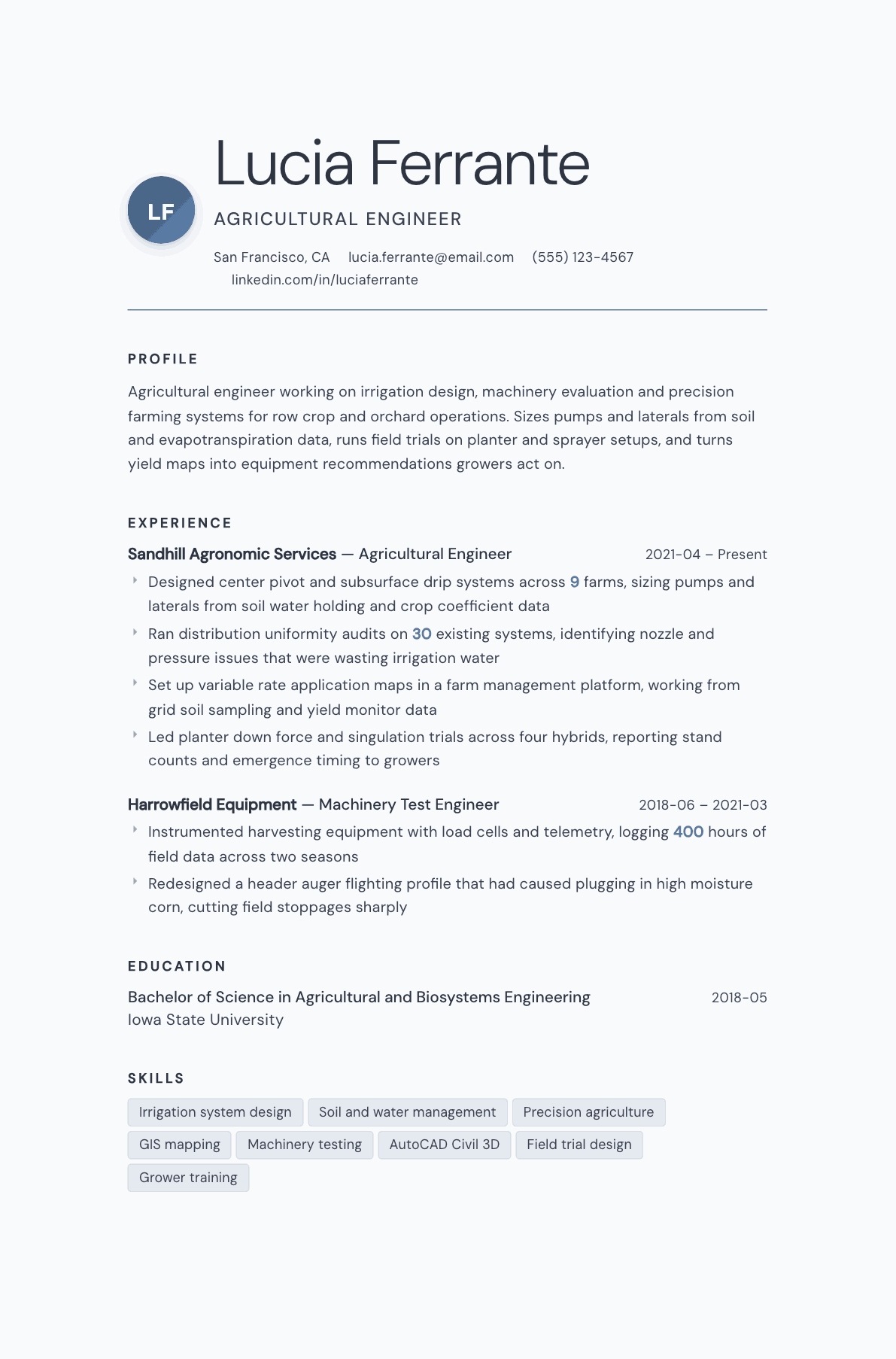
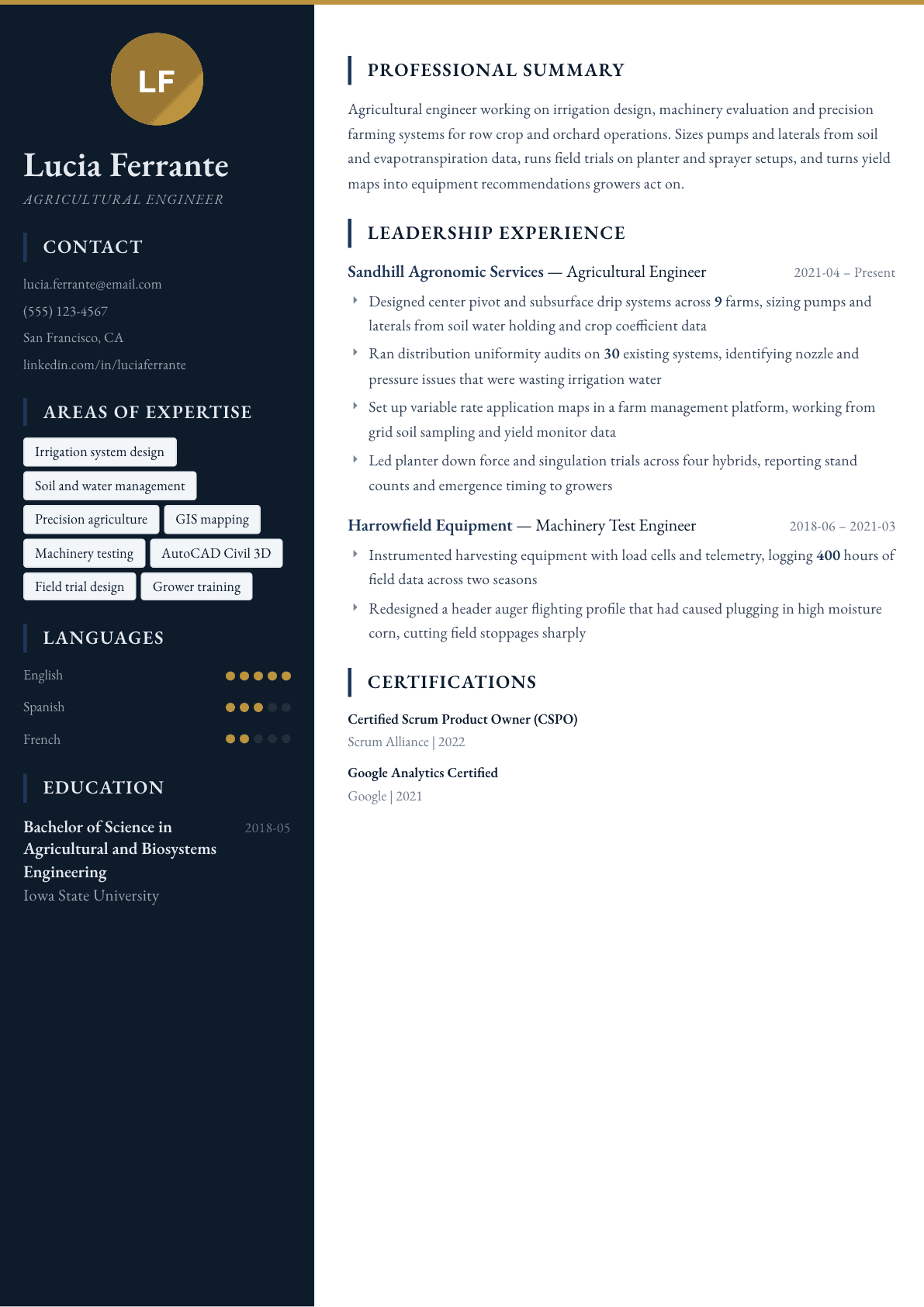
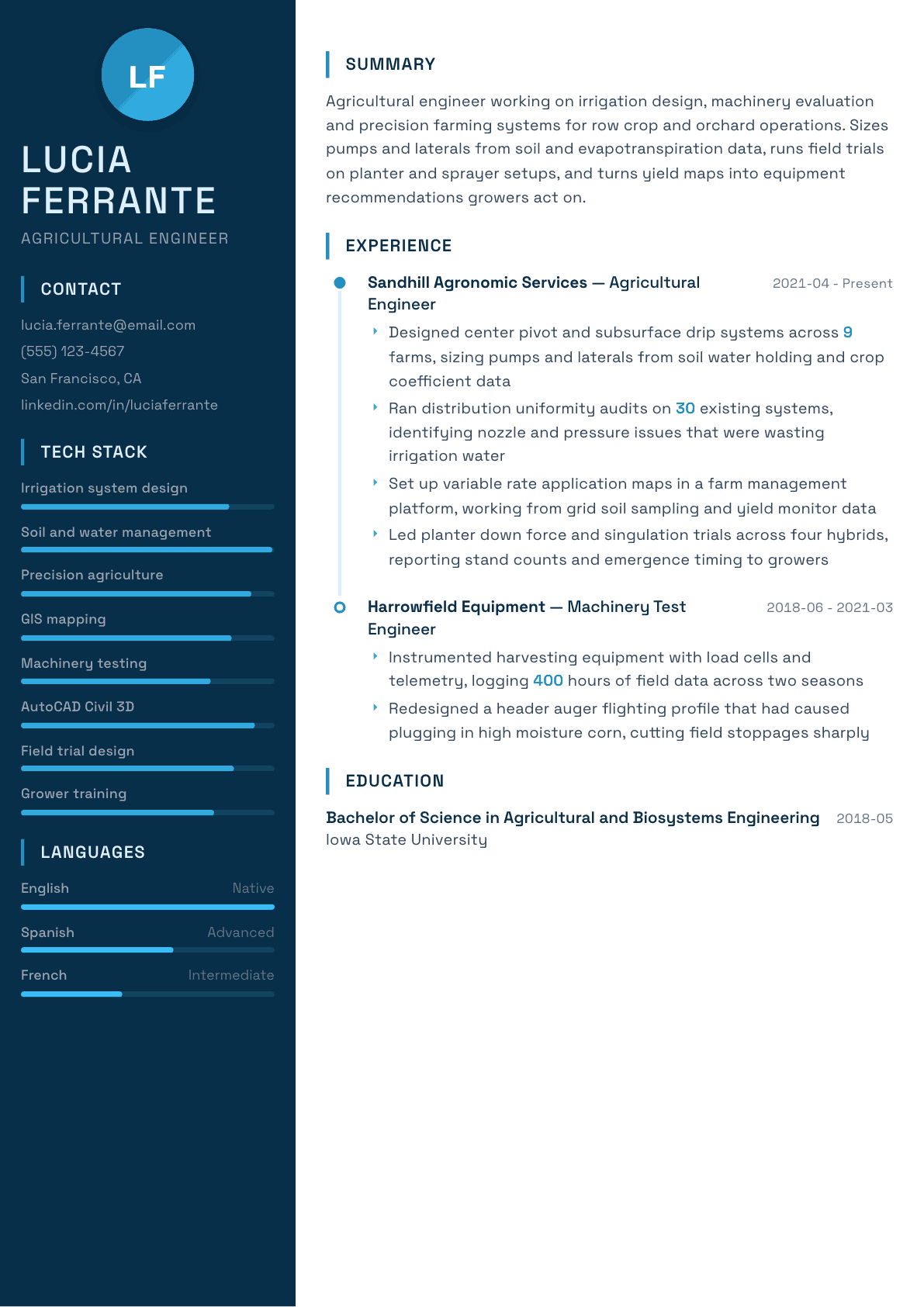
Example Agricultural Engineer summary
Agricultural engineer with six years across irrigation design, machinery testing and precision farming support for row crop and orchard growers. Sizes pumps and laterals from soil and crop water data, audits distribution uniformity on existing systems, and builds variable rate maps from grid sampling and yield monitors. Two seasons of instrumented harvest equipment testing. Seeking a lead engineering role with a regional agronomy team.
Skills to list on a Agricultural Engineer resume
- Irrigation system design
- Pump and hydraulic sizing
- Soil and water conservation
- Drainage design
- Precision agriculture systems
- Variable rate application
- Yield monitor data analysis
- GIS and GPS mapping
- Agricultural machinery testing
- Field trial design
- AutoCAD Civil 3D
- SolidWorks
- Livestock and grain structure design
- Grower and operator training
What actually gets this resume read
- State the acreage and crop types you worked with, because scale and commodity define the engineering problems.
- Split irrigation, machinery, structures and precision agriculture clearly, since employers usually hire for one of them.
- Use agronomic outcomes carefully: report what you measured, such as stand counts or distribution uniformity, not yield promises.
- Name the platforms you used for variable rate and yield data, and the controller brands you configured.
- Include seasonality in your work history, as field trial roles are judged by how many seasons you have run.
- List professional registration and any pesticide or irrigation auditor credentials with the issuing body named.
How to write a agricultural engineer resume
Agricultural engineering covers four distinct specialties that share one title: irrigation and water management, machinery and power systems, agricultural structures, and precision agriculture. Employers hire for one of them. A resume that presents all four equally reads as a graduate who has not chosen yet, even when the candidate has years of field seasons behind them.
The second thing readers check is whether you have worked in the field or only in the office. Growers, equipment makers and consultancies all want an engineer who can stand in a pivot track, read a soil probe and talk to an operator without a translator.
This guide sets out how to organize an agricultural engineer resume around a specialty, three summaries across career stages, before and after bullets from irrigation and machinery work, and the questions engineers ask when their results depend on a season they did not control.
Format: specialty first, acreage and crops second
Declare the specialty in the summary and then keep the experience consistent with it. Under each job, add a scope line with the crops, the acreage or herd size, the region and the systems you worked on. Scale and commodity define the engineering problems in this field, and the reader cannot infer them from a job title.
One page suits most agricultural engineers. Put professional registration and any auditor or applicator credentials in a short block, because those are searched for directly by consultancies and public agencies.
- Header: name, city and state, phone, email, and a note on seasonal travel availability.
- Sections: summary, technical skills, experience with a scope line per job, education, licenses and certifications.
- Add a software line covering your design package, mapping tools and any farm management platform you configured.
Summary: the specialty, the crops, and the seasons
Say what you design and for whom. Irrigation design for row crop and orchard operations is a specific practice with its own math, standards and clientele, and it belongs in the first sentence rather than under a general heading about agricultural systems.
Count your seasons. Field trial and machinery testing work is measured in seasons rather than years, because a season is one full opportunity to collect data. Two seasons of instrumented harvest testing communicates more than a date range does.
Irrigation and water: sizing, sources, and audits
Irrigation bullets need the inputs. Soil water holding capacity, crop coefficients, evapotranspiration data and peak demand drive the design, and naming them shows you sized the system rather than copied a catalog. Then give the hardware: the pivot, the drip laterals, the pump curve and the filtration.
Audits are the other half of the practice. Distribution uniformity testing on existing systems finds nozzle wear, pressure problems and leaks that waste water, and this is often how a consultancy earns repeat work. Say how many systems you audited and what you found.
Drainage and conservation work belongs in the same section. Tile drainage design, waterway and terrace layout, and erosion control practices are core agricultural engineering, and public agency roles screen for them explicitly.
Machinery, structures and instrumentation
For machinery work, name what you instrumented and what you measured. Load cells on a header, telemetry on a harvester, hours of field data logged across seasons: these details prove you ran a real test program rather than observed equipment working.
Design changes should carry the failure they solved. Redesigning a header auger flighting profile because it plugged in high moisture corn is a complete engineering story, and it also shows a reader that you understand the crop condition that caused the problem.
Structures work, whether grain storage, ventilation or livestock housing, needs the load cases and the codes. Say what you designed to and who reviewed it, because structural agricultural work is frequently permitted.
Precision agriculture, data and honest outcomes
Precision agriculture bullets should name the data source and the action taken. Grid soil sampling into a variable rate prescription, yield monitor data cleaned and mapped, or guidance and section control configured on a specific controller family. The chain from data to field action is the value, not the software itself.
Be careful with yield claims. Weather, hybrid and management all move yield, so attributing a yield gain to your engineering invites a challenge you cannot win. Report what you measured directly: stand counts, emergence timing, distribution uniformity, application accuracy or fuel use per acre.
Agricultural Engineer resume summary examples
New graduate
Agricultural and biosystems engineering graduate with a senior project designing a subsurface drip layout for a 60 acre orchard block, including pump sizing and emitter uniformity testing. One summer supporting planter trials. Seeking an entry agricultural engineer role with an irrigation or equipment group.
Six years in
Agricultural engineer designing center pivot and subsurface drip systems for row crop and orchard growers, sizing pumps and laterals from soil water holding and crop coefficient data. Audits distribution uniformity on existing systems and builds variable rate prescriptions from grid sampling and yield monitor data.
Lead agricultural engineer
Lead agricultural engineer with fifteen years across irrigation design, drainage and precision agriculture for a regional consultancy. Holds professional registration, signs designs across four counties, has run twelve field trial seasons on machinery and application equipment, and mentors three junior engineers through their first grower projects.
Work experience bullets: before and after
Before: Designed irrigation systems for local farms.
After: Designed center pivot and subsurface drip systems across 9 farms, sizing pumps and laterals from soil water holding capacity and crop coefficient data for each field block.
Naming the design inputs shows the system was engineered rather than selected from a catalog page.
Before: Checked existing irrigation for problems.
After: Ran distribution uniformity audits on 30 existing systems, catching nozzle wear and pressure regulation faults that were leaving parts of each field under-watered every set.
The audit count and the specific faults found turn an inspection into a measurable service.
Before: Worked with precision agriculture data.
After: Built variable rate application maps in a farm management platform from grid soil sampling and cleaned yield monitor data, then loaded and verified the prescriptions on the applicator controller.
Following the data all the way to the controller proves the prescription reached the field.
Before: Ran field trials on planting equipment.
After: Led planter down force and singulation trials across four hybrids, reporting stand counts and emergence timing back to growers rather than attributing any yield change to the setup.
Reporting only what was measured is the discipline agronomic clients respect and interviewers test for.
Before: Improved a harvesting machine.
After: Redesigned a header auger flighting profile that had been plugging in high moisture corn, cutting field stoppages during the following harvest season after 400 logged hours of instrumented testing.
The failure mode, the crop condition and the test hours show a full engineering investigation.
Hard skills
- Irrigation system design
- Pump and hydraulic sizing
- Evapotranspiration and crop water demand
- Distribution uniformity auditing
- Tile drainage and conservation design
- Soil and water resource assessment
- Precision agriculture systems
- Variable rate prescription development
- Yield monitor data processing
- GIS and GPS mapping
- Agricultural machinery instrumentation
- Field trial design and statistics
- AutoCAD Civil 3D
- SolidWorks
- Grain storage and ventilation design
Soft skills
- Talking engineering with growers
- Working to a season, not a schedule
- Operator training in the field
- Reporting results without overclaiming
- Coordinating with agronomists
- Physical work in field conditions
Certifications worth listing
- Fundamentals of Engineering (FE) (NCEES)
- Professional Engineer (PE), Agricultural and Biological Engineering (NCEES and state licensing boards)
- Certified Crop Adviser (American Society of Agronomy)
- Certified Irrigation Designer (Irrigation Association)
- Certified Agricultural Irrigation Specialist (Irrigation Association)
Mistakes that cost agricultural engineer candidates the interview
- Presenting irrigation, machinery, structures and precision work as equal, so no hiring group sees a specialist.
- Leaving out crops, acreage and region, which are the facts that define the engineering problem in this field.
- Attributing yield increases to your design, a claim that weather and management make impossible to defend.
- Counting years instead of seasons for field trial work, which understates hard-won testing experience.
- Omitting distribution uniformity, drainage or conservation work when public agency roles screen for exactly that.
- Listing farm software without showing the chain from data to a prescription that ran in the field.
Agricultural Engineer resume questions
Which agricultural engineering specialty should my resume lead with?
The one you want your next job in. Irrigation and water, machinery and power, structures, and precision agriculture are hired separately by different employers. Lead with one, keep the others as supporting evidence of range, and rewrite the summary when you apply into a different branch.
How do I show results when the season controls the outcome?
Report the variables you controlled and measured directly, such as distribution uniformity, stand counts, application accuracy, water applied per acre or machine downtime. Those numbers survive a bad weather year, and experienced readers trust them far more than a yield claim.
Is a professional engineering license worth it in agriculture?
For consultancy, drainage, structures and public agency work it matters, because designs get stamped and permitted. For equipment manufacturers and precision agriculture service roles it is far less common. Match the credential to the branch you are targeting rather than pursuing it by default.
How do I show field experience without sounding like a farm hand?
Frame field time as data collection and problem diagnosis. Hours of instrumented testing logged, systems audited, trials run, operators trained. That language keeps the credibility of having been in the field while making clear you were doing engineering work there.
Do agricultural engineers need agronomy knowledge?
Enough to speak the client language and understand why a design matters. Knowing crop water demand, growth stages and the conditions that stress equipment makes your recommendations land. A crop adviser credential is a strong signal for consultancy roles that sit close to agronomy teams.
Related resume examples
- Environmental Engineer Resume example
- Civil Engineer Resume example
- Water Resources Engineer Resume example
- Food Scientist Resume example
- Surveyor Resume example
- Packaging Engineer Resume example