Water Resources Engineer Resume Examples: free ATS score
Write a Water Resources Engineer Resume Built on Modeled Watersheds
By Mustafa Tarabya, founder of CVBooster · Published · Updated
Water resources engineer resume example with hydrology, hydraulic modeling, stormwater permits, keywords and a full writing guide.
Sample resumes for a water resources engineer
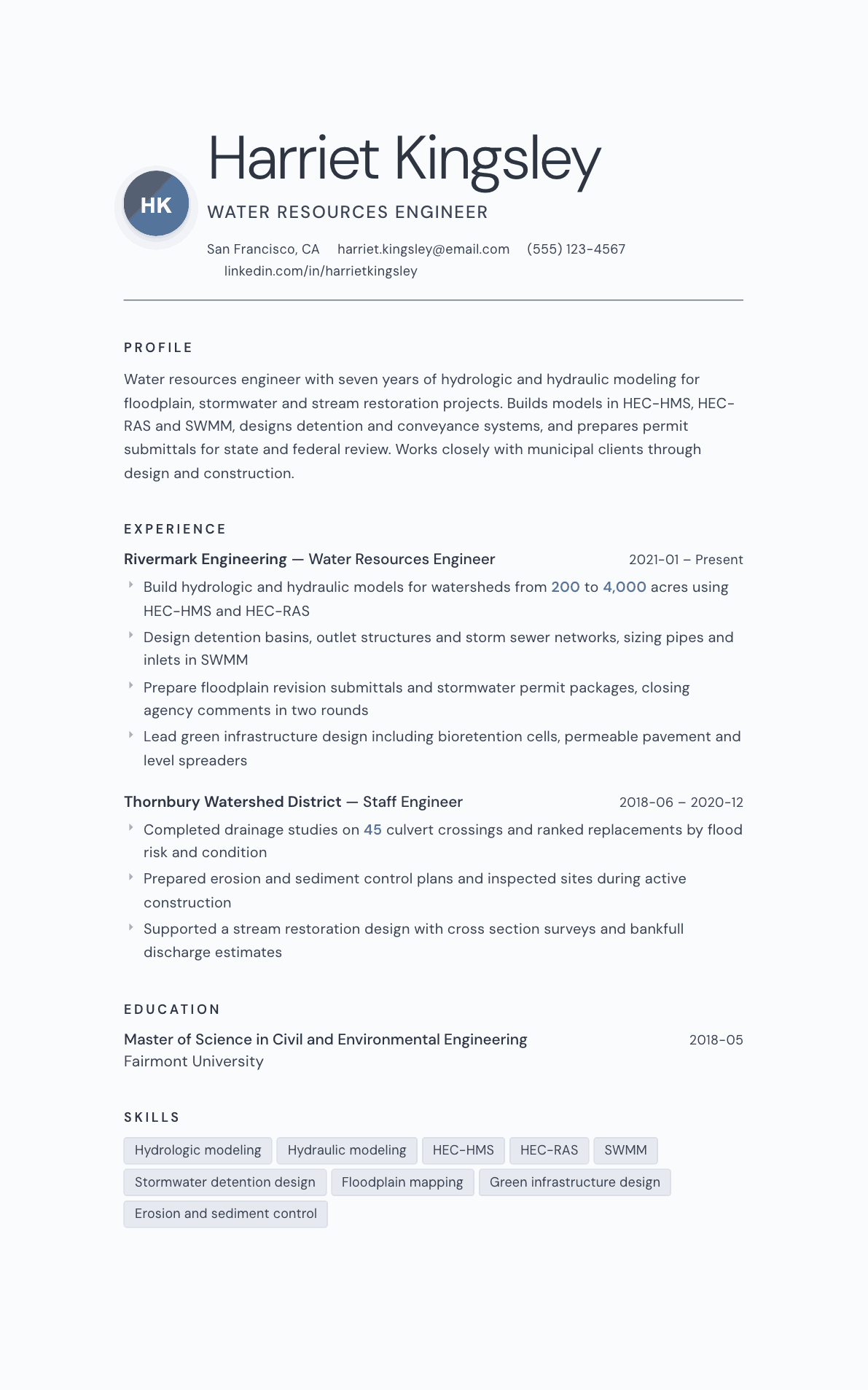
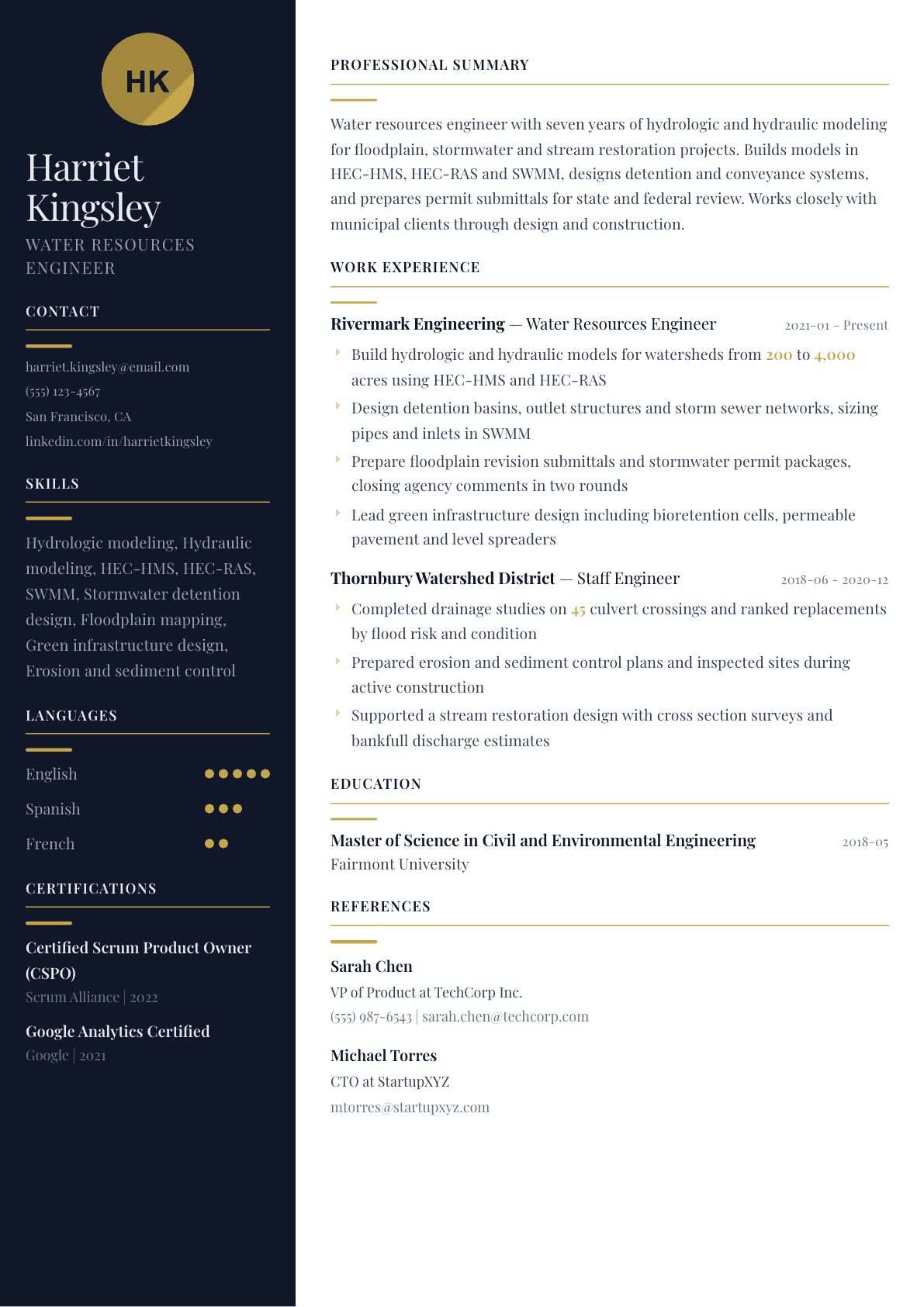
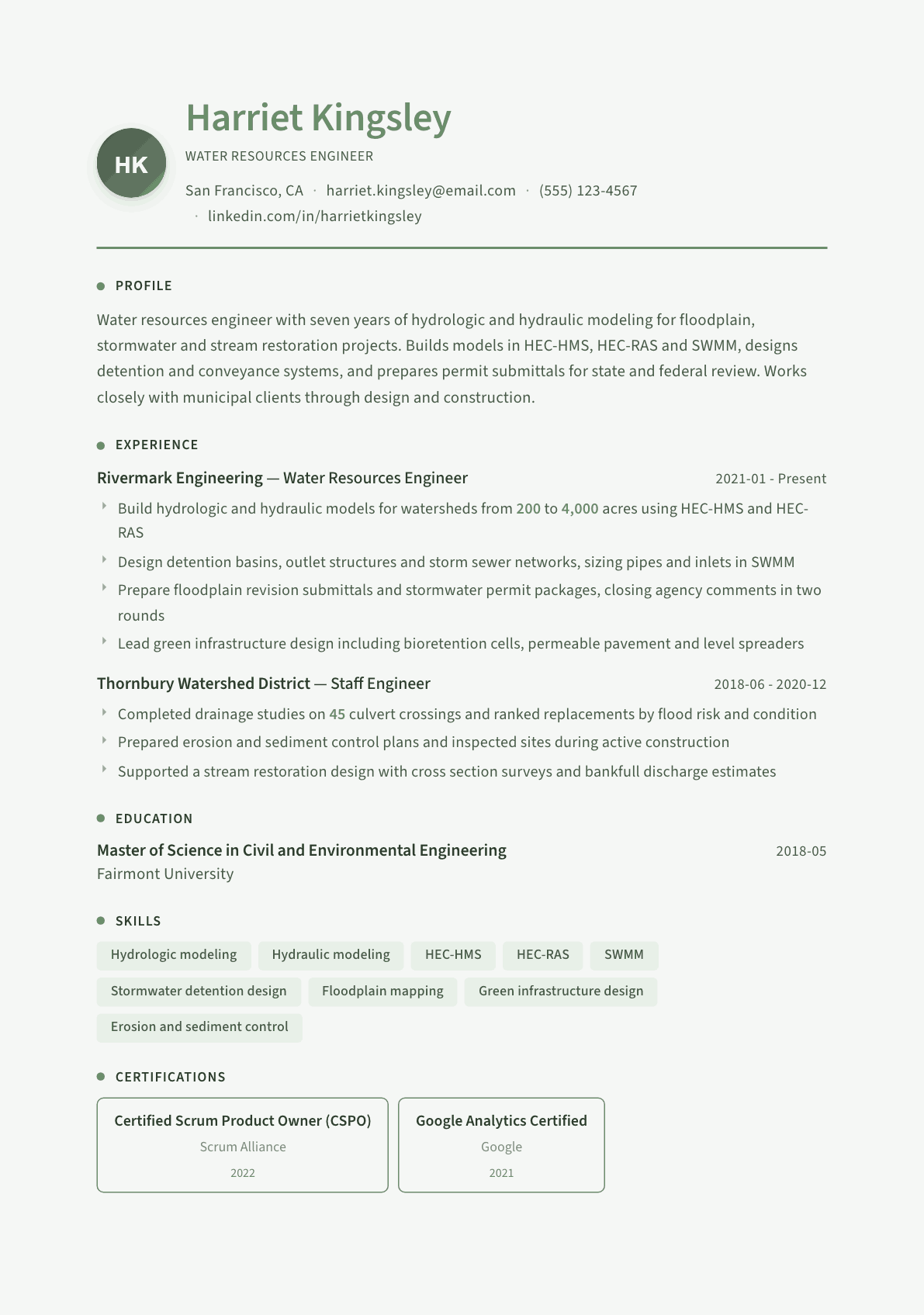
The same water resources engineer content laid out in three CVBooster templates, so you can see what the finished document looks like before you write a word.
Example Water Resources Engineer summary
Water resources engineer with seven years modeling watersheds and designing the systems that drain them. Builds and calibrates HEC-HMS, HEC-RAS and SWMM models, sizes detention basins, storm sewer networks and culvert crossings, and prepares the floodplain and stormwater permit packages that carry the design. Also handles erosion control plans and inspection through construction.
Skills to list on a Water Resources Engineer resume
- Hydrologic modeling
- Hydraulic modeling
- HEC-HMS
- HEC-RAS
- SWMM
- Storm sewer design
- Detention and retention design
- Floodplain mapping and revisions
- Culvert and bridge hydraulics
- Green infrastructure design
- Erosion and sediment control
- Stream restoration
- Water quality treatment design
- GIS and terrain analysis
- Civil 3D grading
- Permit preparation
What actually gets this resume read
- Name the models you have actually built and calibrated, not every package you have opened once.
- Give watershed or drainage area size in acres or square miles so a reviewer can judge complexity.
- Separate stormwater design work from floodplain and river hydraulics work; agencies hire for one or the other.
- List the permits you have prepared and which regulator reviewed them, because permitting is half the job.
- Include construction phase work such as erosion control inspection and as-built certification.
- Mention green infrastructure practices by name, since municipal clients increasingly require them.
How to write a water resources engineer resume
Water resources covers a wide territory, and firms hire for a narrow slice of it. Stormwater design for land development, floodplain hydraulics and map revisions, stream and river restoration, dam and levee evaluation, collection system modeling, and water supply planning are all under the same title. A reviewer scanning your resume is trying to work out which of those you can be handed on Monday.
The second thing she checks is whether the models are yours. Plenty of applicants have run a model someone else built. Far fewer have delineated the subcatchments, chosen the loss method, set the roughness values, calibrated against a gauge or a high water mark, and then defended the result to a regulator who disagreed.
This guide covers the section order that suits a water resources engineer, how to present modeling and design work credibly, what permitting evidence to include, and the questions candidates ask when moving between stormwater, floodplain and restoration work.
Format: subdiscipline first, then projects with drainage areas attached
Two pages with a project list is standard. In the summary, name the subdiscipline plainly. Then under each employer, give projects with the drainage area, the model built, the design produced and the permit obtained. Watershed size is the single fastest way for a reviewer to gauge complexity, so it belongs on nearly every project line.
Put software and licensure high on the page. Water resources work is model-driven and seal-dependent, so a reviewer wants both facts before she reads the experience section.
- Header: name, credentials, city, phone, email, license states and status.
- Sections: summary, licenses and certifications, modeling software, project experience, education.
- A certified floodplain manager credential belongs in the header, not buried at the end.
Modeling: say what you built, not what you opened
Describe model construction in the terms a senior engineer would use to check your work: subcatchment delineation, loss and transform methods, routing, cross section development, roughness selection, boundary conditions, and steady versus unsteady runs where that distinction matters.
Calibration is the credibility line. If you have matched a model to a stream gauge record, a surveyed high water mark or observed system surcharging, say so and say against what. If you have not calibrated, do not imply that you have; describe the design storm approach you used instead, which is perfectly normal for most stormwater work.
- Watershed hydrology: drainage areas, storm events analyzed, and the method used.
- Open channel hydraulics: reach length, cross section source and structure modeling.
- Collection systems: pipe network size, inlet capacity and surcharge analysis.
Design: the structures the model justifies
The model is the argument; the design is the product. List what you have sized and detailed: storm sewer networks, inlets, detention and retention basins, outlet control structures, culverts, channels, energy dissipation, pump stations and water quality treatment practices.
Green infrastructure deserves separate treatment because municipal clients ask for it by name. Bioretention cells, permeable pavement, vegetated swales, tree trenches and infiltration practices each have their own sizing logic and maintenance implications, so listing the ones you have designed is more useful than the umbrella phrase.
Permitting: the deliverable that decides the schedule
Half of a water resources engineer's calendar is regulatory. Say which submittals you have prepared and which agency reviewed them: local stormwater management approvals, state construction general permit coverage, wetland and waterway permits, floodplain development permits, and map revision requests to the federal flood mapping program.
Show the outcome. A permit approved in two comment rounds says something real about how you write and how carefully you check a model before it leaves the office. That is exactly what a project manager is buying.
Construction phase and field work
Field experience is undervalued on these resumes and shows up immediately in design quality. Erosion and sediment control plan preparation, site inspections during active construction, as-built review and certification, and post-construction basin verification all belong in a short block.
Survey and terrain work is worth a line as well. Collecting cross sections, working with light detection and ranging terrain data, and building a surface in a civil design package are routine tasks that a water resources engineer is expected to handle without help.
Water Resources Engineer resume summary examples
Graduate engineer
Civil and environmental engineering graduate with coursework in hydrology and open channel hydraulics and a capstone that modeled a 300 acre urban watershed in HEC-HMS. Internship experience preparing erosion control plans and drainage exhibits. Fundamentals of Engineering exam passed.
Six years in
Water resources engineer with six years building hydrologic and hydraulic models for watersheds from 200 to 4,000 acres and designing the detention, conveyance and treatment systems that follow. Prepares stormwater and floodplain permit submittals and closes agency comments within two rounds.
Licensed project manager
Licensed water resources engineer with fourteen years across floodplain hydraulics, municipal stormwater programs and stream restoration. Leads unsteady river models supporting map revisions, manages a team of four, and represents clients in regulatory negotiations and public drainage meetings.
Work experience bullets: before and after
Before: Built hydrologic models for projects.
After: Built HEC-HMS models for watersheds from 200 to 4,000 acres, delineating subcatchments from terrain data and selecting loss and transform methods for each land cover group.
Watershed range and the modeling choices you made show authorship rather than running someone else's file.
Before: Did floodplain modeling.
After: Developed an unsteady HEC-RAS model across a 4 mile reach with surveyed cross sections and bridge geometry, and calibrated water surface elevations to two high water marks.
Reach length, data source and calibration targets are what a reviewer needs before trusting a hydraulic result.
Before: Designed stormwater systems.
After: Sized storm sewer networks, inlets and a detention basin with a multi-stage outlet structure so post-development peak flows matched pre-development rates for three design storms.
Naming the structures and the release criteria shows the design met a standard rather than merely existing.
Before: Prepared permit applications.
After: Prepared stormwater management and floodplain development permit packages for 12 projects, closing agency comments in two rounds on all but one.
Permit volume and comment rounds are the practical measure of how cleanly your work leaves the office.
Before: Worked on green infrastructure.
After: Designed bioretention cells, permeable pavement sections and a level spreader for a municipal retrofit, sizing each practice for the required water quality volume and underdrain capacity.
Practice-by-practice detail with sizing criteria proves real design work instead of a policy interest.
Hard skills
- Watershed hydrology
- Open channel hydraulics
- HEC-HMS
- HEC-RAS
- SWMM
- Storm sewer and inlet design
- Detention and retention design
- Culvert and bridge hydraulics
- Floodplain mapping and map revisions
- Green infrastructure design
- Erosion and sediment control
- Stream restoration design
- Civil 3D grading and surfaces
- GIS and terrain analysis
Soft skills
- Regulatory negotiation
- Technical writing
- Client coordination
- Public meeting communication
- Model quality checking
- Deadline management
Certifications worth listing
- Professional Engineer (PE), Civil (State board of professional engineers)
- Certified Floodplain Manager (CFM) (Association of State Floodplain Managers)
- Fundamentals of Engineering (FE) (National Council of Examiners for Engineering and Surveying)
- Certified Professional in Erosion and Sediment Control (CPESC) (EnviroCert International)
- Envision Sustainability Professional (Institute for Sustainable Infrastructure)
Mistakes that cost water resources engineer candidates the interview
- Listing model names as skills without ever describing a network you delineated or a boundary condition you chose.
- Leaving drainage areas off the project list, which removes the only quick measure of hydrologic complexity.
- Implying calibration on projects that used design storms, which unravels fast in a technical interview.
- Omitting permitting work even though it consumes much of a water resources engineer's schedule.
- Mixing stormwater site design and floodplain hydraulics together, so neither hiring manager sees her own project.
- Ignoring construction phase work such as erosion control inspection and as-built certification.
- Writing about sustainability in general terms rather than naming the treatment practices you sized.
Water Resources Engineer resume questions
Which modeling software should a water resources engineer know first?
Start with a rainfall runoff model and a hydraulic model, because almost every project needs both. Add a collection system package if you work on urban drainage, and learn the terrain and geographic information tools that feed all three.
How important is the certified floodplain manager credential?
It matters a great deal for map revision and community assistance work, and many public clients look for it in proposals. It is less critical if your projects are private land development, where the professional engineer license carries the weight.
Can I move into water resources from a general civil design role?
Yes, and the grading and drainage work you have already done is the bridge. Emphasize storm sewer sizing, basin design and erosion control plans you produced, then add a modeling package and describe a watershed you delineated yourself.
How do I show permitting experience without naming clients?
Describe the permit type, the reviewing agency level and the outcome. State construction general permit coverage for a 40 acre site approved in one comment round communicates everything a project manager needs without identifying anyone.
Should stream restoration experience go on the same resume as stormwater design?
Keep both, but order them for the posting. Restoration hiring looks for geomorphic assessment, bankfull determination and natural channel design, so those lines should rise to the top when that is the job you are targeting.
Related resume examples
- Civil Engineer Resume example
- Environmental Engineer Resume example
- Geotechnical Engineer Resume example
- Water Treatment Engineer Resume example
- Agricultural Engineer Resume example
- Pipeline Engineer Resume example