Aircraft Maintenance Technician Resume Examples: free
Write an Aircraft Maintenance Technician Resume That Passes an Audit
By Mustafa Tarabya, founder of CVBooster · Published · Updated
Aircraft maintenance technician resume example with airframe and powerplant keywords, plus a guide to writing certificates, aircraft types and sign off authority.
Sample resumes for a aircraft maintenance technician
The same aircraft maintenance technician content laid out in three CVBooster templates, so you can see what the finished document looks like before you write a word.
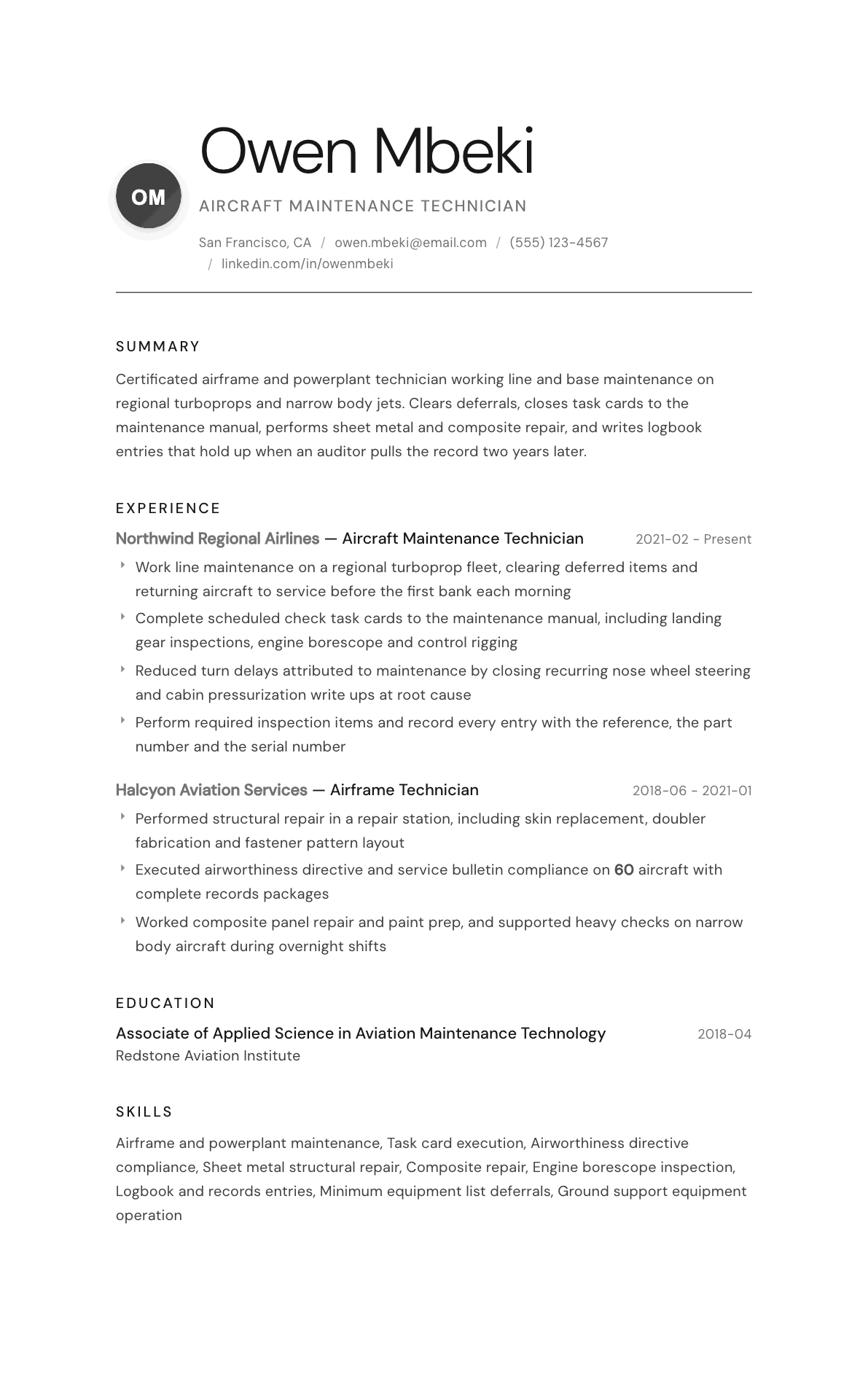
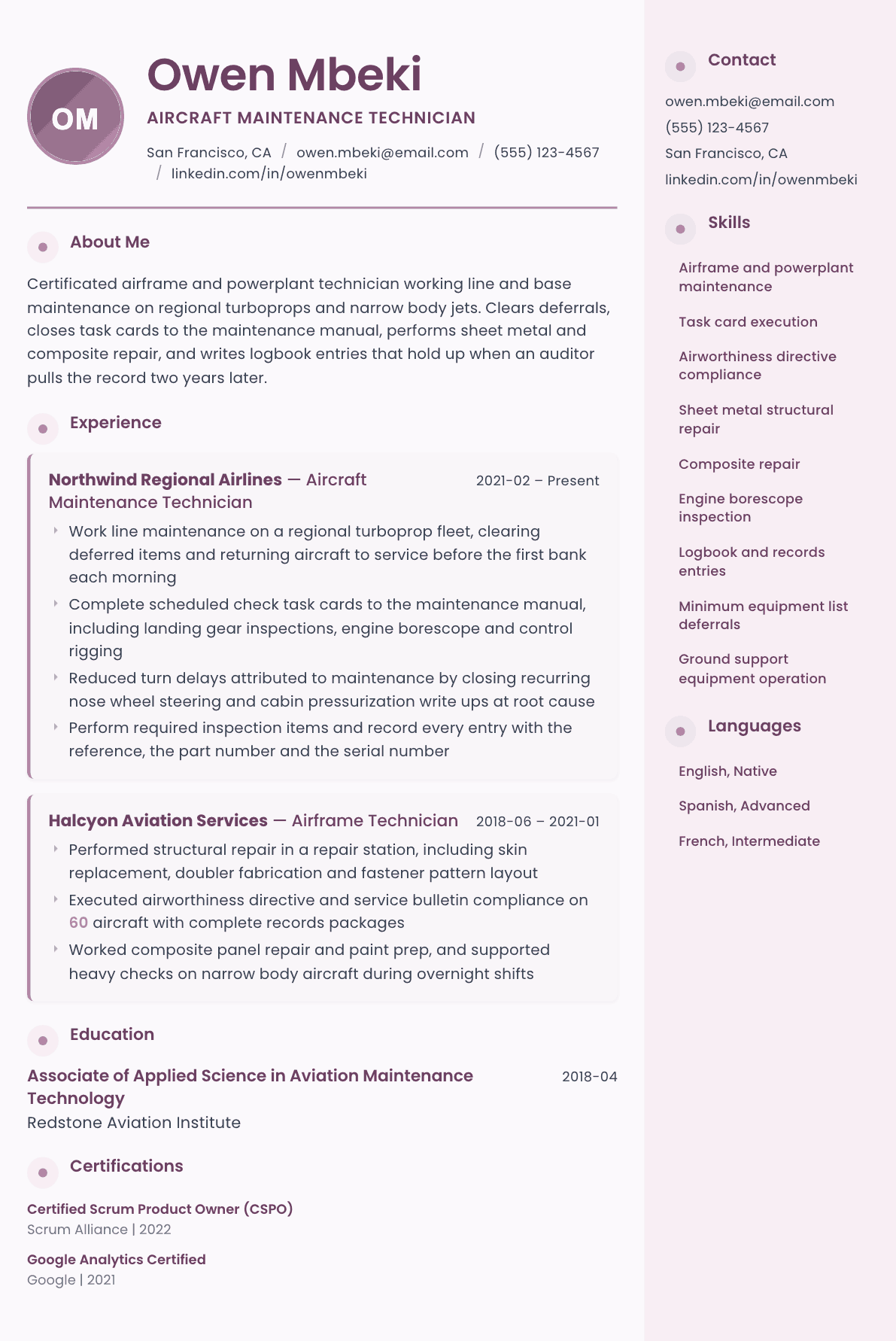
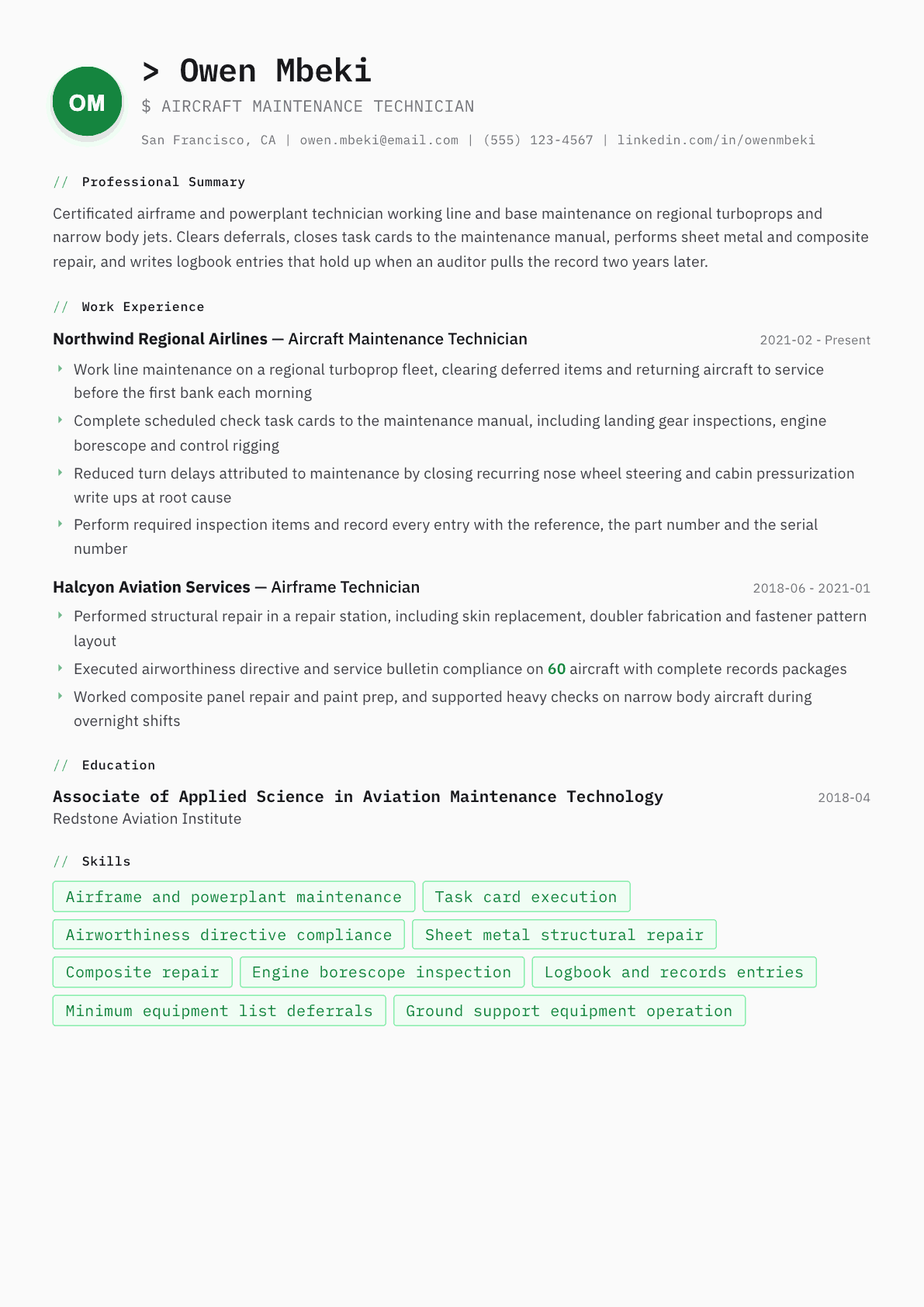
Example Aircraft Maintenance Technician summary
Certificated airframe and powerplant technician with seven years across a repair station and an airline line station, working regional turboprops and narrow body jets. Clears deferrals and returns aircraft to service on the morning bank, closes scheduled task cards to the maintenance manual, and performs sheet metal and composite structural repair. Writes records entries that survive audit, and has completed airworthiness directive campaigns with full documentation packages.
Skills to list on a Aircraft Maintenance Technician resume
- Airframe systems maintenance
- Turbine and piston powerplant work
- Line maintenance turnarounds
- Heavy check and base maintenance
- Task card and work package closure
- Minimum equipment list deferrals
- Airworthiness directive compliance
- Service bulletin incorporation
- Sheet metal and structural repair
- Composite bonded repair
- Engine borescope inspection
- Landing gear inspection and service
- Control cable rigging
- Torque and safety wire standards
- Maintenance records and logbook entries
- Required inspection item procedures
What actually gets this resume read
- Put your airframe and powerplant certificate number and date at the top, because nothing else on the page matters without it.
- List aircraft types by model with the hours or checks you have worked on each, not a vague family name.
- Separate line maintenance from base and heavy check work, since employers hire for one pattern or the other.
- Say whether you hold inspection authorization or a repairman certificate and what you are authorized to sign.
- Show your records discipline with the kind of entries you write and any audit you have come through clean.
- Name your specialties honestly: sheet metal, composite, engine run, borescope, nondestructive testing or avionics support.
How to write a aircraft maintenance technician resume
Aviation maintenance hiring starts with a certificate number and ends with a records audit. A maintenance manager reading your resume is asking whether you hold the certificate, whether you have worked the type of operation he runs, and whether the entries you write would survive being pulled from a file two years from now by someone looking for a reason to ground an aircraft.
The second question is pattern. Line maintenance and base maintenance are different rhythms. Line work is quick, deadline driven and public, clearing deferrals so an aircraft departs on time. Base work is deliberate and deep, opening panels for days on a scheduled check. Technicians tend to be good at one and adequate at the other, and a resume that does not say which is which forces the manager to guess.
Below is the structure an aviation employer expects, how to write type experience without inflating it, how to describe inspection and records work, three summaries from a fresh certificate through a senior technician, before and after bullets, and the questions technicians ask when moving between general aviation, repair stations and air carriers.
Format: certificate first, then types, then operation
One page early in a career, two once you have several operations and a long type list. The certificate block goes at the top: airframe and powerplant with the certificate number and date issued, any inspection authorization, repairman certificates tied to a specific station, and additional qualifications such as nondestructive inspection levels or run and taxi authorization.
Then the type list, written as models rather than families, with the depth of your involvement on each. A technician who has worked one model for years and touched another twice should show that difference. Managers cross reference the list against their own fleet and against the training they would have to buy.
- Certificate block: airframe and powerplant number and date, inspection authorization, repairman certificates.
- Type list by model with the work performed: line, scheduled checks, structural repair, engine change.
- Operation line: repair station, air carrier line station, base maintenance hangar, corporate flight department.
- Special qualifications: engine run and taxi, borescope, nondestructive inspection, composite repair, ground equipment.
Summary: certificate, operation, types, what you sign for
Four lines. Certificate, the operations you have worked, the types you know well, and the scope of what you complete and sign yourself. Sign off scope is the honest measure of seniority in this trade and it is frequently missing from resumes that otherwise read well.
Include the shift pattern you are used to. Overnight base checks, early morning line coverage before the first departure, and rotating shifts on a maintenance control desk are all normal and all different. A manager staffing a night hangar wants to see that you have already lived that schedule.
Experience: task cards, deferrals and the write up you closed for good
Line maintenance bullets should describe what you cleared and under what pressure. Deferred items worked off before the first departure, troubleshooting completed at the gate, and the discipline of following the maintenance manual rather than a shortcut when a schedule is slipping. Give the fleet and the station size so the reader can picture the operation.
Base maintenance bullets should describe the checks and the tasks. Landing gear inspections, control rigging, engine borescope, structural inspection zones, and the work packages you closed. Say whether you performed required inspection items and what qualification allowed that, since the required inspection function is controlled and not everyone holds it.
The best single bullet on this kind of resume is a recurring write up eliminated. An intermittent system fault that had been deferred repeatedly, traced to a connector, a chafed harness or a rigging tolerance, and closed for good. It shows troubleshooting depth and it directly reduces delays, which is the currency of a line station.
Records, compliance and the audit that comes later
Maintenance records are the product as much as the repair is. Describe the entries you write: the reference to the manual or the approved data, part numbers and serial numbers on and off, the work performed and the return to service statement. Managers have all inherited files with missing entries and they read this part of a resume carefully.
Compliance campaigns belong here too. Airworthiness directive and service bulletin work is measurable: aircraft completed, the records package assembled, and whether the compliance survived a later audit. Describing that work in those terms shows you understand that the paperwork is the compliance, not the evidence of it.
- Say which manuals and approved data you work from and how you find the current revision.
- Describe the parts discipline: serviceable tags, shelf life, traceability and rejection of anything unclear.
- Mention tool control and lost tool procedures, which auditors and safety programs both check.
- Note human factors or safety management training, because the industry treats it as core rather than optional.
Keywords, honesty about type experience and the interview that follows
Recruiters filter on airframe and powerplant, line maintenance, base maintenance, heavy check, task card, work package, airworthiness directive, service bulletin, minimum equipment list, required inspection item, borescope, structural repair, composite, return to service and records. Use the ones that match, and put the model designations in exactly the form the posting uses.
Do not inflate type experience. It is checked in the interview by someone who has worked the same aircraft and knows which panel is a nuisance and which task takes two people. Understating slightly and being able to discuss the work in detail is a far better position than a long list you cannot defend for ten minutes.
Aircraft Maintenance Technician resume summary examples
New certificate holder
Airframe and powerplant technician certificated this year after an accredited maintenance program, with hangar experience in sheet metal repair, control rigging and engine removal on light aircraft. Trained in maintenance manual research, torque and safety wire standards, and records entries. Seeking a line station or repair station position.
Five years, line and base
Airframe and powerplant technician with five years across a repair station and a regional line station, clearing deferrals before the morning bank and closing scheduled check task cards on turboprop and narrow body types. Performs sheet metal structural repair, engine borescope and landing gear inspections, and writes complete records entries.
Senior technician with inspection authorization
Senior aircraft maintenance technician with 13 years across corporate, repair station and air carrier work, holding inspection authorization. Leads heavy check work packages, performs required inspection items, completes airworthiness directive campaigns with full records packages, and mentors technicians on troubleshooting and manual discipline.
Work experience bullets: before and after
Before: Performed maintenance on aircraft.
After: Worked line maintenance on a regional turboprop fleet at a station with eight overnight aircraft, clearing deferred items and completing return to service before the first departure bank each morning.
Fleet, station size and the deadline show the operation instead of leaving the reader to imagine one.
Before: Completed scheduled inspections.
After: Closed scheduled check task cards to the maintenance manual, including landing gear inspection, flight control rigging and engine borescope, and raised nonroutine cards with the findings documented rather than absorbed.
Naming the tasks and the nonroutine discipline shows how a check is actually completed and recorded.
Before: Fixed recurring problems on aircraft.
After: Closed a repeatedly deferred nose wheel steering write up by tracing an intermittent fault to a chafed harness behind a panel, replacing the affected section and confirming the fix over a week of operation.
A specific recurring fault traced and confirmed is the clearest possible evidence of troubleshooting depth.
Before: Did sheet metal work.
After: Performed structural repair in a repair station, including skin replacement, doubler fabrication and fastener pattern layout to approved data, with holes drilled to size and edge distances held to the standard.
Approved data and the workmanship details are what separate structural repair from general metal work.
Before: Complied with airworthiness directives.
After: Executed airworthiness directive and service bulletin compliance on 60 aircraft, assembling a records package for each with the method of compliance, part numbers and the return to service entry.
Aircraft count and the records package describe the compliance work as the paperwork task it really is.
Hard skills
- Airframe systems maintenance
- Turbine and piston powerplant maintenance
- Line maintenance and turnaround support
- Base maintenance and heavy checks
- Task card and work package closure
- Nonroutine finding documentation
- Minimum equipment list deferrals
- Airworthiness directive compliance
- Service bulletin incorporation
- Sheet metal and structural repair
- Composite bonded repair
- Engine borescope inspection
- Landing gear inspection and servicing
- Flight control rigging
- Torque, safety wire and fastener standards
- Maintenance records and return to service entries
Soft skills
- Refusing to sign for work that is not finished
- Working a deadline without skipping a manual step
- Handing over a task cleanly at shift change
- Speaking up about a finding that will cost the schedule
- Teaching a new technician the reference habit
Certifications worth listing
- Airframe and Powerplant Certificate (Federal Aviation Administration)
- Inspection Authorization (Federal Aviation Administration)
- Repairman Certificate (Federal Aviation Administration)
- Nondestructive Testing Level II (American Society for Nondestructive Testing)
Mistakes that cost aircraft maintenance technician candidates the interview
- Leaving the certificate number and date off the page when it is the first thing an aviation employer verifies.
- Listing aircraft families instead of models, which hides how much real time you have on the type being hired for.
- Blending line and base experience together when employers staff those two patterns separately.
- Saying you performed inspections without stating what you were qualified to sign and under whose authority.
- Ignoring records work even though the entries are the deliverable that outlasts every repair you make.
- Inflating a type list that will be tested in the interview by someone who has worked the same aircraft.
Aircraft Maintenance Technician resume questions
How do I write this resume right after getting my certificate?
Lead with the certificate and the program, then treat school projects as work: engine removal and installation, sheet metal repairs, rigging and inspection tasks with the aircraft types involved. Add any tool box you own and your willingness to work nights, which matters more than most graduates realize.
Should I list aircraft types even with limited hours on them?
List them with the depth stated. A model you have worked one check on should say so rather than sitting in the same list as a type you know well. Honest depth is respected in this industry because everyone knows the difference will show up quickly.
How do I move from general aviation into an air carrier?
Emphasize manual discipline, records quality and any experience working to a schedule with departure pressure. Carriers care about process adherence and shift work as much as hands on skill, so make both visible and note your availability for overnight coverage.
Does inspection authorization belong on a resume if I rarely use it?
Yes. It signals experience level, judgment and a clean record, and it tells an employer what you could be used for as you grow into a role. Note the date it was issued and keep the currency requirements in mind before you list it.
What should I say about a period out of aviation?
State it plainly with the dates and any work performed, then show your currency: recent training, a current certificate, tools maintained and any return to the field. Employers understand career gaps far better than they understand a resume with unexplained silence in it.
Related resume examples
- Aircraft Mechanic Resume example
- Mechanic Resume example
- Avionics Engineer Resume example
- Avionics Technician Resume example
- Wind Turbine Technician Resume example
- Pest Control Technician Resume example