Pool Technician Resume Examples: the lines they read
Write a Pool Technician Resume That Reads as Water Chemistry
By Mustafa Tarabya, founder of CVBooster · Published · Updated
Pool technician resume example with route size, chemistry and equipment keywords, plus a guide to writing repairs, CPO status and callbacks.
Sample resumes for a pool technician
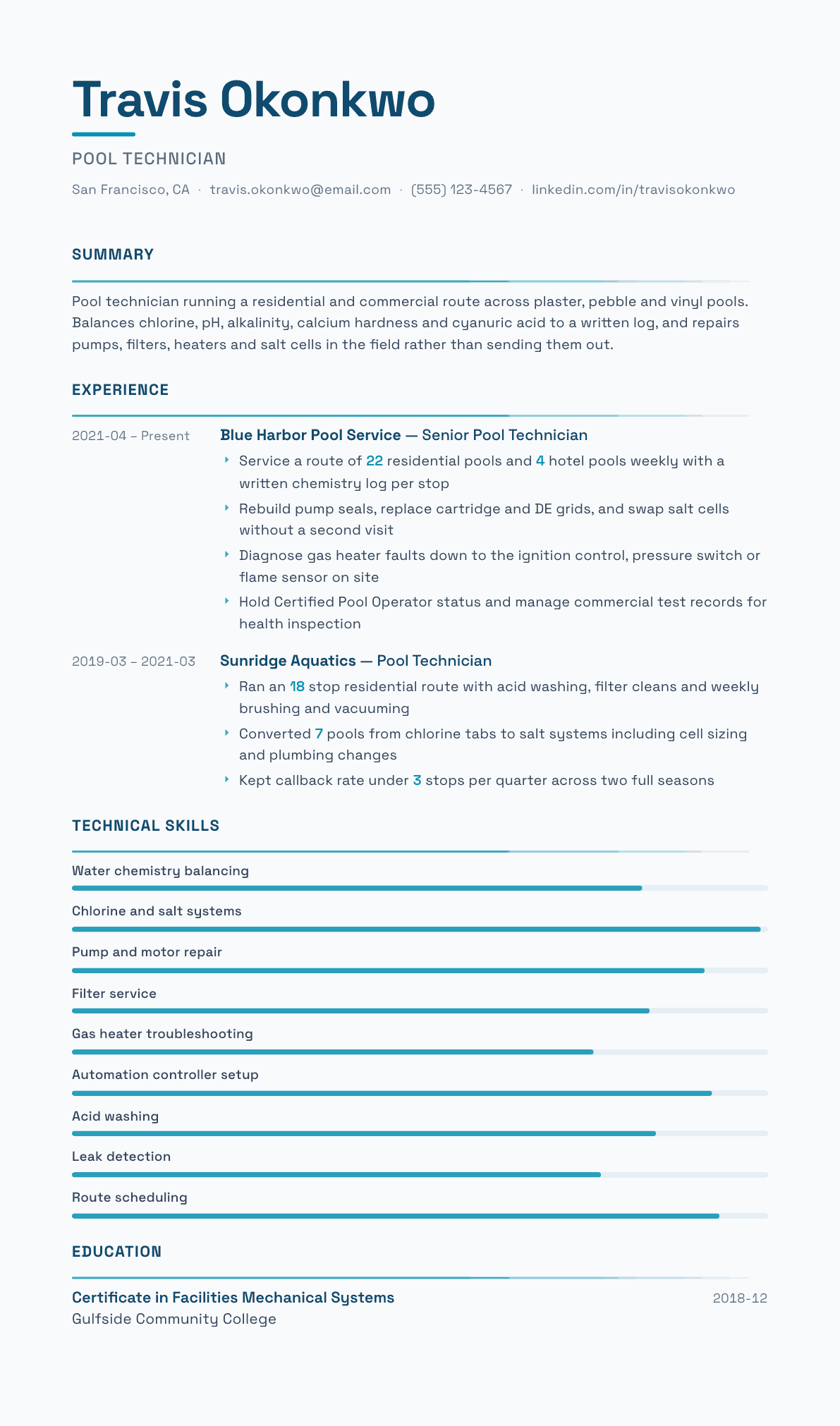
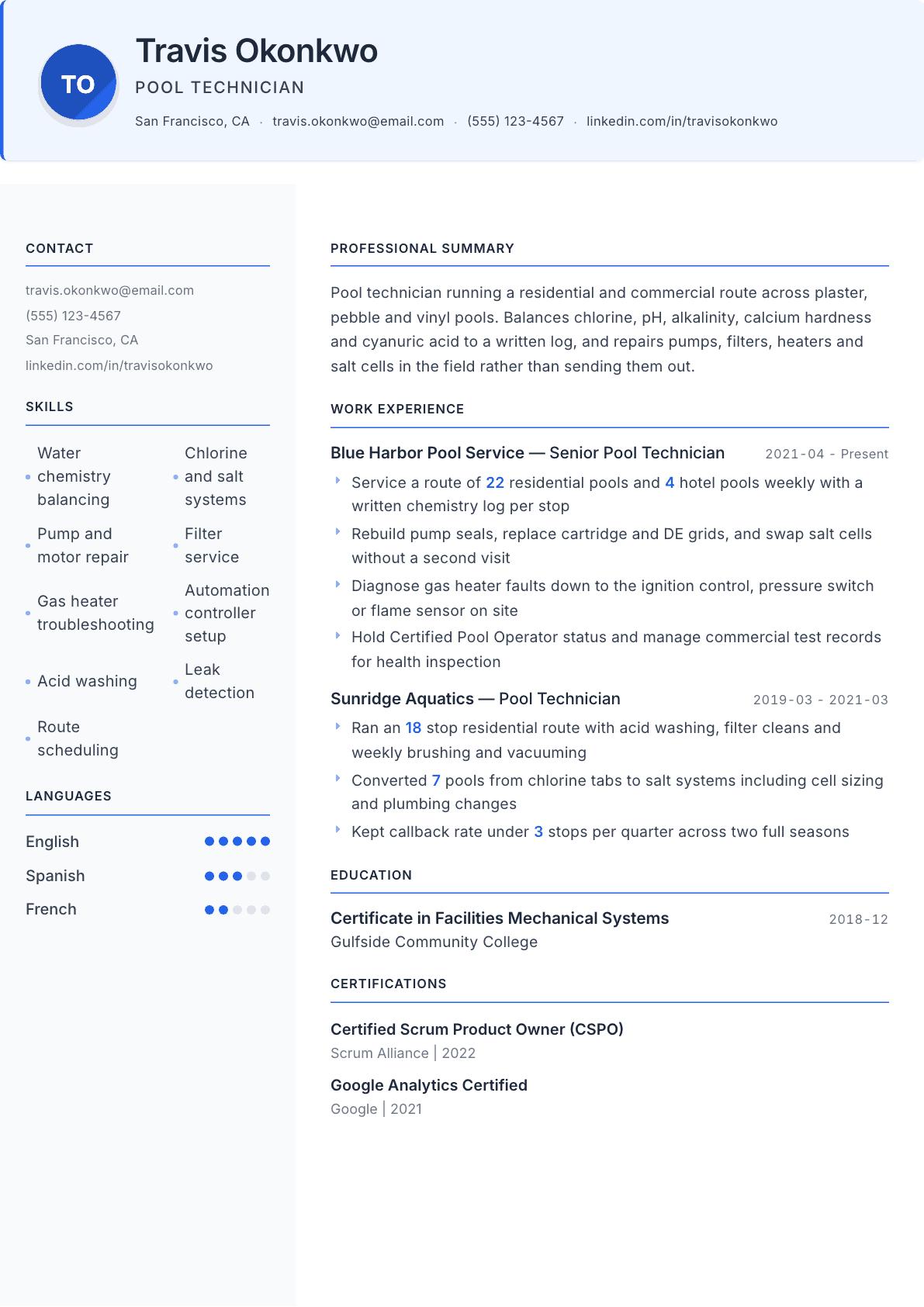
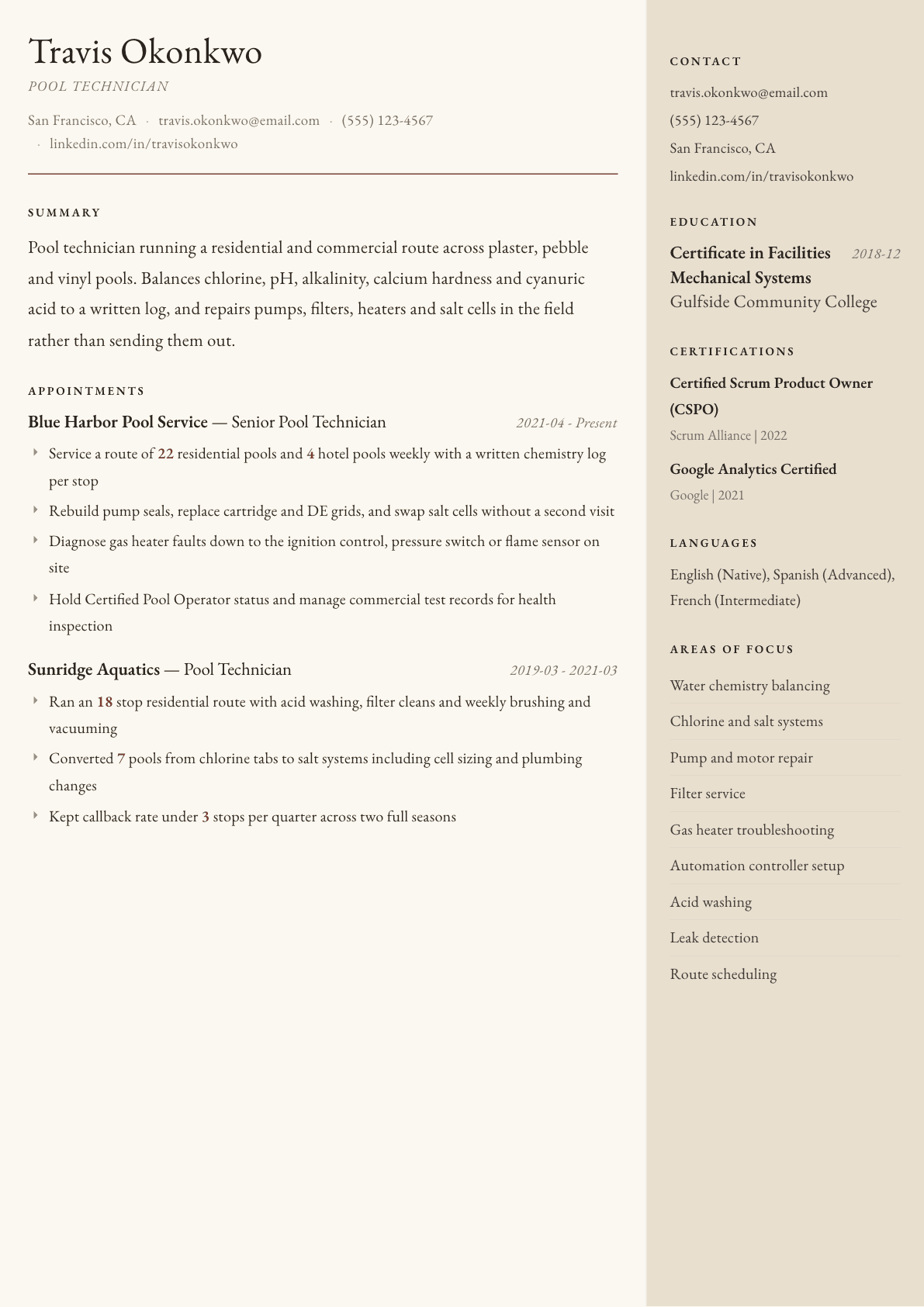
The same pool technician content laid out in three CVBooster templates, so you can see what the finished document looks like before you write a word.
Example Pool Technician summary
Pool technician running a mixed route of residential and hotel pools across plaster, pebble and vinyl surfaces. Balances chlorine, pH, alkalinity, calcium hardness and cyanuric acid against a written log at every stop, and repairs pumps, filters, gas heaters and salt cells on site instead of scheduling a return trip. Certified Pool Operator, keeps commercial test records ready for health inspection, and holds callbacks to a handful a quarter.
Skills to list on a Pool Technician resume
- Chlorine, pH and alkalinity balancing
- Calcium hardness and cyanuric acid control
- Salt chlorine generator service
- Pump seal and impeller replacement
- Cartridge, sand and DE filter service
- Gas heater diagnosis
- Heat pump service
- Automation controller programming
- Acid washing and stain treatment
- Leak detection and pressure testing
- Plumbing and valve repair
- Brushing, vacuuming and skimming
- Chemical handling and storage
- Route scheduling and logs
What actually gets this resume read
- State your route size in stops per week and split it between residential and commercial accounts.
- List the chemistry values you balance by name, because a service manager reads that as your actual training.
- Name the equipment you repair in the field, since a technician who avoids a second trip earns the route money.
- Put Certified Pool Operator status near the top if you hold it, because commercial work usually requires it.
- Give a callback or redo figure, which is the number a route manager watches more closely than any other.
- Mention automation controllers and salt systems by category, since those are the upsells shops want handled.
How to write a pool technician resume
A route manager hiring a pool technician is protecting two things: the water and the second trip. Water that goes green on a Friday costs an account. A second trip to a stop you already visited costs the route its margin. Everything worth putting on the resume answers one of those two worries.
Most applicants write that they maintained pools and provided excellent customer service. That tells a manager nothing about whether you can read a test result and know which of five chemicals is actually the problem, or whether you can rebuild a pump seal at the equipment pad instead of writing a work order for somebody else.
This guide walks through the sections a pool service company reads, how to write chemistry and repair work so it is checkable, how to present Certified Pool Operator status and commercial work, with summaries at three career stages and bullets you can adapt to your own route.
Format: route size at the top, chemistry and repair as two separate blocks
One page, reverse chronological. Open with the shape of your route: stops per week, the split between residential and commercial, and the pool surfaces you have worked, since plaster, pebble, fiberglass and vinyl each punish the wrong chemical or the wrong brush.
Then keep chemistry and repair apart on the page. They are two different hires. Some companies want a strong service route technician who keeps water perfect; others want a repair technician who follows behind the route fixing heaters. Showing both, clearly separated, lets a manager pick you for either opening.
- Route line: stops per week, residential and commercial split, and whether you run your own truck and stock.
- Chemistry block naming every value you balance, not the phrase water chemistry on its own.
- Repair block listing equipment you fix in the field: pumps, filters, heaters, salt cells, automation, plumbing.
- Credential line with Certified Pool Operator status, any state contractor registration and your driving record.
Summary: water, equipment, and the callback number
Three or four lines carrying route size, chemistry range, repair capability and a reliability figure. A route manager can convert that directly into whether she hands you her worst route or her easiest one.
If you hold Certified Pool Operator status, put it in the summary rather than only in a credentials list. Commercial accounts such as hotels, apartment complexes and community pools sit under health department rules, and the certification is often the reason a company can take those accounts at all.
Experience: chemistry you log, repairs you finish, trips you avoid
Lead each job with the route and its makeup, then use the bullets for the technical work. Chemistry bullets should name values: free and combined chlorine, pH, total alkalinity, calcium hardness, cyanuric acid, and how you record them. A written log per stop is worth saying out loud, because it is what a health inspector asks for and what a manager uses when a customer complains.
Repair bullets should say what you finish on site. Pump seal and impeller replacement, cartridge and diatomaceous earth grid service, salt cell replacement with sizing, gas heater faults traced to the ignition control or the pressure switch, automation controller setup. A technician who diagnoses to the component instead of the box is a technician who does not order the wrong part.
Then give the callback number. Redos per quarter, or stops that needed a return visit, is the single most useful line on a pool resume, and almost nobody writes it. If you have never tracked it, use the next best thing: a season with no green pool complaints on the route.
Commercial pools, records and health inspection
Commercial work changes the job. Test frequency is set by rule rather than by judgment, records must exist and be legible, and an inspector can close a pool on the spot. If you have carried commercial stops, say how many, what type, and that you kept the test log ready for inspection.
Say what you do when a reading goes out of range on a commercial pool: close it, correct it, retest, document, reopen. Writing that sequence shows a manager you will not quietly adjust a number to keep a hotel happy, which is the risk she is really screening for.
Skills and the words a pool company searches
Postings recycle a tight vocabulary: water chemistry, chlorine, salt system, cyanuric acid, cartridge filter, sand filter, diatomaceous earth, pump motor, heat pump, gas heater, automation, acid wash, leak detection, route service. Use the terms from the advert once in the skills block and once in the bullet where you performed the work.
Add the practical facts route managers screen on and applicants forget: a clean driving record, comfort working outdoors in heat, safe transport and storage of acid and chlorine, and whether you have run a truck stocked to your own par list.
Pool Technician resume summary examples
First season
Pool technician in a first full season, trained on brushing, vacuuming, filter cleaning and basic chemistry balancing across a residential route. Holds a clean driving record, handles acid and chlorine to the safety procedure taught in training, and is working toward Certified Pool Operator status before commercial stops are added.
Four years in
Pool technician running twenty two residential and four hotel stops a week across plaster, pebble and vinyl pools. Balances chlorine, pH, alkalinity, calcium hardness and cyanuric acid against a written log per stop, rebuilds pump seals and services cartridge and diatomaceous earth filters without a return trip.
Senior route technician
Senior pool technician holding Certified Pool Operator status, covering a mixed residential and commercial route and taking the repair calls other technicians escalate. Diagnoses gas heaters to the ignition control, pressure switch or flame sensor on site, converts pools to salt with correct cell sizing, and keeps commercial test records inspection ready.
Work experience bullets: before and after
Before: Maintained pools on a weekly route.
After: Serviced a weekly route of twenty two residential pools and four hotel pools, recording a full chemistry panel in a written log at every stop.
Route size plus a logged panel shows both capacity and the discipline a health inspector needs to see.
Before: Balanced pool chemicals.
After: Balanced free chlorine, pH, total alkalinity, calcium hardness and cyanuric acid, correcting stabilizer buildup by partial drain rather than by adding more chlorine.
Naming the values and one real correction choice shows judgment instead of a routine dose.
Before: Fixed pool equipment when it broke.
After: Rebuilt pump seals, replaced impellers and diatomaceous earth grids, and swapped salt cells at the pad without scheduling a second visit.
Finishing at the pad is the difference between a route that earns and a route that bleeds trips.
Before: Worked on pool heaters.
After: Diagnosed gas heater faults down to the ignition control, pressure switch or flame sensor before ordering parts, so the correct component arrived the first time.
Component level diagnosis is the skill shops pay for, because wrong parts are the real cost.
Before: Customers were happy with my service.
After: Held callbacks under three stops per quarter across two full seasons on a route of twenty six accounts, with no green pool complaints.
Callbacks per quarter is the metric a route manager already tracks, so it needs no translation.
Hard skills
- Free and combined chlorine testing
- pH and total alkalinity balancing
- Calcium hardness and cyanuric acid control
- Salt chlorine generator service and cell sizing
- Pump seal, impeller and motor replacement
- Cartridge, sand and diatomaceous earth filter service
- Gas heater diagnosis and repair
- Heat pump service
- Automation controller programming
- Acid washing and stain treatment
- Leak detection and pressure testing
- Plumbing, valve and actuator repair
- Chemical transport and storage safety
Soft skills
- Working a full route in summer heat without cutting stops short
- Explaining a chemistry problem to a customer without jargon
- Refusing to sign off a commercial pool that is out of range
- Planning a day so repairs fit around fixed service days
- Keeping legible records somebody else can read
Certifications worth listing
- Certified Pool Operator (CPO) (Pool and Hot Tub Alliance)
- Certified Service Technician (CST) (Pool and Hot Tub Alliance)
- Certified Maintenance Specialist (CMS) (Pool and Hot Tub Alliance)
Mistakes that cost pool technician candidates the interview
- Writing water chemistry as a single skill instead of naming the five values you actually test and correct.
- Leaving route size off the page, so a manager cannot tell whether you can carry twelve stops a day or five.
- Blurring service work and repair work together when companies frequently hire for one of them at a time.
- Omitting Certified Pool Operator status or the fact that you are working toward it, on a resume aimed at commercial accounts.
- Never mentioning callbacks, the number that decides whether a route makes money for the company.
- Skipping the driving record and truck stocking, both of which are practical screens for a route job.
Pool Technician resume questions
Do I need Certified Pool Operator status to get hired?
Not for residential route work, where most companies train new technicians on the job. It becomes close to mandatory once commercial accounts are involved, because health rules govern those pools and the company usually needs a certified operator attached to them.
How do I show experience if I have only worked one season?
Give the route you covered, the pool surfaces you handled, the chemistry you balanced and any equipment you serviced. One honest season described in detail reads better than three vague years, and route managers hire heavily on attitude and reliability at entry level.
Should I list the chemicals I work with by name?
List the values you balance rather than product brands. Free chlorine, pH, total alkalinity, calcium hardness and cyanuric acid are the language of the trade, and naming them proves training in a way that a product list never does.
How much repair skill do route jobs actually need?
More than most job adverts admit. A route technician who can rebuild a pump seal, clear a filter or swap a salt cell saves the company a separate repair visit, and that ability is usually what moves you from entry pay to senior pay.
What should I put on the page about safety?
Chemical transport and storage, keeping acid and chlorine separated, personal protective equipment, and safe practice around energized equipment at the pad. One concrete line is enough, and it reassures a manager who has seen an untrained technician mix products badly.
Related resume examples
- Maintenance Technician Resume example
- HVAC Technician Resume example
- Apartment Maintenance Technician Resume example
- Facilities Technician Resume example
- Maintenance Worker Resume example
- Refrigeration Technician Resume example