Application Engineer Resume Examples: what gets the call
Build an Application Engineer Resume That Shows Technical Depth and Customer Reach
By Mustafa Tarabya, founder of CVBooster · Published · Updated
Application engineer resume sample, keyword list, and a writing guide covering sizing, integration support, and pre-sales technical work.
Sample resumes for a application engineer
The same application engineer content laid out in three CVBooster templates, so you can see what the finished document looks like before you write a word.
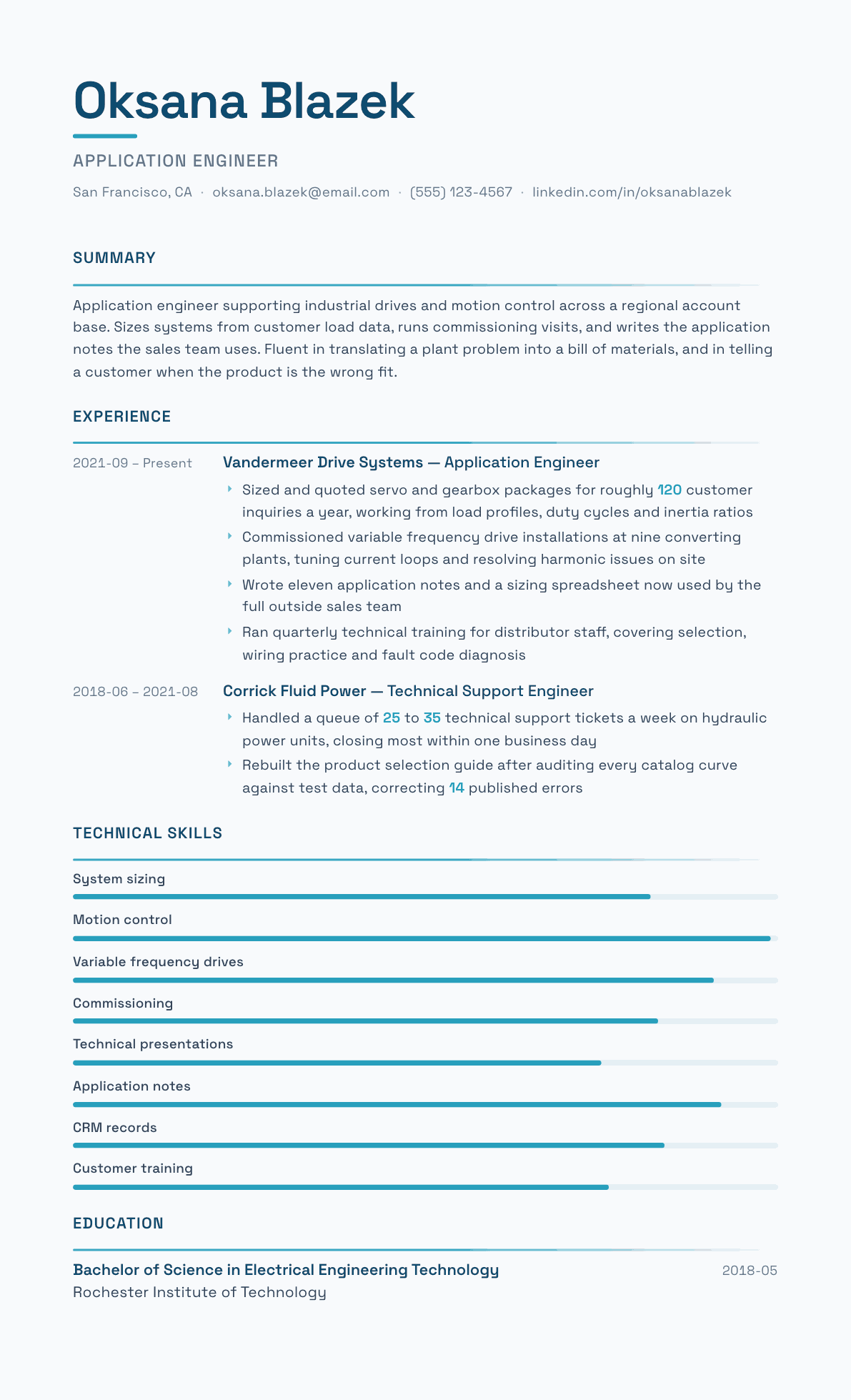
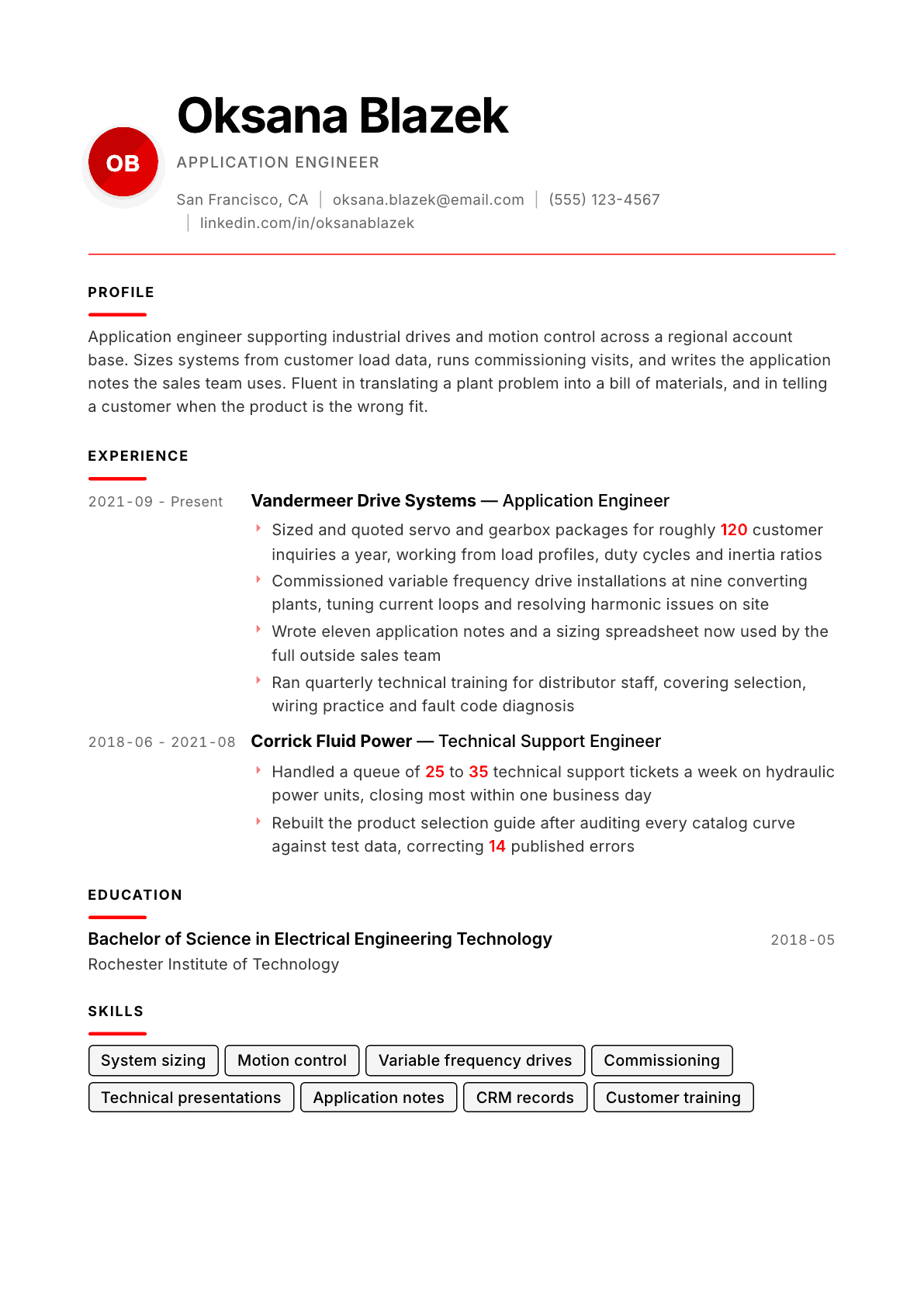
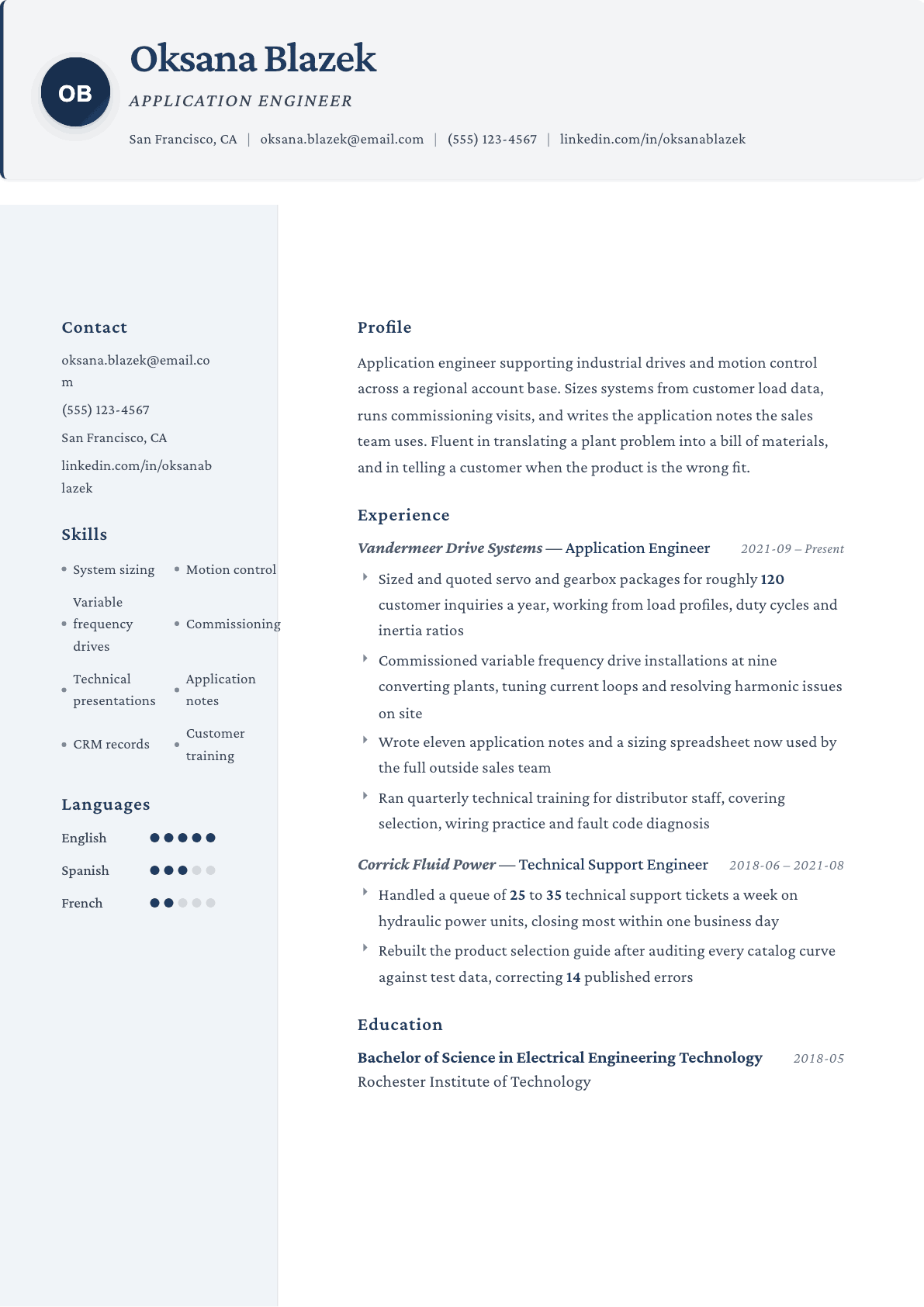
Example Application Engineer summary
Application engineer with six years supporting drives, motion control and fluid power for converting and packaging plants. Sizes systems from customer load data, commissions installations on site, and authors the application notes and selection tools the sales organization relies on. Trains distributor technicians and works alongside account managers from first inquiry through startup. Seeking a senior application role with regional technical ownership.
Skills to list on a Application Engineer resume
- Product sizing and selection
- Pre-sales technical support
- Commissioning and startup
- Motion control
- Variable frequency drives
- PLC integration
- Root cause troubleshooting
- Application notes
- Customer training
- Requirements gathering
- Bill of materials
- Technical presentations
- AutoCAD
- CRM systems
What actually gets this resume read
- Show the two halves of the job: the calculation you ran and the customer conversation that followed it.
- Quantify your inquiry or ticket volume, because that is how an application engineering manager measures load.
- Name the industries you have supported, since account teams hire for familiarity with a specific plant environment.
- List travel percentage and territory if the posting mentions field work, so the recruiter does not have to ask.
- Include the documents you authored, such as sizing tools, application notes, and selection guides.
- Mention any revenue you were attached to only as scope, not as a sales quota you personally carried.
How to write a application engineer resume
An application engineer sits between a product and the customer who has to make it work, and the resume has to prove competence on both sides. Hiring managers in this function have all met the candidate who can size a gearbox but freezes in front of a plant manager, and the one who charms the room but quotes the wrong frame size.
Two people read the file. A recruiter screens for the product family, the industries and the travel tolerance. The engineering or sales manager reads the bullets to work out whether you can hold a technical conversation without escalating every question back to the factory.
This guide covers the section order that works for pre-sales and support roles, summaries for three career stages, before and after bullets from sizing and commissioning work, and the questions application engineers ask when their contribution is hard to separate from the sales number.
Format: product families across the top, accounts underneath
Use reverse chronological order and give each job a one-line scope statement before the bullets: the product families you supported, the territory, the industries and the travel share. That line answers most of the recruiter questions in one pass and keeps the bullets free for real work.
One page is right for most application engineers. Keep the layout single column, because these resumes travel through distributor and manufacturer applicant tracking systems that handle columns badly.
- Header: name, city and state, phone, email, and a note if you are open to a field-based territory.
- Sections: summary, technical skills, experience with a scope line per job, education, certifications.
- Add a short line for languages if you support export accounts, since that is a real filter in this function.
Summary: what you size, who you support, where you travel
Name the product technology, the customer type and the geography in the first sentence. An application engineer for servo drives in converting plants and one for analytical instruments in pharmaceutical labs share a job title and almost nothing else, and the summary is where the reader learns which you are.
Add one sentence on the documents or tools you produced. Sizing spreadsheets, selection guides and application notes are durable outputs that outlast any single quote, and managers notice candidates who leave something behind.
Experience: the calculation and the conversation
Every strong bullet in this role contains an engineering act and a customer act. You took a load profile and returned a sized package. You found a harmonic problem on site and explained the filter choice to a maintenance supervisor. Bullets that only show one half read as either a desk engineer or an account manager, and both get filtered.
Quantify volume. Inquiries handled per year, tickets closed per week, commissioning trips per quarter, distributors trained: these are the numbers an application engineering manager uses to staff a territory, and a resume without them forces a guess.
Be careful with revenue. Attaching yourself to a large booking figure invites the interviewer to ask what you actually owned. Describe the scope you supported and let the sales counterpart carry the quota language.
Commissioning and field work
If you go on site, that deserves its own bullets. Name the equipment you started up, the settings you tuned, and the problems you closed in the plant rather than from an office. Startup experience is the hardest thing for a manager to train and the easiest for a candidate to leave out.
Give travel share honestly. A candidate who has run a territory at a quarter of their time on the road is a different hire from one who has done a single trip, and overstating it becomes obvious in the first month.
Skills and keywords the screen is matching
Application engineering postings reuse a small vocabulary: sizing and selection, pre-sales support, commissioning, startup, requirements gathering, bill of materials, root cause troubleshooting, customer training and technical presentations. Mirror the posting language once in the skills block and once inside a bullet where it is demonstrated.
List the specific technologies alongside the generic terms. Naming variable frequency drives, servo amplifiers, hydraulic power units, programmable controllers or the analytical technique you support gives the human reader something the keyword list cannot.
Application Engineer resume summary examples
First technical role
Electrical engineering technology graduate with a co-op term in drive systems technical support, including 200 sizing requests and two commissioning trips. Comfortable reading load profiles, wiring diagrams and fault codes. Seeking an entry application engineer position supporting industrial automation customers.
Five years in
Application engineer supporting motion control and drives across a five-state territory, handling roughly 120 sizing inquiries a year and commissioning installations at converting and packaging plants. Wrote the sizing spreadsheet and application notes now used by the outside sales team. Travels about 30% of the time.
Lead application engineer
Lead application engineer with eleven years in industrial automation, running the technical function for a national distributor network. Sets selection standards, trains distributor engineers, and is the escalation point for the installations nobody else can start up. Regularly briefs product management on field failure patterns.
Work experience bullets: before and after
Before: Assisted customers with product selection.
After: Sized servo and gearbox packages for about 120 customer inquiries a year, working from load profiles, duty cycles and inertia ratios supplied by plant engineering.
Volume plus the actual inputs you worked from shows the depth of the selection work rather than the fact that it happened.
Before: Traveled to customer sites for support.
After: Commissioned variable frequency drive installations at nine converting plants, tuning current loops on site and resolving a harmonic issue that had tripped a shared supply.
Naming the site count and a real fault turns travel into demonstrated startup capability.
Before: Created technical documentation.
After: Wrote eleven application notes and a sizing spreadsheet adopted by the full outside sales team, cutting the number of quotes that came back to engineering for rework.
It shows a durable output and who uses it, which is how internal influence is measured in this role.
Before: Provided training to distributors.
After: Ran quarterly technical training for distributor staff across the territory, covering selection method, wiring practice and fault code diagnosis, with a hands-on bench session each time.
The cadence and syllabus prove you can teach the product, not that you once presented slides.
Before: Answered support tickets.
After: Handled 25 to 35 technical support tickets a week on hydraulic power units, closing most within one business day and escalating recurring faults to product engineering with data.
A rate, a closure standard and an escalation habit describe a support engineer a manager can staff around.
Hard skills
- Product sizing and selection
- Load and duty cycle analysis
- Pre-sales technical support
- Commissioning and startup
- Motion control and drives
- Programmable controller integration
- Root cause troubleshooting
- Bill of materials preparation
- Application note authoring
- Requirements gathering
- AutoCAD
- CRM and quotation systems
- Technical presentations
- Customer and distributor training
Soft skills
- Translating plant problems into specifications
- Saying no to a bad fit
- Working alongside account managers
- Explaining technical limits to non-engineers
- Managing a support queue under pressure
- Field composure during a startup
Certifications worth listing
- Fundamentals of Engineering (FE) (NCEES)
- Certified Automation Professional (International Society of Automation)
- Certified Control Systems Technician (International Society of Automation)
- Certified Fluid Power Specialist (International Fluid Power Society)
Mistakes that cost application engineer candidates the interview
- Writing the resume as a sales document, which makes an engineering manager doubt the technical depth behind every claim.
- Leaving out inquiry, ticket or commissioning volume, so the reader cannot judge whether you have carried a real territory.
- Naming the product family only once, in a job title, instead of in the scope line where a recruiter searches for it.
- Overstating travel share, which is exposed in the first month and is the most common reason these hires do not last.
- Claiming credit for booking figures you supported rather than owned, which invites an uncomfortable interview question.
- Listing every industry you have touched, so the resume reads as unfocused rather than as deep in one plant environment.
Application Engineer resume questions
Is an application engineer a sales role or an engineering role?
It is an engineering role measured partly by commercial outcomes. You size, specify and troubleshoot, and you do it in front of customers alongside an account manager. Write the resume so the engineering carries the weight and the customer contact appears as evidence of range.
How do I show commercial impact without claiming a sales quota?
Describe scope rather than credit. Say how many inquiries you sized, how many installations you started up, and which documents the sales team adopted. That gives a hiring manager a real sense of contribution without a number that belongs to someone else.
Should I list every product I have supported?
No. Group them into two or three families and give each one a line in the scope statement. A long undifferentiated list makes the reader assume shallow exposure, while three families with depth underneath reads as someone who owns a technology area.
How much travel should I mention on the resume?
State an honest share for each role, such as a quarter or a third of your time. Field-based postings screen on this directly, and an accurate figure saves both sides a wasted interview when the territory turns out to be larger than you want.
What if I have support experience but never commissioned equipment?
Say so implicitly by leading with the depth you do have: fault diagnosis, sizing accuracy, documentation and training. Then add any bench or lab startup work you have done. Managers will train commissioning, but only when the diagnostic judgment is already visible.
Related resume examples
- Automation Engineer Resume example
- Electrical Engineer Resume example
- Field Engineer Resume example
- Controls Engineer Resume example
- Agricultural Engineer Resume example
- Mechatronics Engineer Resume example