Mechatronics Engineer Resume Examples: read this first
Build a Mechatronics Engineer Resume Across Three Disciplines
By Mustafa Tarabya, founder of CVBooster · Published · Updated
Mechatronics engineer resume examples that balance mechanical, electronics and controls work, with ATS keywords, bullets and a writing guide.
Sample resumes for a mechatronics engineer
The same mechatronics engineer content laid out in three CVBooster templates, so you can see what the finished document looks like before you write a word.
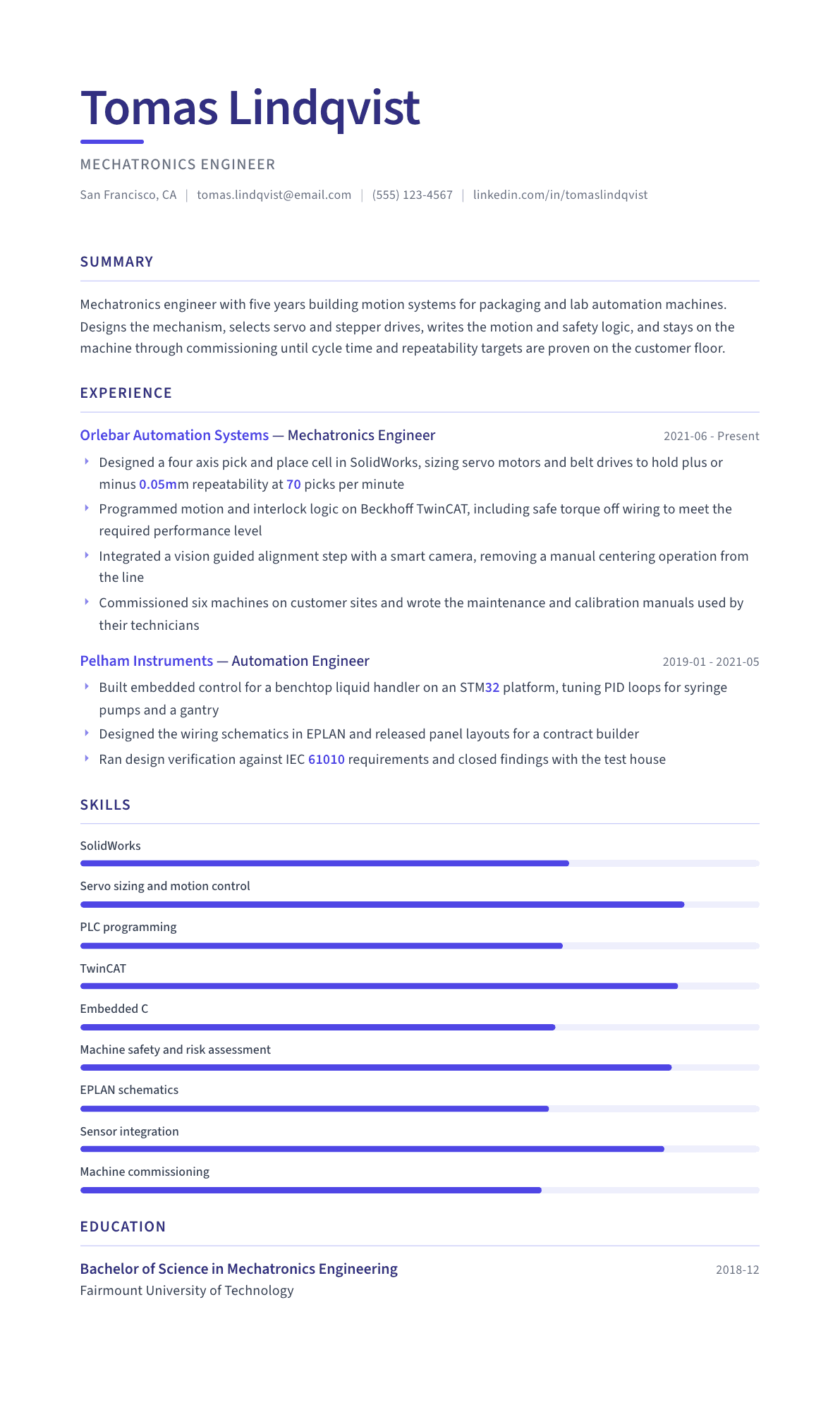
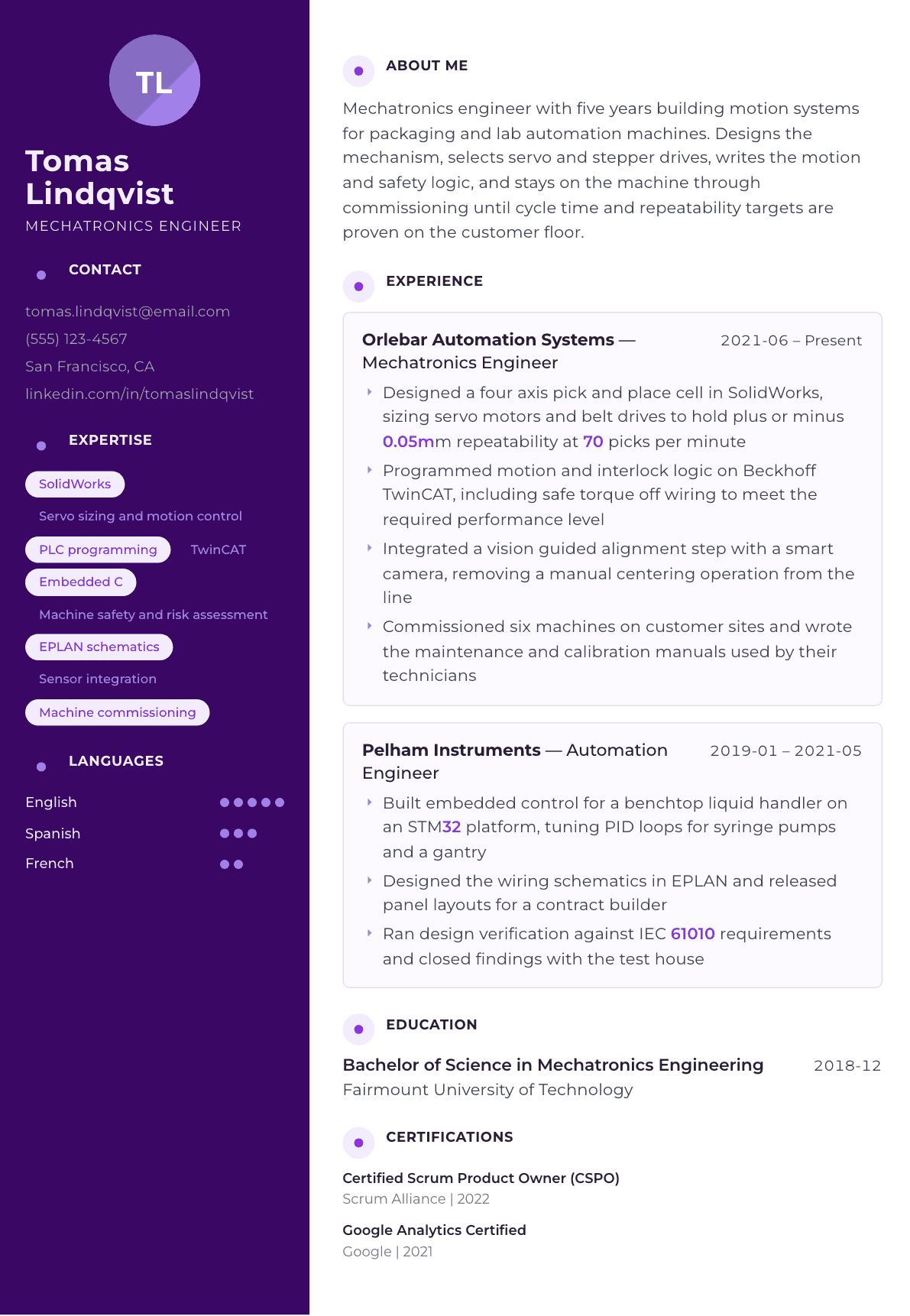
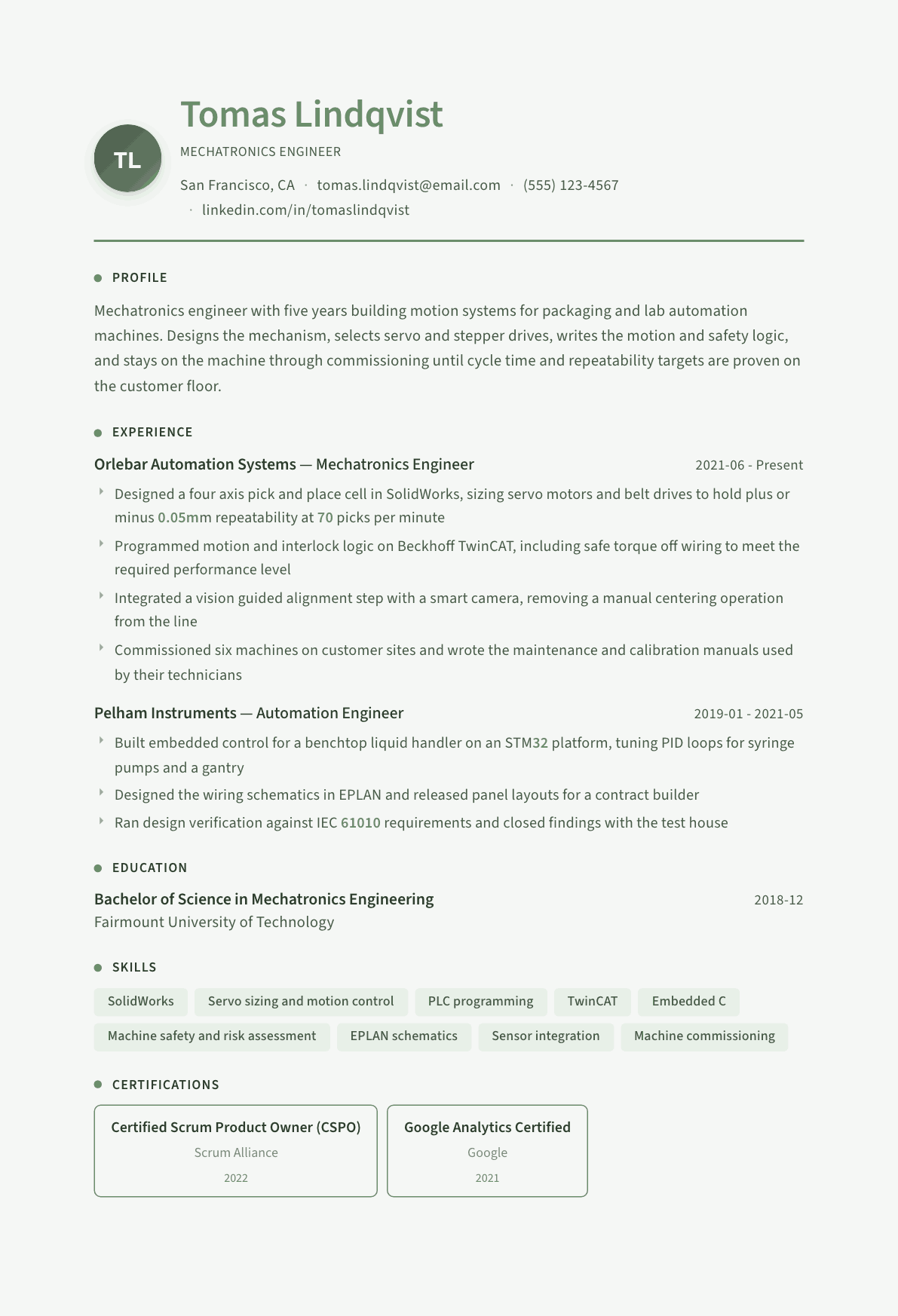
Example Mechatronics Engineer summary
Mechatronics engineer with five years building motion systems for packaging and laboratory automation. Designs the mechanism in SolidWorks, sizes the servo drives, writes the TwinCAT motion and safety logic, then commissions the machine on the customer floor. Delivered a four axis cell holding tight repeatability at seventy picks per minute and replaced a manual alignment step with vision guidance. Comfortable moving between mechanical, electrical and control work in one day.
Skills to list on a Mechatronics Engineer resume
- Motion control
- Servo and stepper sizing
- PLC programming
- TwinCAT
- Siemens TIA Portal
- Embedded C
- SolidWorks
- Tolerance stack analysis
- Sensor and actuator integration
- Machine vision
- EPLAN schematics
- Machine safety and risk assessment
- PID tuning
- Commissioning and site support
- Industrial networks such as EtherCAT
What actually gets this resume read
- Split your skills into mechanical, electrical and software so a reader can see the balance rather than guess it.
- Name the controller platform you program, because Beckhoff, Siemens, Rockwell and embedded C attract different teams.
- Give motion numbers: axis count, repeatability, cycle rate and payload, since those define the machines you can build.
- Show machine safety work, including risk assessment, safe torque off and the performance level you designed to.
- Add commissioning experience with customer names removed, because employers want engineers who finish on site.
- Keep one bullet on the mechanical detail work, such as tolerance stacks or bearing selection, so you are not read as a programmer.
How to write a mechatronics engineer resume
A mechatronics engineer resume has a structural problem that no other engineering resume has: it must prove competence in three disciplines without looking thin in any of them. The machine builder reading it wants to see mechanical design judgment, electrical and controls capability, and enough software to make an axis move correctly. If one of those three is missing, the reader files you as a mechanical engineer who has seen a controller, or a programmer who has seen a machine.
The second thing that reader wants is evidence that you finish. Machines are accepted on a customer floor, not in a design review, and commissioning experience is the rarest thing in this candidate pool. An engineer who has stood at a running machine at two in the morning solving a motion fault is worth more to a builder than one with a longer software list.
This guide covers how to split a mechatronics skills block so the balance is visible, how to write motion and safety bullets with the numbers a machine builder checks, what commissioning experience looks like on paper, and the questions that come up when moving between automation, laboratory instruments and robotics work.
Format: single column, three part skills block, one page until you have machines to list
Reverse chronological, single column, no icons. Machine builders and system integrators use ordinary applicant tracking systems, and the three part skills block you need renders badly in a side panel anyway.
The block is the heart of this resume. Give it three labeled lines: mechanical, electrical and controls, and software. A reader scans it in two seconds and immediately knows where you are strongest, which is exactly the judgment you want him to make on your terms rather than by guessing from job titles.
- Header: name, city and state, phone, email, and a title naming the machine type you build.
- Sections in this order: summary, three part skills block, experience, machine list, education.
- Graduates add a capstone entry describing an actual mechanism they built, wired and programmed.
Summary: machine type, controller platform, and how far you carry the build
Four lines. Name the machines you build, the controller platform you program, and whether you own concept through commissioning or a narrower slice. Packaging machinery, laboratory automation, semiconductor handling and test rigs are different worlds with different cycle rate expectations, and naming yours anchors everything else.
Say the controller by name. Beckhoff, Siemens, Rockwell and bare metal embedded work attract different employers, and a builder standardized on one of them screens for it before reading anything else. If you have worked across two, say which one you would call yourself fluent in.
Experience: axes, repeatability, cycle rate, and the site you commissioned
Every machine bullet should carry motion numbers. Axis count, repeatability, cycle rate, payload and stroke are the specification a customer bought, and they tell a hiring manager exactly what class of machine you can design. A four axis pick and place cell holding tight repeatability at seventy picks per minute is a specification; a high speed automated cell is an adjective.
Write at least one bullet on the mechanical detail work so you are not read as a programmer with a computer aided design license. Tolerance stacks, bearing and guide selection, belt and screw sizing, or a stiffness problem you solved all serve. Then one on the electrical side: schematics, panel layout, drive selection, sensor and network topology.
Machine safety belongs in its own bullet. Risk assessment, the category or performance level you designed to, safe torque off wiring, guarding and interlock architecture are the parts of the job that carry liability, and many resumes leave them out entirely. Naming them separates an engineer who has released a machine from one who has only built prototypes.
Close with commissioning. How many machines, at how many sites, and what you handed over: acceptance test results, calibration procedures, maintenance manuals and operator training. That is the evidence that the projects you list actually finished.
The three part skills block, written properly
The mechanical line should name the computer aided design system, the analysis you do yourself, and the mechanism types you have designed. The electrical and controls line should name the controller platform and development environment, the drive and motor families, the industrial network, the schematic tool, and the safety architecture you have implemented. The software line should name the languages, whether that is structured text, ladder, embedded C or a scripting language for test and data work.
Resist the urge to pad each line to the same length. An honest block that shows a stronger controls side and a competent mechanical side is more persuasive than three identical lists, because a reader who has hired for this role knows nobody is equally deep in all three.
- Mechanical: computer aided design system, tolerance stacks, drivetrain sizing, mechanism types.
- Electrical and controls: controller platform, servo and stepper drives, sensors, industrial networks, schematic tool.
- Software: structured text, ladder, embedded C, scripting for test and data.
- Safety: risk assessment method, safe torque off, guarding, performance level achieved.
Keywords a machine builder posting repeats
These postings reuse a tight vocabulary: motion control, servo sizing, programmable logic controller programming, machine vision, risk assessment, commissioning, and the industrial network name. Mirror each once in the skills block and once in a bullet where it did real work, so the file survives both the parser and the engineer reading right after it.
One caution: do not claim vision, safety and embedded work all at expert level unless every one of them appears in a project bullet with a specific outcome. In a three discipline role, unsupported breadth is the fastest way to lose credibility in a technical interview.
Mechatronics Engineer resume summary examples
New graduate
Mechatronics engineering graduate who designed, wired and programmed a two axis test rig for a capstone project, sizing the stepper drives and writing the motion sequence in structured text. Comfortable in a computer aided design system, on a bench with an oscilloscope, and in a controller development environment.
Five years in
Mechatronics engineer with five years building motion systems for packaging and laboratory automation. Designs the mechanism, sizes the servo drives, writes the motion and interlock logic, then commissions on the customer floor. Delivered a four axis pick and place cell holding 0.05mm repeatability at 70 picks per minute.
Lead machine engineer
Lead machine engineer with eleven years across automation and instrument platforms, owning architecture from mechanism concept through safety validation and site acceptance. Sets the controls standard for a machine family, reviews risk assessments, and has commissioned equipment at more than twenty customer sites across three continents.
Work experience bullets: before and after
Before: Designed an automated pick and place machine.
After: Designed a four axis pick and place cell, sizing servo motors and belt drives to hold 0.05mm repeatability at 70 picks per minute across a two kilogram payload.
Axis count, repeatability, rate and payload are the specification a customer buys, and they place your work in a machine class.
Before: Programmed the machine controls and safety.
After: Programmed motion and interlock logic on a Beckhoff controller, including safe torque off wiring and a guard door architecture that met the required performance level from the risk assessment.
Naming the platform and the safety architecture turns a generic controls claim into evidence of a released machine.
Before: Added a camera to improve accuracy.
After: Integrated a vision guided alignment step with a smart camera and a calibrated coordinate transform, removing a manual centering operation from the line and its associated operator variation.
The calibration detail and the operation removed show the reader both the engineering and the reason it was worth doing.
Before: Supported machines at customer sites.
After: Commissioned six machines on customer sites through site acceptance testing, then wrote the calibration and maintenance procedures their technicians now run.
Acceptance testing and handover documentation are what distinguish commissioning from a service visit.
Before: Worked on embedded control for an instrument.
After: Built embedded control for a benchtop liquid handler on a microcontroller platform, tuning position and pressure loops for the syringe pumps and the gantry against measured step responses.
The platform, the loops and the tuning evidence prove real embedded controls work rather than firmware exposure.
Hard skills
- Motion control architecture
- Servo and stepper sizing
- Programmable logic controller programming
- Structured text and ladder logic
- Embedded C
- Computer aided design for machine frames and mechanisms
- Tolerance stack analysis
- Sensor and actuator integration
- Machine vision integration
- Electrical schematics and panel layout
- Industrial networks such as EtherCAT
- Machine safety and risk assessment
- Control loop tuning
- Site commissioning and acceptance testing
Soft skills
- Calm fault finding on a live machine
- Customer facing communication during acceptance
- Translating between mechanical and software teams
- Documentation technicians can follow
- Prioritizing under a build schedule
Certifications worth listing
- Certified Automation Professional (CAP) (International Society of Automation)
- Certified Control Systems Technician (CCST) (International Society of Automation)
- Functional Safety Engineer (TUV Rheinland)
- Certified SolidWorks Professional (CSWP) (Dassault Systemes)
Mistakes that cost mechatronics engineer candidates the interview
- Presenting one undifferentiated skills list, so a reader cannot tell whether you are stronger in mechanics, electronics or code.
- Describing machines without motion numbers, which leaves axis count, repeatability and cycle rate entirely to the imagination.
- Leaving machine safety out, when risk assessment and performance level are the part of the release a builder cannot skip.
- Naming a controller platform in the skills list that never appears in a project bullet, which collapses in the first interview.
- Omitting commissioning, the scarcest and most valuable experience an integrator can hire.
- Claiming expert level in vision, safety and embedded work at once with no project behind any of them.
- Listing every sensor brand ever specified instead of the architecture decisions you made.
Mechatronics Engineer resume questions
How do I show balance across three disciplines without looking shallow?
Use a labeled three part skills block and let the depths differ honestly, then back the strongest two with project bullets. A reader who hires for this role expects an uneven profile and trusts a candidate who shows the shape of it rather than flattening everything into one list.
Which controller platform should I lead with?
The one named in the posting, if you genuinely have it, and otherwise the one you are fluent in. Say the level of fluency plainly, because integrators know the transition between platforms takes weeks rather than months and would rather hire an honest ramp than a bluff.
Does a mechatronics engineer need a machine list on the resume?
It helps once you have built several. A compact list of machine type, axis count, cycle rate and the industry it served gives a builder your scope faster than prose, and it becomes the natural agenda for the technical interview that follows.
How do I present commissioning work without naming customers?
Give the machine type, the country or region, and what the acceptance covered. Six machines commissioned to site acceptance testing across two regions communicates the experience fully while keeping every confidentiality obligation intact.
Is functional safety certification worth pursuing for this role?
Yes if you release machines rather than prototypes. A recognized functional safety credential shortens the conversation about whether you can own a risk assessment, and safety responsibility is one of the clearest paths from engineer to lead in machine building.
Related resume examples
- Robotics Engineer Resume example
- Automation Engineer Resume example
- Controls Engineer Resume example
- Electrical Design Engineer Resume example
- Application Engineer Resume example
- Design Engineer Resume example