Field Engineer Resume Examples: the lines they read
Write a Field Engineer Resume That Survives the Travel Screen
By Mustafa Tarabya, founder of CVBooster · Published · Updated
Field engineer resume example with commissioning, service and site handover bullets, travel readiness keywords and a writing guide.
Sample resumes for a field engineer
The same field engineer content laid out in three CVBooster templates, so you can see what the finished document looks like before you write a word.
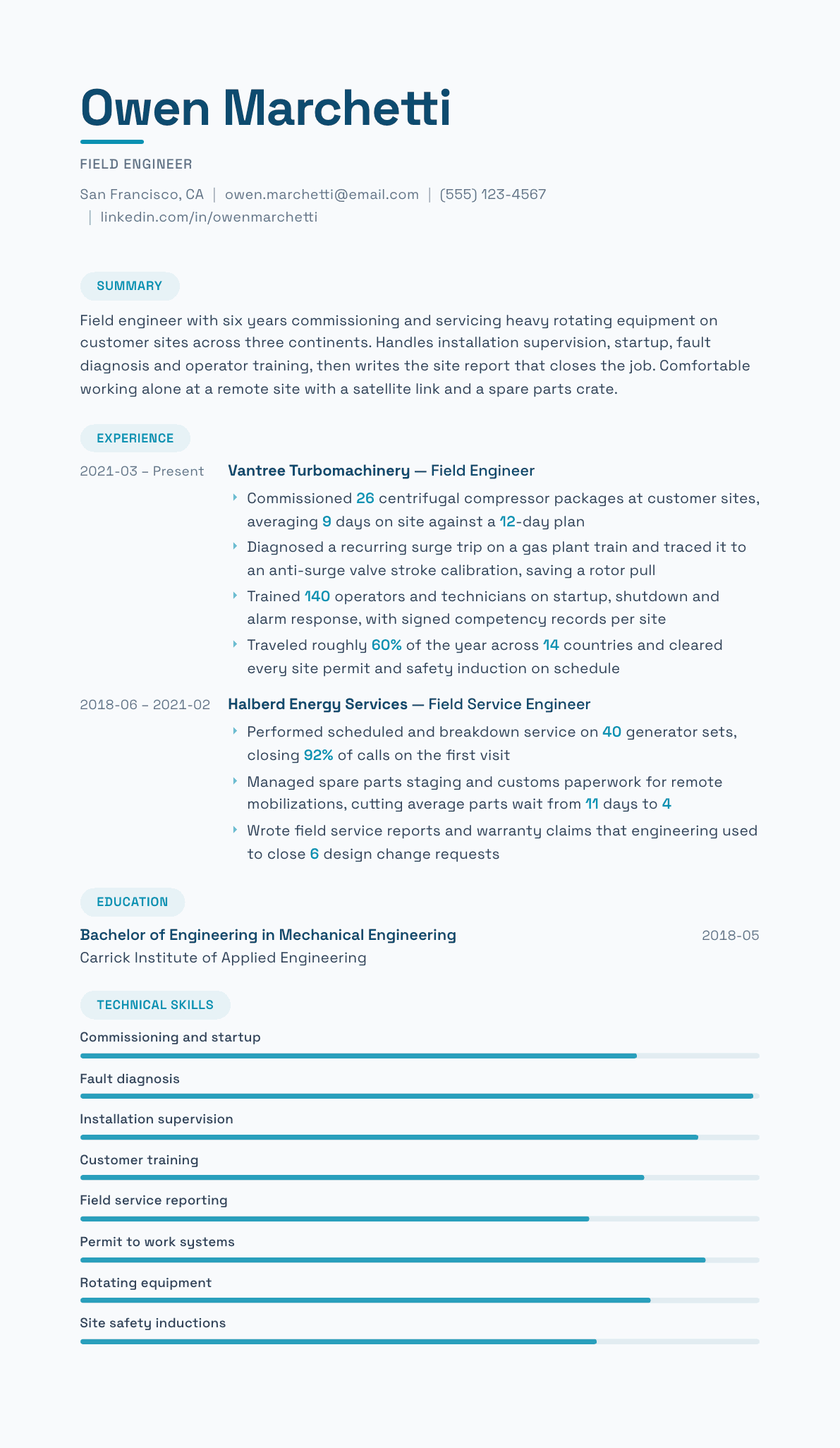
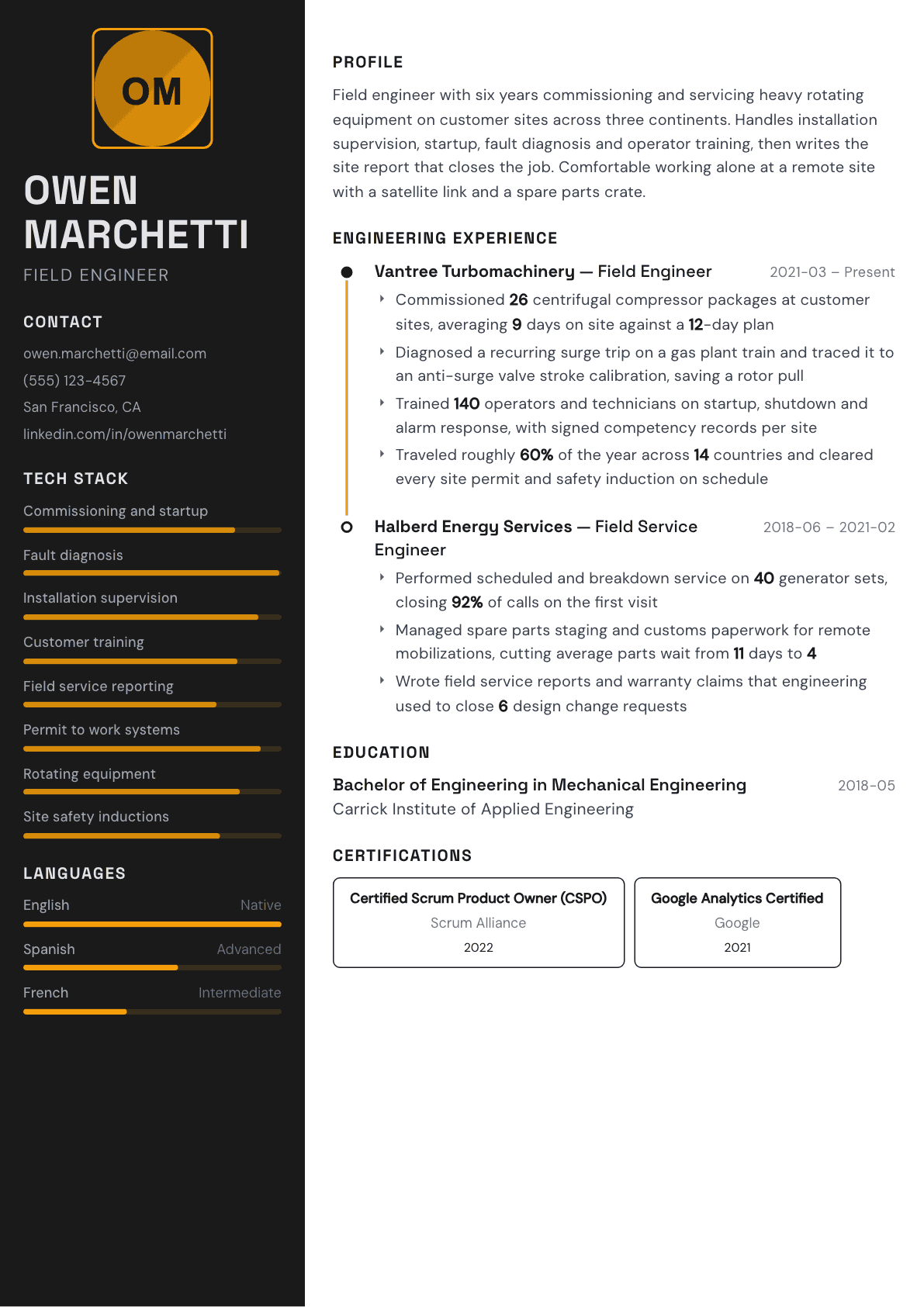
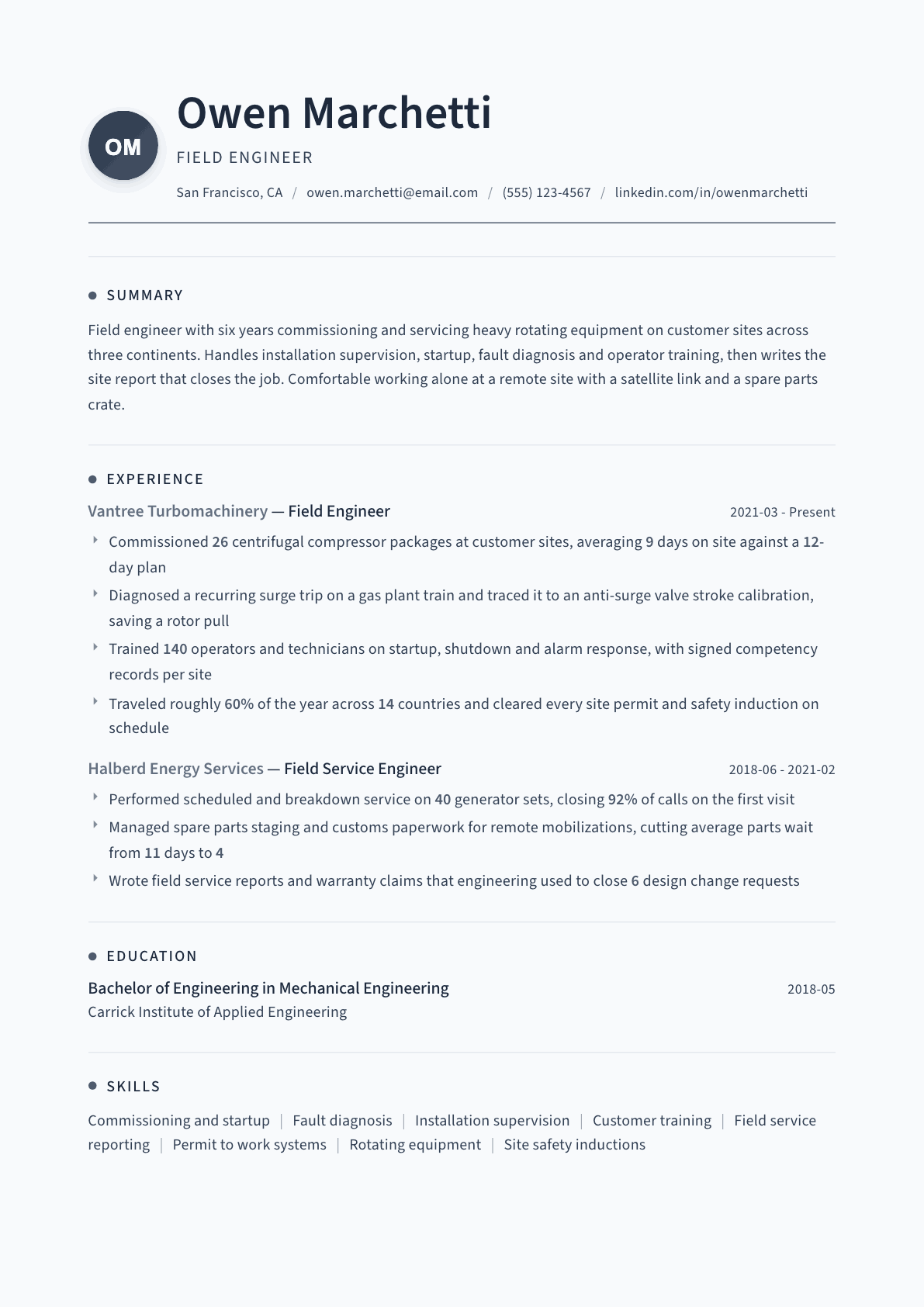
Example Field Engineer summary
Field engineer with six years commissioning and servicing heavy rotating equipment on customer sites worldwide. Supervises installation, runs startup and performance testing, diagnoses faults under production pressure and trains the operating crew before handover. Writes the site reports and warranty documentation that feed design improvements back to engineering. Holds current offshore survival and safety certification and is available for frequent international travel.
Skills to list on a Field Engineer resume
- Commissioning and startup
- Installation supervision
- Fault diagnosis
- Rotating equipment service
- Control system checkout
- Customer training delivery
- Field service reporting
- Warranty claim documentation
- Permit to work
- Lockout tagout
- Spare parts planning
- Site handover documentation
- Root cause investigation
- Contractor coordination
What actually gets this resume read
- State your travel availability and passport or visa status early, because the travel screen removes most applicants before the technical read.
- Count sites and countries, since a field engineer who has mobilized often is worth more than one with a single long assignment.
- Give first visit fix rate or commissioning duration against plan, as these are the numbers a service manager already reports upward.
- List the safety certificates you hold and keep current, because many customer sites will not grant access without them.
- Name the equipment families and control systems you have started up, not just the employer that sold them.
- Mention your reporting discipline, since field reports and warranty documentation are what engineering back at base actually receives.
How to write a field engineer resume
A field engineer resume is screened twice, and the first screen is not technical. Before anyone assesses your commissioning ability, a service manager checks whether you can travel, whether your passport and visas allow it, whether your site safety certificates are current, and whether you have worked away from home for long stretches without the assignment falling apart. Candidates who bury that information lose interviews they would have won.
The technical screen that follows is about independence. On site you are the company. You diagnose without the lab, you decide without the design team on the phone, and you write the report that engineering will read weeks later. The resume needs to show judgment exercised alone, not tasks completed under supervision.
This guide walks through the layout, what each section should carry, three example summaries, five rewritten bullets, and the questions field engineers ask when their applications are not converting.
Format: clear the travel screen in the header
Put a mobility line directly under your contact details: travel availability as a proportion of the year, passport nationality, visas held, driving license class and any offshore or site medical status that is current. Two lines here remove the single largest reason field engineering applications are rejected.
Then use a reverse chronological experience section, one page under seven years. Add a short assignment table if you have worked many sites, listing country, equipment, duration and scope. It reads faster than paragraphs and shows breadth at a glance.
- Mobility line: travel percentage, passport, visas, license, offshore survival and medical validity.
- Section order: summary, mobility, experience, assignment list, technical skills, safety certificates.
- Per job: equipment families, customer industries, and the regions you covered.
Summary: equipment, regions, and what you close alone
Name the equipment families and the customer industries first, because a field engineer on turbomachinery, one on medical imaging systems and one on semiconductor tools live in different worlds despite sharing a title. Then give the geographic spread and the number of sites.
End with the outcome that matters to a service manager: first visit fix rate, commissioning duration against plan, or repeat call rate. These are the numbers on the service dashboard, and quoting them signals that you understand how the department is measured.
Experience: mobilization, diagnosis, handover
Structure your bullets along the shape of a real assignment. Mobilization covers preparation, parts staging, permits, customs paperwork and site induction. Execution covers installation supervision, alignment, checkout, startup, performance testing and fault diagnosis. Handover covers operator training, punch list closure, documentation and the final sign-off.
Diagnostic bullets are the ones to invest in. Describe a fault the customer could not solve, the evidence you gathered, the hypothesis you tested and the outcome. A field engineer who traced a recurring trip to a valve calibration and avoided a machine teardown has told a story every service manager wants to hear again.
Do not leave out the commercial side. Warranty determination, chargeable work, quoting follow-up repairs and protecting the relationship during a difficult failure are part of the role, and candidates who show that awareness rise faster.
Safety and site access
List your safety credentials with their validity, because expired certificates cost mobilization time and the reader is doing that arithmetic. Include the site systems you have worked under: permit to work, isolation and lockout, confined space, working at height, and any client specific inductions.
If you have worked offshore, on live plants or in hazardous areas, say so plainly. Those environments are a screening question in themselves and are the difference between a shortlist and a polite decline.
- Safety credentials: offshore survival, first aid, gas testing, working at height, confined space entry.
- Site systems: permit to work, energy isolation, risk assessment and method statement authoring.
- Environments: offshore platforms, live process plants, hazardous area sites, remote locations.
Reporting and the feedback loop to engineering
Field reports are the product that leaves the site with you. Describe your reporting discipline, the systems you logged into, and any case where your documentation drove a design change, a bulletin or a warranty campaign. Engineering departments value a field engineer whose reports they can act on.
Training delivery belongs here too. Operator and technician training with recorded competency is a deliverable in many contracts, and stating the number of people trained per site gives the claim substance.
Field Engineer resume summary examples
Junior field engineer
Mechanical engineering graduate with 18 months assisting commissioning on packaged pump and compressor units at customer sites. Holds current first aid and site safety training and is available for full-time travel. Seeking a junior field engineer position with an equipment manufacturer.
Six years in
Field engineer with 6 years commissioning centrifugal compressor packages across 14 countries, averaging 9 days on site against a 12-day plan. Diagnoses control and mechanical faults independently, trains operating crews, and closes 92% of service calls on the first visit.
Lead field engineer
Lead field engineer with 15 years on rotating equipment, running multi-engineer mobilizations, resolving escalated customer failures and owning warranty determination. Mentors junior engineers on site conduct and reporting, and has led commissioning on 60 plus installations worldwide.
Work experience bullets: before and after
Before: Commissioned equipment at customer sites.
After: Commissioned 26 centrifugal compressor packages at customer sites across 14 countries, averaging 9 days on site against a 12-day plan and handing over signed performance test records.
Volume, geography, duration against plan and the handover artifact all prove delivery rather than attendance.
Before: Troubleshot equipment problems in the field.
After: Diagnosed a recurring surge trip on a gas plant train, traced it to anti-surge valve stroke calibration through logged trend data, and avoided a rotor pull the customer had already scheduled.
The evidence used and the expensive intervention avoided demonstrate independent diagnostic judgment.
Before: Provided training to customer staff.
After: Trained 140 operators and technicians on startup, shutdown and alarm response across 18 sites, issuing signed competency records that formed part of the contractual handover.
Numbers and the contractual link turn a generic claim into a deliverable that was accepted.
Before: Managed spare parts for site visits.
After: Staged spare parts and cleared customs documentation for remote mobilizations, cutting average parts waiting time from 11 days to 4 and keeping two outage windows on schedule.
Logistics is where field assignments usually fail, so a measured improvement here is unusually persuasive.
Before: Wrote service reports after each visit.
After: Wrote field service reports and warranty determinations that engineering used to raise 6 design change requests, including a bearing housing revision that closed a repeat failure across the fleet.
Linking your reports to a design outcome shows the feedback loop worked, not just that paperwork was filed.
Hard skills
- Commissioning and startup
- Installation supervision
- Mechanical alignment and clearances
- Control system checkout
- Performance testing
- Fault diagnosis under production pressure
- Operator and technician training
- Field service reporting
- Warranty determination
- Permit to work and energy isolation
- Risk assessment and method statements
- Spare parts staging and logistics
- Punch list and handover documentation
- Customer escalation handling
Soft skills
- Working alone at remote sites
- Customer relationship under failure conditions
- Cultural adaptability across regions
- Decision making without back office support
- Clear written handover
Certifications worth listing
- Basic Offshore Safety Induction and Emergency Training (BOSIET) (OPITO)
- OSHA 30-Hour General Industry (OSHA Training Institute Education Centers)
- First Aid and CPR (American Red Cross)
- Certified Maintenance and Reliability Technician (CMRT) (Society for Maintenance and Reliability Professionals)
Mistakes that cost field engineer candidates the interview
- Hiding travel availability and visa status at the bottom, where the first screener never reaches it.
- Listing employers without the equipment families, so the reader cannot judge technical fit.
- Describing site visits without duration, country or outcome, which makes a long career look shallow.
- Omitting safety certificates and their validity, which raises immediate mobilization doubts.
- Writing only about repairs and leaving out commissioning, training and reporting.
- Failing to show a single fault you diagnosed alone, which is the core of what the role tests.
Field Engineer resume questions
How much travel detail should a field engineer resume include?
Enough for the screener to stop worrying. Give the proportion of the year you traveled, the regions covered, your passport and visa position, and confirm your willingness to continue at that level. Two lines answer what would otherwise be the first three interview questions.
Should I list every site I have worked on?
List them in a compact assignment table if the count is impressive, giving country, equipment, duration and scope. Otherwise summarize by count and region in the job bullets. The goal is showing breadth without turning the resume into a travel log.
How do I move from field service into an office engineering role?
Lead with the analytical output of your field work: failure investigations, design change requests you raised, and documentation you authored. Field experience is highly valued by design teams, but only when the resume shows you fed findings back rather than only fixing units.
Do safety certificates really belong on the resume?
Yes, with expiry status. Site access depends on them and an out of date certificate delays a mobilization by weeks. Listing them current tells a service manager you could be on a customer site next month without an administrative scramble.
What if my field assignments were all with one product line?
Depth is not a weakness if you present it as ownership. Show the range of failure modes, customer industries and site conditions you handled within that product, then name the transferable practices: commissioning discipline, diagnosis method, reporting and customer handling.
Related resume examples
- Mechanical Engineer Resume example
- Maintenance Technician Resume example
- Commissioning Engineer Resume example
- Site Engineer Resume example
- Application Engineer Resume example
- Plant Engineer Resume example