Controls Engineer Resume Examples: the lines they read
Write a Controls Engineer Resume That Proves Startup Experience
By Mustafa Tarabya, founder of CVBooster · Published · Updated
Controls engineer resume example with PLC programming, HMI development, commissioning, safety systems, keywords and a full writing guide.
Sample resumes for a controls engineer
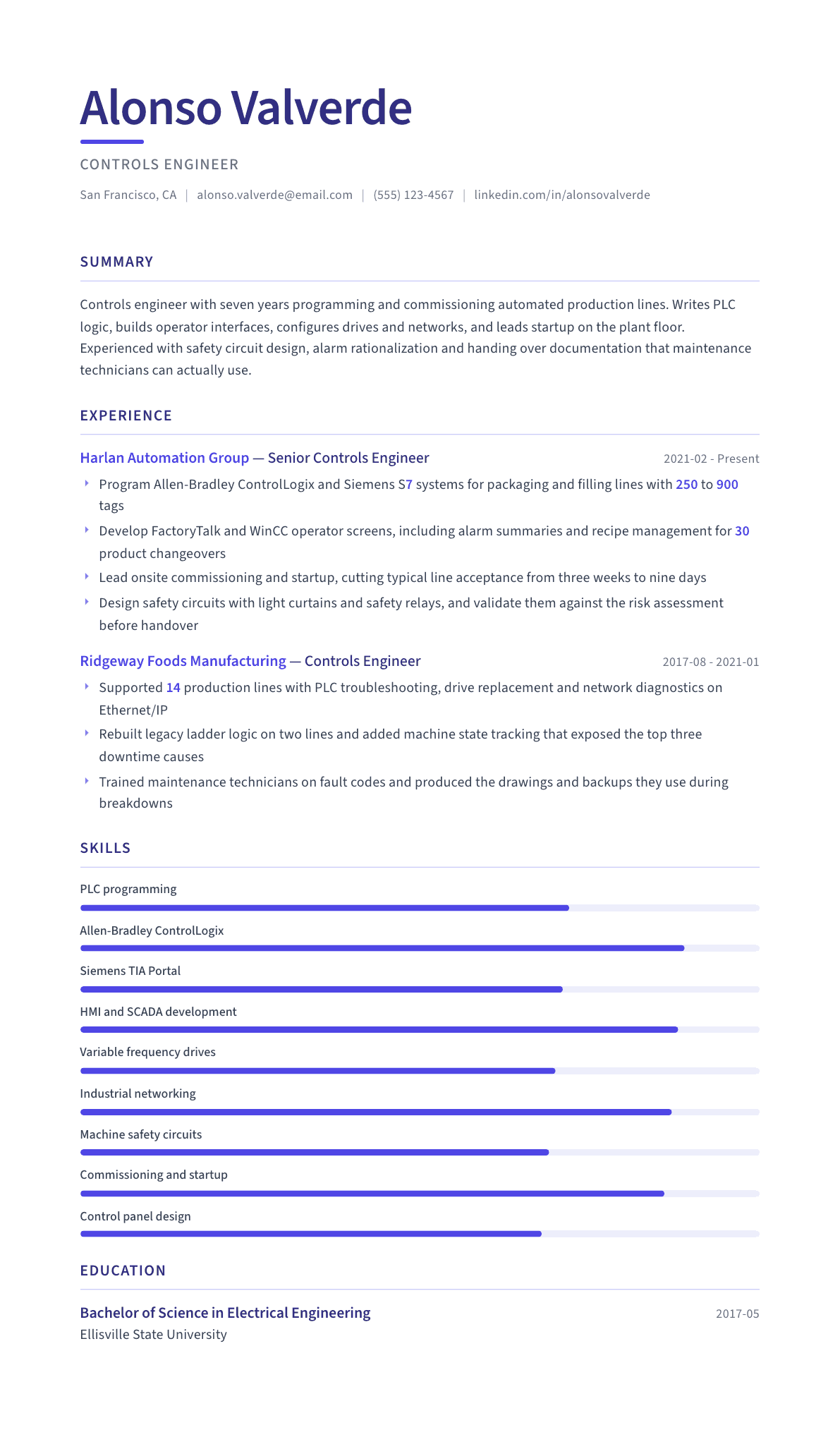
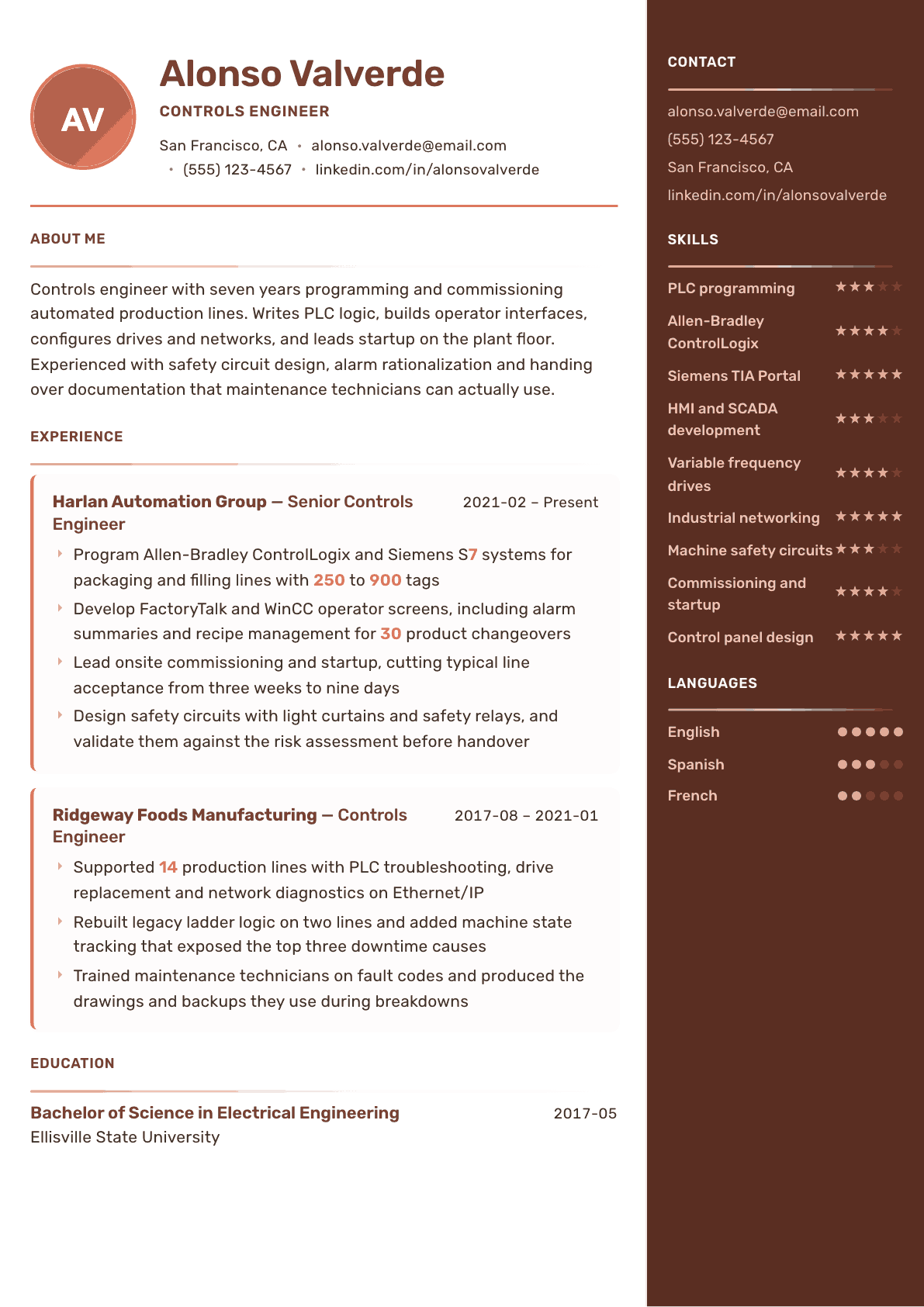
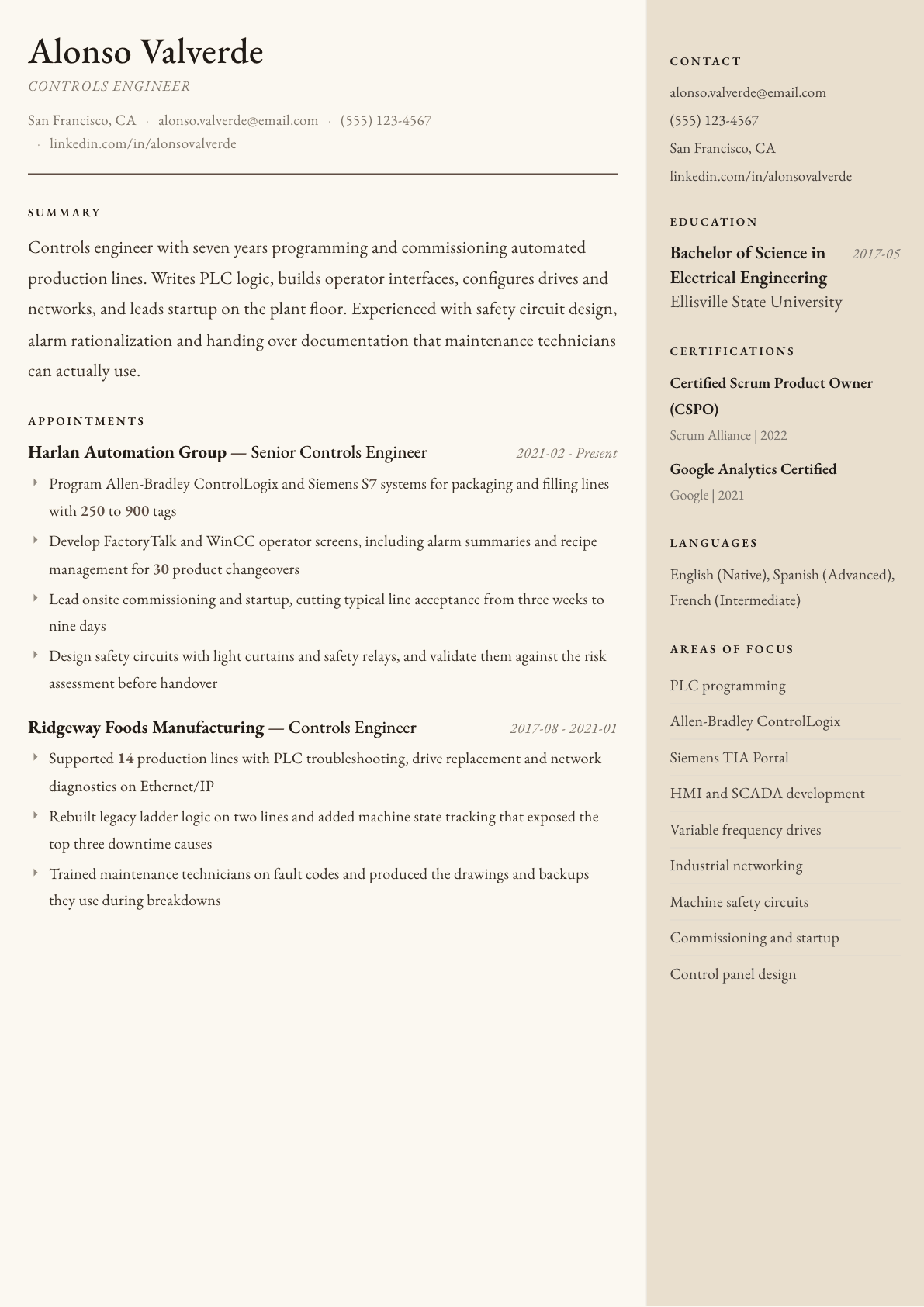
The same controls engineer content laid out in three CVBooster templates, so you can see what the finished document looks like before you write a word.
Example Controls Engineer summary
Controls engineer with seven years programming, commissioning and supporting automated production lines. Writes ControlLogix and Siemens logic, builds operator interfaces with alarm and recipe handling, and configures drives and industrial networks. Leads startup on the plant floor, validates safety circuits against the risk assessment, and leaves maintenance teams with drawings and backups they can work from.
Skills to list on a Controls Engineer resume
- PLC programming
- Allen-Bradley ControlLogix and CompactLogix
- Siemens TIA Portal and S7
- Ladder logic and structured text
- HMI development
- SCADA systems
- Variable frequency drives
- Servo and motion control
- Ethernet/IP and Profinet
- Modbus and OPC UA
- Machine safety and risk assessment
- Control panel design
- Instrumentation and sensor selection
- Commissioning and startup
- Alarm rationalization
- Maintenance training and handover
What actually gets this resume read
- Name the PLC platforms and software versions you program, because plants hire for the brand on their floor.
- Say how many lines or machines you supported and what the downtime picture looked like.
- Put commissioning and startup work near the top; it is the experience that separates candidates.
- Include safety system work with the standards you validated against and the devices you wired in.
- List the industrial networks you have configured and troubleshot, not just the ones you have heard of.
- Mention travel availability if you have done integrator work, since it is a screening question.
How to write a controls engineer resume
A controls engineer is hired for one moment that has not happened yet: the day the line is down, the plant manager is standing behind you, and the fault is somewhere between a sensor, a drive, a network switch and a piece of logic nobody has opened in years. Everything on the resume is read as evidence about how that moment will go.
That is why platform names matter so much in this field. A plant standardized on one controller brand does not want to pay for six months of ramp-up on another, so the first filter is almost always the hardware in the panel. The second filter is commissioning: whether you have started up a machine on site, or only written logic that someone else made work.
This guide covers how to structure the resume around platforms and startups, what to say about safety systems and networks, how to write bullets that show troubleshooting depth, and the questions candidates ask when moving between integrator and plant roles.
Format: platforms in the first block, projects underneath
Put a platform block near the top listing controller families, operator interface and supervisory software, drive families, safety hardware and industrial networks. A hiring manager filters on that block before reading anything else, and burying it costs interviews.
Then a project or line list under each employer. Give the machine or process, the input and output or tag count, the platform, and the phase you owned: design, program, commission, support. Two pages is normal, and integrator candidates should add a travel availability line because it is a screening question.
- Header: name, city, phone, email, travel availability, electrical safety training.
- Sections: summary, platforms and networks, project experience, safety work, education.
- Include panel design and drawing packages if you produce them, since many roles expect both.
Programming: say what the logic does, not that you wrote logic
Describe the control problem. Sequencing a filler through fill, cap and reject stages, coordinating a servo axis to a registration mark, managing recipe parameters across product changeovers, or handling batch phases against a control recipe are all statements about the machine, and they are what a controls engineer is actually paid to understand.
Name the languages you use and where. Ladder for machine logic, structured text for math and parsing, function block for process control, and any add-on instruction or reusable code library you built. Managers who maintain code care greatly about structure and naming conventions, so mention standards you have followed.
Operator interfaces, data and supervisory systems
Interface work is half the perceived quality of an automation project, because operators judge the whole system by the screens. Say what you build: process graphics, alarm summaries, trends, recipe management, changeover prompts and diagnostic screens that point a technician at the failed device rather than at a raw fault code.
Data and reporting is increasingly part of the role. Historians, downtime tracking, overall equipment effectiveness reporting, and pushing tags into a plant database or a manufacturing execution system all make a controls engineer more valuable, so name the systems you have connected.
Safety systems and networks
Machine safety deserves its own treatment. Say what devices you have designed in, light curtains, interlocked guards, two-hand controls, emergency stop circuits, safety relays and safety rated controllers, and what you did with the risk assessment. Selecting an architecture to meet a required performance level, then validating it before handover, is a skill many candidates claim and few can describe.
Networks are the other frequent gap. List the industrial protocols you have configured and troubleshot, along with the diagnostic work: finding a bad connector, isolating a broadcast storm, resolving an address conflict, or replacing a switch that was quietly dropping frames.
- Protocols you have actually commissioned, not simply read about.
- Diagnostic tools you use for network and device level faults.
- Any remote access architecture you have set up and the security controls around it.
Commissioning, support and handover
Startup experience is the strongest section a controls engineer can have. Say how many startups you have led, what the acceptance criteria were, and how long the line took to reach steady production. If you have shortened a startup by preparing simulation or testing logic offline before arrival, say that too.
Handover is the part plants complain about. Updated drawings, backed up programs, documented tag naming, fault code reference sheets and technician training are the difference between a machine the plant can maintain and one that calls you at midnight. Listing what you leave behind is a strong closing note.
Controls Engineer resume summary examples
Graduate engineer
Electrical engineering graduate with training on Allen-Bradley and Siemens controllers and a capstone that programmed a three station conveyor cell with an operator interface. Comfortable reading panel drawings, wiring sensors and testing logic offline. Seeking a junior controls engineer position with commissioning exposure.
Five years in
Controls engineer with five years programming and commissioning packaging and filling lines on ControlLogix and Siemens platforms. Builds operator interfaces with alarm and recipe handling, configures drives and industrial networks, and has led onsite startup on nine machines through customer acceptance.
Lead controls engineer
Lead controls engineer with twelve years across integrator and plant roles, responsible for control system architecture, safety validation and startup for full production lines. Directs two engineers, standardizes code libraries across sites, and owns the supervisory and downtime reporting layer.
Work experience bullets: before and after
Before: Programmed PLCs for production equipment.
After: Programmed ControlLogix and Siemens S7 systems for packaging and filling lines carrying 250 to 900 tags, including sequencing, changeover and reject handling logic.
Platform names and tag counts let a manager judge the scale of system you can take responsibility for.
Before: Built HMI screens for operators.
After: Developed operator screens with alarm summaries, live trends and recipe management for 30 product changeovers, plus a diagnostic page naming the failed device instead of a raw fault code.
The diagnostic screen detail shows you design for the technician who has to fix the machine at 3 in the morning.
Before: Commissioned equipment at customer sites.
After: Led onsite commissioning and startup on nine lines, cutting typical acceptance from three weeks to nine days by testing logic against a simulated machine before travel.
A named method and a schedule result turn startup experience into a repeatable capability.
Before: Worked on machine safety.
After: Designed safety circuits with light curtains, interlocked guards and a safety rated controller, then validated the architecture against the risk assessment before handover.
Device level detail plus validation against the assessment shows the full safety workflow, not just wiring.
Before: Troubleshot downtime issues on the plant floor.
After: Added machine state tracking to two legacy lines, which exposed the top three downtime causes and led to a sensor mounting change that removed the most frequent stoppage.
Instrumenting the problem before fixing it is the mark of an engineer rather than a reactive responder.
Hard skills
- PLC programming in ladder and structured text
- Allen-Bradley ControlLogix and CompactLogix
- Siemens TIA Portal and S7
- HMI development
- SCADA and historian configuration
- Variable frequency drive setup
- Servo and motion control
- Ethernet/IP and Profinet
- Modbus and OPC UA
- Machine safety architecture and validation
- Control panel design and drawings
- Instrumentation and sensor selection
- Commissioning and startup
- Downtime and performance reporting
Soft skills
- Plant floor communication
- Pressure handling during downtime
- Technician training
- Customer acceptance management
- Documentation discipline
- Travel flexibility
Certifications worth listing
- Certified Automation Professional (CAP) (International Society of Automation)
- Certified Control Systems Technician (CCST) (International Society of Automation)
- TUV Functional Safety Engineer, Machinery (TUV Rheinland)
- Professional Engineer (PE), Electrical (State board of professional engineers)
- NFPA 70E Electrical Safety Training (Employer or accredited training provider)
Mistakes that cost controls engineer candidates the interview
- Hiding the controller platforms deep in the experience section when they are the first filter a manager applies.
- Saying you programmed logic without describing the machine sequence or process the logic controls.
- Leaving commissioning off, which makes a plant assume you have only worked from an office desk.
- Claiming safety experience without mentioning the risk assessment, the architecture or the validation step.
- Skipping network troubleshooting, even though device level communication faults cause a large share of downtime.
- Ignoring handover material such as updated drawings, program backups and technician training.
- Omitting travel availability on an integrator application, which is often the very first screening question.
Controls Engineer resume questions
How important is the controller brand on a controls engineer resume?
It is usually the first filter, because plants standardize their spare parts and technician training around one family. List every platform you have programmed, and if you are strong on one and light on another, indicate the depth rather than listing both flatly.
Should I work for an integrator or a manufacturing plant?
Integrator work builds breadth and commissioning experience quickly but usually demands heavy travel. Plant work builds depth on one process with a stable schedule. Many careers use the integrator years first, then move in-house, and resumes should be framed for whichever you are targeting.
How do I show troubleshooting skill on paper?
Give one complete story per role: the symptom, how you narrowed it down, what the actual cause turned out to be, and what you changed so it stopped recurring. Generic troubleshooting claims are ignored because every candidate makes them.
Do controls engineers need a professional engineering license?
Rarely. Machine and process control work almost never requires a seal, so most controls engineers never sit the exam. Functional safety credentials and vendor platform training generally carry more weight with hiring managers in this field.
What should I include if my experience is mostly maintenance support?
Emphasize the modifications you made rather than the repairs. Logic changes you wrote, screens you added, drives you configured and networks you diagnosed all count as controls engineering, and together they build a credible case for a design and commissioning role.
Related resume examples
- Automation Engineer Resume example
- Electrical Engineer Resume example
- Instrumentation Engineer Resume example
- Manufacturing Engineer Resume example
- Mechatronics Engineer Resume example
- Application Engineer Resume example