Army Veteran Resume Examples: free ATS score and gap list
Write an Army Veteran Resume That Lands Civilian Interviews
By Mustafa Tarabya, founder of CVBooster · Published · Updated
Army veteran resume example with translated bullets, civilian keyword list and a guide to using your MOS, schools and clearance on one page.
Sample resumes for a army veteran
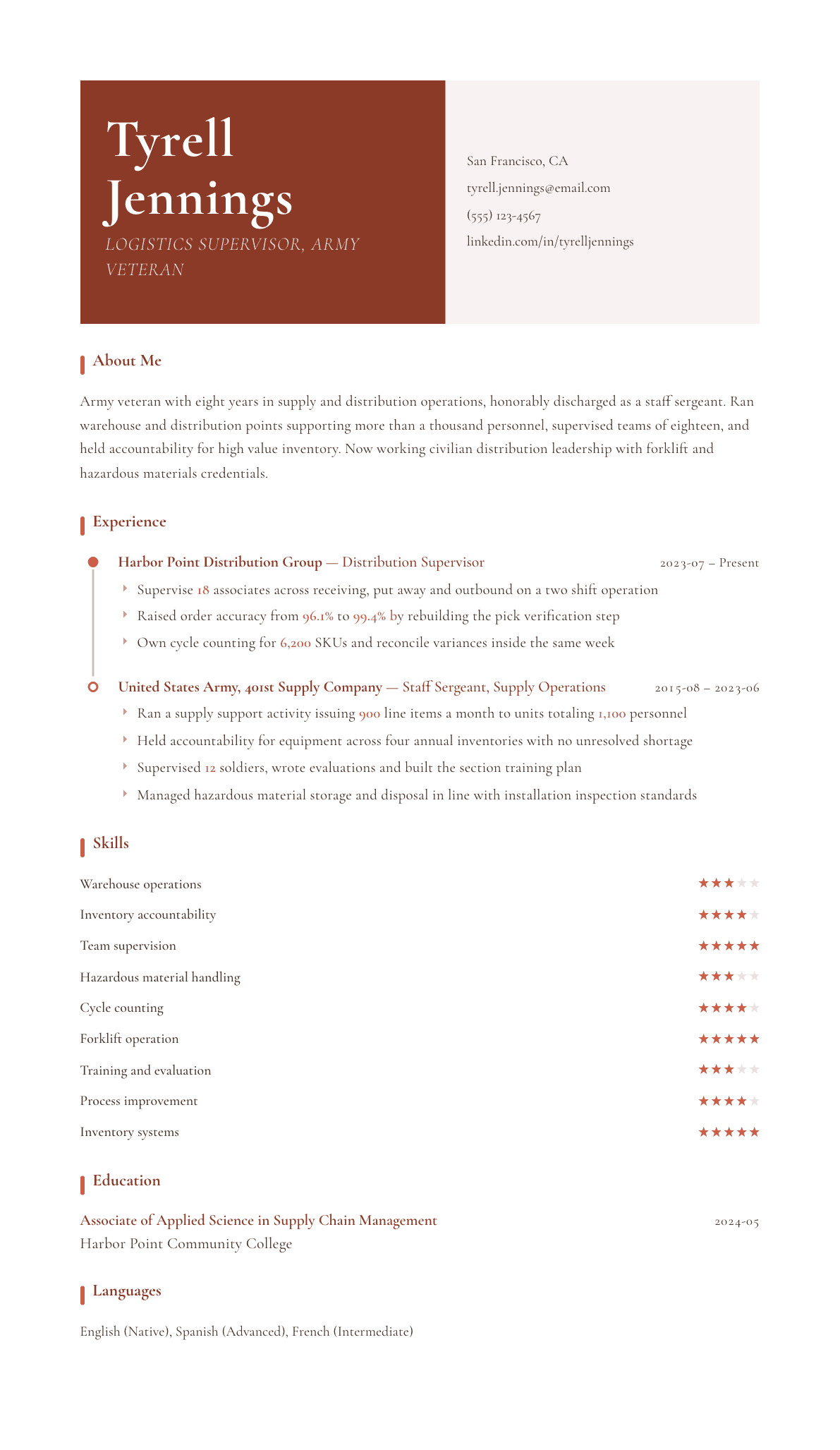
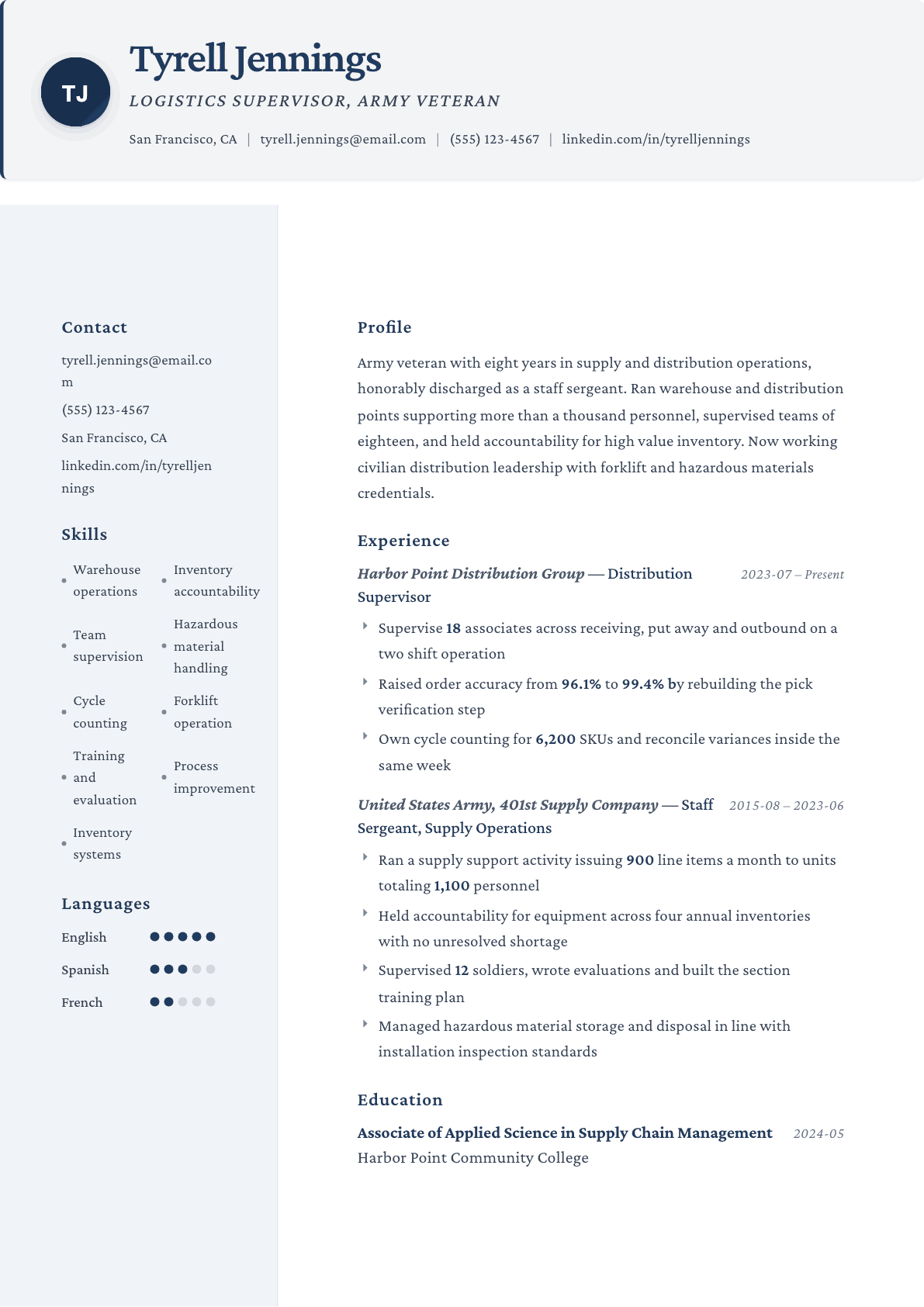
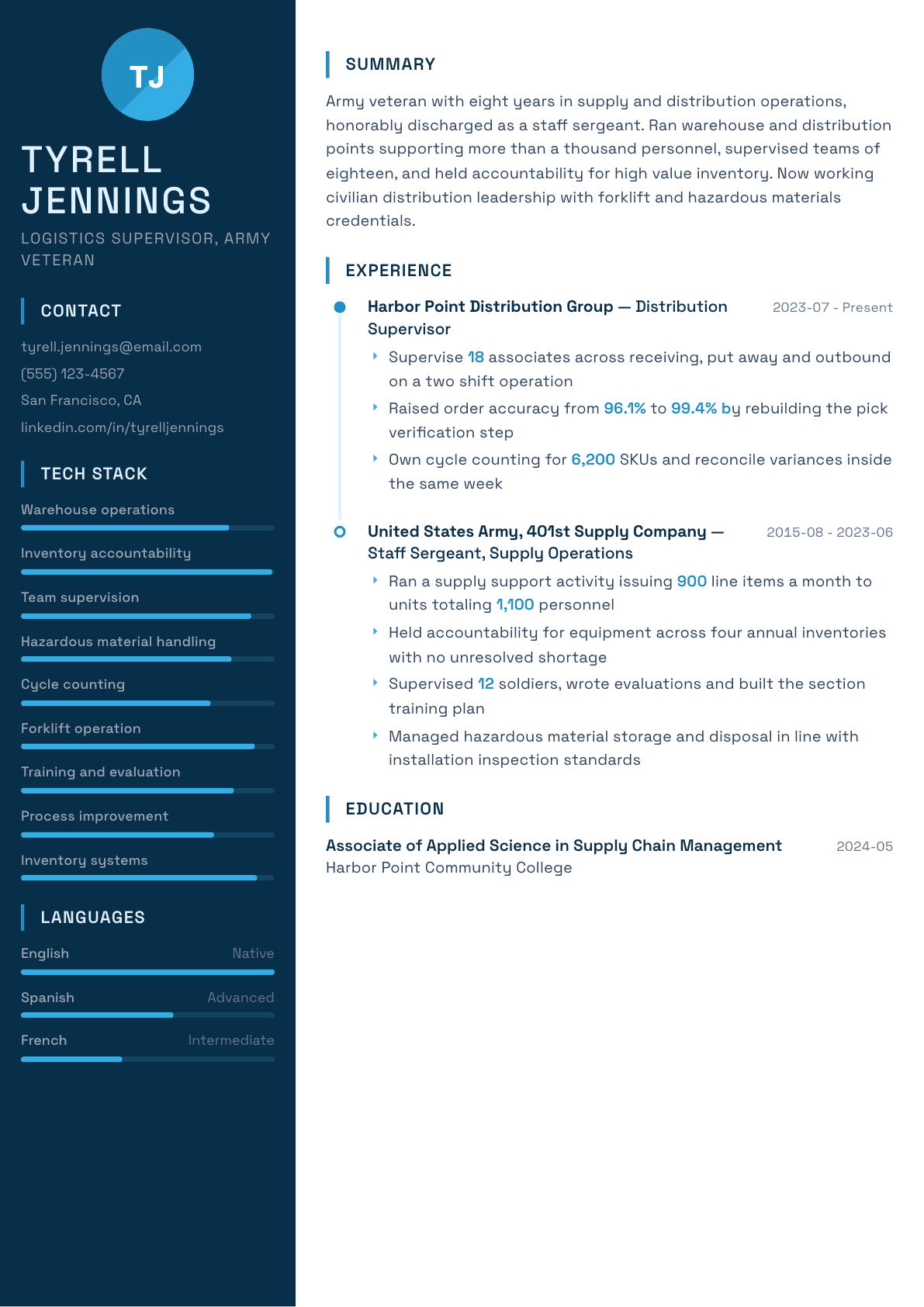
The same army veteran content laid out in three CVBooster templates, so you can see what the finished document looks like before you write a word.
Example Army Veteran summary
Army veteran and logistics supervisor with eight years in supply and distribution, honorably discharged as a staff sergeant. Ran a supply support activity issuing hundreds of line items a month to units of more than a thousand personnel, supervised twelve soldiers, and closed four inventories with no unresolved shortage. Now leads an eighteen person civilian distribution team and holds hazardous materials and forklift credentials.
Skills to list on a Army Veteran resume
- Supply and distribution operations
- Inventory accountability and reconciliation
- Team supervision and evaluation
- Warehouse management systems
- Hazardous material handling
- Forklift and material handling equipment
- Cycle counting and variance control
- Training plan development
- Process improvement
- Maintenance and readiness reporting
- Vendor and unit coordination
- Safety inspection
- Security clearance holder
- Standard operating procedure writing
- Scheduling and shift planning
What actually gets this resume read
- Put a civilian job title at the top and keep the rank as a detail inside the military experience block.
- Translate your military occupational specialty into the industry term a recruiter is already searching for.
- Convert unit strength, inventory value and vehicle counts into numbers a civilian manager understands.
- List Army schools under training with a plain sentence on the skill each one certified.
- State your discharge character once, keep the paperwork ready, and do not paste the full record onto the page.
- Add any civilian credential earned since separation, since it proves you have already made the crossing.
How to write a army veteran resume
Army veterans usually leave service with more supervisory experience than the civilian applicants they compete against, and a resume that hides it. A staff sergeant who ran a section of twelve, held accountability for a substantial equipment account and wrote annual evaluations has already done the work a warehouse or operations supervisor posting is asking for. The page has to say that in words a civilian hiring manager reads without translating.
The obstacle is that Army language is dense and internally consistent, which makes it feel clear from the inside. Specialty codes, unit numbers, evaluation phrasing and installation shorthand all mean something precise to another soldier and nothing at all to a recruiter sorting applications between meetings.
This guide covers the specific translation an Army veteran needs: turning a military occupational specialty into an industry job title, converting noncommissioned officer duties into supervisory language, handling schools, awards and the separation document, plus summaries by career stage, rewritten bullets and the questions veterans ask after the first month of applications goes quiet.
Format: industry title first, service block underneath
Put the target job title at the top and the Army experience underneath it as an ordinary employer entry. If you have already worked a civilian job since separation, that goes first and the service follows, which quietly answers the question a hiring manager has about whether you have adjusted.
One page for a single enlistment, two once you are past eight years or have civilian roles to add. Write the employer line as the branch and the unit, the position line as the civilian equivalent of what you did, and the rank as a short parenthetical. That structure lets the reader move through the page without stopping.
- Top block for an Army veteran: target job title, city and state, phone, email, clearance status if current.
- Service entry format: United States Army with the unit name as employer, civilian job title as position, rank noted after.
- Page order: summary, core skills, civilian roles, Army assignments, training and schools, education, credentials.
- Veterans applying to federal positions build the longer federal version separately, with hours per week and grade for each assignment.
Summary: your trade, your team size, your accountability
Three lines carrying the trade you practiced, your years, the size of the team you supervised and the scale of what you were accountable for. A recruiter hiring a distribution supervisor wants to see supply operations, twelve soldiers supervised and inventories closed without shortage, in that order, before she reads anything else.
End with where you are going. Naming the target function converts an interesting service record into a candidate for a specific opening, and it prevents the reader from filing you under general veteran and moving on to the next page in the stack.
Translating your specialty into an industry title
Start from the work rather than the code. A supply specialty is warehouse and inventory management. A wheeled vehicle mechanic is a diesel technician. A signal specialty is network or field support. A human resources specialty is personnel administration. Read three postings in the target field and adopt the title they use, then check that your bullets support it honestly.
Where the specialty splits across several civilian jobs, choose the one your evidence is strongest for and let the rest appear as secondary skills. Trying to present yourself as qualified for four different fields on one page produces a resume that reads as unfocused to every one of those four hiring managers.
Convert scale as you go. Unit strength becomes headcount supported, a property book becomes an inventory with a stated line item count, a motor pool becomes a fleet, an installation becomes a site. Numbers survive translation better than titles do, so keep every one you can verify.
Noncommissioned officer duties are supervisory experience
Squad leader, section sergeant and platoon sergeant time is management experience, and it should be written the way a civilian manager writes it: how many direct reports, what you scheduled, how you handled performance, what training you built, what you were held accountable for when it went wrong. Most veterans undersell this because inside the Army it is simply expected.
Include the harder parts too. Counseling a soldier back to standard, managing a section through a leadership vacancy, or rebuilding a process that had been failing inspections are exactly the situations an interviewer will probe. Naming them on the page invites the question you most want to be asked.
Schools, awards, the separation document and keywords
List Army schools under training with a plain sentence on what each certified. A leadership course becomes supervisory training with the subject matter named. Technical courses become the equipment and systems they qualified you on. Add any credential you converted or earned after separation, since it shows you have already begun the crossing.
State your discharge character in one short line and keep the separation document ready for verification, but never paste its contents onto the resume. Claim veterans preference through the federal application system rather than across the top of the page. Then match the target industry vocabulary: inventory accuracy, cycle counting, safety compliance, throughput, scheduling, standard work.
Army Veteran resume summary examples
Separating after one enlistment
Army supply specialist separating after four years, responsible for issuing equipment to a company of one hundred and twenty and maintaining an inventory without shortage. Forklift qualified, trained in hazardous material storage, and seeking a warehouse associate role with a path to supervision.
Eight years, now civilian
Army veteran and distribution supervisor with eight years in supply operations, honorably discharged as a staff sergeant. Ran a supply support activity issuing hundreds of line items a month, supervised twelve soldiers, and now leads eighteen associates across receiving, put away and outbound work.
Twenty years, senior noncommissioned officer
Senior Army noncommissioned officer with twenty years in logistics and operations, retiring as a first sergeant. Advised commanders on readiness for organizations of four hundred, managed multi site equipment accounts, and built the training program adopted across a battalion. Holds a project management credential.
Work experience bullets: before and after
Before: Served as supply sergeant for the company.
After: Ran a supply support activity issuing 900 line items a month to units totaling 1,100 personnel, managing requisition, receipt, issue and turn in.
Issue volume and supported headcount turn a title into a measurable operation.
Before: Maintained accountability for sensitive items.
After: Held accountability for equipment across four annual inventories with no unresolved shortage, reconciling every discrepancy inside the reporting cycle.
A repeated inventory cycle with a clean result proves a process rather than a claim.
Before: Supervised soldiers and wrote counseling statements.
After: Supervised 12 soldiers including scheduling, monthly performance counseling, annual evaluations and a section training plan built around inspection findings.
Written as management duties, it maps straight onto a civilian supervisor posting.
Before: Handled hazardous materials in accordance with regulations.
After: Managed hazardous material storage, labeling and disposal for the section, passing three installation inspections with no corrective actions issued.
Inspection outcomes are the civilian equivalent of a compliance track record.
Before: Improved inventory accuracy at my civilian job.
After: Raised order accuracy from 96.1% to 99.4% across a two shift operation by rebuilding the pick verification step and retraining 18 associates on it.
A before and after with the change named shows the improvement was yours.
Hard skills
- Supply and distribution operations
- Inventory accountability and reconciliation
- Warehouse management systems
- Cycle counting and variance control
- Hazardous material storage and disposal
- Forklift and material handling equipment
- Team supervision and performance evaluation
- Training plan development
- Maintenance and readiness reporting
- Safety inspection and corrective action
- Scheduling and shift planning
- Standard operating procedure writing
- Process improvement
Soft skills
- Supervising people close to your own age
- Holding a standard without losing the team
- Adapting when the plan changes at short notice
- Explaining a decision up and down the chain
- Mentoring new hires through their first months
Certifications worth listing
- OSHA 30-Hour General Industry (OSHA Outreach Training Program)
- Certified Logistics Technician (CLT) (Manufacturing Skill Standards Council)
- CompTIA Security+ (CompTIA)
- Project Management Professional (PMP) (Project Management Institute)
Mistakes that cost army veteran candidates the interview
- Leaving a military occupational specialty code on the page instead of the industry title it corresponds to.
- Underwriting noncommissioned officer time, which is the strongest supervisory evidence most veterans hold.
- Presenting yourself as qualified for four different fields on a single page.
- Listing Army schools by name with nothing explaining what each one certified you to do.
- Pasting separation document contents onto the resume rather than keeping it ready for verification.
- Writing awards as decorations a civilian cannot rank instead of naming what each was awarded for.
Army Veteran resume questions
How do I find the civilian job title for my specialty?
Work from duties rather than codes. List everything you actually did in a week, then read job postings until you find the ones describing that work, and adopt their title. Veteran career counselors and state workforce offices also run crosswalk tools that give a useful starting point.
Should I say I am a veteran on the resume itself?
Your service record makes it obvious, so a separate announcement is not needed on a private sector resume. For federal applications, claim veterans preference through the application system where it is processed correctly, and attach the documentation the announcement asks for.
How do I explain a gap between separation and my first civilian job?
State it plainly. Terminal leave, relocation, using education benefits or completing a certification are all ordinary reasons and none of them concern a hiring manager. A short line in the cover letter closes the question before anyone has to wonder about it.
Do combat deployments help or hurt a civilian application?
They help when written as assignments with responsibility and results. Give the function you performed, the team size and what you delivered under difficult conditions. Leave out graphic detail, which shifts the reader from evaluating your work to reacting to your circumstances.
Is a resume enough, or do I need something else?
For federal positions you also need the longer federal version with hours per week and grade for every assignment. For private employers, pair the resume with a short cover letter that names the target role and connects two or three Army accomplishments directly to it.
Related resume examples
- Military Resume example
- Navy Veteran Resume example
- Air Force Veteran Resume example
- Military to Civilian Resume example
- Security Guard Resume example
- Marine Corps Veteran Resume example