Military Resume Examples: free score, then the gap list
Turn Military Service Into a Resume Civilians Can Read
By Mustafa Tarabya, founder of CVBooster · Published · Updated
Military resume example, keyword list and translation guide that turns rank, unit and duty descriptions into language a civilian hiring manager scores.
Sample resumes for a military
The same military content laid out in three CVBooster templates, so you can see what the finished document looks like before you write a word.
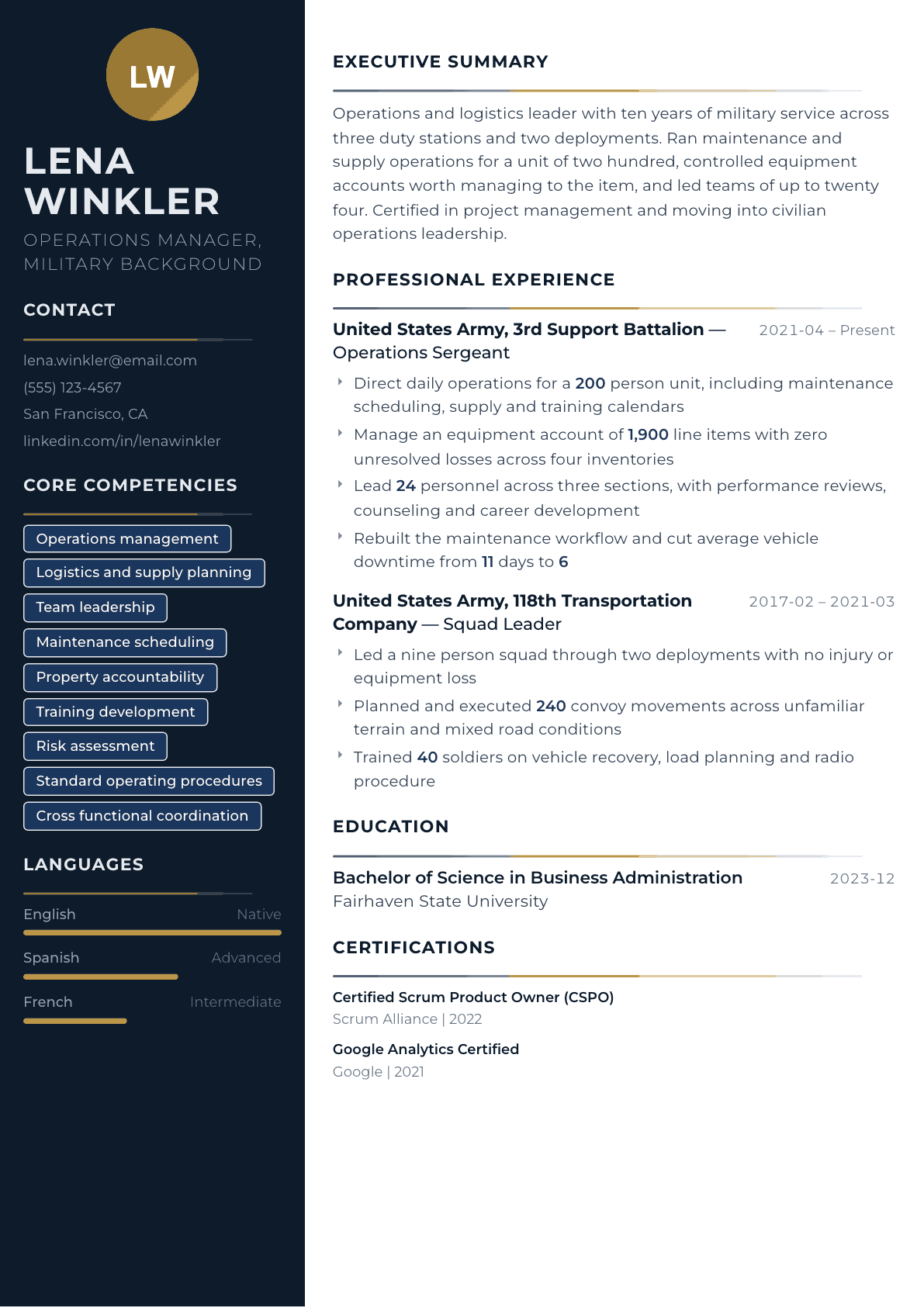
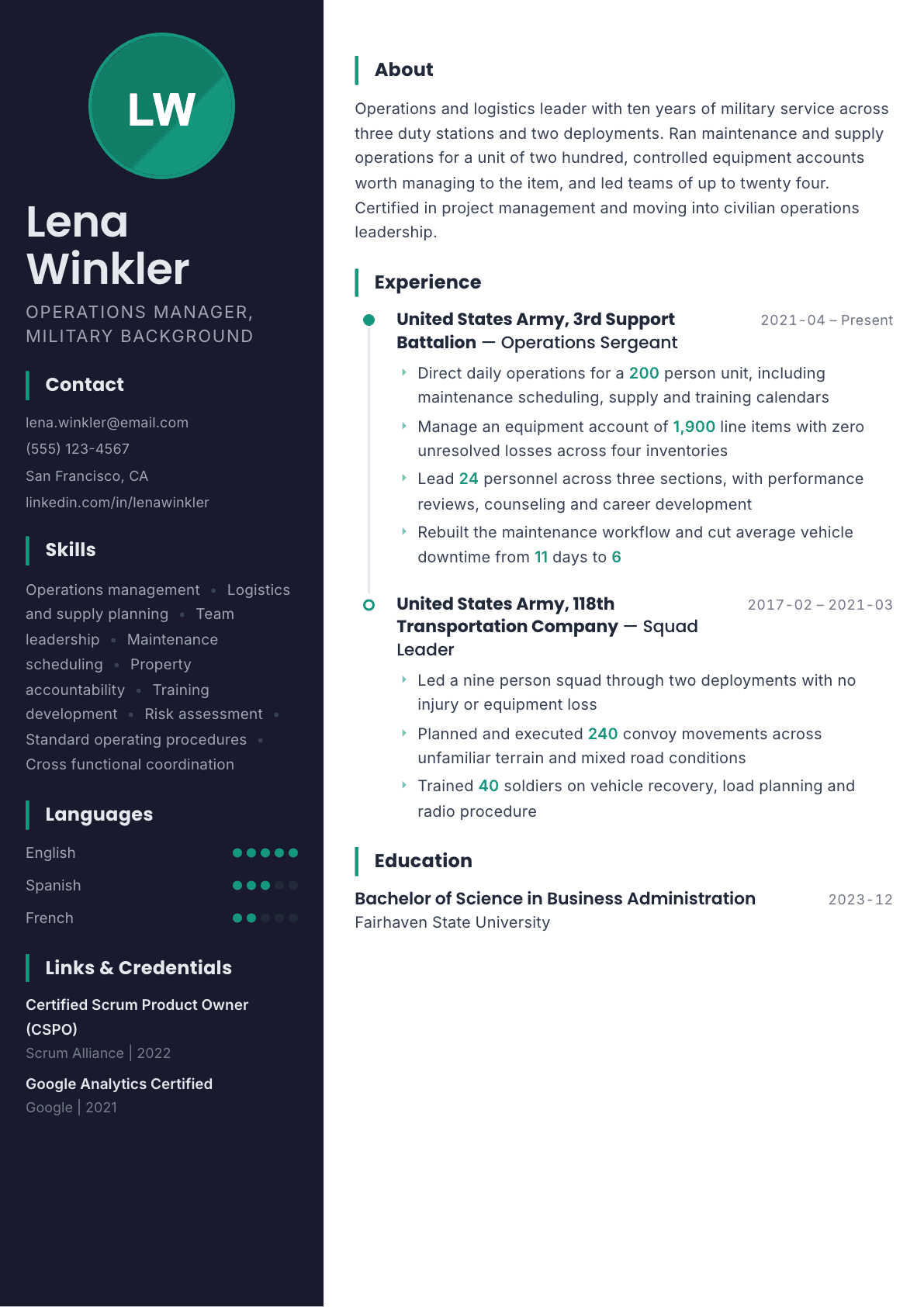
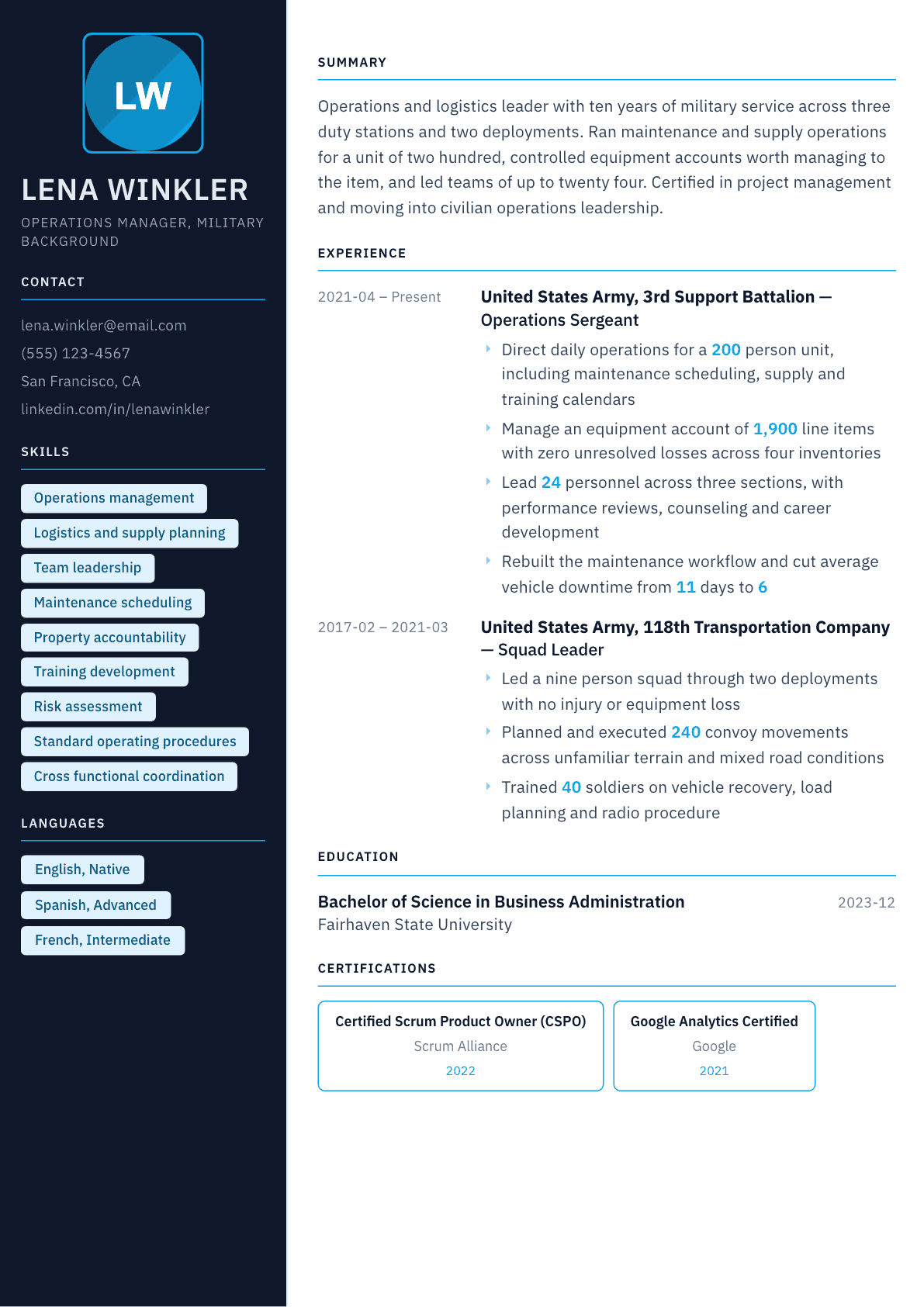
Example Military summary
Operations leader with ten years of military service running maintenance, supply and training for a two hundred person unit. Led teams of up to twenty four, controlled a large equipment account through four inventories without an unresolved loss, and cut vehicle downtime by rebuilding the maintenance workflow. Holds a project management credential and a current clearance, and is moving into civilian operations management.
Skills to list on a Military resume
- Operations management
- Logistics and supply chain planning
- Team leadership and supervision
- Property and asset accountability
- Maintenance and readiness planning
- Training program design
- Risk assessment and mitigation
- Standard operating procedure writing
- Budget and resource stewardship
- Personnel evaluation and coaching
- Emergency and contingency planning
- Briefing senior leaders
- Quality control inspection
- Security clearance holder
- Cross functional coordination
What actually gets this resume read
- Replace rank with the civilian job title that matches the work, and put the rank in parentheses after it.
- Translate unit size into headcount and budget authority into the value of what you controlled.
- Drop every acronym a civilian recruiter would not recognize, or spell it out fully on first use.
- Lead each bullet with the outcome, since military evaluations describe duties and civilian resumes reward results.
- Group your military schools under education or training and say what each one qualified you to do.
- Name your clearance and its status plainly, because it is often the single most transferable thing on the page.
How to write a military resume
A military resume fails for a reason that has nothing to do with the quality of the service behind it. The person reading it is a civilian recruiter who does not know what a unit designation means, cannot convert a rank into a level of responsibility, and has thirty seconds to decide whether you belong in the interview pile. Every acronym you leave on the page spends part of those thirty seconds.
The service member usually knows this and overcorrects, stripping the record down until it reads like a stranger wrote it. What actually works is translation, not deletion. The headcount you led, the equipment value you controlled, the training you built and the crisis you managed all have civilian equivalents, and those equivalents are frequently stronger than what the other applicants can show.
This guide walks through that translation: how to choose the civilian job title, how to convert unit language into business language, how to write military schools and clearance, three summaries by career stage, rewritten bullets, and the questions service members ask in the months before separation.
Format: civilian title at the top, service as context
Lead with the civilian job title you are applying for, not your rank. Operations Manager, Logistics Supervisor, Security Coordinator, Maintenance Lead: the title tells the recruiter which pile you belong in, and the rank then appears inside the experience block where it belongs as context.
Keep it to one page under about eight years of service and two pages after that. Group each duty assignment as a job, with the branch and unit as the employer line, your civilian equivalent title as the position, and the rank noted afterward. Do not build a separate military section that walls your entire career off from the rest of the page.
- Top line for a transitioning service member: civilian target title, city and state, phone, email, clearance status.
- Each assignment reads as branch and unit for the employer, civilian equivalent title for the position, rank in parentheses.
- Order the page as summary, core competencies, assignments, training and military schools, education, awards.
- Service members with a specific industry target add a short block naming the certifications they hold for it.
Summary: what you ran, how many, what it was worth
Three lines built from four facts: years of service, the function you ran, the size of the team you led, and the scale of what you were accountable for. A recruiter can place a candidate who managed maintenance and supply for two hundred people. She cannot place one who served with distinction in a demanding environment.
Say what you are moving toward in the last line. Transition candidates who name the target function read as intentional, while those who describe themselves as seeking to apply military skills in a challenging civilian role read as undecided, and undecided candidates lose to specific ones every time.
Translation: rank, unit and acronyms into civilian language
Work through the page and replace each military term with what it means. A platoon of thirty becomes a team of thirty. A property book becomes an asset account with a stated value. A field training exercise becomes a large scale operational readiness event you planned and executed. Keep the specifics, drop the vocabulary that only makes sense inside the gate.
Acronyms are the fastest way to lose a reader. If a term is not common outside the service, either spell it out fully or replace it with the civilian equivalent. The exceptions are credentials the civilian world already recognizes, and even those are worth writing in full the first time so nobody has to guess.
Military evaluations describe duties because that is what the form asks for. Civilian resumes reward results, so each bullet needs to end somewhere: a rate that improved, a loss that did not happen, a timeline that was met, a team that qualified. Bring the outcome forward and let the duty description support it.
Schools, clearance and what the paperwork proves
Group military schools under training and add one plain sentence to each explaining what it qualified you to do. A leadership course becomes management training with the team size and subject matter attached. A technical school becomes the equipment and systems it certified you on. Recruiters cannot rank courses they do not recognize, so tell them what each one bought.
Clearance is often the single most marketable line on a transition resume, particularly for defense contractors. State the level and whether it is current. Keep your separation document handy for verification, and state your discharge character once, without pasting the record itself anywhere on the page.
Keywords, awards and where the numbers come from
Match the vocabulary of the industry you are entering. Operations postings want scheduling, throughput, capacity, standard operating procedures and continuous improvement. Safety roles want risk assessment, inspection, incident investigation and compliance. Read three postings in your target field and use their words for work you genuinely did.
Awards need translation as well. Rather than listing decorations a civilian cannot rank, write the reason: recognized for rebuilding a maintenance workflow, selected as the senior noncommissioned officer of the quarter across a battalion of four hundred. And pull your numbers from evaluations and unit records before you separate, because they are much harder to reconstruct afterward.
Military resume summary examples
First enlistment, separating soon
Communications specialist completing four years of service, responsible for radio and network equipment supporting a company of one hundred. Trained twelve junior personnel, maintained an equipment account without loss, and is moving into a field technician role with an active clearance.
Ten years, moving to operations
Operations and logistics leader with ten years of service across three duty stations and two deployments. Directs maintenance, supply and training for a unit of two hundred, leads twenty four personnel across three sections, and rebuilt a maintenance workflow that cut average vehicle downtime by nearly half.
Twenty years, senior leader
Senior military leader with twenty years managing operations, personnel and readiness for organizations of up to six hundred. Built training programs adopted across a brigade, advised commanders on resource allocation, and holds a project management credential and a current top secret clearance.
Work experience bullets: before and after
Before: Served as platoon sergeant responsible for soldiers and equipment.
After: Led 24 personnel across three sections, owning scheduling, performance reviews, career development and an equipment account of 1,900 line items.
Headcount, functions and asset scale give a recruiter something she can compare.
Before: Maintained 100% accountability of all assigned property.
After: Managed an equipment account through four annual inventories with zero unresolved losses, reconciling discrepancies inside the same reporting cycle.
The inventory cycle and the resolution habit show a process, not a slogan.
Before: Conducted training for unit personnel as required.
After: Built and delivered a quarterly training program for 40 personnel covering vehicle recovery, load planning and radio procedure, with qualification tracked to completion.
Curriculum, audience size and tracked completion translate directly to civilian training roles.
Before: Improved unit maintenance operations.
After: Rebuilt the maintenance workflow by resequencing parts ordering ahead of inspection, cutting average vehicle downtime from 11 days to 6 across a year.
A named change with a before and after is the shape a hiring manager already reads.
Before: Completed two deployments with no incidents.
After: Planned and executed 240 convoy movements across two deployments with no injuries and no equipment losses, coordinating routes, communications and recovery support.
Operation count with the planning functions shows logistics work, not just presence.
Hard skills
- Operations and readiness management
- Logistics and supply planning
- Property and asset accountability
- Maintenance scheduling and reporting
- Training program design and delivery
- Risk assessment and mitigation
- Standard operating procedure writing
- Budget and resource stewardship
- Personnel evaluation and development
- Contingency and emergency planning
- Quality control inspection
- Briefing senior decision makers
- Security clearance held
Soft skills
- Leading people who did not choose their team
- Decision making with incomplete information
- Composure during a real emergency
- Coaching underperformers back to standard
- Working across ranks and organizations
Certifications worth listing
- Project Management Professional (PMP) (Project Management Institute)
- CompTIA Security+ (CompTIA)
- Certified Six Sigma Green Belt (CSSGB) (American Society for Quality)
- OSHA 30-Hour General Industry (OSHA Outreach Training Program)
Mistakes that cost military candidates the interview
- Leading with rank instead of the civilian job title the posting is written for.
- Leaving acronyms and unit designations on the page for a reader who has never seen them.
- Copying evaluation language, which describes duties where a civilian resume rewards outcomes.
- Erasing the service entirely out of fear it reads as unrelated, which throws away the leadership evidence.
- Listing decorations without saying what each one was awarded for.
- Separating without collecting the numbers from evaluations and unit records that your bullets will need.
Military resume questions
Should I put my rank on a civilian resume?
Yes, but inside the experience block rather than at the top. Lead with the civilian equivalent title so a recruiter can place you, then note the rank so the record is accurate. Anyone familiar with the service will read it correctly, and anyone unfamiliar will not be blocked.
How do I write deployments without sounding either dramatic or vague?
Treat a deployment as an assignment with a mission, a team and results. Name the function you performed, the scale, and what you delivered. Skip combat detail unless the role is directly related, and never include anything that is still restricted.
What do I do about a military occupational specialty with no civilian equivalent?
Break it into components. Almost every specialty contains scheduling, equipment accountability, training, documentation, safety and supervision. Build the resume from those components and target roles where they add up, rather than searching for a single perfect translation.
When should I start writing my transition resume?
About a year before separation, mainly so you can gather the numbers while you still have access to evaluations, inventory records and training rosters. Reconstructing headcounts and equipment values from memory afterward produces vaguer bullets and slower applications.
Is it worth mentioning my clearance if I am leaving defense work?
Yes. It is objective evidence that you passed a thorough background investigation and have been trusted with sensitive information. Even outside defense, employers in finance, healthcare and critical infrastructure read a current clearance as a screening result they did not have to pay for.
Related resume examples
- Army Veteran Resume example
- Navy Veteran Resume example
- Military to Civilian Resume example
- Security Guard Resume example
- Military Officer Resume example
- Military Intelligence Analyst Resume example