Navy Veteran Resume Examples: free ATS score and gap list
Write a Navy Veteran Resume That Translates Shipboard Work
By Mustafa Tarabya, founder of CVBooster · Published · Updated
Navy veteran resume example, civilian keyword list and a guide to turning watch standing, ratings and maintenance work into language employers score.
Sample resumes for a navy veteran
The same navy veteran content laid out in three CVBooster templates, so you can see what the finished document looks like before you write a word.
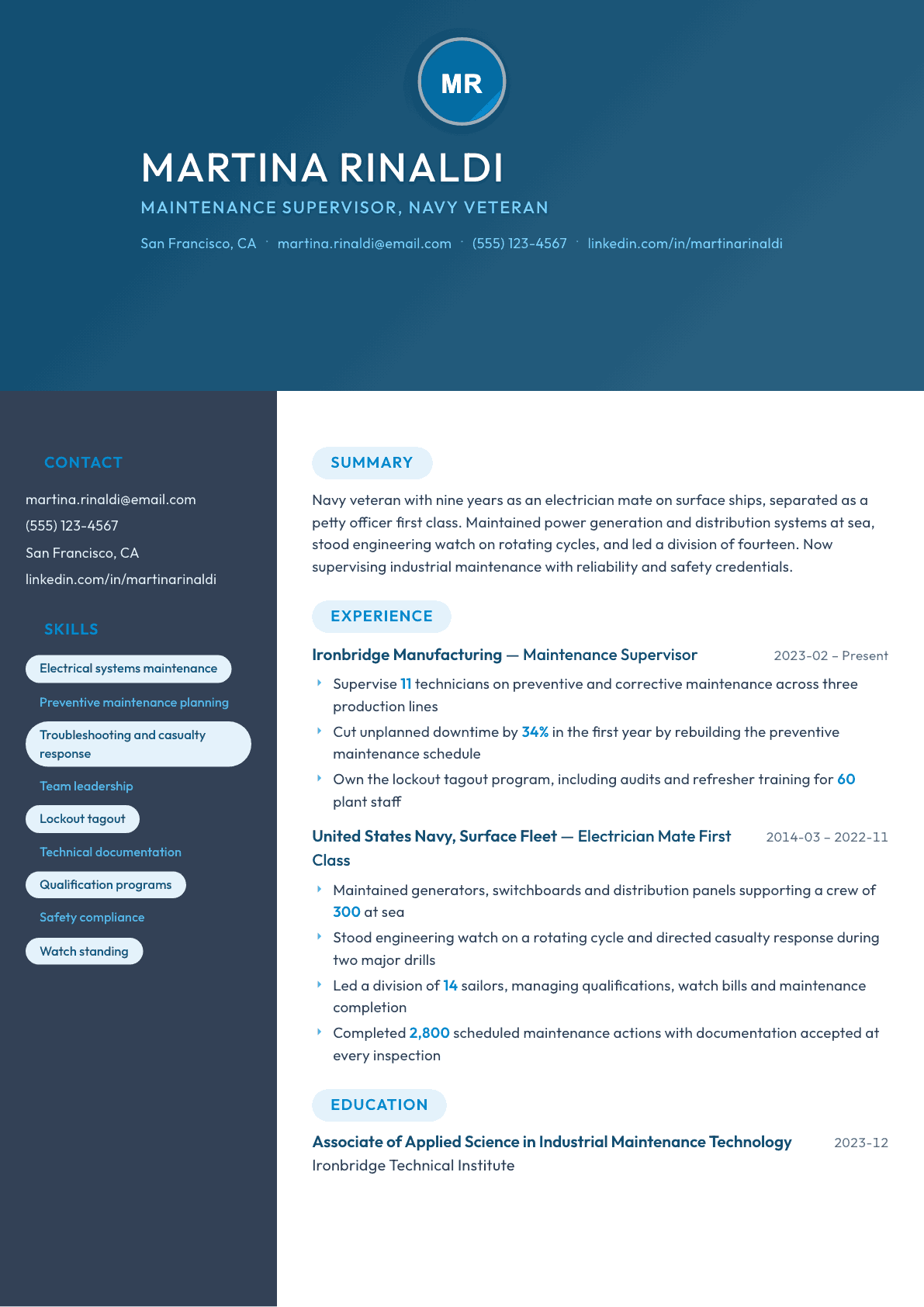
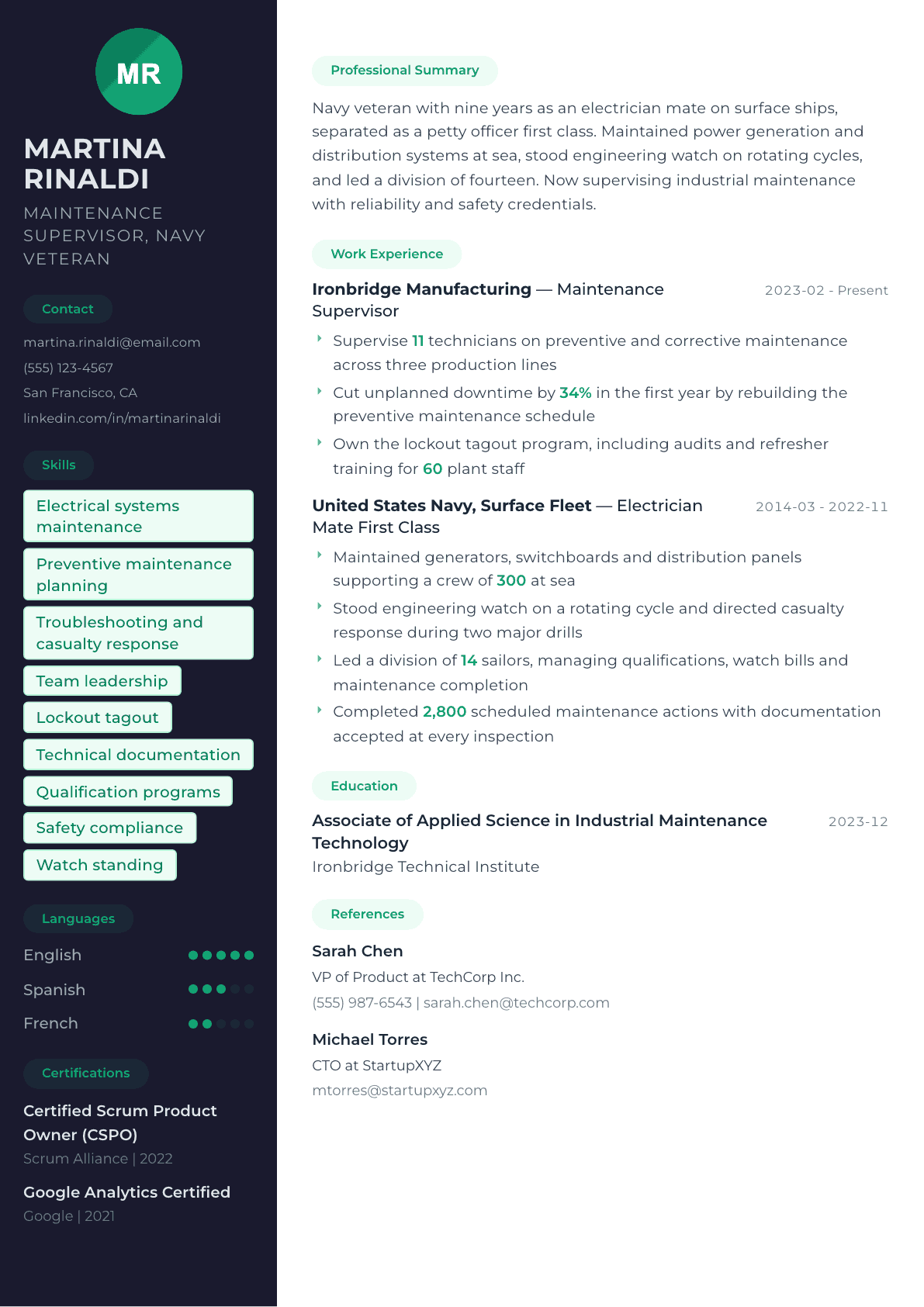
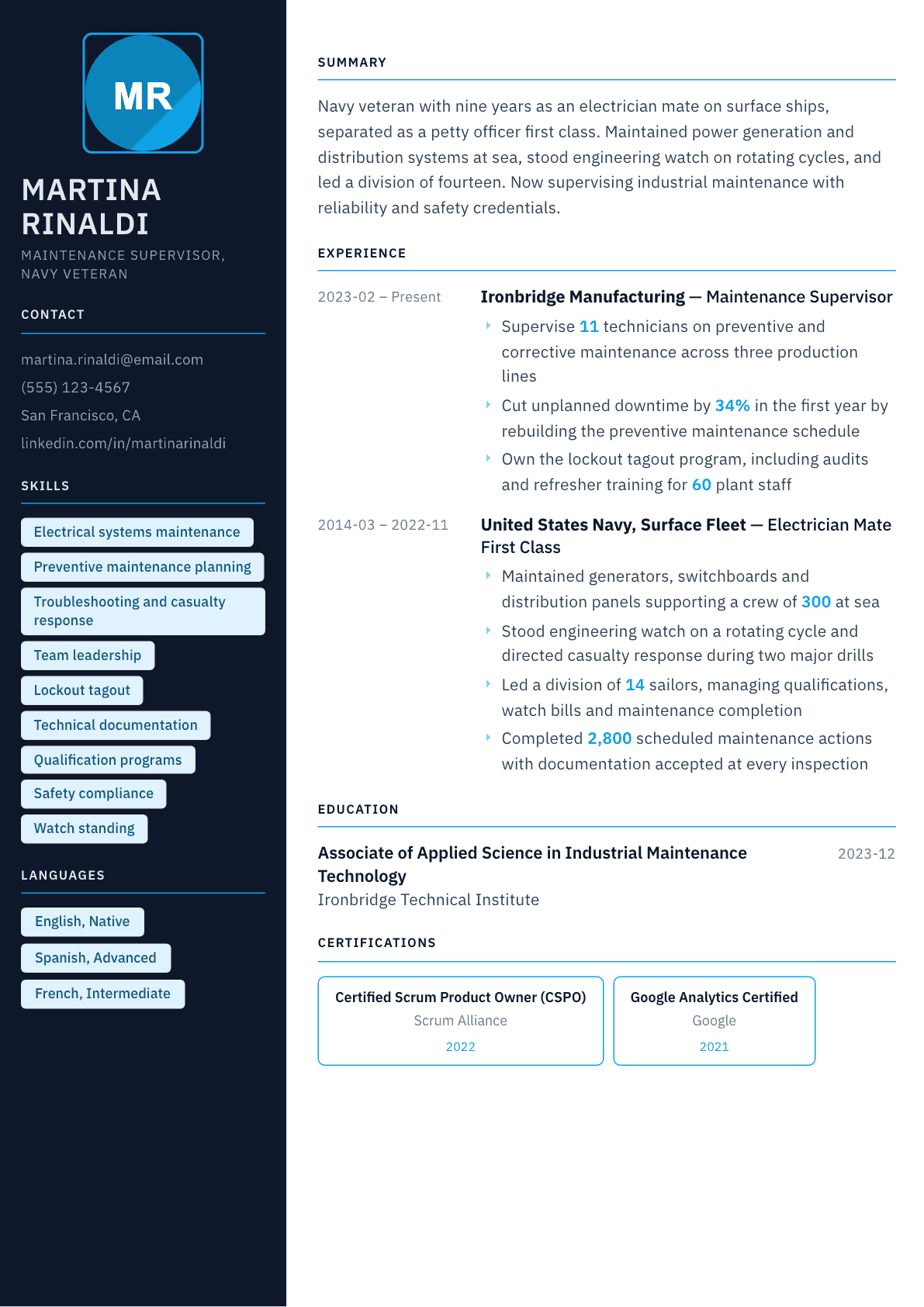
Example Navy Veteran summary
Navy veteran and maintenance supervisor with nine years as a shipboard electrician mate, separated as a petty officer first class. Maintained power generation and distribution for a crew of three hundred, stood engineering watch, and led a division of fourteen through qualification and maintenance completion. Now supervises eleven civilian technicians and owns the plant lockout tagout program.
Skills to list on a Navy Veteran resume
- Electrical power generation and distribution
- Preventive and corrective maintenance
- Troubleshooting and root cause analysis
- Casualty and emergency response
- Watch standing and shift leadership
- Qualification and training programs
- Lockout tagout and safety compliance
- Technical documentation and maintenance records
- Inspection readiness
- Team leadership and mentoring
- Parts and material planning
- Reliability improvement
- Confined space and shipboard safety
- Security clearance holder
- Cross rate coordination
What actually gets this resume read
- Translate your rating into the civilian trade title first, and keep the rate abbreviation out of the header.
- Explain watch standing as shift responsibility with authority, staffing and escalation, not as a Navy ritual.
- Turn crew size, plant capacity and maintenance actions into the numbers a plant manager already tracks.
- Name the qualifications you earned aboard and what each one authorized you to operate or supervise.
- Show inspection and audit results, since they are the closest Navy equivalent to civilian quality metrics.
- Keep sea duty and shore duty visible as separate assignments so your career progression reads clearly.
How to write a navy veteran resume
Navy experience translates unusually well and gets described unusually badly. A sailor who maintained power generation aboard a ship has worked on equipment more demanding than most industrial plants, under conditions where a failure cannot be handed to the next shift or an outside contractor. Plant managers value exactly that, and they will never guess it from a resume built out of rates, hull numbers and command names.
The confusion starts with vocabulary. A rating is a trade, a watch is a shift with authority, a casualty is an equipment failure, a qualification is a documented competency sign off, and sea duty is a rotation. Each of those words means something a civilian employer already understands, but only after somebody performs the swap.
This guide handles that swap for Navy veterans: turning a rating into a trade title, writing watch standing as shift leadership, presenting maintenance volume and inspection results, plus three summaries by career stage, rewritten bullets and the questions sailors ask while working through a transition class.
Format: trade title first, sea and shore as separate jobs
Open with the civilian trade title you are targeting: maintenance supervisor, electrical technician, reliability planner, operations coordinator. Then list your assignments as separate positions rather than compressing an entire enlistment into one block, because sea duty and shore duty involve genuinely different work and a single entry hides your progression.
Write the employer as the branch with the command type described in plain words. A civilian reader gets more from surface fleet, submarine force, aviation squadron or shore maintenance activity than from a hull number, and none of the useful information is lost in the substitution.
- Top line for a Navy veteran: target trade title, city and state, phone, email, clearance status if current.
- Assignment entries name the command type in plain words rather than by hull number or acronym.
- Page order: summary, technical skills, civilian roles, Navy assignments, qualifications, schools, education.
- Veterans with a maritime target keep credential numbers and endorsement details ready for verification.
Summary: trade, systems, crew size, years at sea
Three lines with the trade you practiced, the systems you owned, the size of the division you led and the scale of the platform you served on. Maintaining distribution for a crew of three hundred at sea is a specific claim that a plant manager can size, and it lands far better than a general statement about technical proficiency.
Close with the target. Sailors leaving with a technical rating have several plausible landing places, from industrial maintenance to field service to facilities, and naming one turns a broad record into an application. The rest of your background stays available as supporting skills.
Watch standing is shift leadership, so write it that way
A watch is a shift with defined authority, a turnover procedure, escalation rules and responsibility for equipment that keeps running whether or not you are tired. Describe it in those terms: the rotation you stood, the systems under your control, the decisions you were authorized to make alone, and who you woke up when the situation exceeded that authority.
Casualty response is the strongest part of this story. Loss of power, flooding, fire and equipment failures at sea are handled by the people aboard using a rehearsed procedure. Write what you were responsible for during those events and what the outcome was, because industrial employers deal with the same category of problem and rarely find candidates who have practiced it.
Maintenance volume, qualifications and inspections
Give maintenance work as numbers. Scheduled maintenance actions completed, systems maintained, average time to restore equipment, and the documentation standard you held. Navy maintenance is heavily documented, and a veteran who can show volume with clean records is describing exactly the discipline a reliability program is built on.
Qualifications are the Navy version of a competency matrix. Say what each one authorized you to operate or supervise, and note if you served as a qualification signer for others, since that is a training and assessment role in civilian terms. Add inspection and assessment results, which are the closest available equivalent to an audit history.
Credentials, keywords and the industries that hire
Several Navy trades map onto credentials worth naming: transportation worker identification for port and maritime work, security credentials for technical fields, reliability and maintenance certifications for industrial roles. List the ones you hold and the ones you are studying toward, since employers reading a transition resume want evidence of momentum.
Then match the vocabulary of the target industry. Manufacturing wants preventive maintenance, downtime, root cause, lockout tagout and reliability. Utilities want switching, distribution, outage response and compliance. Maritime wants engineering watch, propulsion and port state inspection. Use the words the posting uses, attached to work you genuinely performed aboard.
Navy Veteran resume summary examples
Separating after first enlistment
Navy electrician mate separating after four years aboard a surface ship, maintaining lighting, distribution panels and auxiliary equipment. Completed several hundred documented maintenance actions, earned engineering watch qualification, and is seeking an industrial electrician role with an active clearance.
Nine years, now in industry
Navy veteran and maintenance supervisor with nine years as a shipboard electrician mate, separated as a petty officer first class. Maintained power generation for a crew of three hundred, led a division of fourteen, and now supervises eleven technicians while owning a plant lockout tagout program.
Twenty years, chief petty officer
Retired chief petty officer with twenty years in shipboard engineering, managing departments of forty and readiness across multiple deployments. Led inspection preparation with repeatedly clean results, ran the qualification program for an engineering department, and now works reliability planning in heavy manufacturing.
Work experience bullets: before and after
Before: Maintained electrical equipment aboard ship.
After: Maintained generators, switchboards and distribution panels supporting a crew of 300 at sea, including load management during extended underway periods.
Naming the systems and the population served gives the work a scale employers recognize.
Before: Stood engineering watch as assigned.
After: Stood engineering watch on a rotating cycle with authority over plant lineup and casualty response, conducting formal turnover at each relief.
Written as shift authority with a handover procedure, it reads as supervision.
Before: Responded to equipment casualties.
After: Directed casualty response during two major drills and three actual equipment failures at sea, restoring power to affected systems without external support.
Real failures resolved by the crew aboard is the detail industrial employers value most.
Before: Completed preventive maintenance on schedule.
After: Completed 2,800 scheduled maintenance actions across an enlistment with documentation accepted at every inspection and assessment cycle.
Volume plus a clean documentation record maps directly onto reliability program work.
Before: Supervised junior sailors in my division.
After: Led a division of 14 sailors, managing watch bills, qualification progress and maintenance completion, and signed off competency qualifications for nine of them.
Qualification sign off authority is a training and assessment role a civilian reader can rank.
Hard skills
- Electrical power generation and distribution
- Preventive and corrective maintenance
- Troubleshooting and root cause analysis
- Casualty and emergency response
- Watch standing and shift turnover
- Qualification and competency programs
- Lockout tagout and energy control
- Maintenance records and documentation
- Inspection and assessment readiness
- Parts and material planning
- Confined space and shipboard safety
- Technical drawing and schematic reading
- Reliability improvement
Soft skills
- Working long hours in a confined environment
- Handing over cleanly to the next shift
- Staying methodical during an active failure
- Teaching a trade to someone with no background in it
- Living with a team you cannot walk away from
Certifications worth listing
- Transportation Worker Identification Credential (TWIC) (Transportation Security Administration)
- Certified Maintenance and Reliability Technician (CMRT) (Society for Maintenance and Reliability Professionals)
- CompTIA Security+ (CompTIA)
- OSHA 30-Hour General Industry (OSHA Outreach Training Program)
Mistakes that cost navy veteran candidates the interview
- Using hull numbers and command acronyms where a plain description of the platform would inform the reader.
- Compressing sea duty and shore duty into one entry, which erases the progression across an enlistment.
- Describing watch standing as a duty rotation rather than as shift authority with escalation rules.
- Leaving out maintenance volume and documentation results, the numbers reliability employers actually track.
- Listing qualifications by name without saying what each authorized you to operate or supervise.
- Ignoring maritime credentials that a port, shipyard or offshore employer treats as a hiring gate.
Navy Veteran resume questions
How do I turn my rating into a civilian job title?
Describe the equipment you maintained and the tasks you performed weekly, then find postings that match and use their titles. An electrician mate usually maps to industrial electrician or maintenance technician, while machinist mate work maps to mechanical maintenance and plant operations.
Does shipboard experience count for shore based industrial jobs?
It counts heavily, because shipboard maintenance happens without outside contractors, spare parts on demand or the option to defer. Employers value that self sufficiency once you explain the constraint you worked under rather than assuming the reader already understands it.
Should I list every qualification I earned aboard?
List the ones that map to civilian competencies, particularly watch qualifications, equipment operation and any qualification signer role you held. Skip the internal ones with no outside meaning, and add one plain sentence explaining what each retained qualification authorized.
How do I present multiple deployments on a resume?
Fold them into the assignment they belong to rather than listing each separately. Note the number of deployments, the total underway time and the responsibility you carried during them. Employers read sustained operational periods as evidence of reliability under pressure.
What industries hire Navy technical veterans most readily?
Manufacturing maintenance, utilities and power generation, shipyards and marine repair, offshore energy, facilities engineering and defense contracting. Each one values a different half of the record, so keep the technical detail constant and adjust the vocabulary to the posting in front of you.
Related resume examples
- Military Resume example
- Army Veteran Resume example
- Air Force Veteran Resume example
- Military to Civilian Resume example
- Coast Guard Resume example
- Safety Officer Resume example