Military to Civilian Resume Examples: what gets the call
Build a Military to Civilian Resume That Reads Clearly
By Mustafa Tarabya, founder of CVBooster · Published · Updated
Military to civilian resume example, plain-language translation of duties and a keyword list for the first job after separation.
Sample resumes for a military to civilian
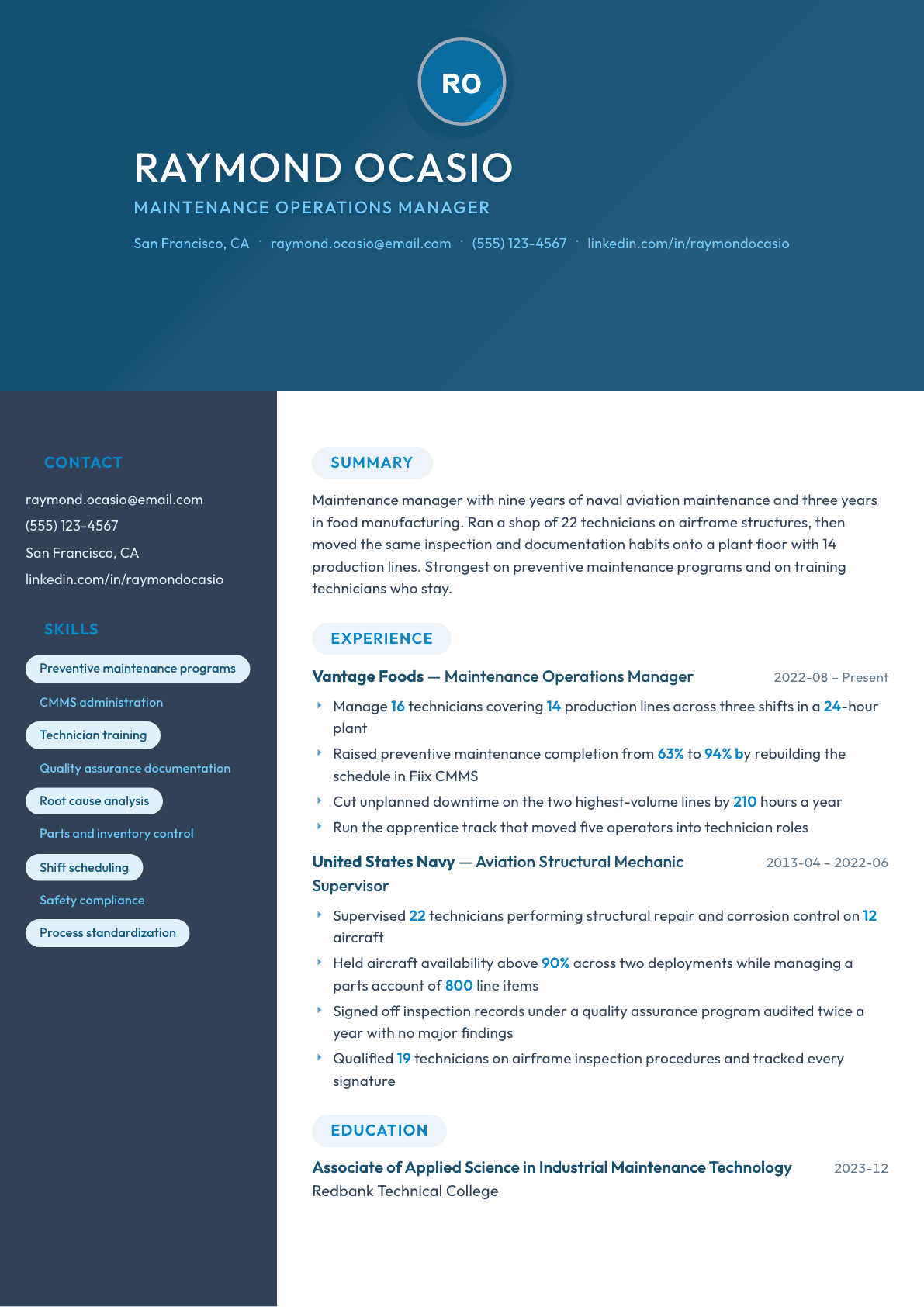
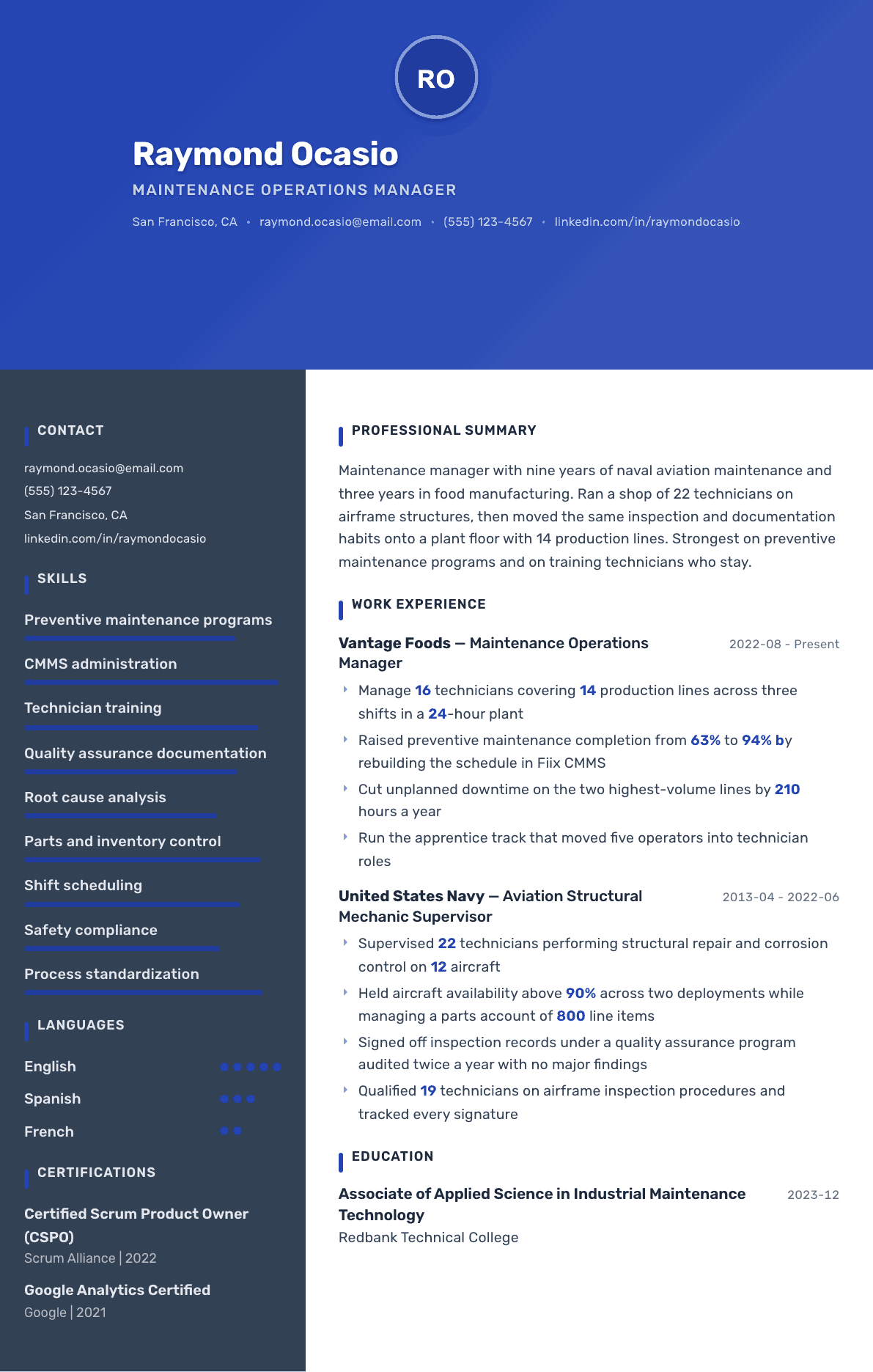
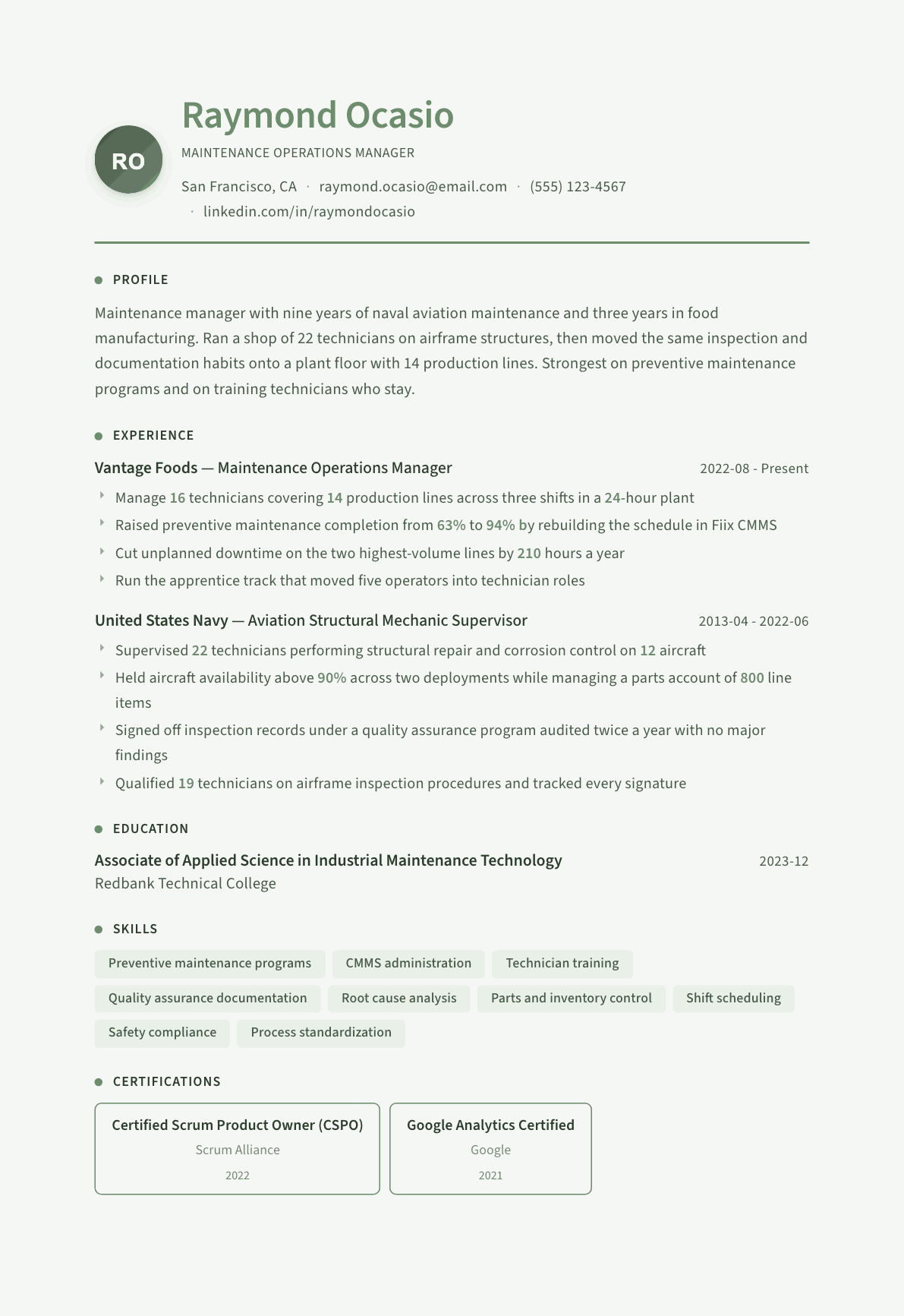
The same military to civilian content laid out in three CVBooster templates, so you can see what the finished document looks like before you write a word.
Example Military to Civilian summary
Maintenance operations manager with nine years of naval aviation maintenance leadership and three years in a 24-hour food plant. Supervised 22 technicians and held aircraft availability above 90%, then rebuilt a plant preventive maintenance schedule and moved completion from 63% to 94%. Trains technicians who stay, documents to audit standard, and reads a CMMS as fluently as a maintenance record. Seeking a plant maintenance manager position.
Skills to list on a Military to Civilian resume
- Operations and maintenance management
- Team leadership
- Standard operating procedures
- Preventive maintenance planning
- Quality documentation
- Inventory and parts control
- Training and qualification
- Safety and compliance
- Root cause analysis
- Scheduling and shift coverage
- Continuous improvement
- Vendor coordination
- Technical writing
- Budget tracking
What actually gets this resume read
- Write the resume in the language of the job posting, then check that a reader with no service background follows every line.
- Give each military job a civilian title on the first line and keep the official title on the line beneath it.
- Turn awards and evaluations into outcomes: what improved, by how much, and over what period of time.
- Delete unit nicknames, weapon system nicknames and installation names that carry no meaning for a hiring manager.
- Use the same measure the civilian industry uses, such as uptime, completion rate or cost per unit, not readiness rates from the service.
- Add a short line explaining your separation date and current availability so a recruiter does not have to ask.
- Keep one clearance line and one certifications block near the top rather than scattering credentials through the jobs.
How to write a military to civilian resume
A military to civilian resume has one job: make a stranger who has never worn a uniform understand what you can do for their business by the end of the first third of page one. Everything else on the page is support. If the reader has to translate anything, you have handed them work, and work is what makes a resume get set aside.
The trap is that most transition advice stops at swapping vocabulary. Changing personnel to staff does not help if the bullet still describes a duty position instead of a result. What actually moves an application forward is choosing a target job, borrowing that job's language from real postings, and then proving each requirement with something you genuinely did in service.
This guide covers how to choose the target before you write, how to rebuild each service assignment in civilian structure, how to handle clearance, credentials and separation dates, and what to say when a recruiter asks why you think a maintenance chief can run a plant floor.
Pick the target job before writing a single bullet
Open three current postings for the role you want and copy their requirement lists into one document. You will see the same eight or nine phrases repeat: supervise a shift, maintain compliance records, manage vendor relationships, drive continuous improvement. Those repeats are the resume outline. Your service history is the evidence.
A general resume that could suit logistics, security or facilities suits none of them. If you genuinely want two different tracks, write two versions and keep them in separate files. The work is smaller than it sounds because only the summary, the competencies row and about a third of the bullets change.
- Build a requirement to evidence table before drafting: left column the posting phrase, right column the assignment that proves it.
- Set the file name and the title line to the exact job title in the posting so both the reader and the parser see a match.
- Drop anything from your service history that does not support the target, no matter how proud of it you are.
- Keep one general version for career fairs and veteran recruiters, and treat it as a starting point rather than a submission.
Rebuild each assignment in civilian structure
A civilian job entry has four parts: an employer, a title, a scope line and results. Military assignments have the same four parts hidden in different places. The branch is the employer, the billet is the title, the unit size and equipment account is the scope, and the results are sitting in your evaluations waiting to be reclaimed.
Write the scope line first because it prevents vague bullets. Supervised 16 technicians across three shifts maintaining 14 production lines is a scope line. Once it exists, the bullets underneath can concentrate on what changed rather than on what you were responsible for.
Then convert measures. Readiness becomes uptime or availability. Sensitive item accountability becomes asset control. Sick call throughput becomes patient volume. Qualification rates become training completion. Every branch measures things obsessively, and almost every measure has a commercial twin.
Language: what to cut and what to keep
Cut installation names, unit designations, weapon and platform nicknames, doctrinal terms and every acronym that is not also a civilian acronym. Keep the ones a recruiter searches: the branch name written out, your occupational code once, clearance level, and any credential name in its official form.
Watch the tone as well as the words. Service writing is compressed and impersonal, which on a civilian page can read as cold or as a duty list. Write full sentences with an active verb, an object and an outcome, and let one or two bullets show judgment rather than execution.
Two words to avoid entirely: warfighter and combat as adjectives for skills you are selling to a commercial employer. They narrow you in the reader's mind at exactly the moment you want to look broad.
Clearance, credentials and the separation timeline
State your clearance level, whether it is active, and the year of the last investigation only if you are targeting government or defense work. In commercial hiring it is a small credibility signal at best and can read as a mismatch, so it belongs in the credentials block rather than the summary.
Credentials earned in service are worth more than most transitioning members assume. Instructor courses, hazardous material handling, quality assurance qualifications, equipment operator licenses and anything funded by tuition assistance all show a civilian reader that you already hold recognized standards, not just internal ones.
Give your availability plainly. A line saying available from a specific month, or currently on terminal leave, answers the first question a recruiter has and prevents your application from sitting while they guess. If you finished a degree during service, put the completion date next to it so the timing makes sense.
The bridge paragraph that answers the obvious doubt
Every hiring manager reading a transition resume has the same silent question: will this person adapt to how we work. Answer it once, in the summary, by naming the civilian context you have already operated in. A joint assignment with contractors, a partnership with a local agency, a college program finished at night, a civilian certification passed on the first attempt.
Do not answer it with adaptability claims. Saying you adapt quickly is the least convincing sentence available. Saying you spent two years coordinating daily with three contractor maintenance teams does the same work and cannot be doubted.
Military to Civilian resume summary examples
Four years, first civilian application
Navy veteran with four years in aviation maintenance, performing structural repair and corrosion control on a 12-aircraft flight line and documenting every inspection under a quality program audited twice a year. Completing an industrial maintenance associate degree. Seeking a maintenance technician role in food or packaging manufacturing.
Nine years, two years civilian
Maintenance operations manager with nine years of naval aviation maintenance leadership and three years running a plant maintenance department. Supervised 22 technicians at above 90% aircraft availability, then rebuilt a preventive maintenance schedule in a 24-hour plant and moved completion from 63% to 94%.
Twenty years, department head track
Retired senior chief with twenty years across maintenance, quality assurance and training leadership, including a department of 90 personnel and the command quality program. Now directing maintenance and reliability for two manufacturing sites, owning the capital request cycle and a technician apprenticeship track.
Work experience bullets: before and after
Before: Responsible for the maintenance and upkeep of assigned aircraft and equipment.
After: Supervised 22 technicians performing structural repair and corrosion control on 12 aircraft, holding availability above 90% across two deployments.
The team size, the asset count and an availability figure give a plant manager three things to compare against their own numbers.
Before: Ensured all maintenance documentation was completed in accordance with regulations.
After: Signed off inspection records under a quality assurance program audited twice a year, closing both audit cycles with no major findings.
Compliance work becomes verifiable when the audit frequency and the outcome are on the page.
Before: Trained junior personnel on maintenance procedures and safety practices.
After: Qualified 19 technicians on airframe inspection procedures, tracking each signature and requalification date so no technician worked outside their current certification.
A qualification count plus the control mechanism reads as a training system rather than an informal duty.
Before: Managed parts and supplies for the maintenance department.
After: Controlled a parts account of 800 line items, cutting stockouts on high-use consumables by moving reorder points onto actual consumption rather than fixed quantities.
It names the inventory decision that produced the improvement, which is the part a supply chain interviewer will probe.
Before: Worked closely with civilian contractors on the flight line.
After: Coordinated daily with three contractor maintenance teams on shared work packages, resolving scheduling conflicts before they reached the production meeting.
It quietly proves civilian workplace experience, which is the doubt a transition resume most needs to close.
Hard skills
- Operations and maintenance supervision
- Preventive maintenance planning
- Quality assurance documentation
- Inventory and parts control
- Safety and regulatory compliance
- Training and qualification management
- Standard operating procedure development
- Root cause analysis
- Shift scheduling and coverage
- Vendor and contractor coordination
- Computerized maintenance management systems
- Continuous improvement methods
Soft skills
- Explaining technical work to people outside the trade
- Building credibility with a team that did not serve
- Taking direction from a manager younger than you
- Working without the structure a unit provides
- Asking for help early instead of absorbing the problem
Certifications worth listing
- Certified Maintenance and Reliability Technician (CMRT) (Society for Maintenance and Reliability Professionals)
- OSHA 30-Hour General Industry (OSHA Training Institute)
- Project Management Professional (PMP) (Project Management Institute)
Mistakes that cost military to civilian candidates the interview
- Writing one resume for every industry and letting the reader work out which parts apply to them.
- Swapping vocabulary while leaving the bullets as duty descriptions with no outcome attached.
- Leaving the branch abbreviated so keyword searches for the full branch name never match.
- Putting clearance at the top of an application to a commercial employer who cannot use it.
- Skipping the availability date and leaving a recruiter to guess when you can actually start.
- Selling adaptability as a trait instead of pointing at the civilian environments you already worked in.
Military to Civilian resume questions
How far back should a transition resume go?
Cover your whole service if it fits in two pages, but give recent assignments most of the space and compress early ones to a title, dates and a single line. A first tour from a decade ago rarely changes a hiring decision.
Should I use a functional or skills-based format?
No. Functional formats hide dates, and recruiters read that as concealment even when it is not. Reverse chronological with a strong summary and a competencies row gives you the same emphasis on skills without triggering suspicion.
Do I explain my military occupational code on the resume?
Include it once in parentheses beside the job title so veteran recruiters and defense contractors can search it, then never use it again. The civilian equivalent title carries the rest of the page for readers who do not know the code.
What do I do about a gap after separation?
Name it in one neutral line: a degree program, a certification course, a move, a caregiving period or a deliberate reset. Gaps only become a problem when they are unexplained, and a single factual sentence closes the question before an interview.
Is it worth applying through veteran hiring programs?
Yes, and tailor for them separately. Those programs read service history fluently and often want more military detail, not less, so a version with the occupational code, unit type and clearance stated fully will perform better there than your commercial version.
Related resume examples
- Security Guard Resume example
- Federal Resume example
- Veteran Resume example
- Marine Corps Veteran Resume example
- Military Officer Resume example
- Military Resume example