Marine Corps Veteran Resume Examples: what gets the call
Turn Your Marine Corps Record Into a Civilian Resume
By Mustafa Tarabya, founder of CVBooster · Published · Updated
Marine Corps veteran resume example, MOS translation guidance and keyword list for moving from the fleet into civilian operations jobs.
Sample resumes for a marine corps veteran
The same marine corps veteran content laid out in three CVBooster templates, so you can see what the finished document looks like before you write a word.
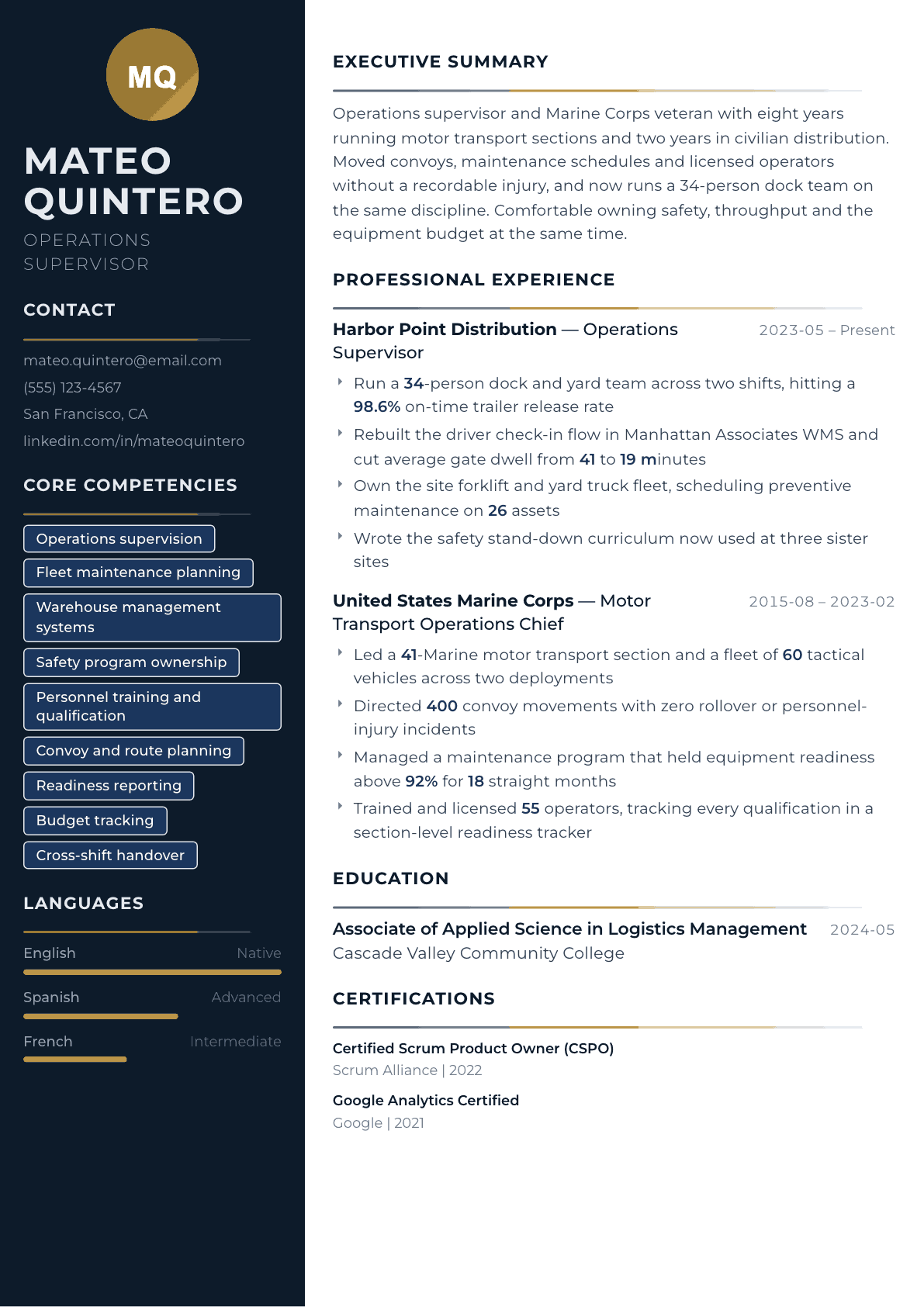
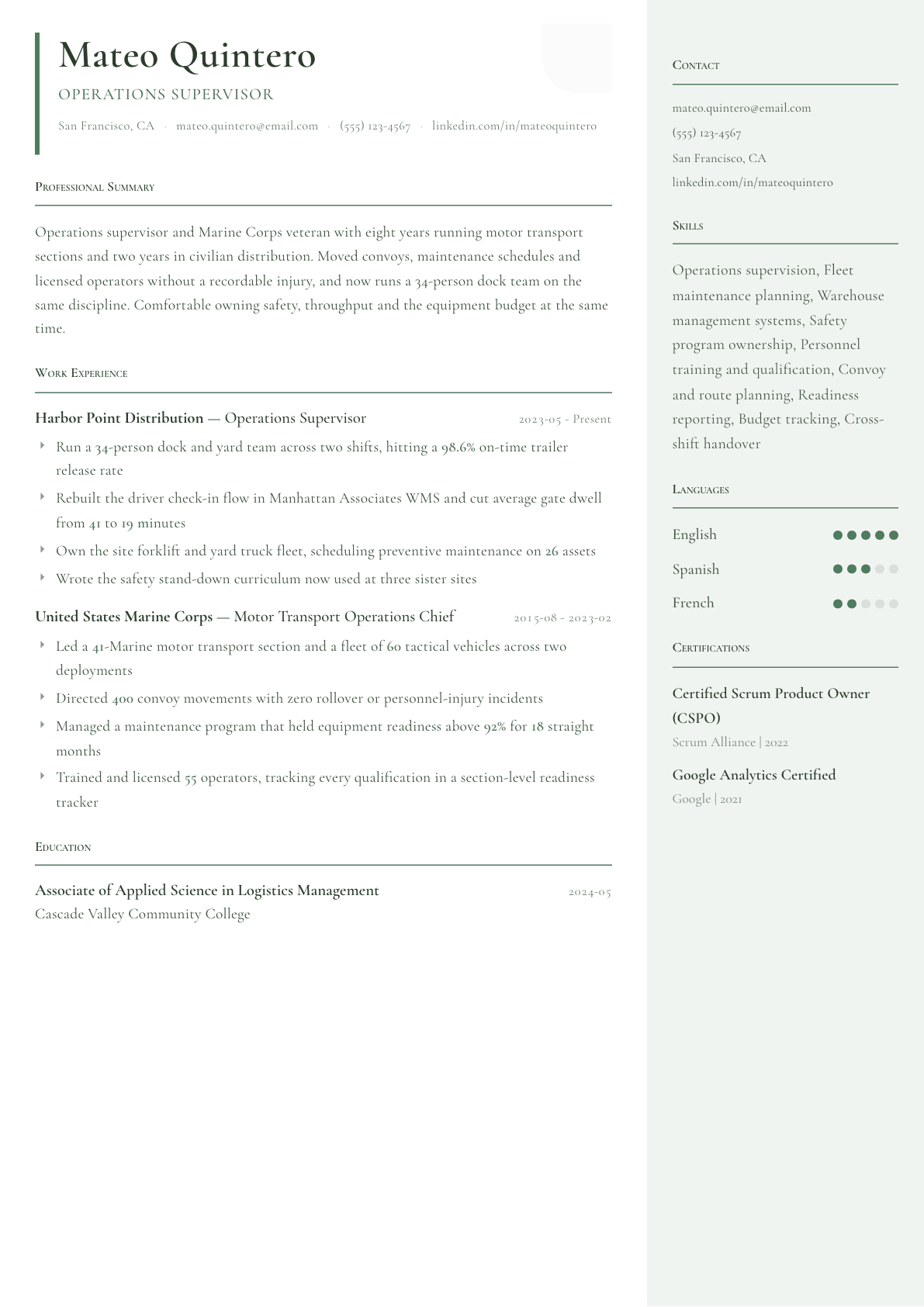
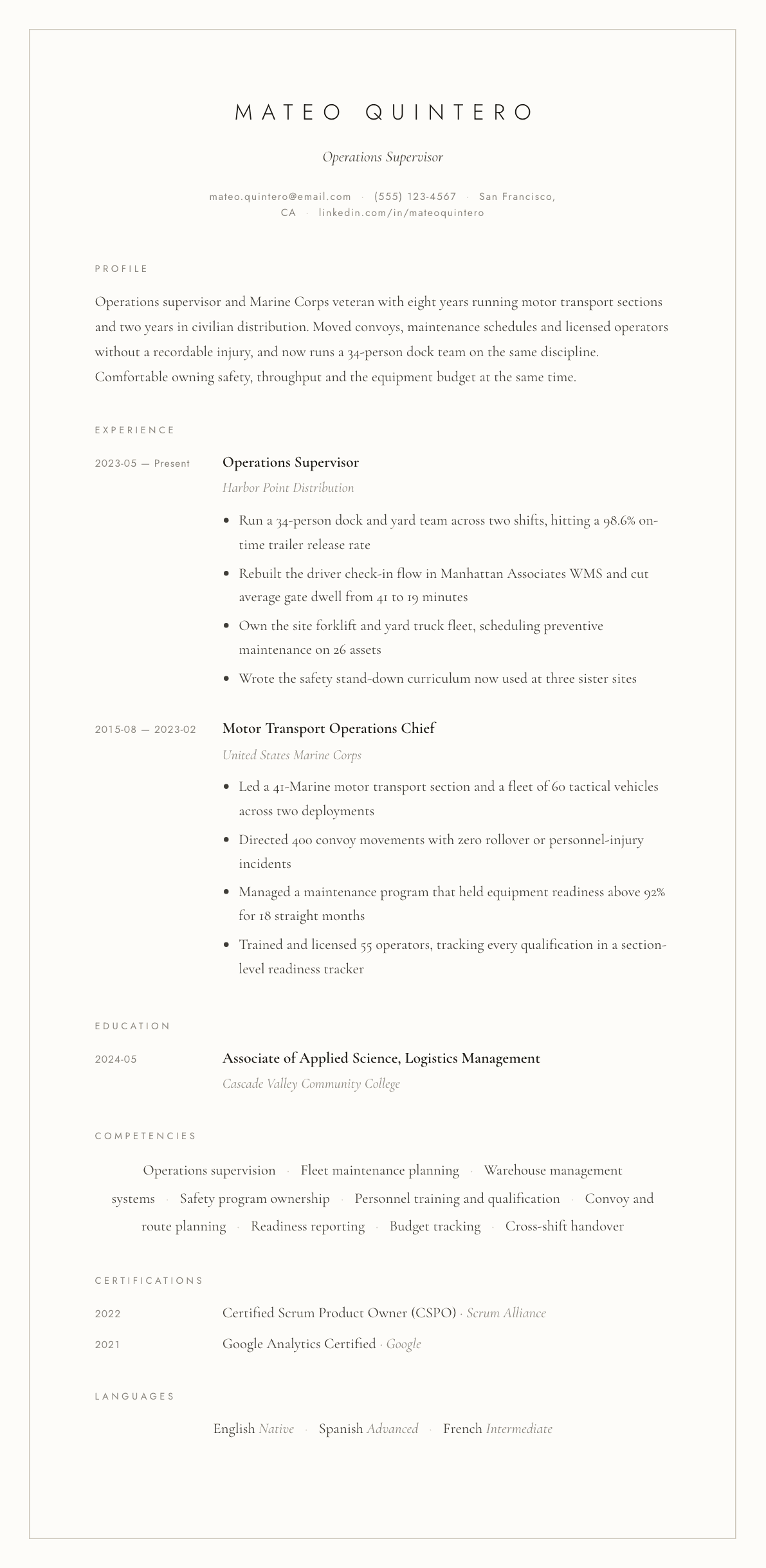
Example Marine Corps Veteran summary
Marine Corps veteran with eight years leading motor transport sections and two years supervising civilian distribution operations. Ran a 41-Marine section and a 60-vehicle fleet at above 92% readiness, then carried that discipline into a 34-person dock team with a 98.6% on-time release rate. Holds an associate degree in logistics management and a current forklift trainer qualification. Looking for a site operations manager seat.
Skills to list on a Marine Corps Veteran resume
- Operations supervision
- Logistics and distribution
- Fleet and equipment management
- Preventive maintenance scheduling
- Safety and risk management
- Team leadership
- Training and qualification programs
- Inventory accountability
- Standard operating procedure writing
- Warehouse management systems
- Continuous process improvement
- Budget and cost control
- Incident investigation
- Cross-functional coordination
- Security clearance handling
What actually gets this resume read
- Translate your MOS into the civilian job title first, then keep the MOS code in parentheses for veteran recruiters.
- Replace rank with a plain leadership line such as team lead or section supervisor, then give the headcount you led.
- Name the equipment fleet you owned by size and type, because that is how a civilian operations manager sizes your scope.
- Convert readiness rates, injury records and inspection results into the same numbers a private employer already tracks.
- Cut every acronym a hiring manager outside the service cannot decode, and spell out the two or three worth keeping.
- Put your security clearance level and status on the resume when the target job is with a defense contractor.
- List the civilian certifications you earned with tuition assistance, since they prove you can work outside the uniform.
How to write a marine corps veteran resume
The hardest part of a Marine Corps veteran resume is not the writing. It is accepting that the person reading it has no idea what a section chief does, what a readiness rate means, or why holding full inventory accuracy on a sensitive item account is remarkable. That reader is a civilian operations manager with a stack of applications and about twenty seconds for each one.
So the job of the page is translation, and translation is not the same as softening. You do not turn a motor transport chief into a generic supervisor. You say what you owned: how many people, how many vehicles, how much equipment by count, what uptime you held, and what happened when you were the one who signed for it. Marine Corps experience survives translation better than most because it is so heavily documented.
This guide covers the format that gets past an applicant tracking system, how to convert a military occupational specialty into a title a recruiter searches for, what to do with rank and awards, and the questions Marines ask when they are three months from an end of active service date.
Format: civilian title on top, service history underneath
Use reverse chronological order, one page if you served a single enlistment, two pages if you have a career of service plus civilian work. Put the civilian job title you are applying for directly under your name. A screener who sees Operations Supervisor followed by a Marine Corps employer understands the whole page in one beat, where a page headed Sergeant makes them work.
Each military position gets two lines of heading: the civilian equivalent title first, then the official billet in smaller emphasis. Motor Transport Operations Chief becomes Fleet Operations Supervisor with the real billet named underneath. Nothing is hidden and nothing has to be decoded.
- Contact block: name, target civilian title, city and state, phone, email, and clearance level when the job is defense work.
- Order the page as summary, core competencies, professional experience with the Marine Corps listed as an employer, education, certifications.
- Write United States Marine Corps in full as the employer name so keyword search finds it.
- One line per deployment inside the job, not a separate section, unless the target job is overseas operations.
Translating the MOS without hollowing it out
Start from the civilian job posting, not from your service record. Read three postings for the role you want, list the verbs and nouns they use, then find the places in your service where you did that work. A supply Marine has been doing inventory control, cycle counting and vendor coordination for years, but only the posting tells you which of those three words to lead with.
Keep the MOS code in parentheses once, near the job title. Veteran recruiters and defense contractors search by code, and it costs you nothing. Everything else should be plain language: sensitive items become high-value assets, a warning order becomes a project kickoff, and a company level standard operating procedure becomes a documented process.
Resist the urge to inflate. Turning a section leader into a director of operations reads as a stretch and falls apart in the first interview question about budget authority. Scope stated honestly is more convincing than a title borrowed upward.
Experience: the numbers a Marine already has
Marine Corps work generates measurable outcomes constantly, and most transitioning Marines throw them away. Equipment readiness rates, inventory accuracy, qualification counts, mishap-free days, convoy movements completed, personnel trained and promoted, and the dollar-free but precise count of end items you signed for all belong on the page.
Write three to five bullets per position. The first should establish scope, the middle ones should show the technical or leadership work only you did, and the last should carry an outcome that a civilian recognizes. Uptime, on-time completion, injury record, audit results and training throughput all translate cleanly.
Delete the lines that describe the Marine Corps rather than describing you. Maintained good order and discipline, performed additional duties as assigned, and demonstrated leadership under pressure are on tens of thousands of pages and separate none of them.
Rank, awards, and what to leave off
Rank belongs in one place, usually a single parenthetical in the summary or the final line of the service block. It is context, not a title. A civilian manager cannot rank order a staff sergeant against a gunnery sergeant and will not try.
Awards are the same. A Navy and Marine Corps Achievement Medal earned for rebuilding a maintenance program is worth one line if you write the reason, not the ribbon. Meritorious masts, letters of appreciation and a long ribbon list belong in the interview, if anywhere.
Leave off unit nicknames, installation names that mean nothing outside the fence line, weapon system designations, and every acronym that would send a reader to a search engine. Each one you keep costs you attention you needed for the next bullet.
Certifications, clearance and the education you already earned
Marines finish more credentials than they realize. Forklift and heavy equipment licenses, hazardous material handling, instructor courses, corporals course and staff noncommissioned officer academy, and anything completed through tuition assistance all count. Group them where a screener can check them against the posting rather than burying them inside a job.
If you hold a clearance, state the level, whether it is active, and the date of the last investigation. Defense employers filter on that line before they read anything else, and an expired clearance stated plainly is still worth more than an unexplained silence.
For skills that map to a common civilian test, name the standard: an operator license against a specific equipment class, a maintenance program against the manufacturer schedule, a safety program against the federal standard it followed. Specificity is what makes a translated bullet credible.
Marine Corps Veteran resume summary examples
First enlistment, separating soon
Marine Corps veteran with four years in supply administration, managing a warehouse account of 1,800 line items at 99% inventory accuracy and processing 300 requisitions a month. Forklift qualified and trained on two inventory systems. Separating in March and seeking a warehouse or inventory control associate role.
Eight years, first civilian job done
Operations supervisor with eight years of Marine Corps motor transport leadership and two years in civilian distribution. Led a 41-Marine section and a 60-vehicle fleet above 92% readiness, then took a 34-person dock team to a 98.6% on-time release rate. Associate degree in logistics management.
Career Marine into management
Retired Marine Corps master sergeant with twenty years across maintenance and logistics leadership, including a battalion maintenance program covering 300 end items and a staff role writing sustainment plans for four subordinate units. Now managing a regional service center of 60 technicians across three sites.
Work experience bullets: before and after
Before: Served as motor transport operations chief responsible for section personnel and equipment.
After: Led a 41-Marine motor transport section and a 60-vehicle fleet, holding equipment readiness above 92% for 18 consecutive months across two deployments.
Headcount, fleet size, a readiness figure and a duration turn a billet description into a scope statement.
Before: Conducted convoy operations in support of unit missions.
After: Planned and directed 400 convoy movements with zero rollovers and no personnel injuries, including route reconnaissance, vehicle load planning and driver rest cycles.
The volume, the safety record and the named planning tasks are all things a civilian transportation manager measures.
Before: Responsible for training junior Marines.
After: Trained and licensed 55 vehicle operators, tracking every qualification and renewal date in a section readiness roster reviewed monthly by the company gunnery sergeant.
Training becomes a system with a number and a review cadence instead of a general responsibility.
Before: Maintained accountability of sensitive items and unit gear.
After: Signed for an equipment account of 340 line items and closed eight consecutive quarterly inventories at full accuracy with no lost or damaged high-value assets.
Property accountability is one of the strongest civilian translations a Marine has, and it only works with counts.
Before: Improved the maintenance program in the section.
After: Rebuilt the preventive maintenance schedule around manufacturer service intervals, cutting deadlined vehicles from 11 to 3 and shortening average repair turnaround by six days.
Naming the change, the before number and the after number gives a hiring manager something they can question and verify.
Hard skills
- Operations supervision
- Fleet and equipment management
- Preventive maintenance planning
- Property and inventory accountability
- Logistics and distribution
- Safety program administration
- Training and qualification tracking
- Standard operating procedure writing
- Readiness and status reporting
- Warehouse management systems
- Convoy and route planning
- Quality inspection
Soft skills
- Leading people who did not choose you
- Making decisions with incomplete information
- Holding a standard without becoming the reason people leave
- Briefing up and translating down
- Staying calm when the plan changes at the last minute
Certifications worth listing
- Certified Logistics Associate (Manufacturing Skill Standards Council)
- OSHA 30-Hour General Industry (OSHA Training Institute)
- CompTIA Security+ (CompTIA)
Mistakes that cost marine corps veteran candidates the interview
- Leading the page with rank so a civilian screener has to work out the job before they can judge the fit.
- Keeping acronyms that were normal in the fleet and are unreadable to everyone outside it.
- Listing every award and ribbon instead of the one that came with a result worth explaining.
- Describing duties in doctrine language when the civilian posting already supplies the vocabulary to use.
- Dropping the numbers, which is the one thing Marine Corps documentation hands you for free.
- Applying to a job with no bridge sentence explaining why an infantry background fits a warehouse operation.
Marine Corps Veteran resume questions
Should I put United States Marine Corps as the employer?
Yes, written in full. Veteran hiring programs and applicant tracking systems search on the branch name, and a civilian reader needs the employer line to make sense of the job titles beneath it. Add the installation only when it helps explain the size of the operation.
How do I handle multiple duty stations and billets?
Treat the Marine Corps as one employer with several positions listed under it in reverse order, the same way you would show promotions inside a company. That keeps the page short and shows progression without making it look like you changed jobs every two years.
Do I need a civilian degree before applying?
Not for most operations, logistics, maintenance and security roles, where experience and certifications carry more weight. If you are studying, list the program, the school and the expected completion date so a recruiter sees momentum rather than a blank education section.
What if all my experience is combat arms?
Write it as leadership, planning, training and equipment management, because that is what it actually was. Then add a bridge line naming the civilian field you are targeting and any certification you have earned toward it, so the reader does not have to invent the connection.
Should I mention my discharge characterization?
No. Discharge type belongs on the DD Form 214, not the resume. Give your dates of service and separation month, and keep the page focused on what you did. If a background process raises it later, answer it directly then.
Related resume examples
- Security Guard Resume example
- Bodyguard Resume example
- Veteran Resume example
- Military to Civilian Resume example
- Infantry Resume example
- Coast Guard Resume example