Air Force Veteran Resume Examples: the lines they read
Write an Air Force Veteran Resume Hiring Managers Understand
By Mustafa Tarabya, founder of CVBooster · Published · Updated
Air force veteran resume example, civilian keyword list and a guide to translating your AFSC, maintenance records and clearance for private employers.
Sample resumes for a air force veteran
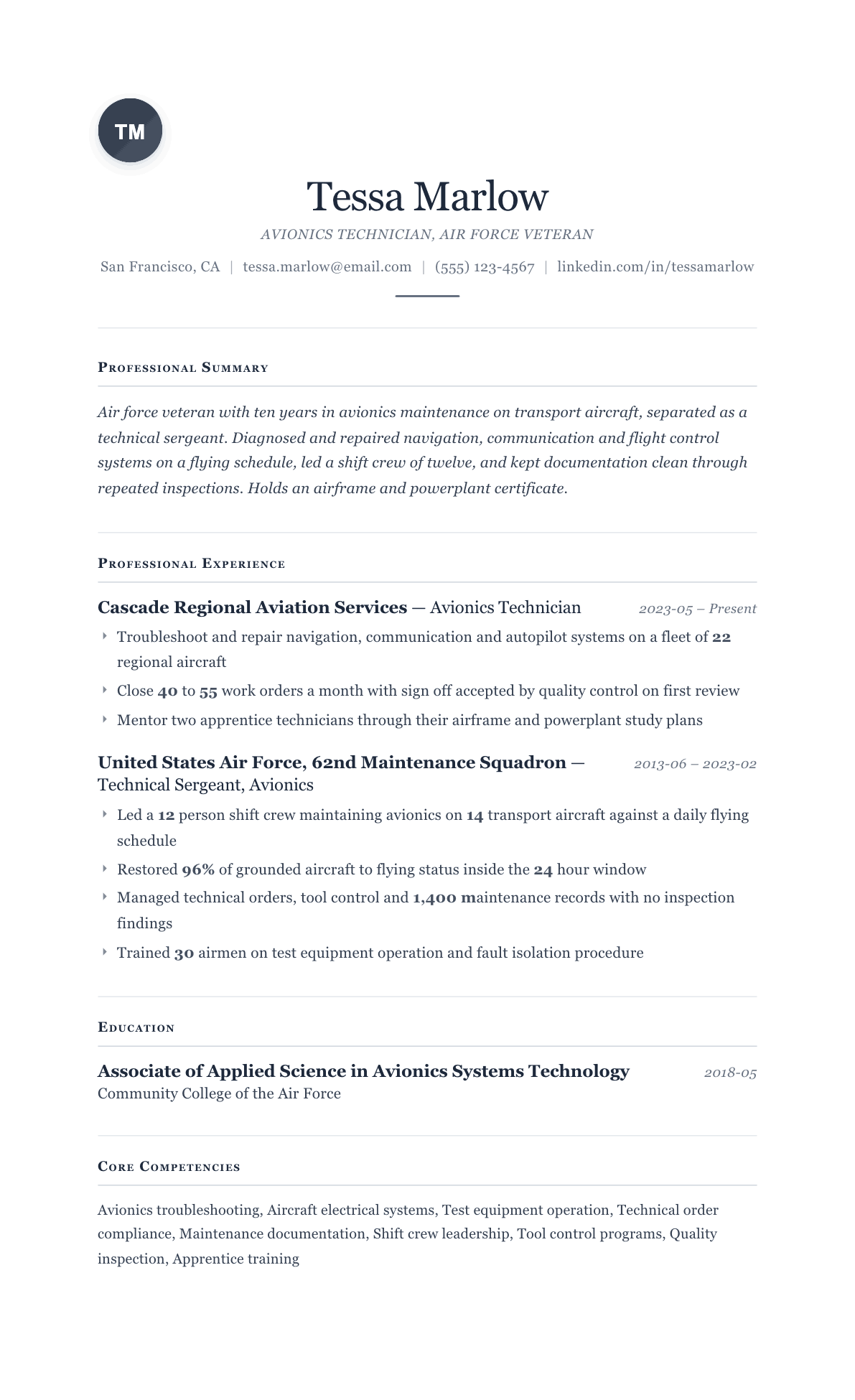
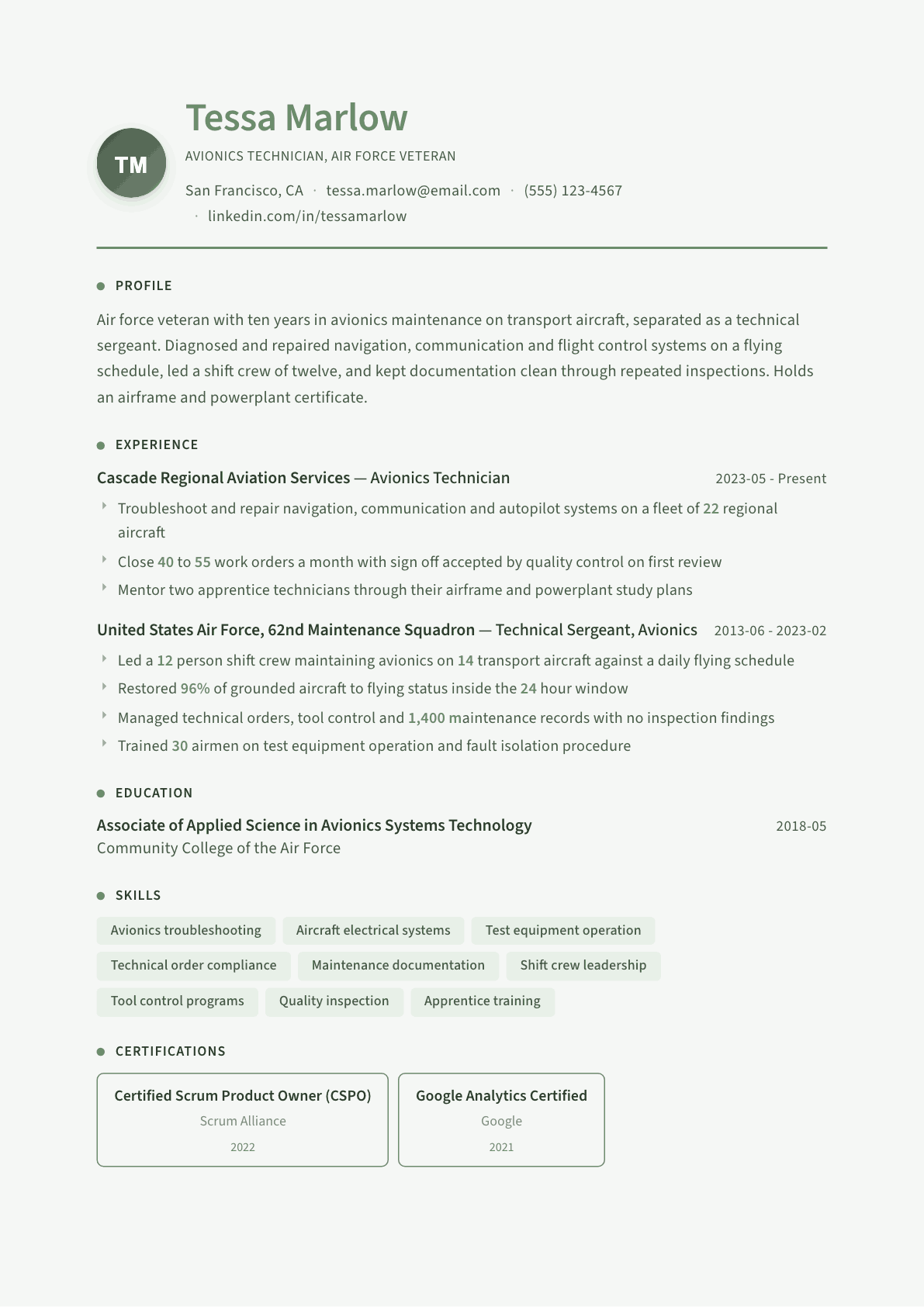
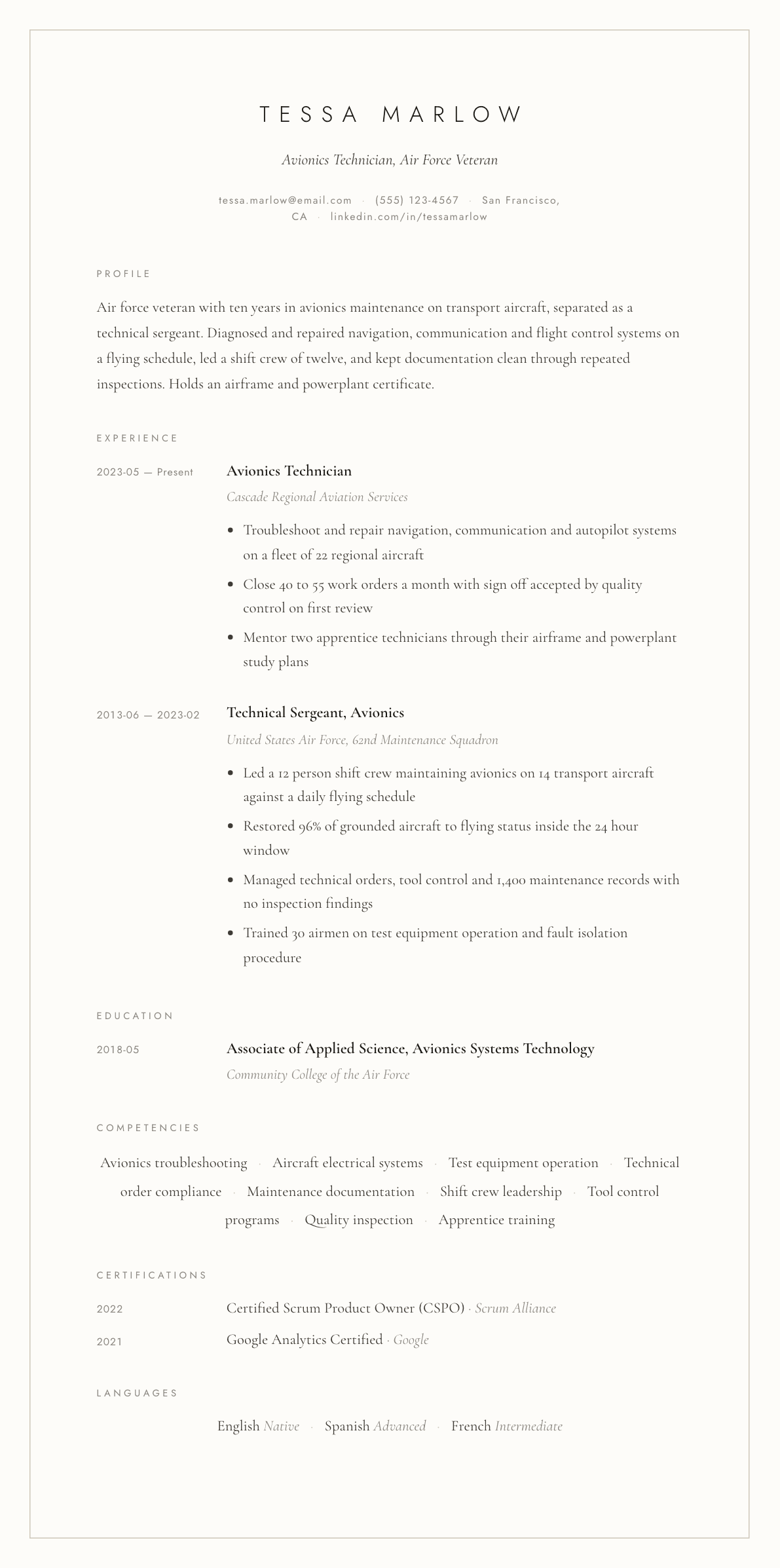
The same air force veteran content laid out in three CVBooster templates, so you can see what the finished document looks like before you write a word.
Example Air Force Veteran summary
Air force veteran and avionics technician with ten years on transport aircraft, separated as a technical sergeant. Diagnosed navigation, communication and flight control faults against a daily flying schedule, led a twelve person shift crew, and kept maintenance records clean through repeated inspections. Now repairing regional aircraft avionics in civilian aviation with an airframe and powerplant certificate in hand.
Skills to list on a Air Force Veteran resume
- Avionics fault isolation
- Aircraft electrical and instrument systems
- Navigation and communication systems
- Automated test equipment operation
- Technical order and manual compliance
- Maintenance record documentation
- Quality assurance inspection
- Tool and consumable control
- Shift crew leadership
- Training and qualification sign off
- Aircraft ground safety
- Component removal and replacement
- Troubleshooting under time pressure
- Security clearance holder
- Supply and parts coordination
What actually gets this resume read
- Open with the civilian trade title and let your air force specialty code appear only where it adds context.
- Say what aircraft or systems you worked on, since aviation employers hire against airframes and system families.
- Turn mission capable rates and turn times into availability and downtime language civilians already use.
- Name the certificates you converted after separation and the ones you are still testing toward.
- Show inspection and quality results, because they map directly onto civilian audit and compliance expectations.
- Keep leadership visible: crew size, shift ownership, training delivered and the qualifications you signed off.
How to write a air force veteran resume
Air force veterans tend to arrive in the civilian market with the cleanest technical documentation of any service, and then write resumes that leave it out. Aviation maintenance, cyber operations, intelligence, logistics and medical fields all run on written procedure, signed inspections and tracked qualifications. Those are the artifacts a civilian quality manager wants to see, and they rarely appear on the page.
What appears instead is specialty codes, squadron numbers and evaluation phrasing. A hiring manager at a regional maintenance provider cannot rank a specialty code, but she can rank an aircraft type, a system family, a work order volume and an inspection history. The information is the same; only the framing has to change.
This guide covers that reframing for air force veterans: turning a specialty into a trade title, presenting aircraft and system experience, converting readiness metrics into availability language, handling the community college degree and certificate conversion, plus summaries by career stage, rewritten bullets and the questions airmen ask before separation.
Format: trade title, aircraft and systems visible early
Lead with the civilian trade title and put the aircraft or system families you worked directly beneath it. Aviation employers hire against airframes and system types, so an avionics technician who has worked transport aircraft should say so in the first few lines rather than leaving it buried in the third bullet of a squadron assignment.
One page for a single enlistment, two for a full career or once civilian roles are added. Write each assignment with the branch and the squadron function in plain words, the civilian equivalent title as the position, and the rank noted afterward. Maintenance squadron, cyber operations squadron or logistics readiness squadron all tell a reader something the unit number does not.
- Top block for an air force veteran: trade title, aircraft or system families worked, city and state, phone, email.
- Squadron entries use the function in plain words rather than the numeric designation alone.
- Page order: summary, systems and platforms, civilian roles, air force assignments, certificates, training, education.
- Aviation candidates place certificate status directly under the summary, since it is a hiring gate for many employers.
Summary: specialty, platform, crew size, certificate status
Three lines naming the technical specialty, the platforms or systems you worked, the crew you led and your certificate status. An avionics technician with ten years on transport aircraft and an airframe and powerplant certificate in hand is a complete candidate description, and a hiring manager can act on it immediately.
If your certificate is still in progress, say where you are in the process rather than omitting it. Employers routinely hire technicians who are testing toward a certificate, and stating the timeline is far better than leaving a gap the reader fills with a pessimistic assumption.
Maintenance work: platforms, work orders and fault isolation
Write the technical work at system level. Navigation, communication, autopilot, instrumentation, electrical power, hydraulic and structural work are all separate skill families, and a hiring manager needs to know which ones you own. Then give the platforms, the fleet size you supported and the flying schedule you maintained against.
Volume and method matter equally. Work orders closed, components removed and replaced, fault isolation using automated test equipment, and how often your sign off was accepted by quality control on first review. That last figure is unusual on a civilian resume and lands well, because rework is what a maintenance manager is trying to eliminate.
Convert readiness language. Mission capable rates become fleet availability, aircraft returned to flying status become downtime resolved inside a stated window, and deferred discrepancies become open items tracked to closure. Keep the numbers and change the words around them.
Quality, technical orders and documentation
Air force maintenance runs on technical orders, tool control and records, and that discipline transfers into any regulated industry. Say that you worked to published procedure, managed tool control accountability, and maintained records that cleared inspections. Quality assurance evaluations are the closest equivalent to a civilian audit, so give the outcomes plainly.
If you held a quality, training or standardization role, write it as an assignment of its own. Evaluating other technicians, writing local procedures or running a qualification program are supervisory functions that civilian employers hire for directly, and they are frequently stronger evidence than the hands on work beside them.
Certificates, the associate degree and keywords
The Community College of the Air Force degree belongs in the education section as a normal accredited associate degree, because many veterans undersell it or leave it off. Add certificates you converted after separation and the ones you are testing toward, along with any manufacturer or systems training you received.
Then match the target vocabulary. Aviation employers want airworthiness, fault isolation, work order, sign off, technical publication and inspection. Cyber and intelligence roles want the security frameworks, tools and clearance language of that field. Keep your clearance status on the page, since defense contractors read it as a hiring accelerator.
Air Force Veteran resume summary examples
Separating after first enlistment
Air force avionics apprentice separating after four years on transport aircraft, performing component replacement and fault isolation under supervision. Holds an accredited associate degree in avionics systems technology, is testing toward an airframe and powerplant certificate, and seeks a technician role in regional aviation.
Ten years, now civilian
Air force veteran and avionics technician with ten years on transport aircraft, separated as a technical sergeant. Led a twelve person shift crew against a daily flying schedule, restored grounded aircraft inside the required window, and now repairs navigation and autopilot systems on a fleet of twenty two regional aircraft.
Twenty years, senior technician and manager
Retired air force senior noncommissioned officer with twenty years in aircraft maintenance and quality assurance. Managed production for a squadron supporting more than thirty aircraft, ran the qualification and standardization program, and now works maintenance planning for a commercial operator.
Work experience bullets: before and after
Before: Performed maintenance on aircraft avionics systems.
After: Diagnosed and repaired navigation, communication and autopilot faults on 14 transport aircraft using automated test equipment and published technical orders.
Naming systems, platform count and method gives an aviation employer something to rank.
Before: Maintained a high mission capable rate.
After: Restored 96% of grounded aircraft to flying status inside the 24 hour window across a year, coordinating parts and inspection support to close discrepancies.
Readiness reframed as downtime resolution is language a civilian manager already uses.
Before: Kept accurate maintenance records.
After: Managed technical orders, tool control accountability and 1,400 maintenance records with no findings across three quality assurance inspection cycles.
Record volume plus clean inspection outcomes reads as an audit history.
Before: Supervised a maintenance shift.
After: Led a 12 person shift crew against a daily flying schedule, assigning work orders, signing off completed tasks and briefing production status to squadron leadership.
Crew size with the actual decisions made turns supervision into a described job.
Before: Trained junior airmen on their tasks.
After: Trained 30 airmen on test equipment operation and fault isolation procedure, tracking each through qualification sign off on the systems they were certified for.
Trainee count and qualification tracking present training as a program you ran.
Hard skills
- Avionics fault isolation
- Aircraft electrical and instrument systems
- Navigation and communication systems
- Automated test equipment operation
- Component removal and replacement
- Technical order and publication compliance
- Maintenance record documentation
- Quality assurance inspection
- Tool and consumable control
- Shift production planning
- Training and qualification sign off
- Aircraft ground safety
- Parts and supply coordination
Soft skills
- Working to published procedure without shortcuts
- Accuracy when a schedule is pressing
- Briefing status honestly to leadership
- Coaching apprentices toward certification
- Cooperating across maintenance specialties
Certifications worth listing
- Airframe and Powerplant Certificate (Federal Aviation Administration)
- CompTIA Security+ (CompTIA)
- Certified Information Systems Security Professional (CISSP) (ISC2)
- Certified Six Sigma Green Belt (CSSGB) (American Society for Quality)
Mistakes that cost air force veteran candidates the interview
- Leaving specialty codes and squadron numbers on the page where platform and system names would inform the reader.
- Omitting the aircraft types worked, which is the first filter most aviation employers apply.
- Keeping readiness terminology instead of translating it into availability and downtime language.
- Leaving the accredited associate degree off the education section because it was earned in service.
- Hiding a certificate that is still in progress rather than stating where you are in the testing sequence.
- Treating quality assurance and standardization roles as side duties when employers hire for exactly that work.
Air Force Veteran resume questions
Does my air force maintenance experience count toward a civilian certificate?
Experience gained in a military maintenance specialty is frequently accepted toward the eligibility requirements for the airframe and powerplant certificate. Documentation from your service record is what establishes it, so gather training records and job history before you separate rather than afterward.
How should I present the Community College of the Air Force degree?
As an ordinary accredited associate degree in the education section, with the field of study named. It is a real credential from an accredited institution, and veterans who omit it lose a qualification that some postings list as a minimum requirement.
What if my specialty was cyber or intelligence rather than maintenance?
The same translation applies with different vocabulary. Name the tools, frameworks and systems you worked, the scale of what you defended or analyzed, and the products you delivered. Keep your clearance status prominent, since it shortens the hiring timeline for defense and government contractors.
How do I write deployments and temporary duty assignments?
Fold them into the parent assignment with a short line on the function performed and the conditions worked. Extended operations away from home station show adaptability and sustained output, which is the part a civilian manager cares about rather than the location itself.
When should I start applying before my separation date?
Roughly six months out for most technical fields, earlier if you are pursuing a certificate that requires testing. Employers are used to future start dates. Applying early also lets you find out which parts of your resume confuse civilian readers while you still have time to fix them.
Related resume examples
- Military Resume example
- Army Veteran Resume example
- Navy Veteran Resume example
- Military to Civilian Resume example
- Aircraft Mechanic Resume example
- Marine Corps Veteran Resume example