Exercise Physiologist Resume Examples: read this first
Craft an Exercise Physiologist Resume for Clinical Hiring
By Mustafa Tarabya, founder of CVBooster · Published · Updated
Exercise physiologist resume examples with stress testing detail, cardiac rehab phases, real certifications and the terms clinical managers scan for.
Sample resumes for a exercise physiologist
The same exercise physiologist content laid out in three CVBooster templates, so you can see what the finished document looks like before you write a word.
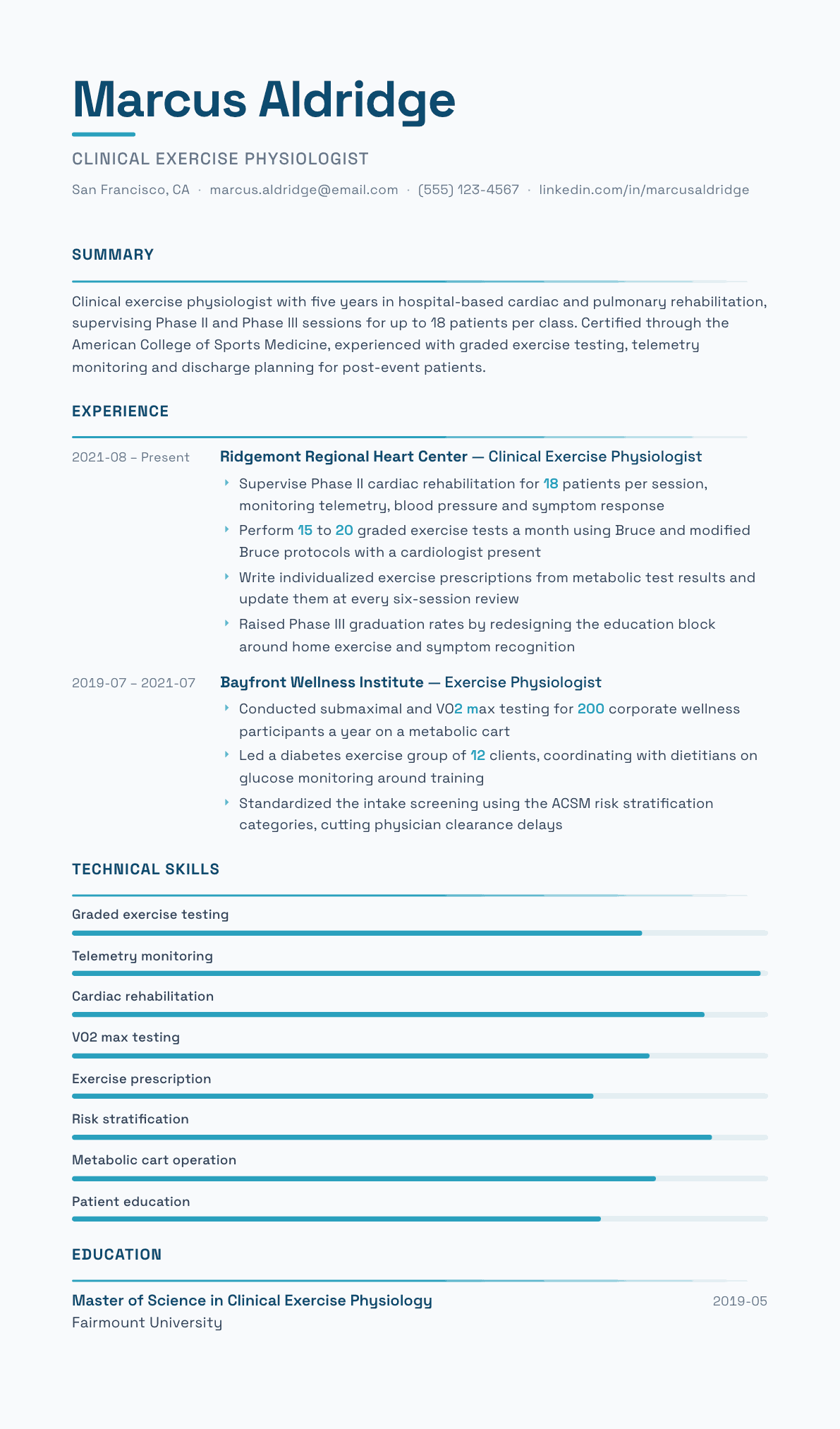
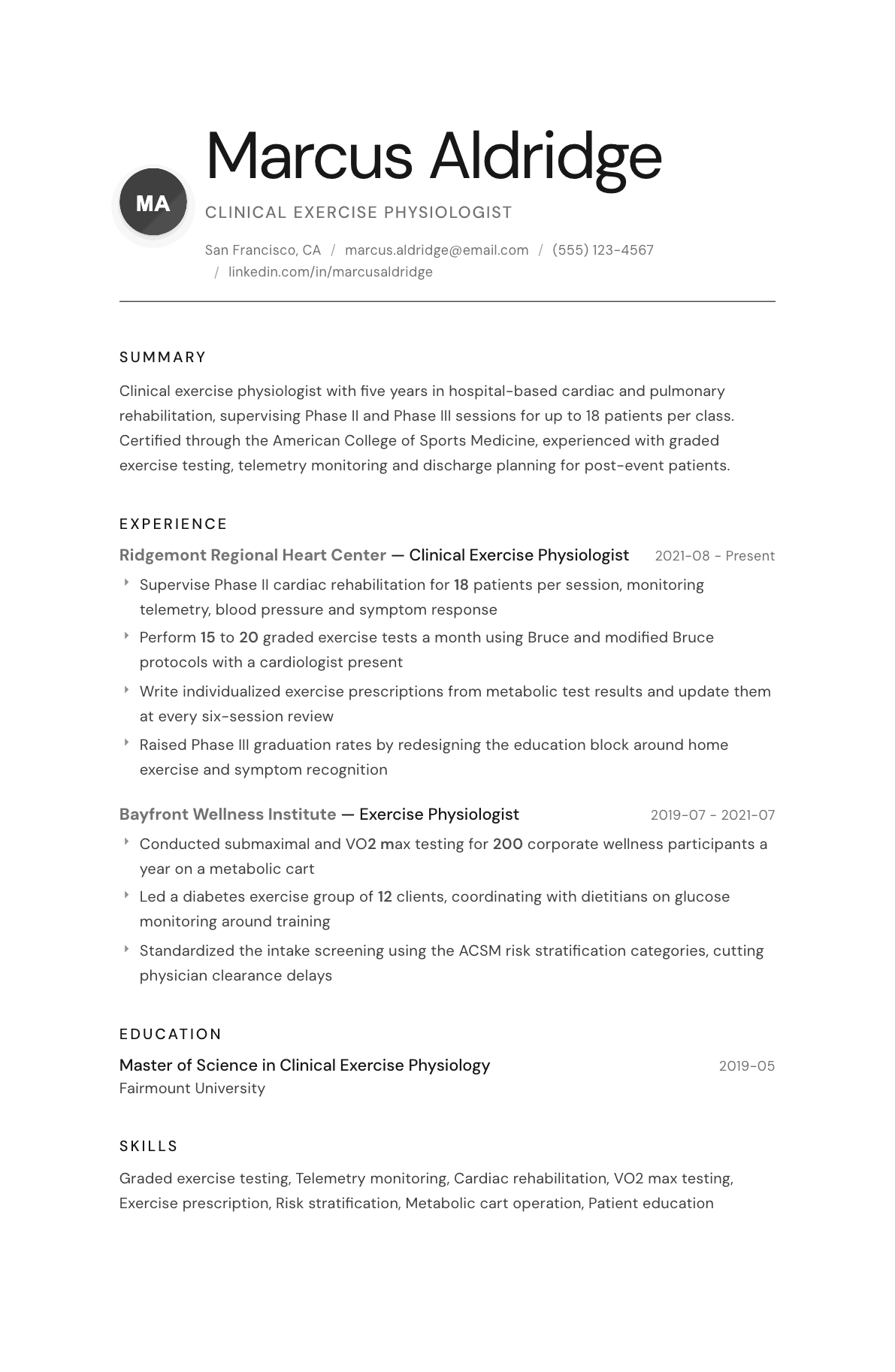
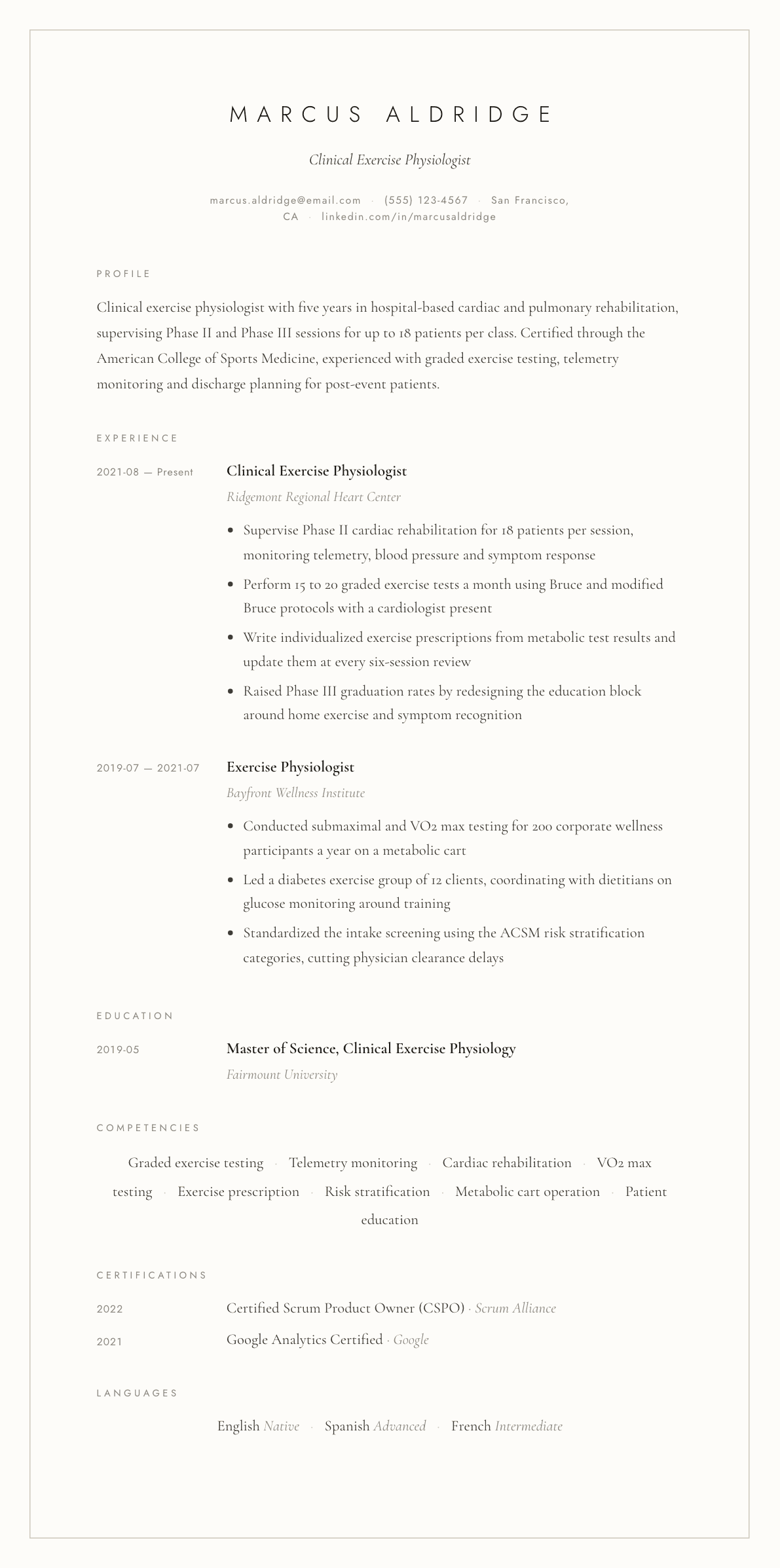
Example Exercise Physiologist summary
Clinical exercise physiologist with five years in hospital cardiac and pulmonary rehabilitation, supervising monitored classes of 18 and running about 20 graded exercise tests a month. Certified through the American College of Sports Medicine and experienced with metabolic testing, telemetry and individualized prescriptions built from real test data. Seeking a lead role in a rehabilitation department.
Skills to list on a Exercise Physiologist resume
- Graded exercise testing
- Bruce protocol
- VO2 max testing
- Telemetry monitoring
- Cardiac rehabilitation
- Pulmonary rehabilitation
- Exercise prescription
- Risk stratification
- Metabolic cart operation
- Blood pressure assessment
- Body composition testing
- Patient education
- Electronic health records
- Emergency response
What actually gets this resume read
- Put your certification and its issuing body in the header, because clinical postings screen for the credential first.
- Name the rehabilitation phase you supervised, since Phase I bedside work is nothing like Phase III maintenance.
- Give class size and test volume, because a clinical manager is staffing a room with fixed monitor capacity.
- List the testing protocols you have run by name so the reader can picture the lab you came from.
- Include your basic life support status and any advanced resuscitation training, since monitored sessions require it.
- Show the physicians and dietitians you coordinated with, because clinical exercise work is never a solo job.
How to write a exercise physiologist resume
An exercise physiologist resume is read by a rehabilitation manager who is staffing a monitored room with a fixed number of telemetry boxes and a fixed patient-to-staff ratio. Her questions are practical. Which phase have you worked, how many patients did you supervise at once, which testing protocols have you run, is your resuscitation card current, and can you write a prescription from real test data rather than a template.
The applicant tracking system asks a narrower question still: does the page contain the credential the posting named. Clinical postings in cardiac and pulmonary rehabilitation almost always specify a certification and current advanced resuscitation training, and a resume that leaves either off the first block gets filtered before a human sees the good parts.
This guide sets out the order a clinical manager reads, what to quantify, three example summaries covering a new graduate, a working clinician and a program coordinator, before and after bullets drawn from the same job, and the questions that come up whenever an exercise physiologist moves between clinical, corporate and performance settings.
Format: certification block above experience, clinical first
Build a credentials block under your contact details holding your certification with the issuing body, your basic life support status, your advanced cardiovascular life support status, and the expiry of each. In monitored settings those cards decide whether you can be scheduled at all, so they go above the fold.
Use a single column and reverse chronological order. If your background mixes clinical rehabilitation with a corporate wellness or sports performance chapter, split experience into a clinical block and a non-clinical block instead of interleaving them by date, because the manager is only really reading one of those blocks.
- Credential block: certification and issuer, resuscitation cards, expiry dates.
- Under each clinical role: program phase, patients supervised per session, and monitor type.
- A testing line naming protocols run, from Bruce and modified Bruce to six-minute walk and submaximal cycle tests.
- Supervising physician relationship, since graded testing is done under medical direction.
Summary: setting, phase, class size, testing volume
Open with the setting and the phase. Phase I bedside mobilization on an inpatient unit, Phase II monitored outpatient rehabilitation and Phase III maintenance are three different jobs, and naming the wrong one costs you the interview.
Then give class size and monthly test volume. Those two numbers let a manager picture you in her room immediately, which no adjective can do. Close with the population you know best, whether post-myocardial infarction, post-bypass, heart failure, pulmonary or metabolic.
Experience: monitoring, testing and the prescription decisions
Lead each role with the department, the phase, the session size and the monitoring setup, then write bullets about the decisions you made. Adjusting workload against rate pressure product, stopping a session on symptom response, escalating an arrhythmia to the supervising physician, and modifying a prescription after a reassessment are the moments that show clinical judgment.
Testing deserves its own bullets. Name the protocols, the volume, the equipment and who supervised. Metabolic cart work, twelve-lead placement and interpretation support, blood pressure measurement during exercise and symptom-limited endpoints all separate a clinical exercise physiologist from a fitness professional with a similar title.
Education blocks are part of the job in most programs. If you delivered the sessions on medication effects, home exercise progression, symptom recognition or nutrition coordination with a dietitian, say how many patients went through them and what you changed after feedback.
Emergency readiness and quality reporting
Monitored rehabilitation carries an emergency response expectation. State your role in the response plan, how often the team drills, and any event you managed. A manager reads that as risk reduction, and it is a fair thing to put on a resume because it is a documented duty rather than a claim.
Programs also report outcomes for accreditation and reimbursement, so mention the data you collected and submitted: functional capacity change, quality of life questionnaires, attendance and graduation rates, and the registry or database you entered them into.
- Emergency response role, drill frequency and crash cart or defibrillator checks you own.
- Outcome data collected at intake, midpoint and discharge, and the instrument used for each.
- Program reporting you contributed to for accreditation or payer requirements.
- Any protocol or intake screening you standardized using recognized risk stratification categories.
Keywords clinical postings repeat
Cardiac and pulmonary rehabilitation postings reuse the same phrases: graded exercise testing, telemetry monitoring, exercise prescription, risk stratification, symptom-limited, rate of perceived exertion, target heart rate, functional capacity, patient education, interdisciplinary care plan. Mirror the exact wording once in skills and once inside a bullet where it is true.
Add the electronic record you charted in and the equipment brands you have used on the floor. Managers value candidates who need less orientation time, and naming the systems is how you signal that quietly.
Exercise Physiologist resume summary examples
New graduate
Exercise science graduate with a 600-hour clinical internship in Phase II cardiac rehabilitation, supervising monitored sessions of 12 under a clinical exercise physiologist. Trained on telemetry, twelve-lead placement and submaximal testing, with current basic and advanced cardiovascular life support cards.
Five years in
Clinical exercise physiologist supervising Phase II sessions of 18 patients and running about 20 graded exercise tests a month on Bruce and modified Bruce protocols. Writes prescriptions from metabolic data, updates them every six sessions, and leads the patient education block on symptom recognition.
Program coordinator
Cardiac and pulmonary rehabilitation coordinator with eleven years clinical experience, overseeing four staff, the emergency response plan and outcome reporting for a hospital program. Redesigned the Phase III transition and raised graduation rates by rebuilding the home exercise education sequence.
Work experience bullets: before and after
Before: Supervised patients during cardiac rehab sessions.
After: Supervised Phase II sessions of 18 patients on continuous telemetry, tracking blood pressure, rhythm and symptom response and adjusting workload within prescribed limits.
Phase, class size and what you were watching turn supervision into a picture of the room you can run.
Before: Performed exercise stress tests.
After: Ran 15 to 20 graded exercise tests a month on Bruce and modified Bruce protocols with a cardiologist present, recording symptom-limited endpoints and rate pressure product.
The protocols, volume and medical supervision confirm real clinical testing rather than a fitness assessment.
Before: Created exercise programs for patients.
After: Wrote individualized prescriptions from metabolic test results and reassessed every six sessions, progressing workload against target heart rate and perceived exertion.
Naming the data source and the review interval shows a method instead of a document.
Before: Taught patients about heart health.
After: Led the education block on medication effects, warning signs and home exercise progression for every intake group, then rebuilt it around teach-back after discharge surveys.
The rewrite based on feedback demonstrates ownership of the program, not just delivery of a slide deck.
Before: Responsible for emergency preparedness.
After: Owned crash cart and defibrillator checks, ran quarterly response drills with nursing, and served as the first responder role in the department emergency plan.
Concrete duties and a drill cadence are verifiable, while responsibility for preparedness is not.
Hard skills
- Graded exercise testing
- Bruce and modified Bruce protocols
- Telemetry and rhythm monitoring
- Twelve-lead electrode placement
- Metabolic cart and VO2 testing
- Exercise prescription
- Risk stratification
- Exercise blood pressure measurement
- Six-minute walk testing
- Body composition assessment
- Patient education delivery
- Outcome data collection
Soft skills
- Calm response to symptom changes
- Patient reassurance
- Physician communication
- Group session management
- Documentation discipline
- Interdisciplinary coordination
Certifications worth listing
- ACSM Certified Exercise Physiologist (ACSM-EP) (American College of Sports Medicine)
- ACSM Certified Clinical Exercise Physiologist (ACSM-CEP) (American College of Sports Medicine)
- Certified Cardiac Rehabilitation Professional (CCRP) (American Association of Cardiovascular and Pulmonary Rehabilitation)
- Advanced Cardiovascular Life Support (ACLS) (American Heart Association)
- Basic Life Support (BLS) (American Heart Association)
Mistakes that cost exercise physiologist candidates the interview
- Omitting the resuscitation card status, which is a scheduling requirement in every monitored program.
- Failing to name the rehabilitation phase, so the reader cannot tell inpatient mobilization from outpatient monitored work.
- Writing about designing workouts in fitness language when the posting is clinical and uses prescription language.
- Leaving out test protocols and volume, the clearest evidence separating clinical work from a wellness assessment.
- Ignoring outcome reporting, even though programs live on the data submitted for accreditation and reimbursement.
- Mixing corporate wellness and clinical roles in one date-ordered list so the clinical experience gets diluted.
Exercise Physiologist resume questions
Which certification matters most for a clinical role?
The one the posting names. Clinical cardiac and pulmonary programs usually ask for a recognized clinical exercise credential plus current advanced resuscitation training, so list both with the issuing body and expiry rather than an unexplained acronym.
How do I list an internship if I have no paid clinical experience?
Give it the same structure as a job: department, phase, hours completed, session size supervised and the testing you assisted with. A new graduate is hired on supervised exposure, so the detail of the internship is the resume.
Can I move from corporate wellness into cardiac rehabilitation?
Yes, if you lead with the transferable clinical work. Highlight submaximal and metabolic testing, risk stratification screening, blood pressure measurement and any medically supervised group you ran, then state the move directly in your summary.
Should I include patient education work?
Yes. Education sessions are a graded part of most programs, and describing the topics you taught, the group size and any redesign you made after feedback shows a manager you can own a piece of the program rather than only staff a floor.
How long should this resume be?
One page through the first several years, two once you coordinate a program or carry teaching, accreditation reporting and supervisory duties. Keep the credential block on page one in either case, because that is the block that gets you screened in.
Related resume examples
- Athletic Trainer Resume example
- Sports Nutritionist Resume example
- Kinesiologist Resume example
- Fitness Coach Resume example
- Personal Trainer Resume example
- Scuba Instructor Resume example