Kinesiologist Resume Examples: free ATS score and gap list
Build a Kinesiologist Resume Clinics Take Seriously
By Mustafa Tarabya, founder of CVBooster · Published · Updated
Kinesiologist resume examples covering movement assessment, caseload detail, registration bodies and the clinical keywords hiring managers search.
Sample resumes for a kinesiologist
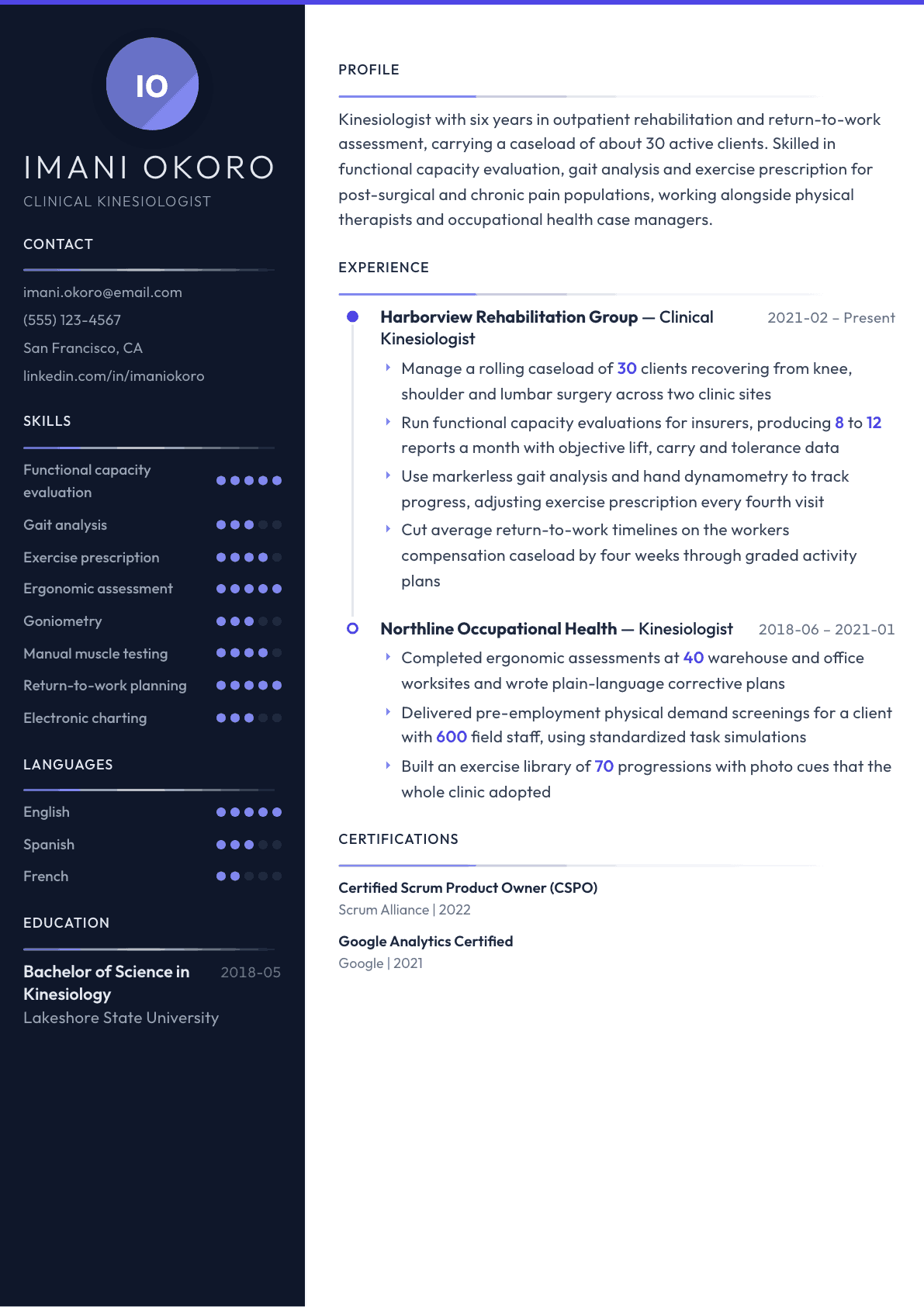
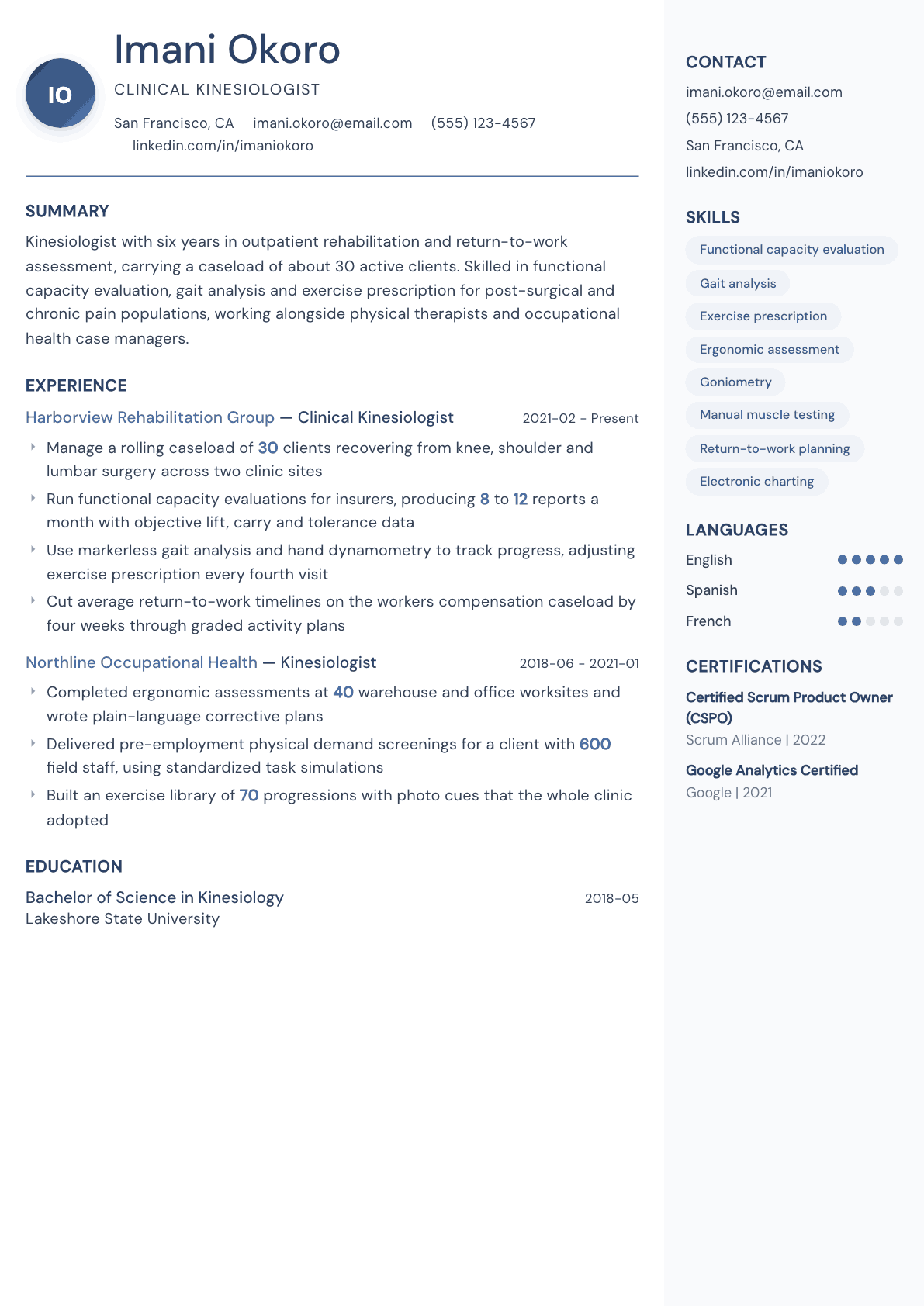
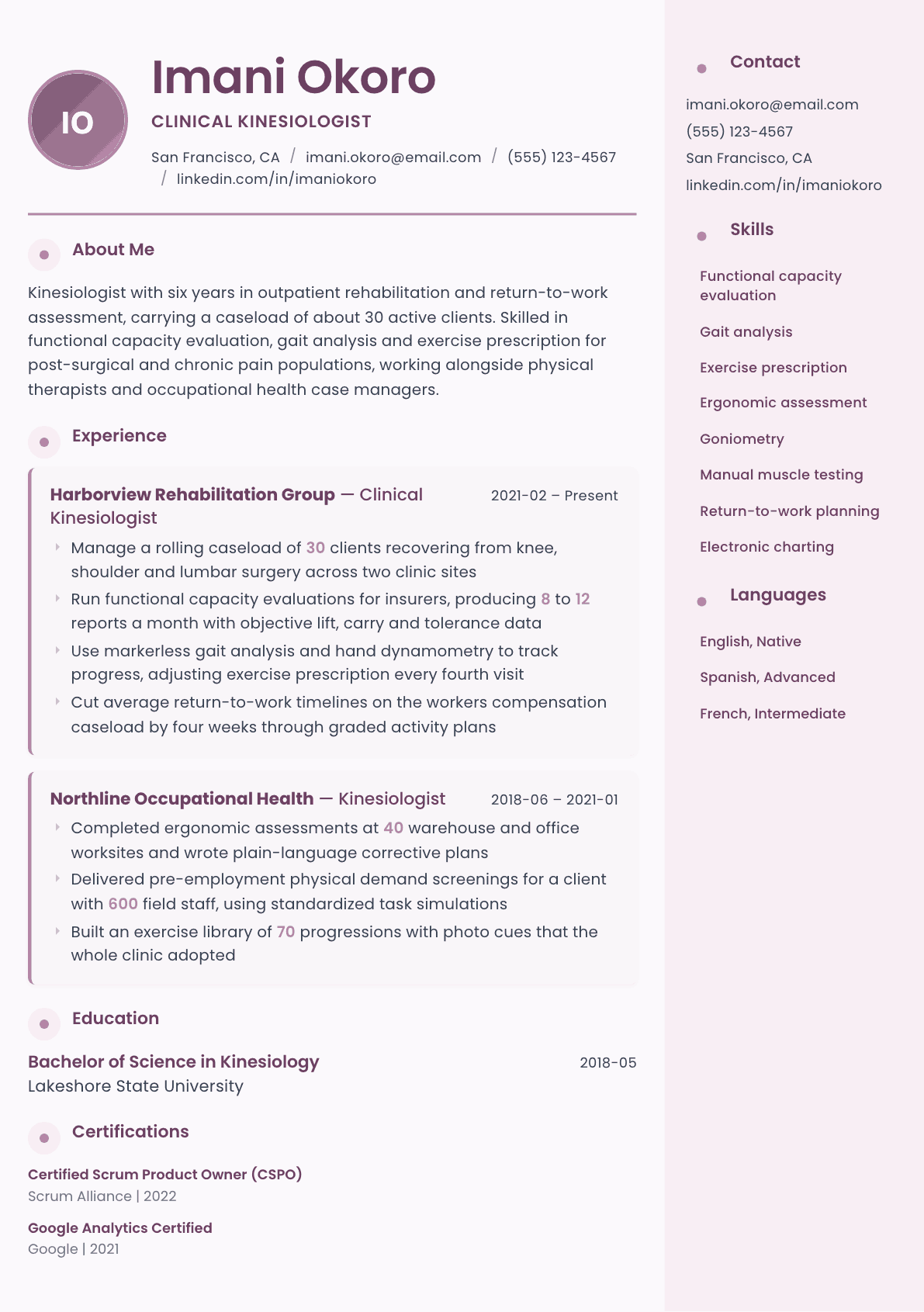
The same kinesiologist content laid out in three CVBooster templates, so you can see what the finished document looks like before you write a word.
Example Kinesiologist summary
Kinesiologist with six years across outpatient rehabilitation and occupational health, carrying 30 active clients and producing a dozen functional capacity reports a month. Experienced with gait analysis, graded activity planning and worksite ergonomic assessment for insurer-funded caseloads. Known for return-to-work plans that supervisors can actually follow on the floor.
Skills to list on a Kinesiologist resume
- Functional capacity evaluation
- Movement screening
- Gait analysis
- Exercise prescription
- Manual muscle testing
- Goniometry
- Ergonomic assessment
- Return-to-work planning
- Post-surgical rehabilitation
- Chronic pain management
- Cardiac rehabilitation
- Outcome measure tracking
- Client education
- Clinical documentation
- Interdisciplinary collaboration
What actually gets this resume read
- State your registration or professional association standing in the header, because clinics screen for it before anything else.
- Describe the population you treat, whether post-surgical, occupational injury, cardiac or neurological, in every single job entry.
- Quantify caseload size and report volume, since a kinesiologist is hired to carry a predictable amount of work.
- Name the assessment tools you actually use, from dynamometers and goniometers to force plates and gait mats.
- Separate clinical work from corporate ergonomics work, because hiring managers in those two settings want different evidence.
- List the charting or case management systems you have documented in, since interoperability saves a clinic training time.
How to write a kinesiologist resume
A kinesiologist resume gets sorted into one of two piles before anyone reads a bullet: clinical or corporate. The clinic manager filling a rehabilitation post wants caseload, populations, assessment tools and documentation habits. The occupational health employer wants worksite assessments, physical demands analysis, insurer reporting and how fast you return people to duty. Sending one generic page to both is the most common reason a strong candidate hears nothing back.
The second problem is vagueness about scope. Kinesiology overlaps with physical therapy, athletic training and personal training, and hiring managers have been burned by candidates who blur the line. Naming exactly what you assess, what you prescribe, who supervises you and who you refer to makes you easy to hire rather than a question mark.
What follows is the section order a clinic director reads, the numbers worth putting on the page, example summaries for a new graduate, a working clinician and a senior lead, before and after bullets, and the questions that come up every time a kinesiologist sits down to rewrite this document.
Format: credentials and setting up top, one page early on
Lead with your degree, your professional association standing and any registration you hold, then the setting you work in. A clinic screening applications is checking eligibility first and reading talent second, so make eligibility a header line rather than something buried under education.
Reverse chronological order throughout. Avoid two-column layouts with icon skill meters, because clinic and hospital systems parse them poorly and because a rating bar next to goniometry tells a clinical lead nothing about how you measure a knee.
- Header line: degree, association standing, and the practice setting you work in such as outpatient rehabilitation or occupational health.
- A caseload line under each role: active clients, visit frequency and the referral source funding them.
- Assessment inventory naming the actual instruments, from dynamometers and goniometers to force plates and gait mats.
- Referral relationships: the physical therapists, physicians and case managers you work under or alongside.
Summary: population, caseload, assessments, funding source
Say who you treat, how many of them, what you assess and who pays. Post-surgical orthopedic clients funded through an insurer are a different job from cardiac maintenance clients on a hospital program or a chronic pain group in community health.
Avoid the sentence that describes kinesiology itself. Every applicant studies human movement. What separates you is the population you have carried and the reports you produce, so put those in the first two lines.
Experience: caseload, assessments and what changed for the client
Open each role with the setting, the caseload size and the population, then use bullets for work that shows clinical reasoning. Functional capacity evaluations, physical demands analysis, gait and posture assessment, graded activity plans, progression decisions and discharge criteria all belong here.
Attach outcomes wherever you honestly can. Return-to-work timelines, tolerance improvements measured in lift weight or standing minutes, range of motion gains and reduced visit counts to discharge are the numbers a manager can compare between candidates. Write the measure, not just the direction.
Cut the bullets that describe attendance rather than practice. Supervising exercise sessions and educating clients are true of everyone in the field, so replace them with the specific protocol, the instrument or the decision you made.
Assessment and reporting: the part employers actually buy
Much of a kinesiologist role is producing defensible documents. Functional capacity evaluation reports, ergonomic assessment reports, physical demands analyses and progress notes go to insurers, employers and physicians who read them closely.
Give report volume per month, the format you write in, and any template or system you have built. If your reports have been used in return-to-work disputes or reviewed by an insurer medical advisor, that is worth a line, because it tells a hiring manager your writing holds up under scrutiny.
- Report types produced and monthly volume, with the audience each one is written for.
- Charting and case management systems used for notes, outcome measures and discharge summaries.
- Standardized outcome measures you administer and score, and how often you repeat them.
- Any template, exercise library or intake screening you built that the clinic adopted.
Skills and keywords the screening pass looks for
Use the terminology of the posting: functional capacity evaluation, physical demands analysis, exercise prescription, graded activity, manual muscle testing, goniometry, gait analysis, ergonomic assessment, return to work, outcome measures. Put them where they are true, once in skills and once inside a bullet that proves them.
Keep the soft qualities inside the experience section. A client who kept a home program because you rewrote it in plain language is more convincing than the word empathetic in a list.
Kinesiologist resume summary examples
New graduate
Kinesiology graduate with 600 supervised practicum hours across outpatient orthopedics and a community cardiac maintenance program. Trained in goniometry, manual muscle testing and graded exercise prescription, comfortable charting outcome measures, and seeking an assistant kinesiologist role in a multidisciplinary clinic.
Five years in
Kinesiologist carrying 30 active post-surgical and occupational injury clients across two clinic sites, producing about a dozen functional capacity evaluation reports a month for insurer files. Uses gait analysis and hand dynamometry to drive progressions, and works directly with case managers on return-to-work planning.
Clinical lead
Senior kinesiologist and clinical lead supervising four practitioners across a rehabilitation group, owning assessment standards, report quality review and the graded activity protocol. Ten years with post-surgical, chronic pain and workers compensation caseloads, and the clinic contact for insurer medical advisors.
Work experience bullets: before and after
Before: Worked with clients on rehabilitation exercises.
After: Carried 30 active post-surgical knee, shoulder and lumbar clients, adjusting graded exercise prescriptions at every fourth visit against range of motion and tolerance data.
The caseload, the body regions and the review cadence show what you can hold and how you make decisions.
Before: Performed functional capacity evaluations.
After: Completed 10 to 12 functional capacity evaluations a month for insurer files, documenting lift, carry, sit and stand tolerances against job demand descriptions.
Volume plus the content of the report tells a manager you can produce defensible documents at pace.
Before: Helped injured workers get back to their jobs.
After: Cut average return-to-work time on the workers compensation caseload by four weeks by building graded duty plans with supervisors and reviewing tolerances every two weeks.
A measured outcome with the mechanism behind it is far stronger than a claim of helping.
Before: Did ergonomic assessments at client sites.
After: Assessed 40 warehouse and office workstations, quantified reach and lift demands, and wrote corrective plans in plain language for supervisors to implement.
Naming the sites, the measurement and the audience shows the whole job rather than the visit.
Before: Used clinic software for notes.
After: Documented every visit and outcome measure in the clinic case management system and built a 70-item exercise library with photo cues that the whole team adopted.
The second half turns a routine tool mention into evidence you improved how the clinic works.
Hard skills
- Functional capacity evaluation
- Physical demands analysis
- Gait and posture assessment
- Manual muscle testing
- Goniometry and range of motion measurement
- Hand dynamometry
- Graded exercise prescription
- Ergonomic assessment
- Return-to-work planning
- Standardized outcome measures
- Clinical documentation
- Cardiac and pulmonary maintenance programs
Soft skills
- Client motivation
- Plain-language education
- Case manager communication
- Caseload prioritization
- Interdisciplinary collaboration
- Boundary awareness on scope of practice
Certifications worth listing
- Certified Exercise Physiologist (ACSM-EP) (American College of Sports Medicine)
- Certified Strength and Conditioning Specialist (CSCS) (National Strength and Conditioning Association)
- Certified Ergonomics Assessment Specialist (CEAS) (The Back School)
- Basic Life Support (BLS) (American Heart Association)
Mistakes that cost kinesiologist candidates the interview
- Sending the same page to a rehabilitation clinic and an occupational health employer when they buy two different skill sets.
- Describing the discipline instead of the practice, so the reader learns what kinesiology is and nothing about you.
- Omitting caseload size, which leaves a clinic director unable to judge whether you can carry their schedule.
- Listing assessment tools without saying what you did with the results or how often you repeated them.
- Blurring scope by implying you diagnose or deliver treatments that belong to another regulated profession.
- Burying report volume when writing defensible reports is a large share of what the employer is paying for.
Kinesiologist resume questions
How is a kinesiologist resume different from a personal trainer resume?
A trainer resume sells client retention and program design for healthy adults. A kinesiologist resume sells assessment, measurement and documentation for injured or clinical populations, so caseload, outcome measures and report volume carry the weight.
Should I list my practicum hours?
Yes if you graduated recently. Give the hours, the setting and the populations you saw, because a new graduate is judged on supervised exposure. Drop the practicum block once you have a full year of paid caseload behind you.
Do I need a certification on top of my degree?
It depends on the setting. Clinical employers often want a recognized exercise physiology or strength credential alongside current basic life support, and occupational health employers value an ergonomics assessment credential. List only ones you actually hold.
How do I quantify work when outcomes take months?
Use process numbers as well as results: active caseload, visits per week, reports per month, assessments completed, and reassessment intervals. Then add the outcomes you can defend, such as tolerance changes or discharge timelines on a specific caseload.
Where should scope of practice appear on the page?
Inside the experience bullets, through the verbs you choose. Words like assess, measure, prescribe, progress and refer show a hiring manager you know where your role ends and a physician or therapist begins, without needing a disclaimer line.
Related resume examples
- Athletic Trainer Resume example
- Sports Nutritionist Resume example
- Exercise Physiologist Resume example
- Strength and Conditioning Coach Resume example
- Personal Trainer Resume example
- Fitness Manager Resume example