Audiologist Resume Examples: free ATS score and gap list
Build an Audiologist Resume That Names Your Test Battery and Population
By Mustafa Tarabya, founder of CVBooster · Published · Updated
An audiologist resume example with diagnostic test battery, hearing aid fitting and clinic volume detail, plus keywords and a complete writing guide.
Sample resumes for a audiologist
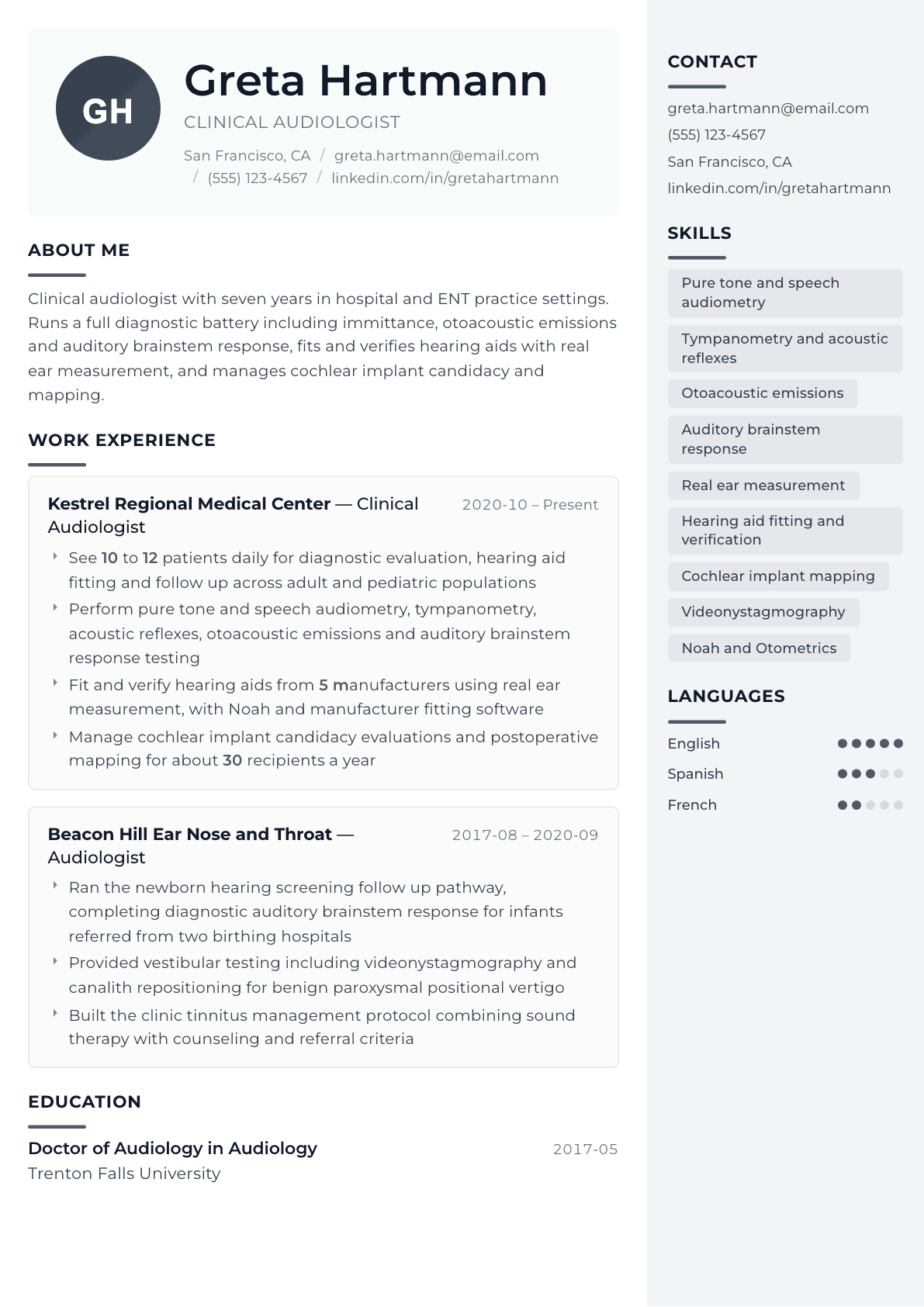
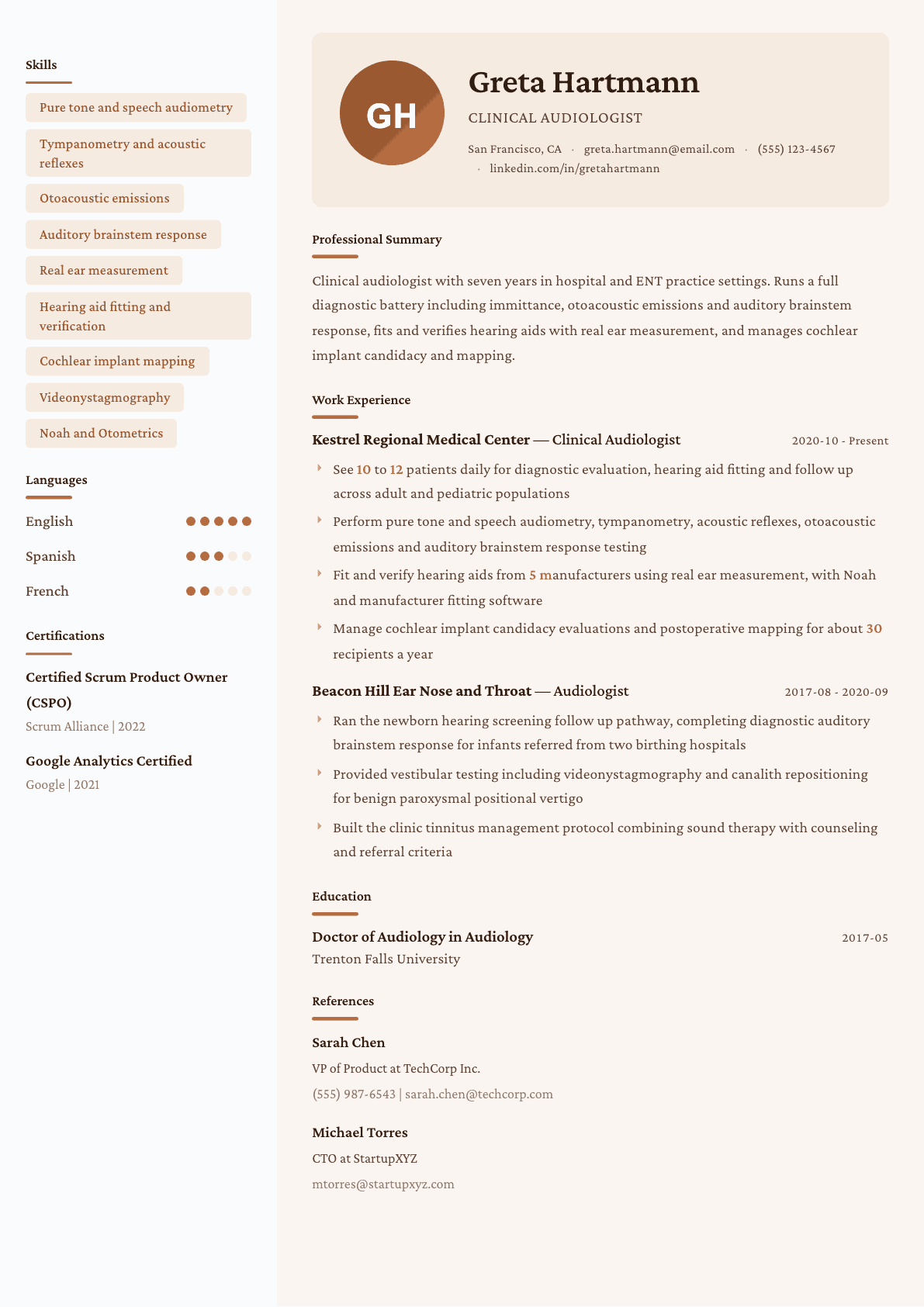
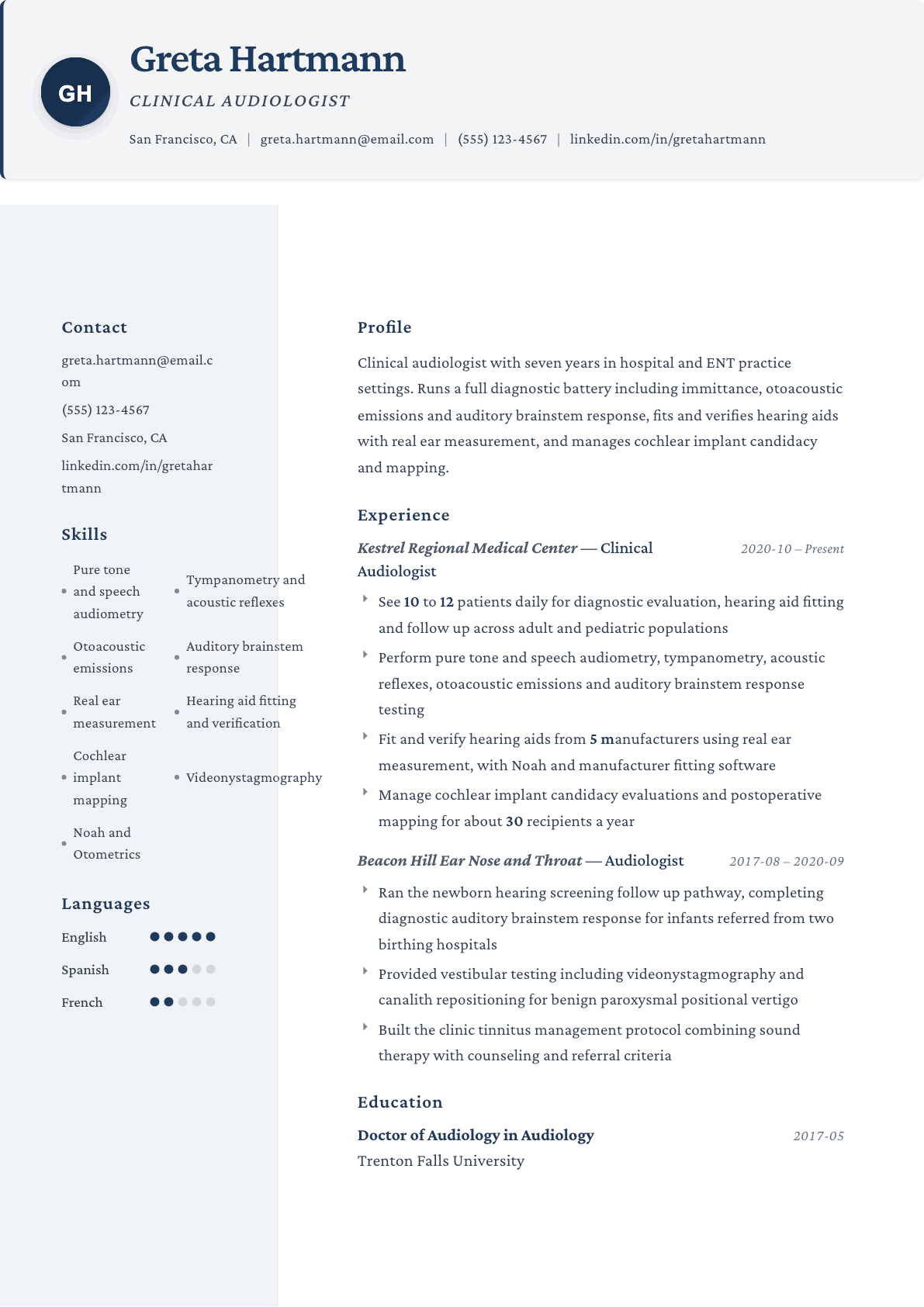
The same audiologist content laid out in three CVBooster templates, so you can see what the finished document looks like before you write a word.
Example Audiologist summary
Clinical audiologist with seven years in hospital and ENT settings, seeing ten to twelve patients daily across adult and pediatric care. Runs the full diagnostic battery from immittance and otoacoustic emissions through auditory brainstem response, fits and verifies amplification with real ear measurement, and manages cochlear implant candidacy and mapping. Also experienced with vestibular assessment and tinnitus counseling.
Skills to list on a Audiologist resume
- Pure tone audiometry
- Speech audiometry
- Tympanometry
- Acoustic reflex testing
- Otoacoustic emissions
- Auditory brainstem response
- Real ear measurement
- Hearing aid selection and fitting
- Hearing aid troubleshooting
- Cochlear implant candidacy
- Cochlear implant mapping
- Tinnitus management
- Videonystagmography
- Canalith repositioning
- Newborn hearing screening
- Earmold impressions
What actually gets this resume read
- Place your doctorate, state license and ASHA or American Board of Audiology status directly under your name.
- List the diagnostic battery you can run independently, because clinics staff around who can do ABR and vestibular testing.
- Say which populations you serve, since pediatric diagnostics, adult amplification and vestibular care are different hires.
- Name the hearing aid manufacturers and fitting software you use, along with your real ear measurement equipment.
- Include cochlear implant work by manufacturer and by task, separating candidacy evaluation from postoperative mapping.
- Give patient volume per day and any clinic revenue or scheduling responsibilities if you have run a dispensing practice.
How to write a audiologist resume
An audiologist resume is read by someone building a clinic schedule. The question underneath every line is which chairs you can fill: diagnostic testing, amplification, pediatric assessment, vestibular, cochlear implants, or all of them. A resume that says provided comprehensive audiological services answers none of that and gets set aside for one that lists the test battery.
The second question is volume and independence. Hospital audiology, private ENT practice, a dispensing office, a school system, an industrial hearing conservation program and a manufacturer clinical role all hire on different evidence. Patients per day, the equipment you calibrate and operate, and whether you have run a clinic without a senior audiologist nearby all belong on the page.
This guide covers the section order clinic managers expect, three summaries from a fourth year extern through a clinic lead, before and after bullets built from real appointments, and the questions audiologists ask when they move between hospital, private practice and manufacturer roles.
Format: doctorate, license and certification in the header
Put the doctorate after your name, then a credential line with your state license number status, your certificate of clinical competence status, and any American Board of Audiology certification. Credentialing staff at a hospital cannot start your file without those, so they belong above the fold rather than buried near education.
Directly under the summary, add a clinical capabilities block listing the diagnostic procedures you perform independently. That single block is the most useful thing on an audiology resume, because it tells a manager which appointment types they can book you for on day one.
- Header: name with doctorate, credential line, city and state, phone, email.
- Order: summary, credentials, clinical capabilities, professional experience, externship, education, equipment and software.
- Fourth year externs put the externship above employment with the rotation sites, populations and procedure counts named.
Summary: setting, population, and the battery you own
Three lines. Name the setting and the patient mix, adult, pediatric or both. Name the battery you run without supervision. Then name your amplification and implant work, because dispensing volume and implant mapping are the two things that most change your value to a practice.
An audiologist who runs immittance, otoacoustic emissions and auditory brainstem response, fits amplification with real ear verification, and maps cochlear implants has said more in one sentence than a paragraph of adjectives could.
Experience: the test battery, the fittings, and the volume
Lead each role with the setting and daily patient volume, then list what you actually performed. Pure tone air and bone conduction, speech reception thresholds and word recognition, tympanometry, acoustic reflex thresholds and decay, distortion product and transient evoked otoacoustic emissions, auditory brainstem response for threshold and neurodiagnostic purposes, and electrocochleography where you have done it.
For amplification, name the manufacturers whose fitting software you use, say you verify with real ear measurement rather than manufacturer first fit, and describe your follow up protocol. Troubleshooting a non adapting patient is where clinical skill actually shows, so give it a bullet.
Implant work should separate candidacy evaluation from programming. Candidacy involves aided testing and counseling against criteria; postoperative mapping involves impedance checks, threshold and comfort level setting and troubleshooting across processors. Say which you have done and roughly how many recipients you follow.
Pediatrics, vestibular and specialty pathways
Pediatric capability is a hiring decision on its own. Visual reinforcement audiometry, conditioned play audiometry, diagnostic auditory brainstem response on sleeping infants, and newborn hearing screening follow up pathways are the specific skills a children hospital or an early hearing detection program screens for. Name them individually.
Vestibular work is likewise its own market. Videonystagmography, rotary chair, video head impulse testing, vestibular evoked myogenic potentials and canalith repositioning maneuvers are separate competencies. Also mention tinnitus management protocols, hearing conservation and industrial audiometry, and central auditory processing evaluation if you perform it.
- Pediatric: behavioral techniques by name plus any sedated or natural sleep testing experience.
- Vestibular: equipment used, maneuvers performed, and whether you interpret and report independently.
- Occupational: audiometric database review, hearing conservation program support and standard threshold shift follow up.
Equipment, software and the business side
List your audiometers, immittance bridges, evoked potential systems, real ear equipment and the fitting software platforms you use, plus the patient management and noise measurement systems where relevant. Audiology is equipment dependent, and a manager wants to know how much training a new hire needs before the first booked patient.
If you have run a dispensing practice, add the business evidence: units dispensed, return rate, capture rate from testing to fitting, insurance and hearing aid benefit authorizations, and inventory or repair workflow. Private practice owners hire on those numbers as much as on clinical skill.
Audiologist resume summary examples
Fourth year extern
Doctor of audiology candidate completing a fourth year externship in a hospital clinic, rotating through adult diagnostics, pediatric behavioral testing and amplification. Performs the full immittance and otoacoustic emissions battery, assists with diagnostic auditory brainstem response, and fits hearing aids with real ear verification.
Five years in an ENT practice
Clinical audiologist seeing 10 to 12 patients daily in a four physician ENT practice. Runs pure tone and speech audiometry, tympanometry, acoustic reflexes, otoacoustic emissions and auditory brainstem response, fits amplification from 5 manufacturers with real ear verification, and provides videonystagmography and canalith repositioning.
Lead audiologist
Lead audiologist with twelve years in hospital and academic settings. Manages cochlear implant candidacy and mapping for a growing recipient panel, supervises three audiologists and two externs, built the newborn hearing screening follow up pathway with two birthing hospitals, and owns equipment calibration scheduling.
Work experience bullets: before and after
Before: Performed hearing tests on adult and pediatric patients.
After: Performed pure tone and speech audiometry, tympanometry, acoustic reflexes, otoacoustic emissions and auditory brainstem response for 10 to 12 adult and pediatric patients daily.
Listing the actual battery and the daily volume tells a manager which appointment slots you can be booked into.
Before: Fit hearing aids for patients and did follow up appointments.
After: Fit and verified amplification from 5 manufacturers using real ear measurement rather than manufacturer first fit, with a structured two week and eight week follow up protocol.
Real ear verification and a defined follow up schedule are the markers of quality fitting practice, and both are checkable.
Before: Worked with cochlear implant patients.
After: Completed candidacy evaluations including aided speech testing and counseling, then managed postoperative activation and mapping for about 30 recipients a year across two processor platforms.
Separating candidacy from mapping and giving a recipient volume shows the depth an implant program needs to see.
Before: Handled infant hearing screening referrals.
After: Ran the newborn hearing screening follow up pathway for two birthing hospitals, completing diagnostic auditory brainstem response on sleeping infants and tracking referrals to confirmed diagnosis.
The pathway, the technique and the tracking responsibility describe a program you owned rather than a task you assisted with.
Before: Helped patients who complained about ringing in their ears.
After: Built the clinic tinnitus management protocol pairing sound therapy with structured counseling, and defined referral criteria for patients screening positive for significant distress.
Writing a protocol and setting referral criteria demonstrates clinical leadership rather than an ad hoc conversation.
Hard skills
- Pure tone air and bone conduction audiometry
- Speech reception and word recognition testing
- Tympanometry and acoustic reflexes
- Otoacoustic emissions
- Auditory brainstem response
- Real ear measurement
- Hearing aid selection fitting and verification
- Hearing aid troubleshooting and repair triage
- Cochlear implant candidacy evaluation
- Cochlear implant mapping
- Videonystagmography and canalith repositioning
- Visual reinforcement and conditioned play audiometry
- Newborn hearing screening follow up
- Earmold impressions and modification
Soft skills
- Counseling patients through hearing loss acceptance
- Working with reluctant pediatric patients
- Family communication about expectations
- Clear written reporting to referring physicians
- Patience during non adapt troubleshooting
- Scheduling judgment in a full clinic
Certifications worth listing
- Certificate of Clinical Competence in Audiology (CCC-A) (American Speech-Language-Hearing Association)
- Board Certified in Audiology (American Board of Audiology)
- Pediatric Audiology Specialty Certification (PASC) (American Board of Audiology)
- Cochlear Implant Specialty Certification (CISC) (American Board of Audiology)
- Course Director for Occupational Hearing Conservation (Council for Accreditation in Occupational Hearing Conservation)
Mistakes that cost audiologist candidates the interview
- Summarizing the work as comprehensive audiological services instead of listing the diagnostic battery you run independently.
- Leaving out patient volume, so a clinic manager cannot judge whether you can hold a full schedule.
- Failing to say that you verify fittings with real ear measurement, which is the quality marker readers look for.
- Merging cochlear implant candidacy and mapping into one vague phrase when they are separate competencies.
- Skipping the equipment and fitting software list, when onboarding time depends entirely on it.
- Applying to a pediatric position without naming visual reinforcement or conditioned play audiometry anywhere on the page.
Audiologist resume questions
Should an audiologist resume list every piece of equipment?
List the categories and the specific systems you operate: audiometers, immittance bridges, evoked potential platforms, real ear systems and the fitting software you use. Skip consumables and generic office tools, which tell a hiring manager nothing about your capability.
How do I show my fourth year externship on a resume?
Treat it as clinical employment. Give the site type, the rotations, the populations, the procedures you performed independently by the end and approximate volumes. That externship is often the only full time clinical evidence a new graduate has.
Do I need to include my state license number?
Include the state and the license status rather than the full number on a public resume. Credentialing staff need to know which states you hold and whether they are active; the number itself can be provided during the credentialing process.
How do I move from a dispensing practice into a hospital audiology role?
Rebalance the resume toward diagnostics. Lead with your test battery, any auditory brainstem response and vestibular work, pediatric techniques and report writing to physicians, then keep the dispensing detail shorter and lower on the page.
What business numbers belong on a private practice audiologist resume?
Units dispensed, capture rate from evaluation to fitting, return for credit rate, follow up compliance and insurance authorization volume. Practice owners hire on those figures because they predict whether a clinician can sustain a clinic.