Pediatrician Resume Examples: free ATS score and gap list
Create a Pediatrician Resume That Shows Panel Size and Preventive Care
By Mustafa Tarabya, founder of CVBooster · Published · Updated
A pediatrician resume guide with well-child and newborn nursery examples, immunization keywords, panel size bullets and a full section-by-section walkthrough.
Sample resumes for a pediatrician
The same pediatrician content laid out in three CVBooster templates, so you can see what the finished document looks like before you write a word.
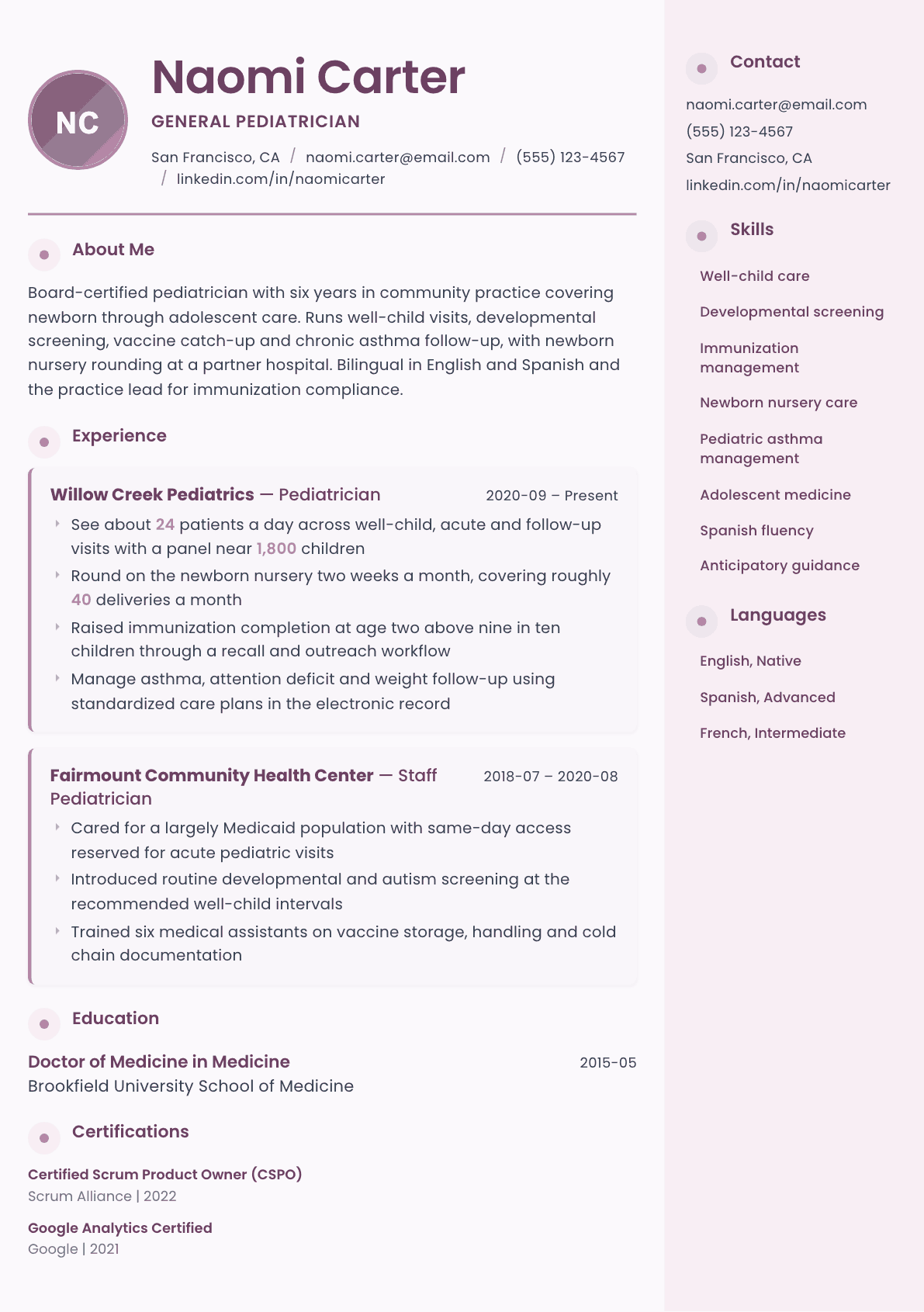
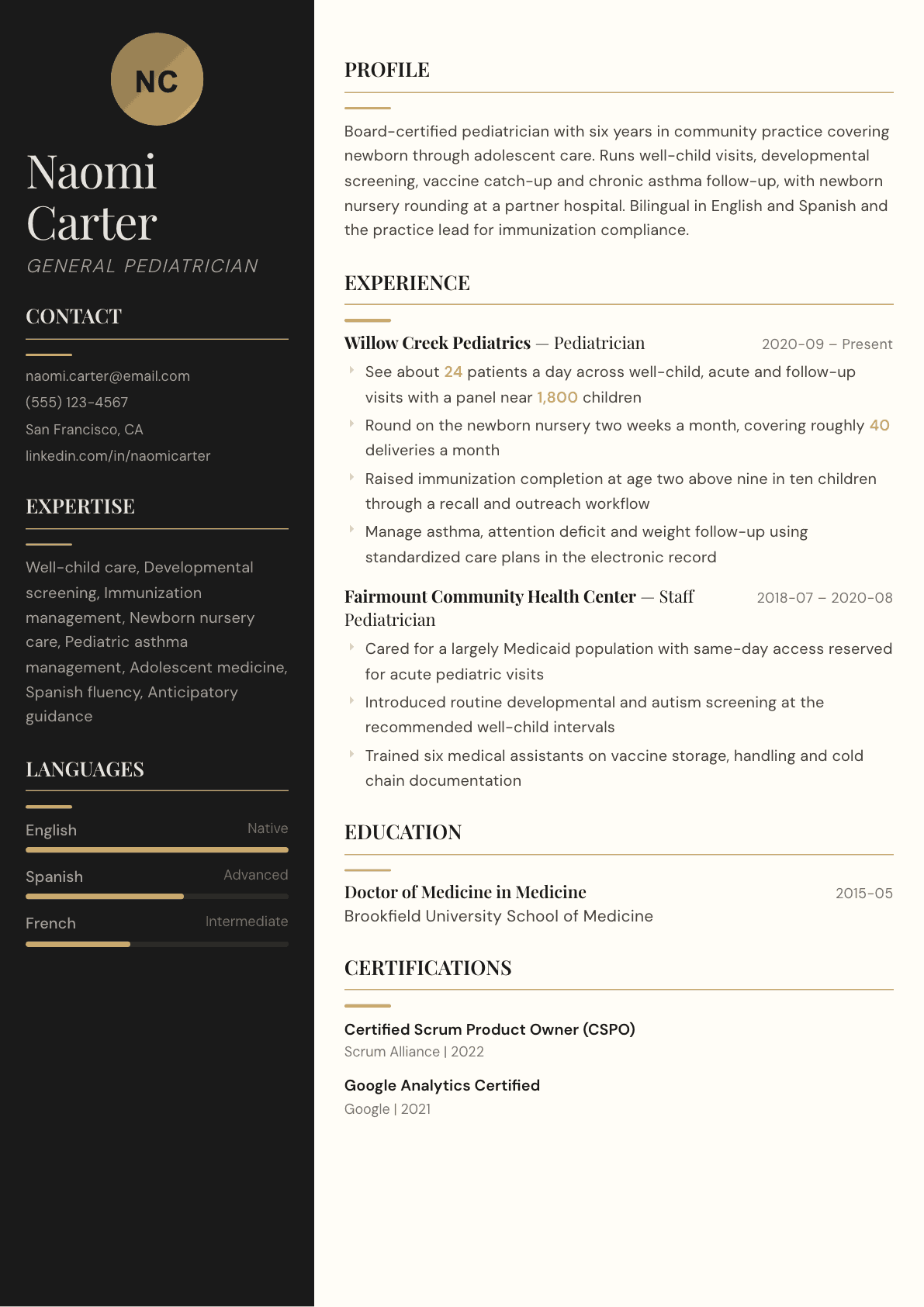
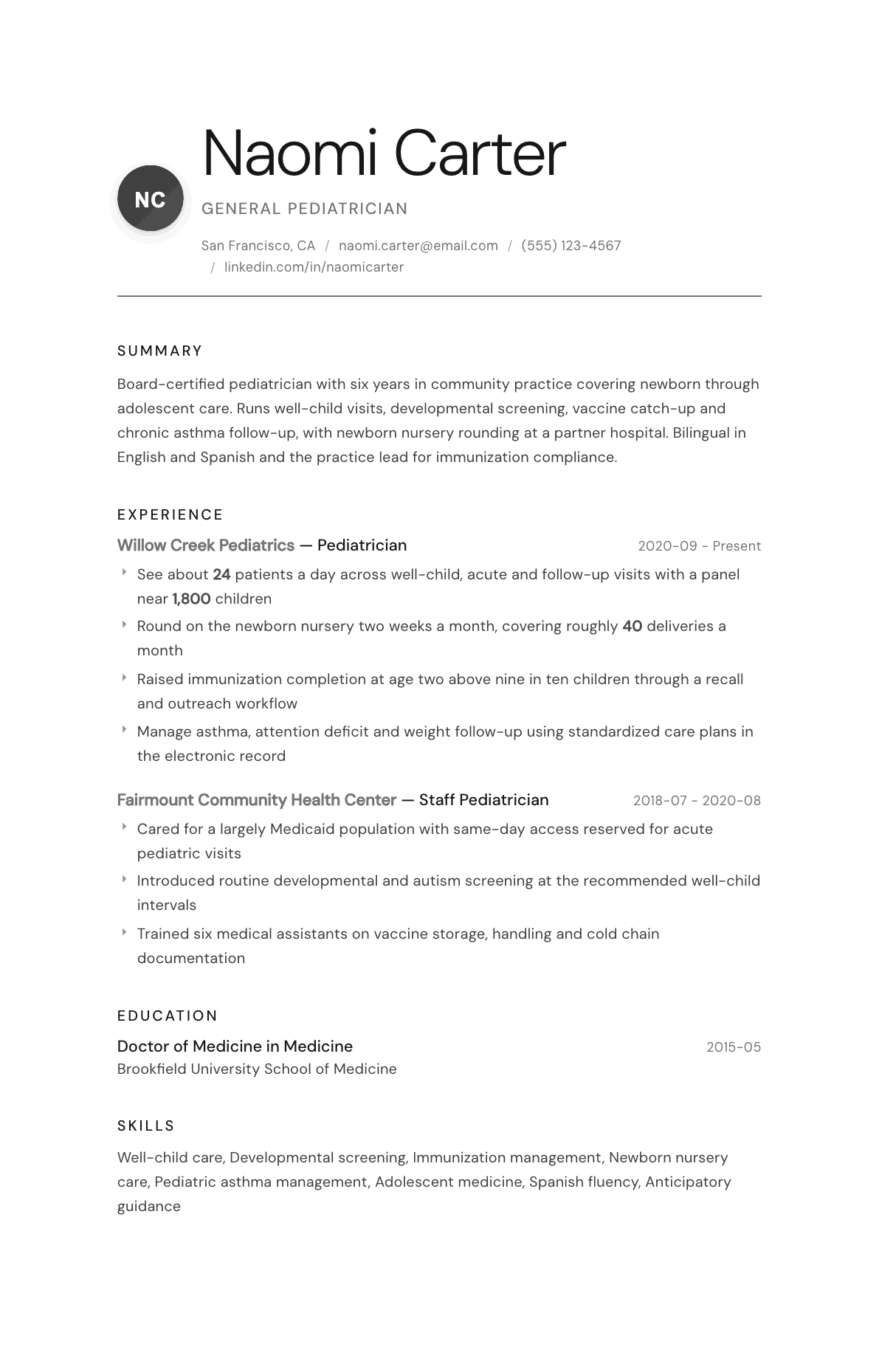
Example Pediatrician summary
Board-certified pediatrician with six years of community practice, carrying a panel near 1,800 children and seeing about 24 patients a day from newborn visits through adolescent care. Rounds on a newborn nursery two weeks a month, raised two-year immunization completion above nine in ten children, and manages asthma and behavioral follow-up. Bilingual in English and Spanish and looking for a group practice with hospital nursery coverage.
Skills to list on a Pediatrician resume
- General pediatrics
- Well-child examinations
- Immunization schedules
- Developmental screening
- Newborn and nursery care
- Pediatric asthma management
- Adolescent medicine
- Behavioral health screening
- Anticipatory guidance
- Acute pediatric illness
- Growth and nutrition counseling
- Parent education
- Pediatric advanced life support
- Electronic health records
What actually gets this resume read
- Name the age range you cover, from newborn nursery through adolescence, because practices staff for specific gaps.
- Give panel size and daily visit volume so a group can judge whether you can carry their schedule.
- Show preventive metrics you moved: immunization completion, well-child visit rates or developmental screening coverage.
- Mention newborn nursery, delivery attendance and any hospital privileges separately from your outpatient work.
- List languages spoken with patients, because pediatric practices value direct communication with parents.
- Include school, sports and special needs care experience if the posting mentions a specific community population.
How to write a pediatrician resume
A pediatrician resume is usually read by a practice owner or a medical group manager who has a schedule with holes in it. They are asking whether you can take a full panel of children, whether you cover the newborn nursery, and how you handle the parts of pediatrics that consume the day: vaccine conversations, behavioral concerns, and parents who need twenty minutes when the schedule allows fifteen.
Preventive care is the measurable half of the job. Immunization completion, well-child visit rates, developmental screening coverage and lead or anemia screening are tracked by payers and reported by practices. A pediatrician who has moved one of those numbers has something to write that almost nobody else writes.
This guide covers panel and visit volume, nursery and hospital coverage, how to present preventive metrics, the language pediatric postings reuse, and the questions pediatricians ask when they move between community practice, community health centers and hospital-owned groups.
Format: one clean document, credentials visible, two pages maximum
Reverse chronological, two pages, no columns or icons. Under the header put a short credentials block with board certification and status, state license and expiration, controlled substance registration, and current pediatric life support and neonatal resuscitation cards. Practices verify these before scheduling an interview.
If you speak a second language with patients, put it in the header line rather than at the bottom of the page. In pediatrics the parent is the historian, and a practice serving a bilingual community treats that as a clinical qualification.
- Header: name and degree, city and state, phone, email, languages spoken with families.
- Credentials: board certification, license, life support and neonatal resuscitation cards.
- Then summary, practice history, residency, education, skills, community and committee work.
Summary: age range, panel, setting, and the extras you cover
Say which ages you cover, from newborn nursery through adolescence, then the setting and its size, then panel and daily visit volume, then anything beyond the standard clinic day: nursery rounding, delivery attendance, school health, sports physicals or a special needs population.
A pediatrician moving from a community health center into private practice should name the acuity and social complexity handled at the health center, because that experience translates into speed and comfort with families who arrive with more than one problem.
Experience: panel size, visit volume, and preventive results
Open each position with the practice type, the number of clinicians and the patient population. A four-provider suburban practice, a federally qualified health center, and a hospital-owned pediatric clinic run at different tempos and against different quality contracts.
Give the panel size and daily visit count, then the mix: well-child visits, acute sick visits, chronic follow-up and consultations. Practice managers build schedules from those numbers, and a resume without them forces a phone call before any real evaluation happens.
Then the preventive results. Immunization completion at age two, adolescent vaccination rates, developmental and autism screening coverage at the recommended intervals, well-child visit adherence, and lead or hemoglobin screening. Say what you did to move the number, not just that the number exists.
- Practice type, clinician count, patient population and payer mix if it shaped the work.
- Panel size, daily visit volume, and the split across well, sick and chronic visits.
- Newborn nursery weeks, deliveries covered, hospital privileges.
- Preventive measures you improved and the workflow change that did it.
Nursery, hospital and after-hours coverage
Nursery coverage is often the deciding factor between two pediatricians. Give the number of weeks a month you round, the average deliveries covered, whether you attend cesarean deliveries, and whether you manage late preterm infants or transfer them. Groups with a nursery contract need someone who can take that rotation from the first month.
After-hours arrangements matter too. Say whether you took a shared call phone, weekend clinic sessions, an urgent care rotation, or a telephone triage line, and how the volume ran. Pediatric call is mostly telephone advice, and a candidate who is comfortable with it is a candidate who will not renegotiate the schedule after three months.
Skills and keywords a pediatric posting repeats
Pediatric job descriptions reuse a small vocabulary: well-child care, anticipatory guidance, immunization schedules, developmental screening, newborn care, adolescent medicine, asthma action plans, behavioral health screening, growth and nutrition. Mirror the posting wording once in the skills block and once inside a bullet.
Name the electronic record and the registry or recall tool you used for vaccine outreach. Practices measure themselves on immunization rates and want to know you have worked inside the system that produces those reports rather than only reading them.
Pediatrician resume summary examples
New from residency
Pediatrics board eligible, completing residency with continuity clinic panel of about 250 children, six months of newborn nursery rotation and inpatient pediatric ward experience. Certified in pediatric advanced life support and neonatal resuscitation. Seeking a community practice position with nursery coverage and an established vaccine outreach workflow.
Six years in practice
Board-certified pediatrician carrying a panel near 1,800 children at about 24 visits a day, from newborn visits through adolescent care. Rounds on a newborn nursery two weeks a month and raised two-year immunization completion above nine in ten children through a structured recall workflow.
Practice medical director
Pediatrician and medical director of a five-site group with fifteen years of practice, accountable for preventive quality measures, clinician onboarding and schedule design across twenty-two providers. Maintains a personal clinic panel, built the behavioral health integration model, and leads the immunization improvement committee.
Work experience bullets: before and after
Before: Provided well-child care and vaccinations.
After: Delivered well-child care across the full schedule from the first newborn visit to age eighteen, seeing about 24 patients a day with a panel near 1,800 children.
The age range, daily volume and panel size let a practice manager decide immediately whether you fit the open schedule.
Before: Improved immunization rates at the practice.
After: Raised immunization completion at age two above nine in ten children by building a monthly recall list, adding vaccine review to every sick visit and training staff on refusal conversations.
The result plus the three specific workflow changes shows how you would repeat it at the hiring practice.
Before: Rounded in the newborn nursery.
After: Rounded on the newborn nursery two weeks a month covering roughly 40 deliveries, including late preterm infants, hyperbilirubinemia management and lactation support referrals.
Weeks, delivery volume and the clinical detail describe a rotation the group can hand over on day one.
Before: Managed children with asthma.
After: Standardized pediatric asthma follow-up with written action plans, controller review at every visit and spirometry in clinic, cutting emergency department visits among the practice asthma registry.
The named tools and the registry outcome turn a diagnosis mention into a program you ran.
Before: Did developmental screening.
After: Introduced standardized developmental and autism screening at the recommended well-child intervals and built the referral pathway to early intervention with a two-week appointment target.
Adding the intervals and the downstream referral pathway shows the screening actually led somewhere.
Hard skills
- Well-child examination and anticipatory guidance
- Immunization schedules and catch-up planning
- Developmental and autism screening
- Newborn and nursery care
- Late preterm and jaundice management
- Pediatric asthma management
- Adolescent medicine and confidentiality practice
- Behavioral and mental health screening
- Growth, nutrition and weight counseling
- Acute pediatric illness management
- Pediatric advanced life support
- Vaccine storage and cold chain oversight
- Preventive quality measure reporting
Soft skills
- Parent education and reassurance
- Vaccine hesitancy conversations
- Working with a child through an exam
- School and early intervention coordination
- Staff training on pediatric workflows
- Cultural and language sensitivity
Certifications worth listing
- General Pediatrics Certification (American Board of Pediatrics)
- Pediatric Advanced Life Support (PALS) (American Heart Association)
- Neonatal Resuscitation Program (NRP) (American Academy of Pediatrics)
- Basic Life Support (BLS) (American Heart Association)
Mistakes that cost pediatrician candidates the interview
- Leaving out panel size and daily visit volume, the two numbers a practice manager uses to build a schedule.
- Describing pediatrics generically instead of naming the ages, the population and the coverage you carried.
- Skipping nursery and delivery coverage when it is often the reason the position was posted at all.
- Listing preventive quality measures without saying what workflow change moved them.
- Putting spoken languages at the bottom of page two when families are the historians in this specialty.
- Omitting the electronic record and recall tools, which suggests a long ramp before you can run outreach.
Pediatrician resume questions
How do I show my patient panel on a pediatrician resume?
Give a rounded panel size per position along with daily visit volume and the split between well-child, acute and chronic visits. Practices are trying to work out whether you can absorb an existing list, and those three numbers answer it faster than any description.
Does newborn nursery coverage belong on the resume?
Yes, with the number of weeks a month you round and the approximate delivery volume you cover. Nursery contracts are hard for groups to staff, so a pediatrician who can take that rotation immediately is worth more than an equally skilled clinic-only candidate.
How should a new pediatrician without practice experience write this?
Lead with residency continuity clinic panel size, nursery and inpatient rotations, and any longitudinal quality project you completed. Then list your life support and neonatal resuscitation certifications, since practices check those before scheduling interviews with new graduates.
Should I mention experience with a Medicaid or underserved population?
Yes when the hiring practice serves a similar community. Name the social complexity you handled, the same-day access model you worked in, and any interpreter or community health worker collaboration, because that experience shapes how quickly you can run a full clinic there.
What quality measures matter most for a pediatrician?
Immunization completion at age two and adolescent vaccination, well-child visit adherence, developmental screening at the recommended intervals, and lead or anemia screening where required. Pick the two you personally improved and write the workflow change that did it.