Diesel Technician Resume Examples: the lines they read
Write a Diesel Technician Resume That Shows Real Diagnostic Depth
By Mustafa Tarabya, founder of CVBooster · Published · Updated
Diesel technician resume example with engine, aftertreatment and brake inspection keywords, plus a guide to writing certifications, hours and comeback rates.
Sample resumes for a diesel technician
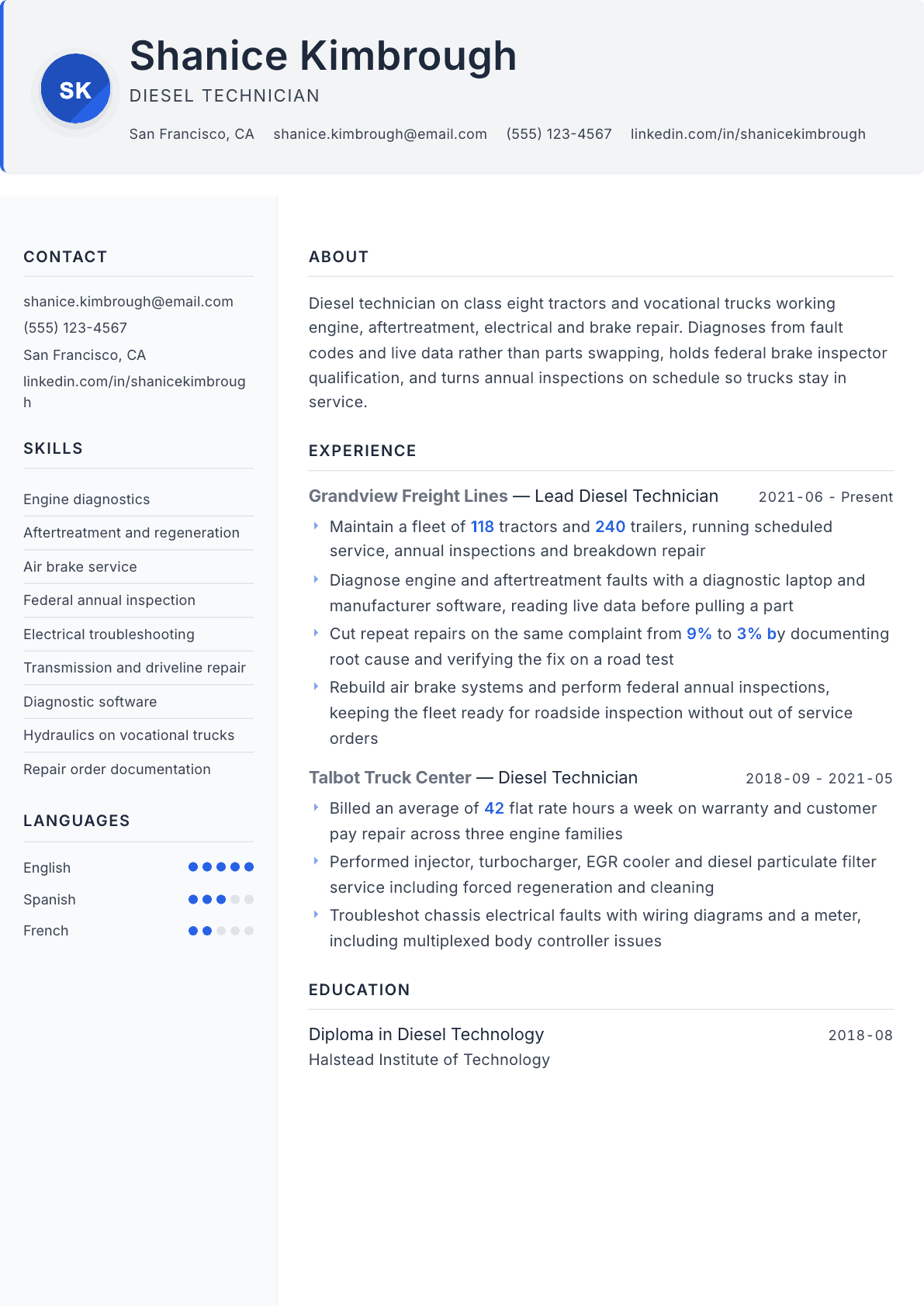
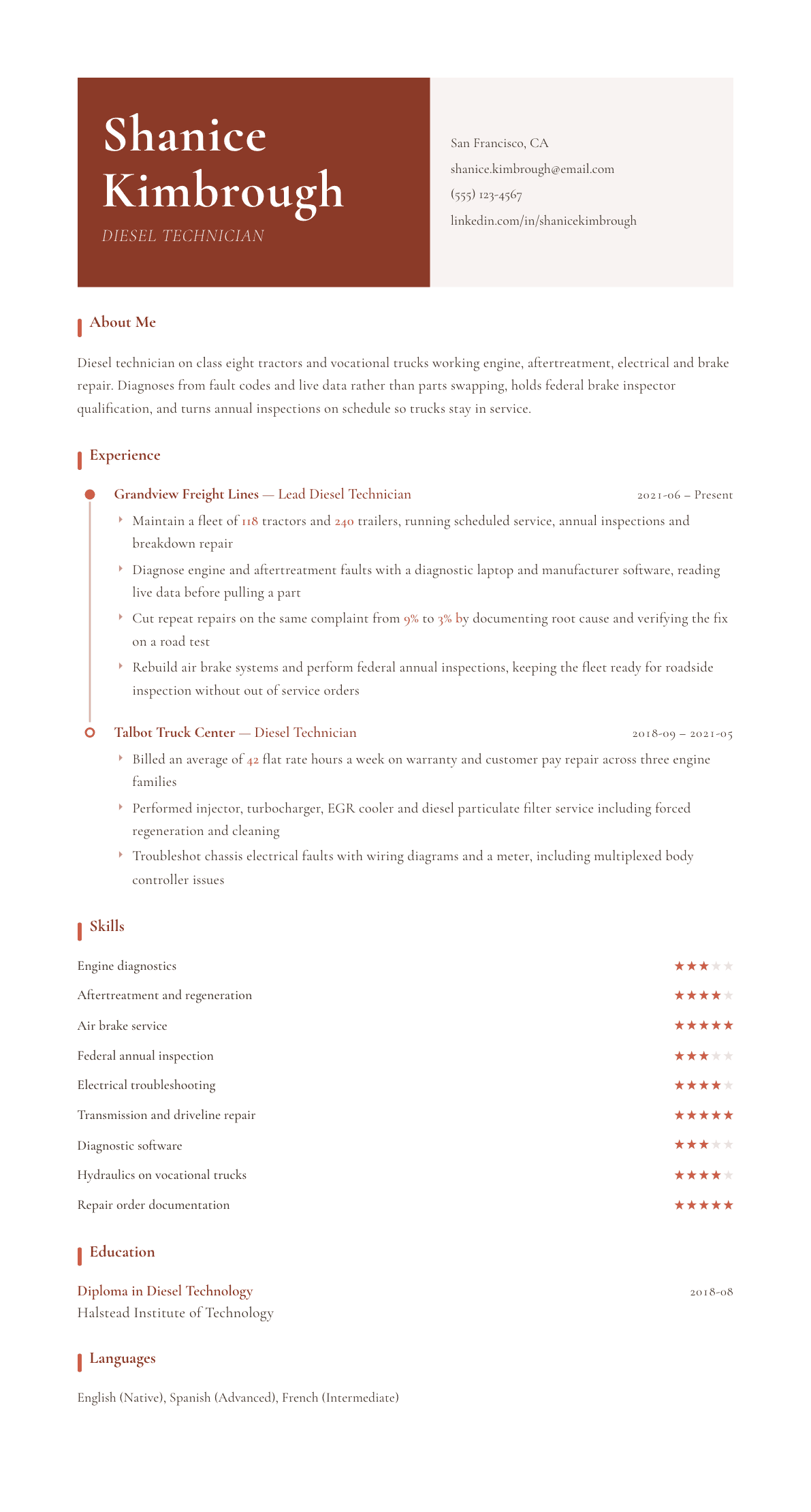
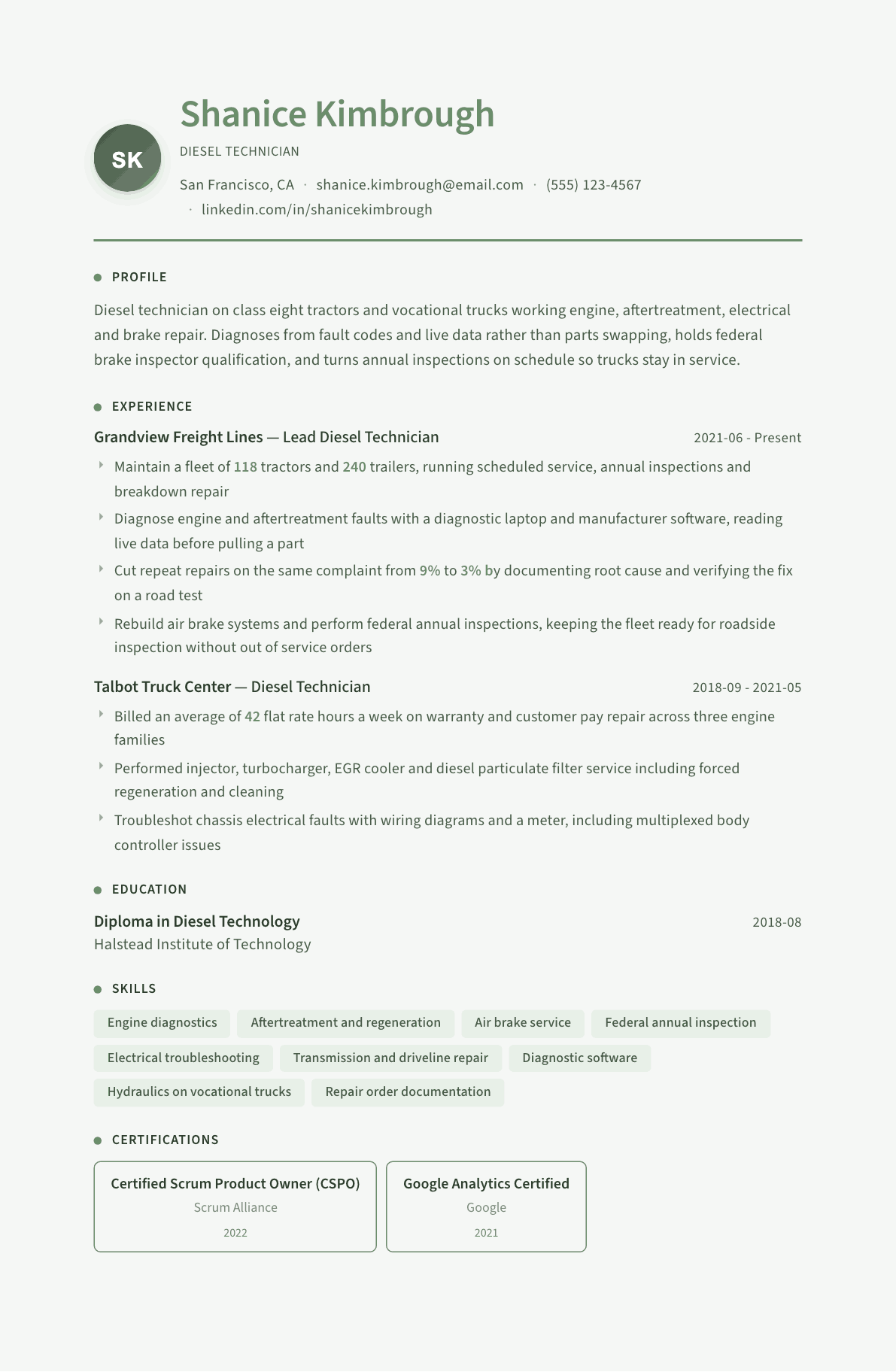
The same diesel technician content laid out in three CVBooster templates, so you can see what the finished document looks like before you write a word.
Example Diesel Technician summary
Diesel technician with seven years across a dealer shop and a private fleet, working class eight engines, aftertreatment, air brakes and chassis electrical. Diagnoses from live data and wiring diagrams before parts are ordered, holds federal brake inspector qualification and signs annual inspections, and keeps repeat repairs low by verifying every fix on a road test. Comfortable on multiple engine families and their diagnostic software.
Skills to list on a Diesel Technician resume
- Heavy duty engine diagnostics
- Fuel injection and injector service
- Turbocharger and EGR repair
- Diesel particulate filter service
- Selective catalytic reduction systems
- Air brake system overhaul
- Federal annual inspection
- Chassis electrical diagnosis
- Multiplexed body controller faults
- Manual and automated transmissions
- Drive axle and differential repair
- Hydraulic system service
- Preventive maintenance programs
- Diagnostic laptop software
- Repair order and warranty documentation
What actually gets this resume read
- List your ASE medium and heavy truck series by number, since a shop foreman reads those codes directly.
- Say whether you hold the federal brake inspector qualification and can sign annual inspections on your own.
- Name the diagnostic software you run for each engine family, because that decides which bays you can cover.
- Give your flat rate hours per week or your fleet size, whichever matches the shops you are applying to.
- Put your comeback rate on the page, because a low repeat repair rate is the strongest proof of real diagnosis.
- Describe your tool box scope and any specialty tooling you own, which shops read as readiness on day one.
How to write a diesel technician resume
A shop foreman reading diesel technician resumes has a bay problem and a comeback problem. He needs someone who can be productive on day one without a two week orientation, and he needs the repairs to hold, because a truck that returns for the same complaint costs him the labor twice and costs the customer a load. Your resume should answer both before he reaches the education section.
The word diesel covers several different jobs. Highway tractors, vocational trucks with hydraulics and body equipment, buses, agricultural equipment and off road machines all use the title. Aftertreatment work, electrical diagnosis and inspection authority sit on top of that. Being specific about which of these you do is not a detail, it is the whole placement decision.
This guide covers how to structure the page around certifications and diagnostic depth, how to write repair work so it proves reasoning rather than part replacement, how to present inspection authority and hours, three summaries by stage, before and after bullets, and the questions technicians ask when moving between dealer, fleet and independent shops.
Format: certifications and software above the job history
One page, reverse chronological. Put a certification block near the top listing the medium and heavy truck series you hold by number, any advanced electronic diesel diagnosis credential, refrigerant handling for cab air conditioning, and your inspection authority. Foremen read these codes fluently and use them to decide which bay you belong in.
Beneath that, list the diagnostic software you can actually operate for each engine family, along with the chassis and transmission tools you use. In a shop that runs several manufacturers, software coverage is what determines whether you can take the next truck through the door or have to hand it to someone else.
- Certification block: series held, advanced diagnosis credential, refrigerant certification and inspection authority.
- Software line: the engine, transmission and chassis diagnostic tools you run without help.
- Equipment line: highway tractors, vocational bodies, buses, trailers, off road machines and any hydraulics.
- Tools line: the scope of your box, plus specialty tooling you own that shortens a job.
Summary: equipment, systems, productivity, comeback rate
Four lines. Name the equipment you work on, the systems you are strongest in, your productivity measure, and your comeback rate. Productivity is flat rate hours in a dealer or independent shop and fleet size with uptime in a private fleet, so use whichever matches the shop you are applying to.
Say plainly that you diagnose before you order parts. It sounds obvious, and it is the single most common complaint foremen have about technicians they inherited. Backing it with a comeback figure turns a claim everyone makes into one that only some can support.
Experience: diagnosis, aftertreatment, and repairs that held
Structure each job around systems rather than tasks. Engine mechanical and fuel, aftertreatment, electrical and multiplexing, air brakes and chassis, drivetrain, and hydraulics on vocational units. Under each, describe the depth: in frame work, injector and cup replacement, turbocharger and exhaust gas recirculation service, filter cleaning and forced regeneration, sensor and harness faults traced with a meter and a diagram.
Aftertreatment deserves particular care because it is where fleets lose the most time. A technician who can distinguish a genuine filter restriction from a sensor reporting one, who knows when cleaning is required rather than replacement, and who verifies the repair with a completed regeneration is describing exactly the skill shops are short of.
Then give the comeback number. Repeat repairs on the same complaint, over a stated window, with the practice that produced it: documenting root cause on the repair order and verifying the fix on a road test before the truck leaves. That combination is more persuasive than any list of systems.
Inspections, compliance and the paperwork side
Federal inspection and brake work authority is a real differentiator and it belongs in its own line. A shop that can sign annual inspections in house keeps trucks off the road for less time, and a technician qualified to perform brake inspections and sign the form is worth more than one who has to hand the truck to someone else.
Repair order writing matters more than most technicians think. Complaint, cause and correction written clearly is what supports a warranty claim, protects the shop in a dispute and tells the next technician what was already ruled out. Say that you write them properly, because foremen spend real time correcting the ones that are not.
- State your inspection authority explicitly and whether you sign the annual inspection form yourself.
- Mention warranty work if you have done it, since warranty claims fail on documentation more than on diagnosis.
- Note any experience with roadside inspection preparation and keeping a fleet clear of out of service orders.
- Include preventive maintenance program design if you set intervals rather than just following them.
Dealer, fleet and independent shops want different pages
A dealer resume leans on flat rate productivity, warranty documentation and depth on one or two engine families. A private fleet resume leans on uptime, preventive maintenance completion, inspection authority and the ability to keep mixed equipment running with limited parts on hand. An independent shop wants breadth across several manufacturers and the judgment to repair economically.
Write the version that matches the posting rather than sending one page everywhere. The terms that recur are diesel technician, heavy duty, engine diagnostics, aftertreatment, particulate filter, selective catalytic reduction, injectors, turbocharger, air brakes, annual inspection, chassis electrical, preventive maintenance and flat rate hours. Use the ones your record supports.
Diesel Technician resume summary examples
Recent graduate
Diesel technology graduate with 12 months in a truck shop performing preventive maintenance, brake and suspension work, and assisting on engine and aftertreatment repairs. Comfortable with a diagnostic laptop for fault code retrieval and live data. Working toward the medium and heavy truck certification series and a brake inspector qualification.
Five years, dealer shop
Diesel technician billing an average of 42 flat rate hours a week across warranty and customer pay repair on three engine families. Performs injector, turbocharger, exhaust gas recirculation and particulate filter service, traces chassis electrical and multiplexed faults with diagrams and a meter, and holds federal brake inspector qualification.
Lead technician, private fleet
Lead diesel technician maintaining 118 tractors and 240 trailers, running preventive maintenance intervals, annual inspections and breakdown repair. Cut repeat repairs on the same complaint from 9% to 3% by documenting root cause and road testing every fix, and mentors two technicians on aftertreatment diagnosis.
Work experience bullets: before and after
Before: Repaired diesel engines and did maintenance.
After: Maintained a fleet of 118 tractors and 240 trailers, covering preventive maintenance intervals, federal annual inspections, breakdown repair and seasonal readiness across three engine families.
Fleet size and the work categories tell a foreman what kind of shop you have actually operated inside.
Before: Used diagnostic tools to find engine problems.
After: Diagnosed engine and aftertreatment faults with a diagnostic laptop and manufacturer software, comparing live data against expected values and checking wiring and sensors before condemning a component.
It shows the sequence a foreman wants, which is data and circuit checks before parts leave the counter.
Before: Worked on emissions systems.
After: Serviced particulate filters and selective catalytic reduction systems, distinguishing genuine restriction from sensor reported restriction, cleaning filters where cleaning was appropriate, and verifying repairs with a completed regeneration.
Aftertreatment is where fleets lose time, and this shows judgment rather than a habit of replacing assemblies.
Before: Reduced repeat repairs.
After: Cut repeat repairs on the same complaint from 9% to 3% over four quarters by writing complaint, cause and correction on every order and road testing each truck before it left the yard.
The metric and the two habits behind it explain how the improvement happened and how it would happen again.
Before: Did DOT inspections.
After: Performed federal annual inspections as a qualified brake inspector, rebuilding air brake systems where measurements required it, and kept the fleet clear of out of service orders through the inspection season.
Naming the qualification and the outcome shows authority you hold rather than a task you assisted with.
Hard skills
- Heavy duty engine diagnostics
- In frame engine repair
- Fuel system and injector service
- Turbocharger and exhaust gas recirculation repair
- Particulate filter service and regeneration
- Selective catalytic reduction systems
- Air brake system inspection and overhaul
- Federal annual inspection
- Chassis electrical diagnosis
- Multiplexed body controller faults
- Manual and automated transmission repair
- Drive axle and differential service
- Hydraulic systems on vocational equipment
- Preventive maintenance interval design
- Repair order and warranty documentation
Soft skills
- Staying with a hard fault instead of guessing at a part
- Writing an order the next technician can read
- Explaining a repair estimate to a driver or a fleet manager
- Keeping pace in a busy bay without cutting a verification step
- Teaching a newer technician the diagnostic sequence
Certifications worth listing
- ASE Master Medium/Heavy Truck Technician (National Institute for Automotive Service Excellence)
- ASE L2 Electronic Diesel Engine Diagnosis Specialist (National Institute for Automotive Service Excellence)
- EPA Section 609 Motor Vehicle Air Conditioning Certification (United States Environmental Protection Agency)
- Commercial Driver License Class A (State department of motor vehicles)
Mistakes that cost diesel technician candidates the interview
- Writing repaired diesel engines without naming systems, equipment types or the depth of the work performed.
- Leaving out the diagnostic software you can run, which decides which trucks you can take through the door.
- Listing certifications as a vague set instead of naming the series a foreman recognizes by number.
- Ignoring aftertreatment even though it is where most fleet downtime and most misdiagnosis happen.
- Omitting comeback or repeat repair figures, the only objective evidence that your repairs hold.
- Sending a flat rate dealer resume to a private fleet that hires for uptime and inspection authority.
Diesel Technician resume questions
Do I need certifications to be hired as a diesel technician?
Not always, but they set your pay band and they move you past screening at larger shops. If you are working toward them, list the ones passed and the date you sit the rest. A foreman reads intent as well as achievement.
How do I show productivity if my shop did not use flat rate?
Use the measure your shop did use. Fleet size covered, trucks through the bay in a week, preventive maintenance completion against schedule, or uptime on the equipment you were responsible for. The point is a number, not a particular accounting system.
Should I list my tools on a diesel resume?
Give the scope in one line and name specialty tooling that shortens real jobs, such as an injector puller set or a scope. Shops read the tool line as how quickly you become billable, and heavy truck tooling is expensive enough to matter.
How do I move from automotive into heavy truck work?
Lead with the transferable diagnostic discipline, then be honest about what is new: air brakes, aftertreatment scale, multiplexed chassis systems and inspection rules. Shops will train a good automotive diagnostician, but they want the gap acknowledged rather than papered over.
Is off road or agricultural experience worth including?
Yes, especially the hydraulics, electrical and engine work, which transfer directly. Name the machine types so the reader can judge the overlap, and be clear about which highway systems you have not worked so the interview starts in the right place.
Related resume examples
- Diesel Mechanic Resume example
- Mechanic Resume example
- Heavy Equipment Mechanic Resume example
- Fleet Mechanic Resume example
- Auto Mechanic Resume example
- Automotive Technician Resume example