Automotive Engineer Resume Examples: what gets the call
Build an Automotive Engineer Resume Around Programs, Gates and Launch Results
By Mustafa Tarabya, founder of CVBooster · Published · Updated
Automotive engineer resume example with program milestones, validation testing and APQP work, plus recruiter keywords and a writing guide.
Sample resumes for a automotive engineer
The same automotive engineer content laid out in three CVBooster templates, so you can see what the finished document looks like before you write a word.
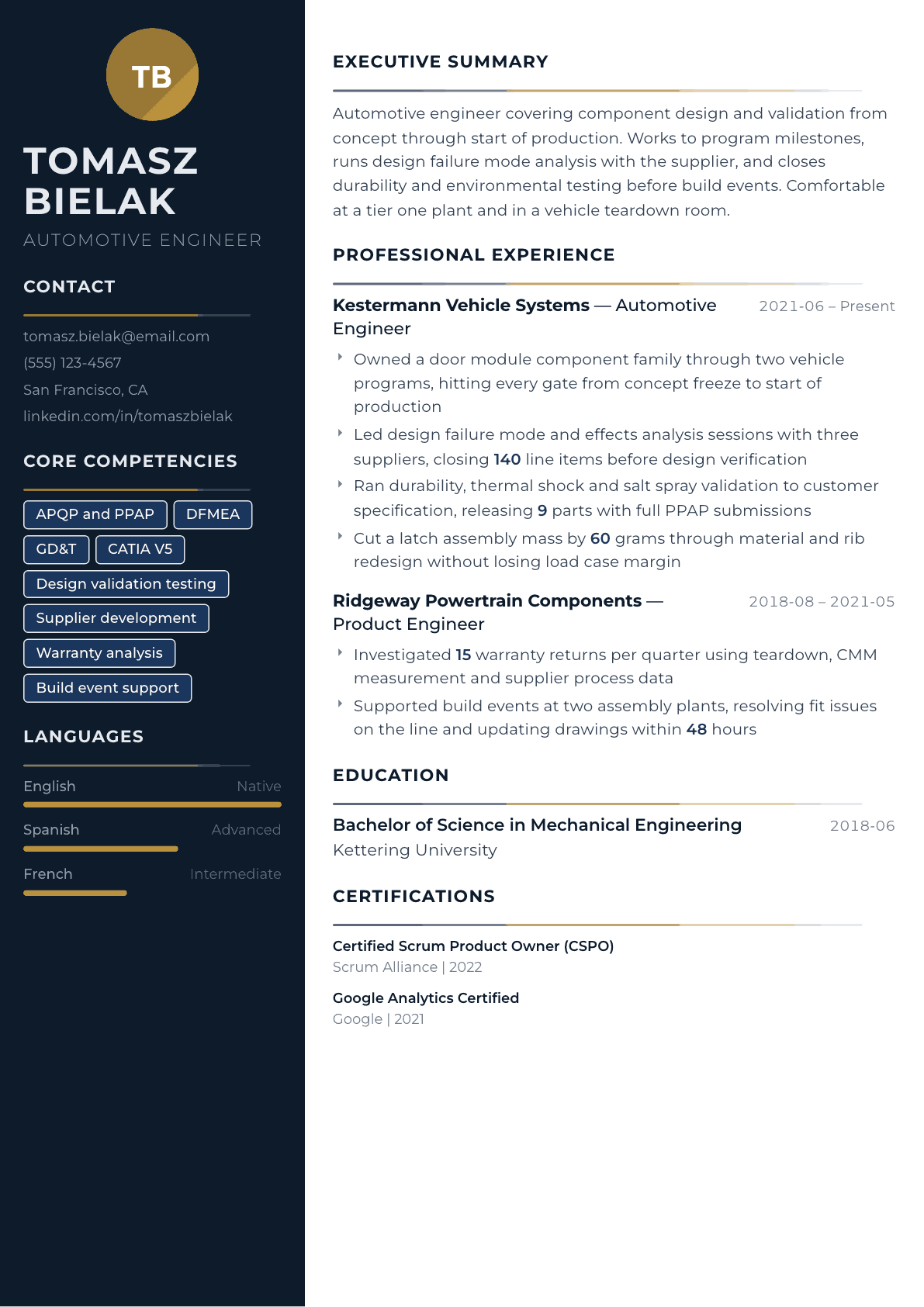
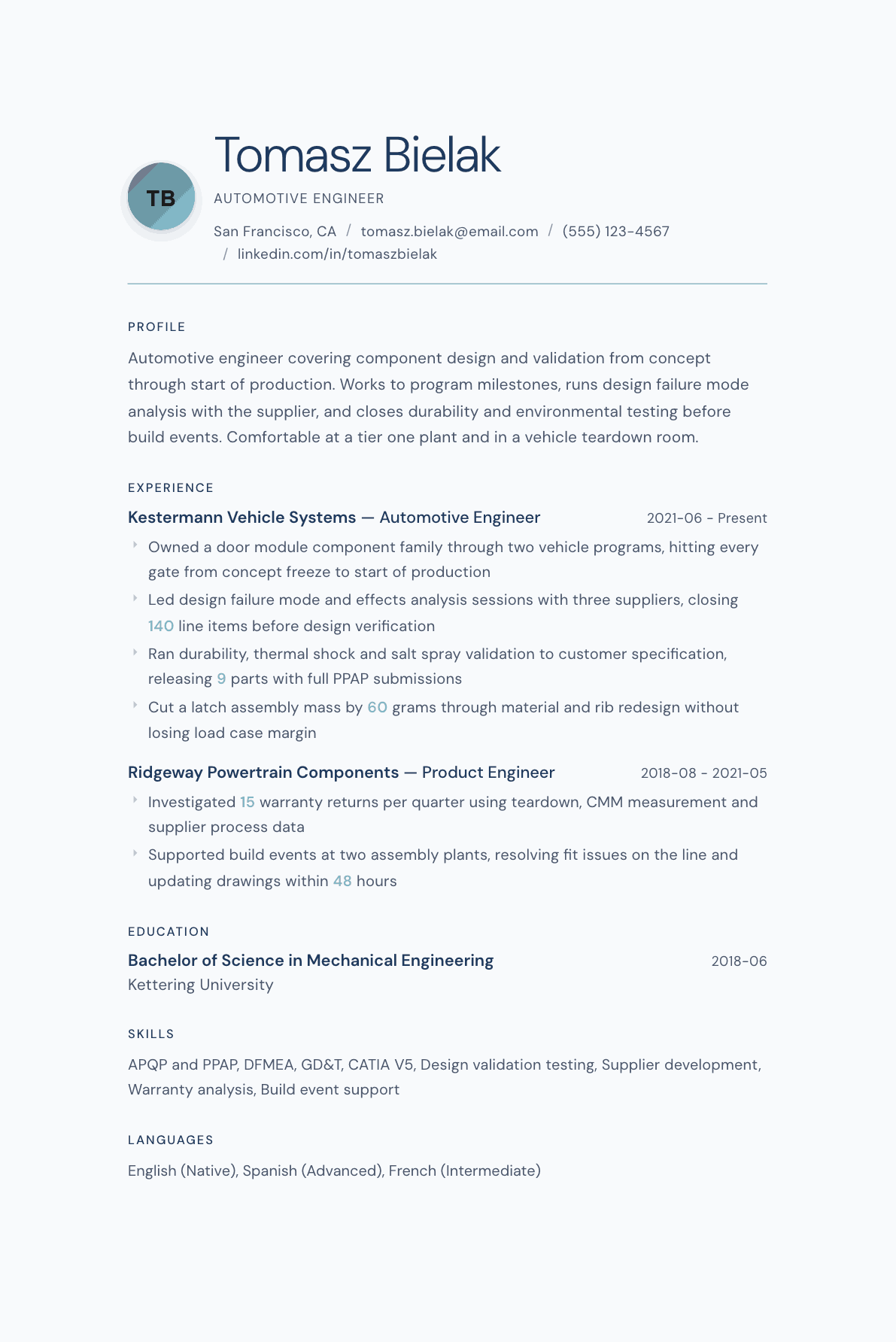
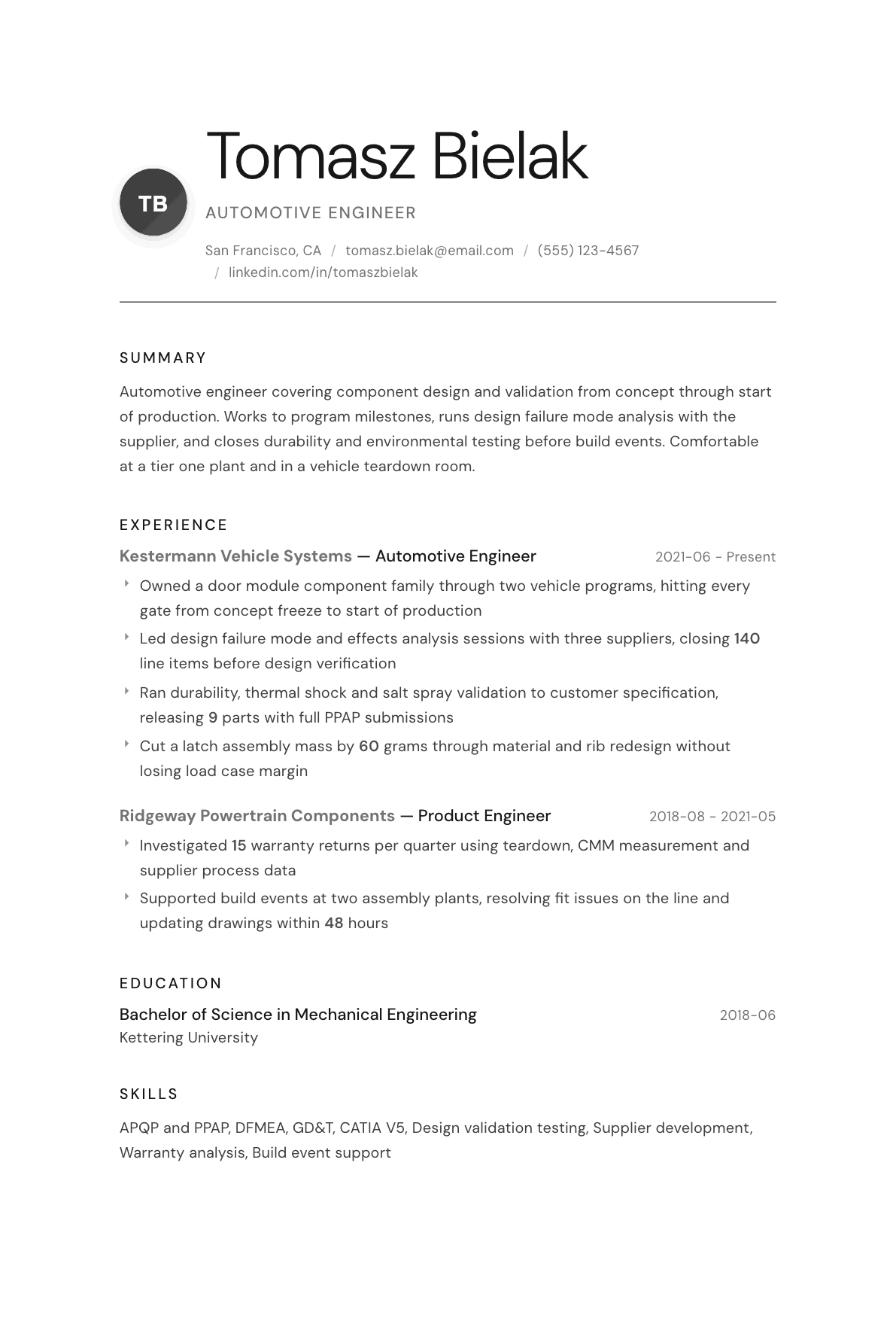
Example Automotive Engineer summary
Automotive engineer with six years of component ownership across body and powertrain programs at tier one suppliers. Carries parts from concept freeze to start of production, leads design failure mode analysis with suppliers, and closes durability and environmental validation to customer specification. Reduced latch assembly mass and resolved fit issues on the line during plant build events. Seeking a lead product engineering role on an electric vehicle program.
Skills to list on a Automotive Engineer resume
- APQP
- PPAP
- DFMEA and PFMEA
- GD&T
- CATIA V5
- NX
- Design validation planning
- Durability and environmental testing
- Supplier development
- Control plans
- Warranty and teardown analysis
- Tolerance stack analysis
- IATF 16949
- Build event support
- Cost and mass reduction
What actually gets this resume read
- Structure each job around vehicle programs, naming the segment and the gates you carried the part through.
- Use the language of the quality system: APQP, PPAP, DFMEA, PFMEA, control plan and production part approval.
- Say which validation tests you ran and to whose specification, since customer specific requirements vary by manufacturer.
- Mention mass, cost or warranty reduction with a real figure, because those three numbers dominate component reviews.
- Note plant and build event experience separately, as it tells a manager you can hold your ground on a line.
- List your CAD system and version, since a tier one supplier will match it against what the customer mandates.
How to write a automotive engineer resume
Automotive engineering runs on programs and gates, so an automotive engineer resume that lists duties instead of programs is unreadable to the people hiring. A component engineering manager wants to know which vehicle programs you carried a part through, which gates you personally cleared, and whether the part launched on time.
There is a second filter underneath. Tier one and original equipment groups screen on quality system vocabulary, because a candidate who has never run a production part approval submission will need months of coaching before they can release anything. Advanced product quality planning, design failure mode analysis and control plans are not buzzwords here, they are the job.
This guide covers the program-first structure these resumes need, three summaries across career stages, before and after bullets from validation and plant work, and the questions engineers ask when a program was canceled or moved to another region.
Format: one block per program, gates named
Under each employer, write a short block per vehicle program with the segment, the customer type and the component family you owned. Then bullets for the gates you cleared: concept freeze, design verification, production part approval, start of production. That structure mirrors how the work is reviewed internally, so a manager can read it at a glance.
One page for the first three or four years, two pages once you have launched multiple programs. Single column, no icons, because supplier applicant tracking systems handle these files roughly and the dates are what matter.
- Header: name, city and state, phone, email, and a line noting willingness to relocate to a manufacturing region.
- Sections: summary, technical skills, experience by program, education, certifications and training.
- Add a systems line naming your CAD platform and version, since customer mandates make that a hard filter.
Summary: component family, tier, and launch record
Name the component family and the position in the supply chain in the first sentence, because a body closures engineer at a tier one and a powertrain calibration engineer at an original equipment manufacturer have almost no overlap. Then state how many parts you have released to production.
A launch record is the most persuasive thing on an automotive engineer resume. Saying you released nine parts with full production part approval submissions across two programs communicates competence more directly than any adjective available.
Experience: quality system language, used correctly
Use the vocabulary precisely. Advanced product quality planning is the framework. Design failure mode and effects analysis covers the product, process failure mode analysis covers the line, and the control plan is what falls out of the latter. Production part approval is the submission that lets a part ship to the customer. Confusing these terms is noticed instantly by anyone who has sat through a customer audit.
Validation deserves its own bullets. Say which tests you ran, to whose specification, and what the parts had to survive. Durability cycles, thermal shock, salt spray, vibration and dust testing each imply a different failure mode, and naming them shows you understood what you were qualifying against.
Plant and build event work is worth disproportionate space. An engineer who has stood on a line during a build event and turned a drawing change around in two days is scarce, and that experience is what a manager keeps in mind when the launch schedule tightens.
Numbers that matter: mass, cost, warranty
Three figures dominate component reviews. Mass, because vehicle programs run weight budgets down to the gram. Piece cost, because the business case lives there. Warranty rate, because a field failure erases both of the other two. Every automotive engineer resume should carry at least one bullet with a real number from one of these three.
Write them as engineering outcomes, not claims. Sixty grams removed from a latch assembly through material and rib redesign while holding load case margin is a bullet an interviewer can dig into for ten minutes, which is exactly what you want.
Skills, standards and the electrification question
Keep a compact skills block with the quality system tools, the CAD platform, the simulation you run, and the standards you work to such as IATF 16949 or a customer specific requirements set. Geometric dimensioning and tolerancing belongs there too, because drawing literacy is assumed and its absence is noticed.
If you have battery, electric drive unit, thermal management or high voltage safety experience, give it a named block rather than a mention. Groups moving programs toward electrification screen for that experience first, and it is the fastest way for a mechanical background to stay relevant.
Automotive Engineer resume summary examples
New graduate
Mechanical engineering graduate from a cooperative program with three terms at a tier one supplier, covering component drawings, tolerance stack analysis and design verification test support. Trained in CATIA V5 and geometric dimensioning and tolerancing. Seeking an entry automotive engineer role in body or interior systems.
Six years in
Automotive engineer owning a door module component family across two vehicle programs, from concept freeze through start of production. Leads design failure mode analysis with suppliers, runs durability and environmental validation to customer specification, and has released nine parts with full production part approval submissions.
Lead product engineer
Lead automotive engineer with fifteen years across body and powertrain components at tier one suppliers, responsible for a component portfolio spanning four customers. Has launched eleven programs, cut warranty rates on two legacy families, and now leads a group of six product engineers through gate reviews.
Work experience bullets: before and after
Before: Responsible for component design on vehicle programs.
After: Owned a door module component family through two vehicle programs, clearing every gate from concept freeze to start of production with no gate slipped for a design reason.
Gate ownership with an explicit outcome is how automotive managers judge whether a part engineer can carry a program.
Before: Participated in FMEA meetings.
After: Led design failure mode and effects analysis sessions with three supplier engineering teams, closing 140 line items and feeding the resulting special characteristics into the control plan.
Leading rather than attending, plus the link into the control plan, shows command of the quality system.
Before: Completed validation testing.
After: Ran durability, thermal shock and salt spray validation to customer specification, releasing nine parts with full production part approval submissions and no rejected packages.
Named tests plus a submission outcome prove the parts actually reached production rather than a report.
Before: Reduced weight on a part.
After: Cut 60 grams from a latch assembly through a material change and rib redesign, holding load case margin and passing durability without a retest of the mating structure.
A mass figure with the constraint it respected is the form a weight reduction claim has to take.
Before: Supported plant launch activities.
After: Supported build events at two assembly plants, resolving fit issues on the line with the plant team and turning updated drawings around within 48 hours to keep the build running.
Response time during a build event is the specific detail that separates plant experience from a plant visit.
Hard skills
- Advanced product quality planning
- Production part approval process
- Design and process failure mode analysis
- Control plan development
- Geometric dimensioning and tolerancing
- Tolerance stack analysis
- CATIA V5 and NX
- Design validation planning and reporting
- Durability and environmental testing
- IATF 16949 quality system
- Supplier development and audits
- Warranty and teardown analysis
- Coordinate measuring machine data review
- Cost and mass reduction studies
Soft skills
- Holding a position in a gate review
- Working with plant teams under launch pressure
- Supplier negotiation
- Clear drawing communication
- Prioritizing across parallel programs
- Coaching junior engineers on the quality system
Certifications worth listing
- Certified Quality Engineer (American Society for Quality)
- Certified Six Sigma Green Belt (CSSGB) (American Society for Quality)
- Geometric Dimensioning and Tolerancing Professional (American Society of Mechanical Engineers)
- Fundamentals of Engineering (FE) (NCEES)
Mistakes that cost automotive engineer candidates the interview
- Writing a duties list instead of program blocks, which makes it impossible to tell how many launches you have behind you.
- Using quality system terms loosely, since anyone who has survived a customer audit hears the error immediately.
- Omitting the CAD platform and version when the customer mandates one, which removes you from a hard filter.
- Leaving out plant and build event experience, the scarcest capability on most component engineering teams.
- Giving no mass, cost or warranty figure anywhere, so the resume never touches the three numbers programs run on.
- Hiding a canceled program instead of stating the phase reached, which leaves an unexplained gap in the history.
Automotive Engineer resume questions
How do I list a vehicle program that was canceled?
Name the program by segment rather than by customer if there is sensitivity, say which gate it reached, and describe what you delivered up to that point. Cancellations are routine in this industry, and the phase you cleared is what a hiring manager is measuring anyway.
Does my resume need production part approval experience?
For component engineering roles at suppliers it is close to essential, because releasing a part without it is not possible. If you have supported submissions rather than owned them, say support explicitly. Overstating ownership is exposed the first time someone asks about a rejected package.
How do I move from mechanical engineering into an automotive role?
Lead with the transferable evidence: tolerance analysis, validation planning, supplier work and drawing release. Then name any quality system exposure, even from another regulated industry. Managers hire for gate discipline, so show that you have worked to a phased release process somewhere.
Should I include electrification experience separately?
Yes, give it a named block. Battery pack, electric drive unit, thermal management and high voltage safety work are screened for first by groups converting their programs, and burying that experience inside a general component list wastes the strongest asset on your resume.
How much plant experience should an automotive engineer show?
As much as you honestly have, described concretely. Name the plants, the build event types and the response time you held. Line-side problem solving is the hardest thing to teach a design engineer, so even a handful of build events deserves its own bullets rather than a passing phrase.
Related resume examples
- Mechanical Engineer Resume example
- Manufacturing Engineer Resume example
- Product Engineer Resume example
- Supplier Quality Engineer Resume example
- Design Engineer Resume example
- Mining Engineer Resume example