Avionics Technician Resume Examples: what gets the call
Write an Avionics Technician Resume Around Installs, Tests and Paperwork
By Mustafa Tarabya, founder of CVBooster · Published · Updated
Avionics technician resume example with wiring, navigation and certification test keywords, plus a guide to writing installs, troubleshooting and approvals.
Sample resumes for a avionics technician
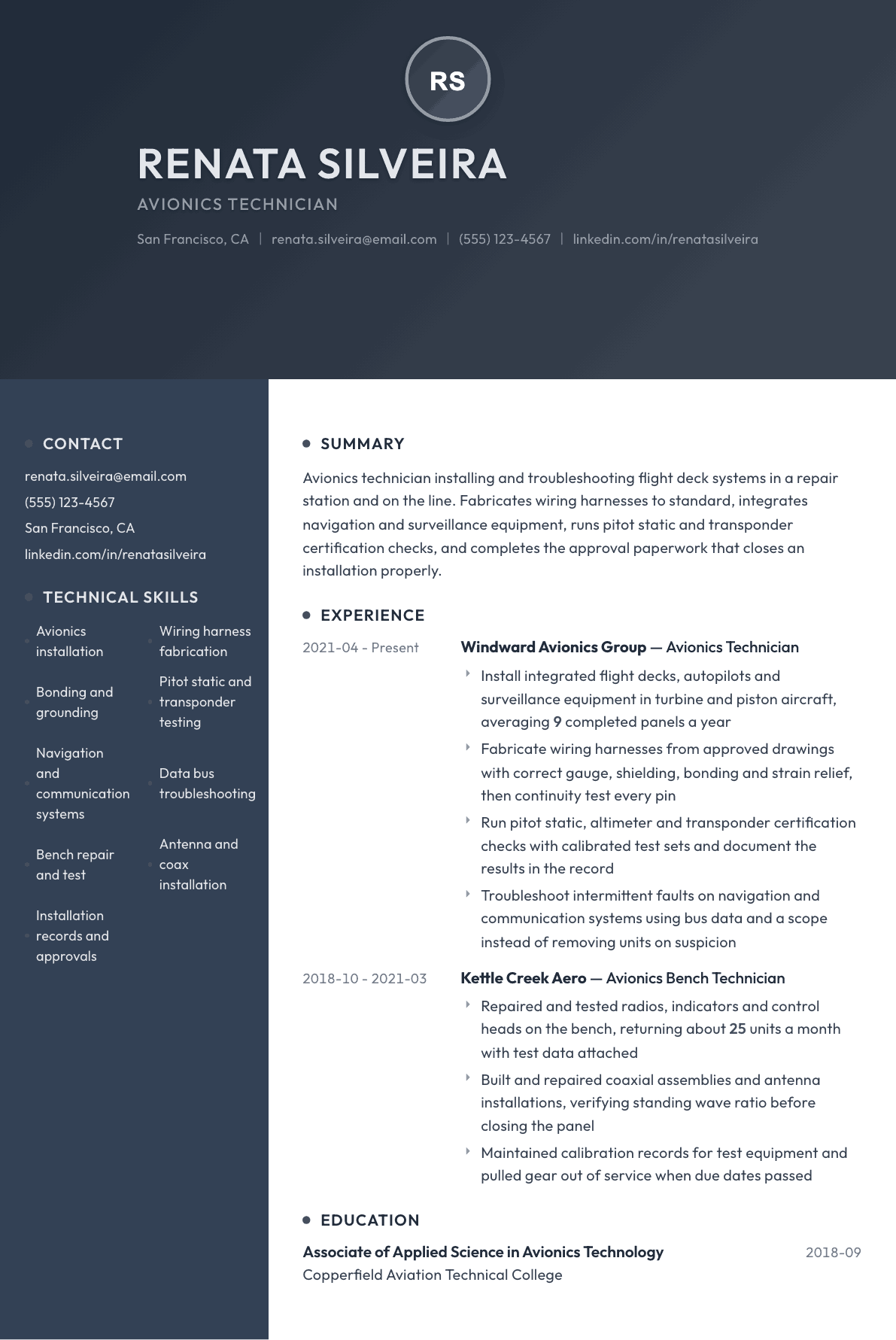
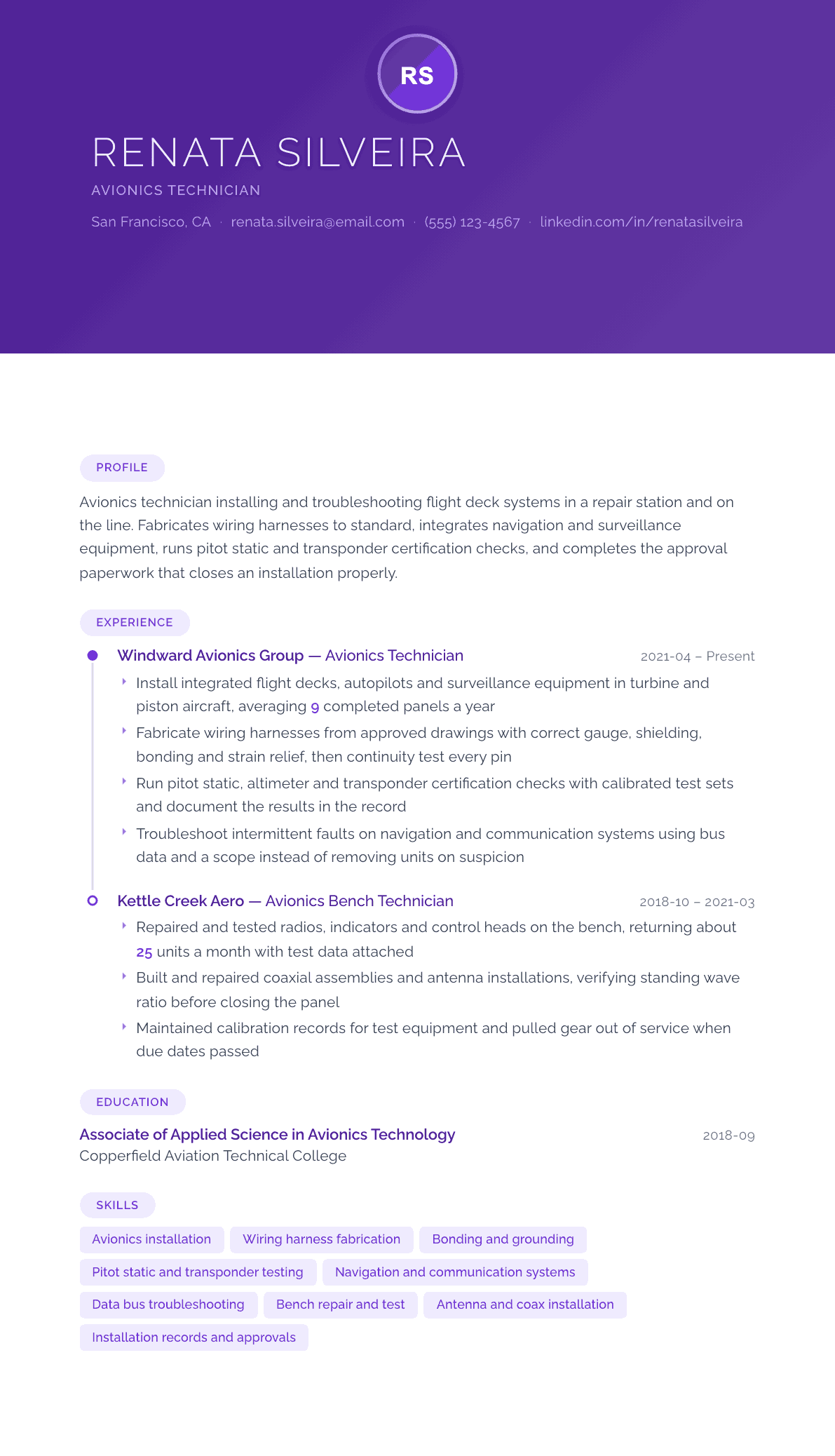
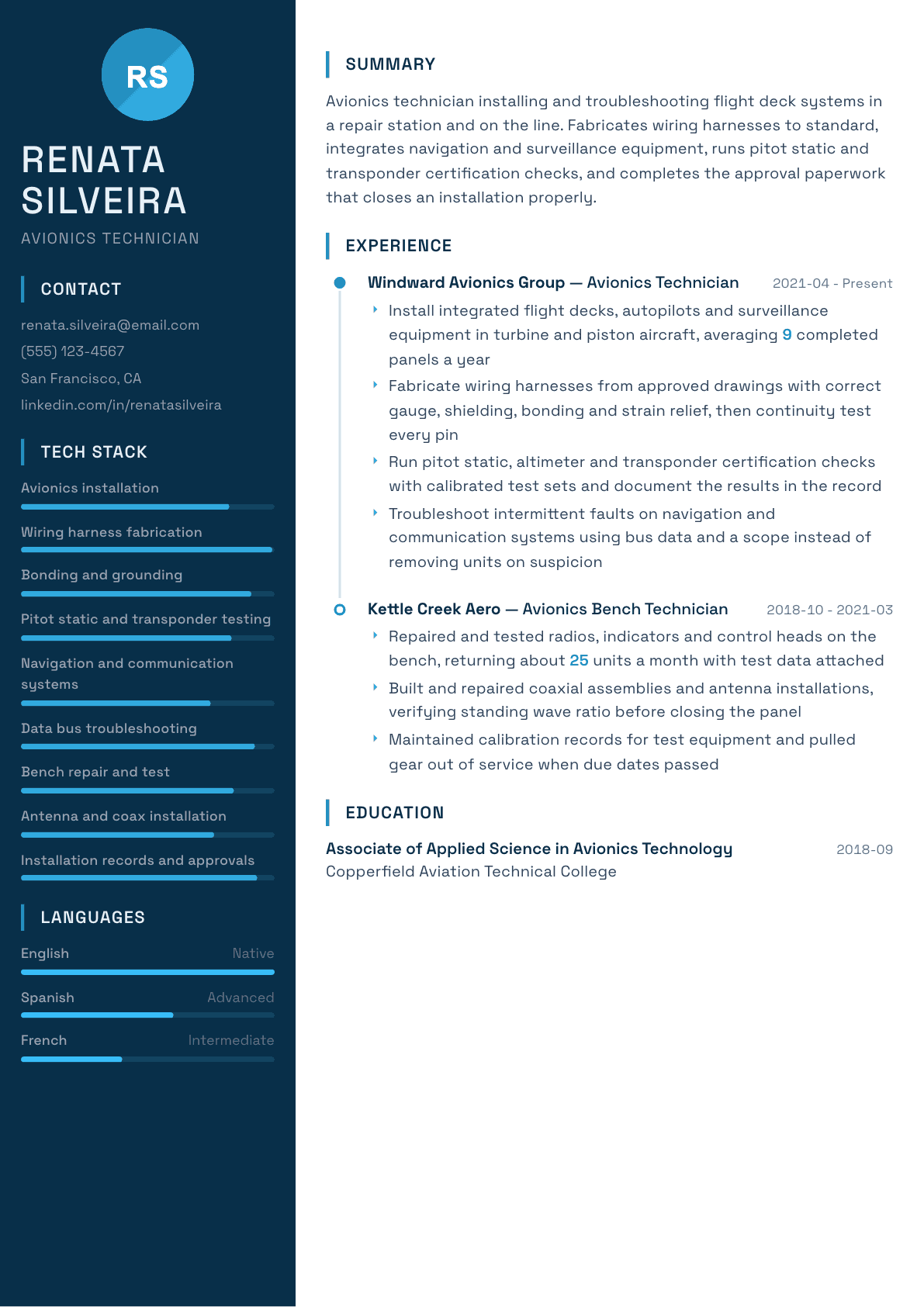
The same avionics technician content laid out in three CVBooster templates, so you can see what the finished document looks like before you write a word.
Example Avionics Technician summary
Avionics technician with seven years across bench repair and aircraft installation, covering integrated flight decks, autopilots, navigation and surveillance systems. Fabricates harnesses to approved drawings with correct shielding and bonding, continuity tests every pin, and runs pitot static and transponder certification checks with calibrated equipment. Troubleshoots intermittent faults from bus data rather than removing units, and closes each installation with complete approval paperwork.
Skills to list on a Avionics Technician resume
- Integrated flight deck installation
- Autopilot installation and rigging
- Surveillance equipment upgrades
- Navigation and communication systems
- Wiring harness fabrication
- Connector and pin termination
- Shielding, bonding and grounding
- Coaxial assembly and antenna work
- Pitot static system testing
- Transponder and altimeter certification
- Data bus troubleshooting
- Oscilloscope and meter diagnosis
- Bench repair and functional test
- Test equipment calibration control
- Installation approval paperwork
- Weight and balance revision
What actually gets this resume read
- Lead with your radiotelephone license and any airframe and powerplant certificate, because avionics work needs both kinds of approval.
- Name the flight deck systems you have installed by product family and say whether you did the panel fabrication too.
- Show that you run pitot static, altimeter and transponder certification checks and record them in the aircraft record.
- Describe your wiring standard: gauge selection, shielding, bonding, strain relief and how you test the harness.
- Put your troubleshooting method on the page, especially bus data and scope work, so you do not read as a parts changer.
- Say what paperwork you complete after an installation, from the approval form to the weight and balance revision.
How to write a avionics technician resume
Avionics work is judged by three separate people. The customer judges the panel by how it looks and whether the equipment does what the sales sheet promised. The pilot judges it by whether the system behaves the same way every flight. The inspector judges it by the paperwork. A resume that speaks only to the second of those is describing half the job.
The trade also splits in a way that resumes rarely make clear. Bench technicians repair and test units in a shop with test equipment and manuals. Installation technicians build harnesses, cut panels, mount antennas, integrate systems and finish the approvals. Troubleshooters find the intermittent fault that two people before them could not. These are different daily lives, and a shop manager needs to know which one you have lived.
This guide covers how to present licenses and approvals, how to write installation work so it reads as craft rather than assembly, how to describe certification testing and troubleshooting method, three summaries by level, before and after bullets, and the questions technicians ask when moving between bench, hangar and line work.
Format: approvals, systems, then the kind of work you do
One page for most careers, two once you have a long installation record across many types. Start with the approvals block: the radiotelephone operator license, any airframe and powerplant certificate, repairman certificates tied to a station, and any electronics technician credential. Avionics sits across two regulatory worlds and an employer needs to see where you stand in both.
Then a systems block, grouped by function rather than by manufacturer: integrated flight decks, autopilots and flight directors, navigation and communication, surveillance and traffic equipment, weather, recording and monitoring. Under each, note whether you have installed, tested, repaired or only supported. That distinction is the most useful thing on the page.
- Approvals block: radiotelephone operator license, airframe and powerplant certificate, repairman certificate.
- Systems block by function, with install, bench repair or troubleshooting noted for each group.
- Test equipment line: the sets you use for pitot static, transponder and navigation testing, and calibration status.
- Aircraft line: the types you have worked, separating turbine, piston, rotorcraft and any experimental work.
Summary: what you install, what you test, what you sign
Four lines. Say what you install, what testing you perform with calibrated equipment, what troubleshooting you do without help, and what paperwork you complete afterward. The paperwork line is what makes a shop manager sit up, because an installation that flies well but cannot be closed out properly is an unfinished job.
If you fabricate harnesses, put it early. Harness work is the craft skill of this trade and it is the difference between an installation that stays quiet for years and one that produces intermittent faults for the rest of its life. A shop that has repaired someone else's wiring knows exactly what that sentence is worth.
Installation work: harnesses, panels and the details that age well
Describe the harness work in the terms that matter: selecting gauge for the load and the run, shielding and where the shield is terminated, bonding and grounding practice, strain relief and support intervals, service loops, and continuity and insulation testing on every pin before the panel goes back together. Those choices decide whether the aircraft has noise problems later.
Panel and structure work deserves a line too. Cutting and finishing a panel, mounting racks and trays, antenna installation with the correct doubler and sealant, and coordinating with the structures side when a modification affects anything load bearing. Say whether you handle the weight and balance revision after the change, because many technicians never do.
Then describe integration. Modern flight decks are configured as much as installed: setting up the system, entering configuration data, verifying interfaces between units, and confirming that the display shows what the sensor actually reports. A technician who describes configuration and verification is describing the part that consumes the schedule.
Testing, troubleshooting and the discipline behind both
Certification testing belongs on the page with the equipment named. Pitot static and altimeter checks, transponder and altitude reporting correspondence, and the record entries that follow. Calibrated test equipment with current dates is a compliance matter, and a technician who mentions calibration control has clearly worked somewhere that took it seriously.
Troubleshooting is where avionics reputations are made. Intermittent faults are the hardest work in the trade and they are solved with method: reproducing the condition, reading bus traffic, checking connectors and grounds under vibration, and confirming a theory before a unit is removed. Removing boxes on suspicion is expensive and slow, and every shop has a story about it.
- Name the buses and interfaces you have troubleshot and the tools you used to observe traffic.
- Describe connector work: pin insertion and removal, contact crimping to a standard, and inspection before closing.
- Say how you handle noise complaints, which usually resolve to bonding, shield termination or routing.
- Mention bench repair experience with the unit types and whether you returned test data with each item.
Paperwork, approvals and the words screeners look for
Closing an installation is a document task. The approval basis for the modification, the installation records, revised weight and balance, updated equipment lists and flight manual supplements, and the return to service entry. Describe what you complete and what someone else completes, because a shop hiring for a modification program needs to know how much of that burden you can carry.
Filters match on avionics technician, avionics installation, wiring harness, bonding and grounding, integrated flight deck, autopilot, navigation, surveillance, pitot static, transponder certification, bus troubleshooting, bench repair, calibration and installation approval. Use those that are true and pair each with the depth so the interview starts from an honest place.
Avionics Technician resume summary examples
First avionics role
Avionics technician with 15 months in a shop, building coaxial assemblies, terminating connectors to standard and assisting on panel installations under a lead technician. Performs continuity and insulation testing, maintains calibration records for test equipment, and holds a radiotelephone operator license. Studying for an airframe certificate.
Five years, install and bench
Avionics technician installing integrated flight decks, autopilots and surveillance equipment in turbine and piston aircraft, averaging 9 completed panels a year. Fabricates harnesses from approved drawings with correct shielding and bonding, runs pitot static and transponder certification checks, and returns bench repairs with test data attached.
Lead avionics technician
Lead avionics technician with 12 years across bench, hangar and line work. Plans modification installations from approval basis through return to service, resolves intermittent faults other technicians have returned from, owns test equipment calibration control, and trains technicians on harness fabrication and bonding practice.
Work experience bullets: before and after
Before: Installed avionics equipment in aircraft.
After: Installed integrated flight decks, autopilots and surveillance equipment in turbine and piston aircraft, completing around 9 panels a year from rack layout through configuration and functional check.
Equipment types, aircraft categories and panel count show the scale and scope of installations you own.
Before: Made wiring harnesses.
After: Fabricated wiring harnesses from approved drawings, selecting gauge for load and run length, terminating shields at the correct end, supporting runs at proper intervals and continuity testing every pin before closing the panel.
The specific choices are what prevent noise and intermittent faults, and they read as craft rather than assembly.
Before: Performed required system checks.
After: Ran pitot static, altimeter and transponder certification checks with calibrated test sets, verified altitude reporting correspondence, and documented results in the aircraft record with the equipment calibration dates noted.
Naming the checks and the calibration record shows compliance testing performed properly rather than casually.
Before: Troubleshot avionics faults.
After: Isolated intermittent navigation and communication faults by reproducing the condition, observing bus traffic and checking grounds and connectors under vibration, confirming the cause before any unit was removed.
The method matters because removing boxes on suspicion is the expensive habit shops are trying to eliminate.
Before: Repaired radios on the bench.
After: Repaired and functionally tested radios, indicators and control heads on the bench, returning about 25 units a month with test data attached and rejecting any unit that could not be verified to specification.
Volume, attached test data and the rejection standard describe a bench that a customer can actually trust.
Hard skills
- Integrated flight deck installation
- Autopilot installation and rigging
- Navigation and communication systems
- Surveillance and traffic equipment
- Wiring harness fabrication
- Connector, contact and pin termination
- Shield termination, bonding and grounding
- Coaxial assembly and antenna installation
- Panel fabrication and rack mounting
- Pitot static and altimeter testing
- Transponder and altitude reporting checks
- Data bus observation and troubleshooting
- Oscilloscope and multimeter diagnosis
- Bench repair and functional test
- Test equipment calibration control
- Installation records and weight and balance revision
Soft skills
- Patience with a fault that only appears in flight
- Explaining an installation option to an owner without overselling it
- Keeping a clean panel when nobody will ever see behind it
- Coordinating with structures and maintenance on a shared aircraft
- Documenting a modification so the next shop is not guessing
Certifications worth listing
- General Radiotelephone Operator License (Federal Communications Commission)
- Airframe and Powerplant Certificate (Federal Aviation Administration)
- Repairman Certificate (Federal Aviation Administration)
- Certified Electronics Technician (CET) (Electronics Technicians Association International)
Mistakes that cost avionics technician candidates the interview
- Writing installed avionics equipment without separating install, bench repair and troubleshooting work.
- Leaving out harness fabrication detail, which is the craft that decides whether the aircraft stays quiet.
- Claiming certification testing without naming the checks or mentioning calibrated equipment.
- Ignoring the paperwork side when an installation that cannot be closed out is an unfinished job.
- Listing equipment brands as a wall of names instead of grouping systems by function and stating depth.
- Describing troubleshooting as replacing faulty units, which tells a shop manager exactly what to avoid.
Avionics Technician resume questions
Do I need an airframe and powerplant certificate to work in avionics?
Not for all positions, since repair stations can use repairman certificates and many shops hire on skill and a radiotelephone license. Holding it widens what you can sign and makes you more useful on a line, so note it if you have it or are working toward it.
How do I move from bench repair into installations?
Lead with the transferable skills: soldering and crimping quality, test equipment use, reading schematics and functional testing. Then name any installation support you have done, even pulling wire or building coax, and state clearly that hangar work is the direction you want.
Should I list the specific equipment models I have installed?
Yes, grouped by function and with your depth on each. Shops carry dealerships for particular product lines and a technician already trained on one of them arrives useful immediately. Keep the list to equipment you could configure without opening the manual first.
How much detail belongs on certification checks?
Name the checks you run, the calibrated equipment you run them with and where the results are recorded. That is enough to show you have done it properly. Avoid describing tolerances or intervals on a resume, since those belong to the current data rather than to memory.
What if most of my electronics background is outside aviation?
Present the transferable craft honestly: harness work, connector standards, test equipment, bus troubleshooting and quality discipline. Then acknowledge what is new, which is the approval and records environment. Shops hire strong electronics people and teach the paperwork when the gap is named.
Related resume examples
- Aircraft Mechanic Resume example
- Electronics Technician Resume example
- Avionics Engineer Resume example
- Aircraft Maintenance Technician Resume example
- Cable Technician Resume example
- Telecommunications Technician Resume example