Cable Technician Resume Examples: the lines they read
Write a Cable Technician Resume Built on Signal Levels and Repeat Rates
By Mustafa Tarabya, founder of CVBooster · Published · Updated
Cable technician resume example with install, service and DOCSIS keywords, plus a guide to writing route metrics, signal readings and customer scores.
Sample resumes for a cable technician
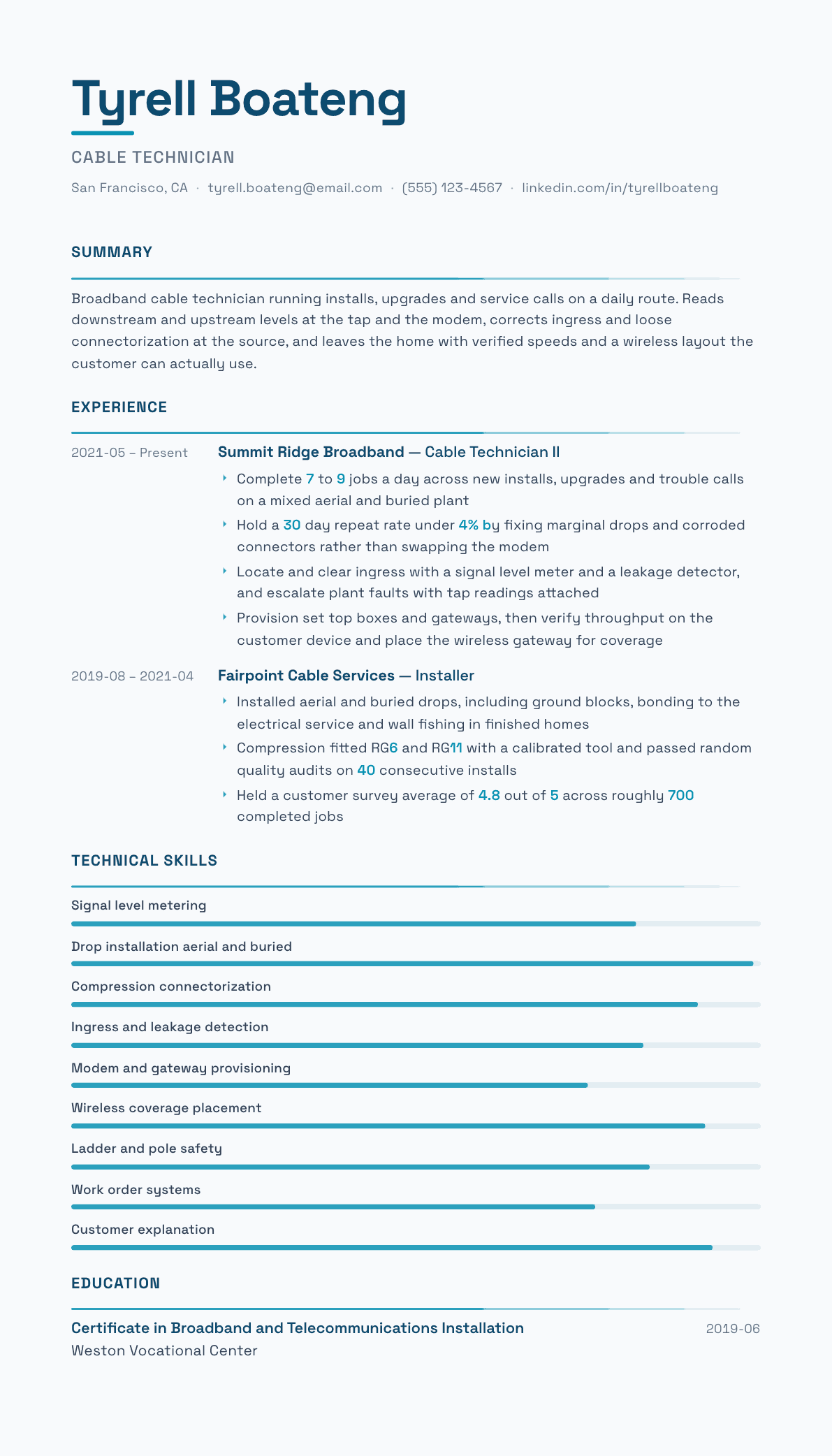
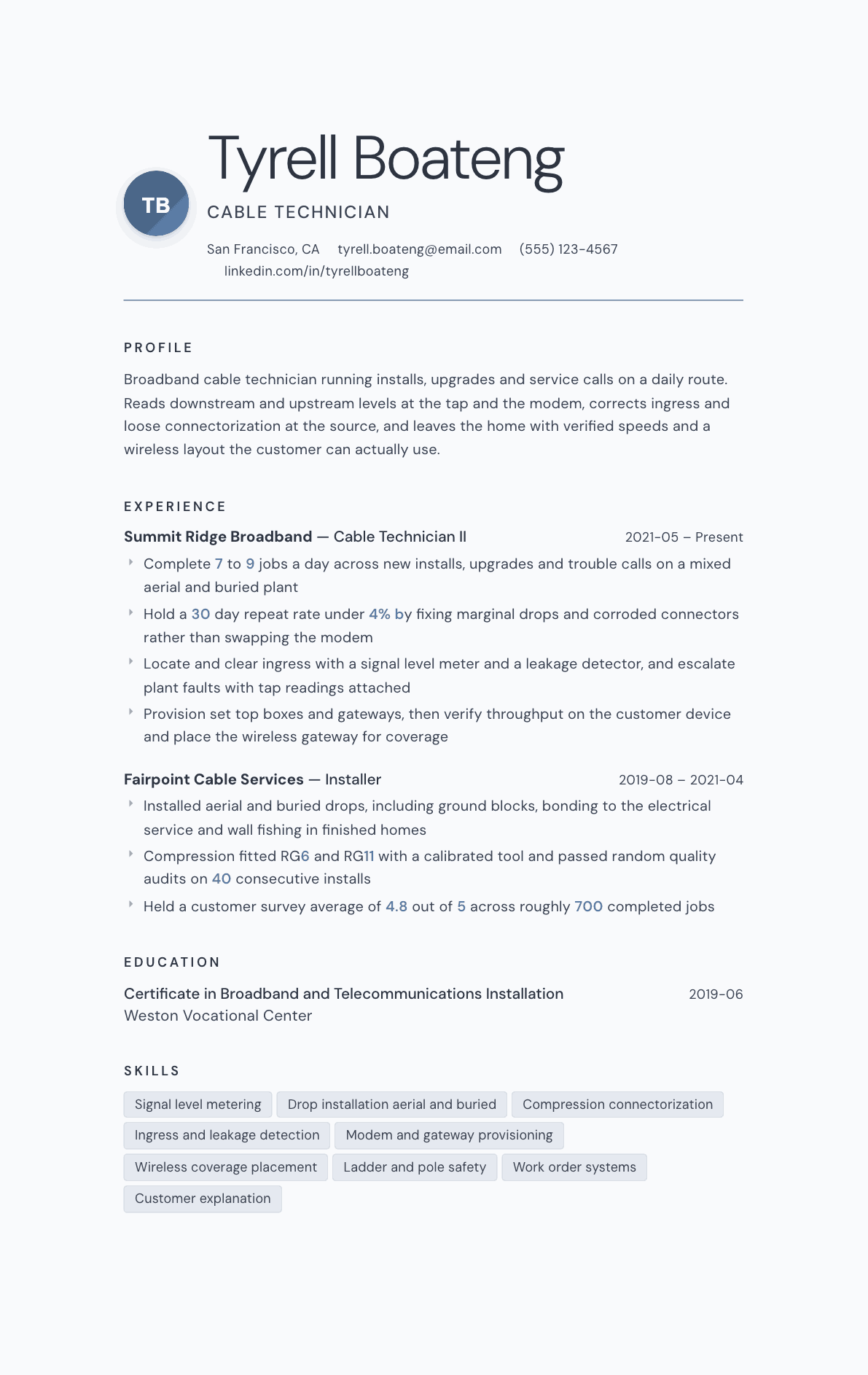
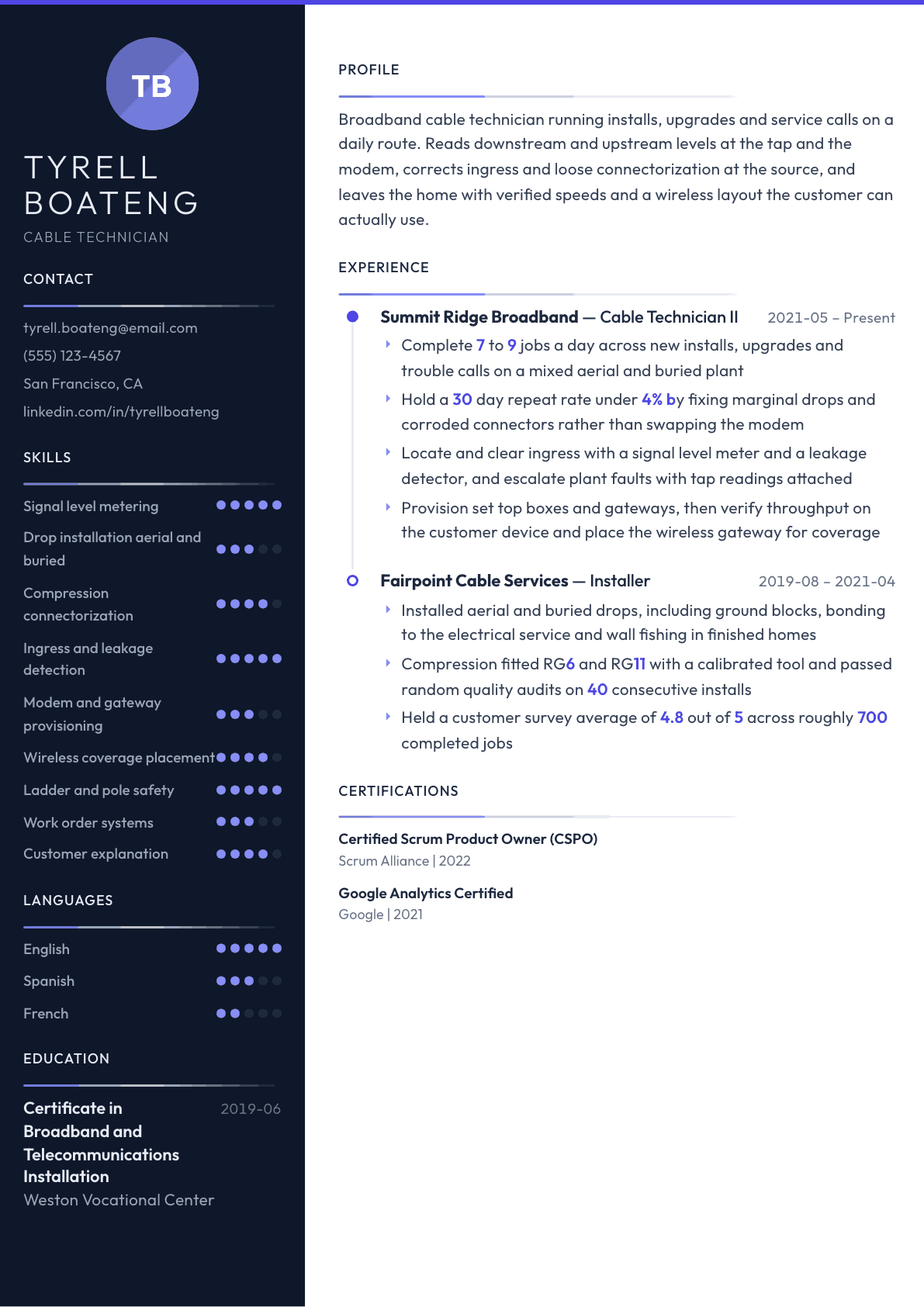
The same cable technician content laid out in three CVBooster templates, so you can see what the finished document looks like before you write a word.
Example Cable Technician summary
Cable technician with six years on installs, upgrades and service calls across aerial and buried plant. Reads levels at the tap, ground block and modem, clears ingress at the source rather than swapping equipment, and holds a low repeat rate on the service queue. Bonds and grounds every drop to code, provisions gateways and set top boxes, verifies throughput on the customer device, and keeps survey scores near the top of the market.
Skills to list on a Cable Technician resume
- Downstream and upstream level readings
- Signal level meter operation
- Ingress and leakage detection
- Aerial drop installation
- Buried drop and trenching
- RG6 and RG11 compression fittings
- Ground block bonding
- Amplifier and splitter placement
- Cable modem provisioning
- Set top box activation
- Wireless gateway placement
- Speed and throughput verification
- Work order and dispatch systems
- Customer education at the door
- Ladder and fall protection safety
What actually gets this resume read
- Give your daily job count and the mix of installs, upgrades and trouble calls so a dispatcher can load your route.
- Put your repeat rate or trouble call rate on the page, because that number decides who gets the service queue.
- Name the meter and leakage gear you use, and say what readings you record at the tap, ground block and modem.
- Show that you bond and ground drops correctly, since a failed audit on that item is treated as a safety issue.
- Add your customer survey score with the job count behind it, and any streak of clean quality audits.
- List your ladder rating, pole climbing status, driving record and any confined space or aerial lift qualification.
How to write a cable technician resume
A field supervisor hiring a cable technician is protecting two numbers: jobs completed per day and the rate at which those jobs come back. Everything else on your resume is read through that pair. A technician who finishes eleven jobs and generates three return visits costs the operation more than one who finishes eight and generates none, and every supervisor has learned this the hard way.
The second thing being judged is what happens at the door. A cable technician is the only employee of the company most customers ever meet, standing in a living room with a ladder and a drill. Survey scores are not a soft metric in this job, they are attached to your name in a system the supervisor can open, and a resume that ignores them looks like it has something to hide.
This guide covers how to structure the page around route metrics, how to write signal readings so they prove diagnosis rather than guesswork, how to present install quality and safety, three summaries by experience level, before and after bullets, and the questions technicians ask when moving between install, service and plant maintenance.
Format: route metrics near the top, then the technical detail
One page, reverse chronological. Directly under the summary put a short metrics block: jobs per day, job mix, repeat rate window and survey average with the number of jobs behind it. Supervisors compare candidates on those four figures and will happily read the rest of the page once the block looks right.
Then structure your job history by what the work actually was. New installs, upgrades, trouble calls and self install support are separate queues in most operations, staffed by different technicians, and saying which queue you carried is more useful than the company name.
- Metrics block: daily job count, mix by type, repeat rate over a stated window, and customer survey average.
- Plant line: aerial, buried, underground and multi dwelling unit experience, and whether you have climbed poles.
- Gear line: the signal level meter and leakage detector you use, and the compression tool you are calibrated on.
- Qualification line: ladder rating, driving record, pole climbing status and any confined space or lift card.
Summary: queue, volume, repeat rate, what you fix at the source
Three or four lines. Name the queue you carried, the daily volume, the repeat rate you held, and the phrase that matters most in this trade: that you fix problems at the source rather than swapping equipment until the symptom disappears. Supervisors have all inherited routes ruined by technicians who replaced modems for a year.
If you have worked both install and service, say so plainly. A technician who can be moved between queues as the schedule shifts is worth more than one who is only fast at drops, and dispatch flexibility rarely appears on a resume even though it is exactly what the operation needs.
Experience: readings, root cause, and the drop you rebuilt instead of patched
The strongest bullets on a cable technician resume describe a diagnosis. Say what you measure and where: downstream and upstream levels at the tap, at the ground block and at the modem, plus signal quality figures when the levels look acceptable but the service does not behave. That sequence is what separates a technician from a box changer.
Then describe the fixes that hold. A corroded connector replaced, a marginal drop rebuilt from the tap, a splitter removed from a run that never needed it, a ground block bonded properly to the electrical service. Each of these is a repeat visit that never happened, and repeat visits are what your future supervisor is trying to buy less of.
Plant faults deserve a bullet. Locating ingress or leakage in the field and escalating it with readings attached, rather than closing the ticket as no trouble found, is the behavior that makes a technician valuable to the maintenance side of the operation as well as to dispatch.
Install quality, bonding and the audits nobody wants to fail
Install quality is audited, and the items are consistent: connector type and compression, drop routing and clearance, ground block placement and bonding to the electrical service, wall penetrations sealed, and equipment placement that does not cook itself behind a cabinet. Bonding is treated as a safety issue rather than a workmanship one, and a failed audit there travels further than any other finding.
Write about audits in the plain form: how many consecutive installs passed, what the auditor checks, and any streak you held. It converts a routine expectation into evidence, and it is one of the few objective quality claims available in this job.
- Say which compression connectors and tools you use and whether the tool is on a calibration check.
- Describe drop routing choices in finished homes, including wall fishing and outside routing to avoid damage.
- Note bonding practice explicitly, since it is the audit item with the largest consequence.
- Mention equipment placement and wireless coverage decisions, which drive a large share of follow up calls.
The doorstep, the survey and the words a screener looks for
Customer handling in this role has a specific shape: explain what you found in language the person understands, show them the speed you left behind, and tell them honestly when a problem is outside the home so they do not expect you to fix it again next week. That last honesty is what protects the survey score on a call you could not close.
Screeners match on cable technician, broadband installer, signal level meter, downstream and upstream levels, ingress, leakage, aerial drop, buried drop, compression connectors, ground block bonding, modem provisioning, wireless gateway placement, repeat rate and survey score. Use them where they are true and give each one a number if you have one.
Cable Technician resume summary examples
First year installer
Broadband installer with 11 months completing new installs and upgrades on aerial and buried plant, averaging 6 jobs a day. Compression fits drops with a calibrated tool, bonds ground blocks to the electrical service, and provisions modems and set top boxes. Passed 40 consecutive quality audits with no findings.
Service queue technician
Cable technician with five years across install and service, running 7 to 9 jobs a day and holding a 30 day repeat rate under 4%. Reads levels at the tap, ground block and modem, clears ingress at the source, and carries a customer survey average of 4.8 across roughly 700 jobs.
Lead technician and trainer
Lead cable technician with nine years on residential and multi dwelling unit work, covering install, service and plant escalation. Trains new hires on meter readings and connectorization, audits completed installs for bonding and routing, and works the difficult repeat accounts other technicians have already visited twice.
Work experience bullets: before and after
Before: Installed cable and internet service for customers.
After: Completed 7 to 9 jobs a day across new installs, upgrades and trouble calls on mixed aerial and buried plant, including multi dwelling unit work with shared lock boxes and riser access.
Daily count, job mix and plant type let a dispatcher load your route before the interview even happens.
Before: Fixed customer internet problems.
After: Held a 30 day repeat rate under 4% by measuring levels at the tap, ground block and modem and correcting corroded connectors and marginal drops rather than replacing the modem and closing the ticket.
The metric plus the diagnostic sequence separates a technician who fixes causes from one who swaps parts.
Before: Reported problems with the cable lines.
After: Located ingress and leakage in the field with a signal level meter and a leakage detector, then escalated plant faults with tap readings and location attached instead of closing the ticket as no trouble found.
Escalating with evidence is the behavior maintenance crews value and the reason plant problems get fixed.
Before: Installed drops to code.
After: Installed aerial and buried drops with compression fittings on a calibrated tool, bonded every ground block to the electrical service, and passed 40 consecutive random quality audits with no findings.
The audit streak converts an expectation everyone claims into a number the supervisor can verify.
Before: Set up equipment and explained it to customers.
After: Provisioned gateways and set top boxes, verified throughput on the customer device rather than at the modem, and placed the wireless gateway for coverage, holding a survey average of 4.8 across roughly 700 jobs.
Testing on the customer device and placing the gateway are the two habits that prevent the next call.
Hard skills
- Downstream and upstream level measurement
- Signal quality and error rate reading
- Signal level meter operation
- Ingress and leakage detection
- Aerial drop installation
- Buried drop placement and trenching
- Multi dwelling unit riser work
- Compression connectorization
- Ground block bonding to the electrical service
- Splitter and amplifier placement
- Modem and gateway provisioning
- Set top box activation
- Throughput verification on customer devices
- Wireless gateway placement for coverage
- Work order and dispatch systems
Soft skills
- Explaining a signal problem in plain language at the door
- Telling a customer honestly when the fault is outside the home
- Keeping a route on time when a job runs long
- Working carefully in finished rooms with other people present
- Staying steady on the last call of a long day
Certifications worth listing
- Broadband Premises Installer (BPI) (SCTE)
- Broadband Premises Technician (BPT) (SCTE)
- Certified Fiber Optic Technician (CFOT) (Fiber Optic Association)
- OSHA 10-Hour General Industry (OSHA Outreach Training Program)
Mistakes that cost cable technician candidates the interview
- Leaving off the daily job count, which is the first thing a field supervisor tries to work out from the page.
- Skipping the repeat rate, since a low one is the strongest evidence a cable technician can offer.
- Describing troubleshooting without naming the readings taken or where in the drop they were taken.
- Treating bonding as routine when it is the audit item with the biggest consequence for the operation.
- Omitting survey scores entirely, which reads as avoidance in a role where every job is scored.
- Listing every piece of equipment ever touched instead of the meter and tools you use every single day.
Cable Technician resume questions
How do I write this resume with no field experience?
Lead with anything that proves ladder work, hand tools, driving record and customer contact. Then show you understand the measurements: name the readings a technician takes and where. Supervisors will train a beginner who already speaks about levels correctly.
Are repeat rates and survey scores worth including if mine are average?
Yes, because leaving them out is read as worse than average. Give the number with the context, such as a difficult route or a stretch covering another technician, and pair it with the change you made to improve it.
Should I mention fiber if the job is mostly coax?
Mention it if you have real work behind it, since operations are converting plant steadily and a technician who can handle both is easier to keep. Be specific about what you have done rather than listing fiber as a general interest.
How do I move from installs into the service queue?
Show diagnosis rather than volume. Describe trouble calls you took, the readings you used, and problems you traced back to plant. Then say directly that you want service work, because supervisors move technicians who ask and stay quiet about the ones who do not.
What if I was let go over metrics at a previous operation?
Keep the resume factual and let the interview handle the rest. Present the metrics you did hold, the queue you carried and any improvement trend. A supervisor cares far more about what you changed afterward than about a single difficult stretch.
Related resume examples
- Field Service Technician Resume example
- Technical Support Specialist Resume example
- Cable Installer Resume example
- Fiber Optic Technician Resume example
- Elevator Mechanic Resume example
- Telecommunications Technician Resume example