Telecommunications Technician Resume Examples: free score
Write a Telecommunications Technician Resume That Names Every Media Type
By Mustafa Tarabya, founder of CVBooster · Published · Updated
Telecommunications technician resume example with structured cabling, fiber and voice keywords, plus a guide to writing testing, standards and turn up work.
Sample resumes for a telecommunications technician
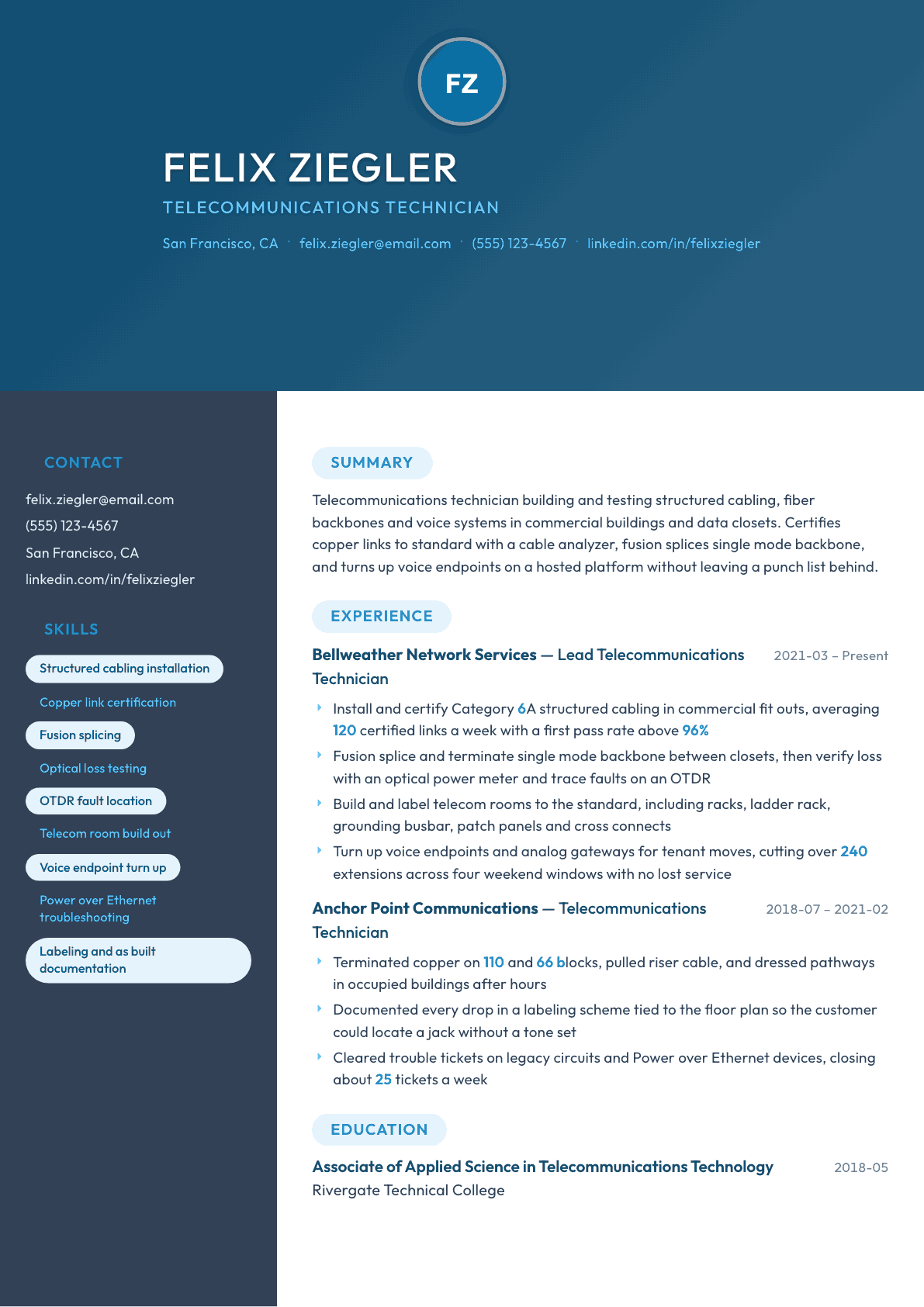
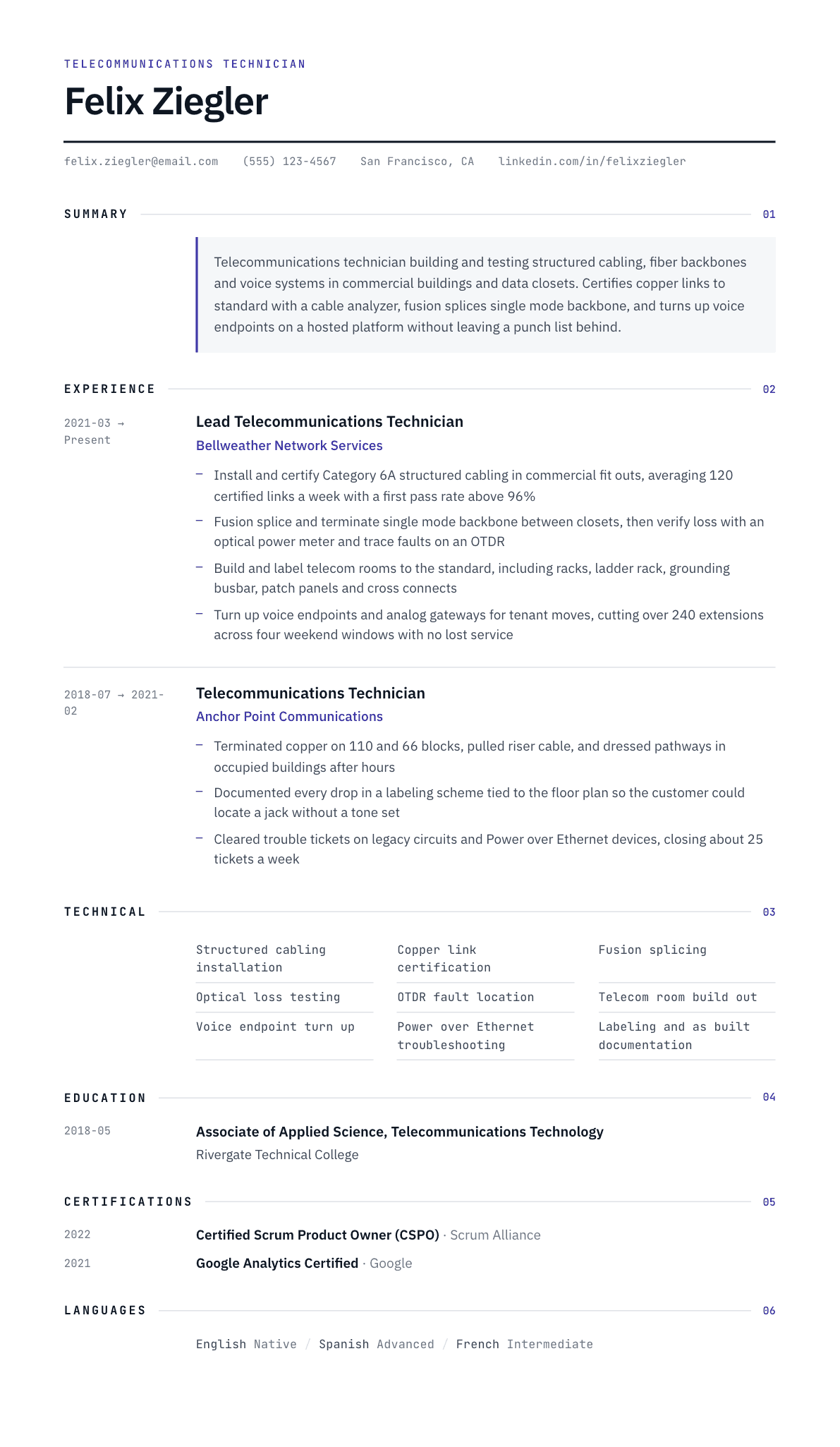
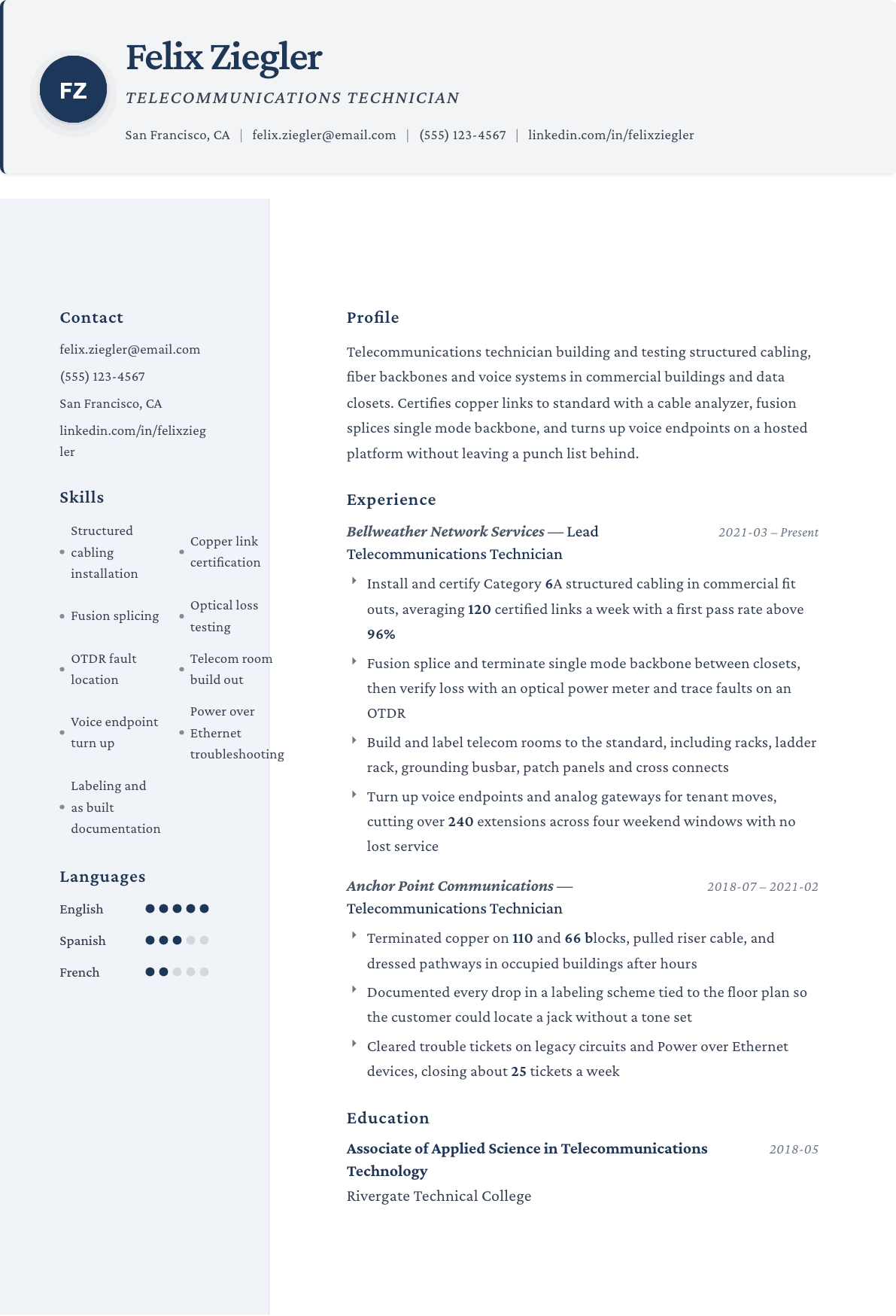
The same telecommunications technician content laid out in three CVBooster templates, so you can see what the finished document looks like before you write a word.
Example Telecommunications Technician summary
Telecommunications technician with seven years installing and certifying structured cabling, fiber backbone and voice systems in commercial buildings. Certifies copper links with a field analyzer and holds a high first pass rate, fusion splices single mode risers and verifies loss end to end, and builds telecom rooms to standard with grounding, labeling and as built records. Runs after hours cutovers of tenant voice systems without losing service.
Skills to list on a Telecommunications Technician resume
- Category 6 and 6A termination
- Copper link certification testing
- Single mode and multimode fiber
- Fusion splicing and mechanical splicing
- Optical loss test sets
- OTDR trace interpretation
- Riser and plenum cable pulling
- Telecom room and rack build
- Grounding and bonding to standard
- Patch panel and cross connect work
- Voice over IP endpoint turn up
- Analog gateway and paging systems
- Power over Ethernet budgeting
- Labeling and as built records
- Aerial lift and ladder safety
What actually gets this resume read
- Name every media type you terminate: Category 6A, coax, single mode fiber, multimode fiber and legacy copper pairs.
- Give the test gear you certify with, because a contractor buys results from a named analyzer, not a continuity check.
- Put your first pass certification rate on the page, since rework on a fit out eats the whole margin.
- Say which standards you build to for pathways, grounding, labeling and telecom room layout.
- Show cutover work with the endpoint count and the window length, because after hours turn ups are the hard part.
- List your lift, ladder and confined space qualifications along with any site badging you already hold.
How to write a telecommunications technician resume
The person hiring a telecommunications technician is usually a project manager at a contractor with a fit out due before a tenant moves in. He is not buying enthusiasm for technology. He is buying certified links, closets that pass a walkthrough, and someone who can be sent to a customer site alone without generating a punch list. Your resume needs to speak to those three.
The title covers a wide territory, which is exactly why vague resumes fail here. One technician terminates copper and pulls cable. Another splices single mode fiber and reads a trace. Another turns up voice endpoints and troubleshoots power delivered over the data cable. Some do all three. A hiring manager staffing a backbone job cannot use a resume that says installed and maintained telecommunications systems.
Below is the layout a contractor reads, how to write testing results so they carry weight, how to describe closet builds and cutovers, three summaries by stage, before and after bullets, and the questions that come up moving between residential, commercial and carrier side work.
Format: media types and test gear before the job history
One page, reverse chronological, with a capability block near the top that lists the media you terminate and the instruments you test with. A telecommunications technician is defined by what he can certify, not by how many buildings he has been inside, and the capability block answers that in four lines.
Keep the job history underneath in the usual order, but name the environment for each role. Commercial fit out, occupied building after hours work, data center, campus backbone, carrier central office and residential all differ in access, standards and pace. A project manager staffing an occupied hospital job will look for that word specifically.
- Media line: copper category ratings, coax types, single mode and multimode fiber, and legacy pair counts.
- Instrument line: the cable analyzer you certify with, optical power meter and source, and the trace tool you read.
- Standards line: the pathway, grounding, labeling and telecom room practices you build to.
- Access line: aerial lift qualification, ladder rating, confined space, badging and background checks already cleared.
Summary: what you certify, at what pass rate, in what setting
Three or four lines. Say what you install and certify, give the pass rate on first test, name the settings, and mention the after hours work you are available for. Certification pass rate is the number this trade lives on, because rework on a fit out consumes the margin and the schedule at the same time.
If you splice, put it in the first line. Fusion splicing and loss testing are the skills that separate a cable installer from a telecommunications technician in most contractor org charts, and burying them under a general statement wastes the strongest fact on your page.
Experience: links certified, closets built, cutovers survived
Copper work is described in certified links per week and first pass rate, with the analyzer named. Fiber work is described in splices, loss budgets held and faults located, with the distance and cause when a trace found something interesting. Both are far more persuasive than a list of buildings.
Closet and rack work is worth its own bullet because it is what a walkthrough judges. Racks plumb and bonded, ladder rack supported, patch panels loaded in a scheme that matches the floor plan, service loops dressed and slack managed, grounding busbar landed. A project manager who has failed a walkthrough reads that bullet closely.
Cutovers deserve a bullet with the endpoint count and the window. Moving a tenant onto new voice service over a weekend, with every extension answering Monday morning, is the kind of work that gets a technician invited back. Say how many endpoints, how long the window was, and what the fallback plan was if the cut failed.
Fiber, voice and the parts people leave out
Fiber sections get thin on most resumes. Fix that by naming the work: preparing and cleaving, splicing in a tray, terminating with connectors, measuring end to end loss against a calculated budget, and interpreting a trace to distinguish a bad splice from a bend or a dirty connector. Cleaning practice belongs here too, because a large share of fiber faults are contamination rather than damage.
Voice work also gets underwritten. Say whether you have turned up endpoints on a hosted platform, configured analog gateways for elevator and fire panel lines, and troubleshot power budget problems when a switch cannot feed every device on it. Those specifics tell a contractor whether you can finish a job or only cable it.
- Splicing detail: fusion or mechanical, tray and closure types, and the loss figure you hold per splice.
- Testing detail: what you measure, against what budget, and how you document the result for the customer.
- Voice detail: endpoint counts, analog gateway work, paging and any legacy circuit you have decommissioned.
- Power detail: the class of powered devices you have supported and how you diagnose a switch that cannot feed them.
Documentation, labeling and the keywords screeners match on
Documentation is the deliverable that outlives the install. Describe the labeling scheme you use, how it ties to the floor plan, and what you hand over at closeout: test results, as built drawings, a port map and photographs of the closet. Customers remember the technician who made the next fault easy to find.
Recruiters searching a stack of resumes look for structured cabling, copper certification, fusion splicing, single mode, multimode, optical loss, telecom room, patch panel, cross connect, voice over internet protocol endpoints, power over the data cable, grounding and bonding, and as built documentation. Use the ones you can defend and leave the rest for later in your career.
Telecommunications Technician resume summary examples
Apprentice installer
Telecommunications installer with 18 months pulling and terminating Category 6 cable in commercial fit outs, dressing pathways and supporting closet builds. Certified links under a lead technician and learned analyzer operation and fault interpretation. Holds an aerial lift card and is studying for a copper installer certification.
Five years, copper and fiber
Telecommunications technician certifying roughly 120 Category 6A links a week at a first pass rate above 96%, fusion splicing single mode backbone between closets, and verifying loss against a calculated budget. Builds telecom rooms to standard with grounding and labeling, and turns up voice endpoints during weekend windows.
Lead technician
Lead telecommunications technician with 11 years across commercial fit outs, campus backbone and occupied building work. Runs a two person crew, owns closeout documentation, cut over 240 extensions across four weekend windows without lost service, and trains installers on analyzer results and fiber cleaning discipline.
Work experience bullets: before and after
Before: Installed network cabling in office buildings.
After: Installed and certified roughly 120 Category 6A links a week in commercial fit outs, holding a first pass rate above 96% and correcting the failures at the termination rather than retesting until they passed.
Volume, pass rate and the honesty about how failures are fixed tell a project manager what rework to expect.
Before: Worked with fiber optic cable.
After: Fusion spliced and terminated single mode backbone between telecom rooms, verified end to end loss against a calculated budget, and located a high loss event with a trace that turned out to be a tight bend above a ceiling.
Naming the splice type, the budget check and a real fault found shows fiber skill instead of fiber exposure.
Before: Set up telecom rooms.
After: Built telecom rooms end to end: racks plumb and bonded to the grounding busbar, ladder rack supported, patch panels loaded to a floor plan scheme, and service loops dressed so a later move does not require a re pull.
These are the exact items a walkthrough checks, so the bullet reads as someone who has passed one.
Before: Moved phone systems for customers.
After: Cut over 240 voice extensions across four weekend windows, staging endpoints and gateways in advance, testing elevator and fire panel analog lines before the window closed, and holding a rollback plan that was never needed.
Endpoint count, window count and the analog line detail show a cutover run by someone who plans for failure.
Before: Labeled cables and kept records.
After: Labeled every drop to a scheme tied to the floor plan and handed over a closeout package with test results, a port map, as built drawings and closet photographs so the customer could find a jack without a tone set.
The deliverable list turns a routine habit into the thing customers actually remember after the job ends.
Hard skills
- Category 6 and 6A termination
- Copper link certification testing
- Coaxial termination and testing
- Single mode and multimode fiber termination
- Fusion and mechanical splicing
- Optical loss budget calculation
- Trace interpretation and fault location
- Connector cleaning and inspection
- Riser, plenum and underground cable pulling
- Telecom room and rack build out
- Grounding and bonding to standard
- Patch panel and cross connect work
- Voice endpoint and gateway turn up
- Power over the data cable troubleshooting
- Labeling schemes and as built records
Soft skills
- Working quietly in occupied buildings after hours
- Explaining a failed test result without defensiveness
- Sequencing a cutover so nothing is discovered on Monday
- Coordinating with electricians and ceiling trades on a shared schedule
- Handing over documentation a stranger can use
Certifications worth listing
- Installer 2, Copper (BICSI)
- Installer 2, Optical Fiber (BICSI)
- BICSI Technician (BICSI)
- Certified Fiber Optic Technician (CFOT) (Fiber Optic Association)
Mistakes that cost telecommunications technician candidates the interview
- Writing installed and maintained telecommunications systems, which tells a contractor nothing about what you can certify.
- Listing fiber as a skill without saying whether you splice, terminate, test or only pull the cable.
- Omitting the analyzer and the first pass rate, the two facts that predict how much rework a job will carry.
- Ignoring closet and rack work even though a walkthrough judges the install on exactly those details.
- Leaving out cutover experience, which is the part of the job that requires planning rather than hands.
- Skipping lift, ladder and badging qualifications that decide whether you can be dispatched to a site at all.
Telecommunications Technician resume questions
How is a telecommunications technician different from a cable installer?
Installers pull and terminate. Technicians certify, splice, turn up services and troubleshoot after the install is done. If you do both, present the technician work first, because that is the part a contractor cannot easily hire off the street.
Do I need certifications to get hired?
They help you past the first screen and they set your rate, but a documented first pass certification history carries as much weight with a working project manager. Get the credentials when you can, and in the meantime put real testing numbers on the page.
How much fiber experience do I need to claim it?
Claim what you have actually done unsupervised. Terminating and testing is one level, splicing in a tray is another, and reading a trace to isolate a fault is another again. Overstating this is quickly exposed because the work happens in front of other people.
Should I include the buildings and clients I have worked in?
Name the building types rather than the client names, unless the client is on the posting. Hospital, data center, school campus, courthouse and occupied office each imply a different access and standards environment, and that is what the reader is trying to learn.
What if my background is residential and I want commercial work?
Emphasize anything that transfers: termination quality, testing, working in finished spaces without damage, and customer contact. Then be direct that you want the standards side of the trade, and list any coursework or certification you are pursuing to get there.
Related resume examples
- Electrician Resume example
- Technical Support Specialist Resume example
- Fiber Optic Technician Resume example
- Cable Installer Resume example
- Cable Technician Resume example
- Avionics Technician Resume example