Prep Cook Resume Examples: free ATS score and gap list
Prep Cook Resume Sample That Shows Speed, Yield and Food Safety
By Mustafa Tarabya, founder of CVBooster · Published · Updated
Prep cook resume example and full cook prep resume sample with prep list volumes, yield and sanitation detail, plus the keywords kitchens screen for.
Sample resumes for a prep cook
The same prep cook content laid out in three CVBooster templates, so you can see what the finished document looks like before you write a word.
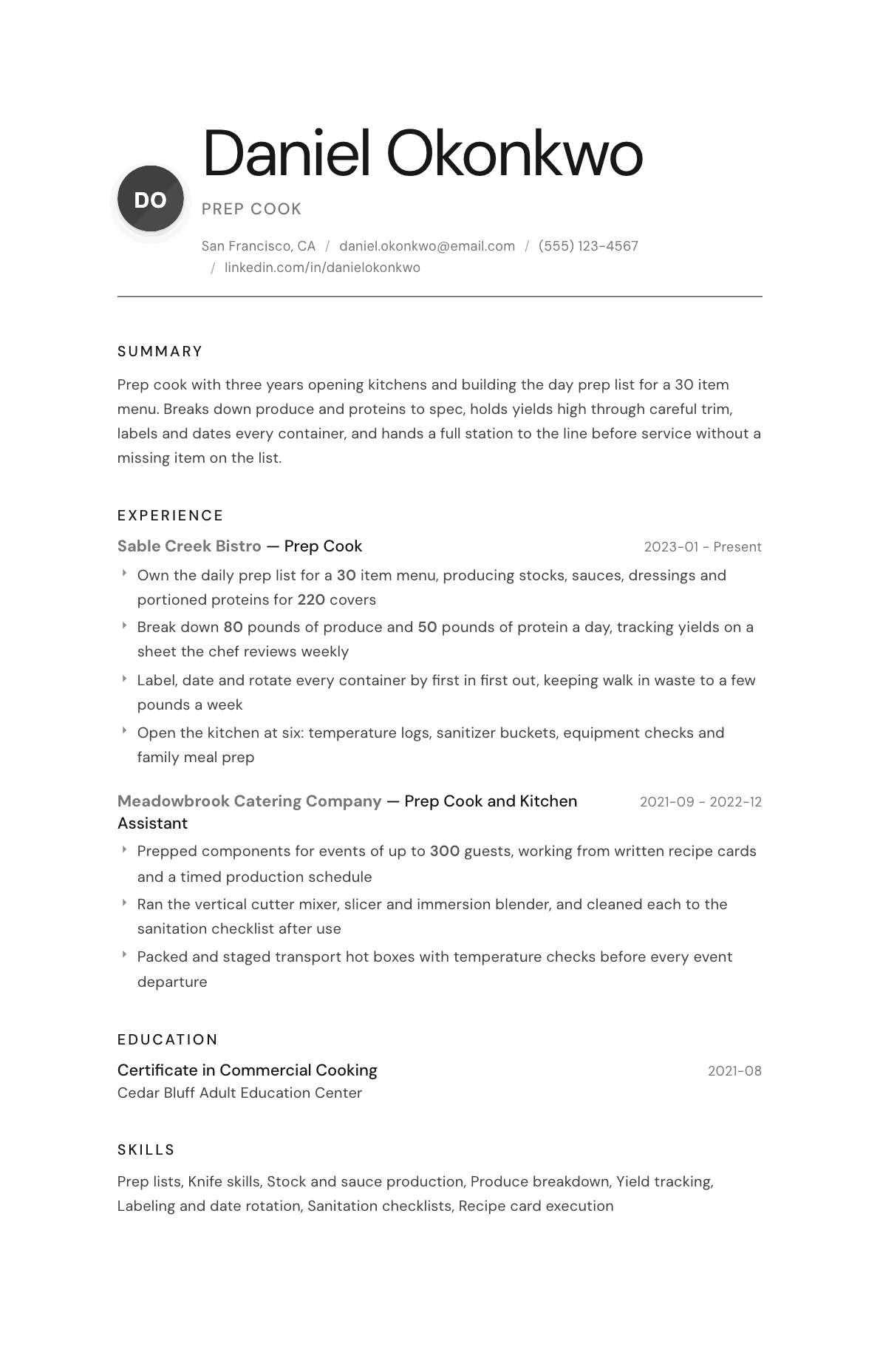
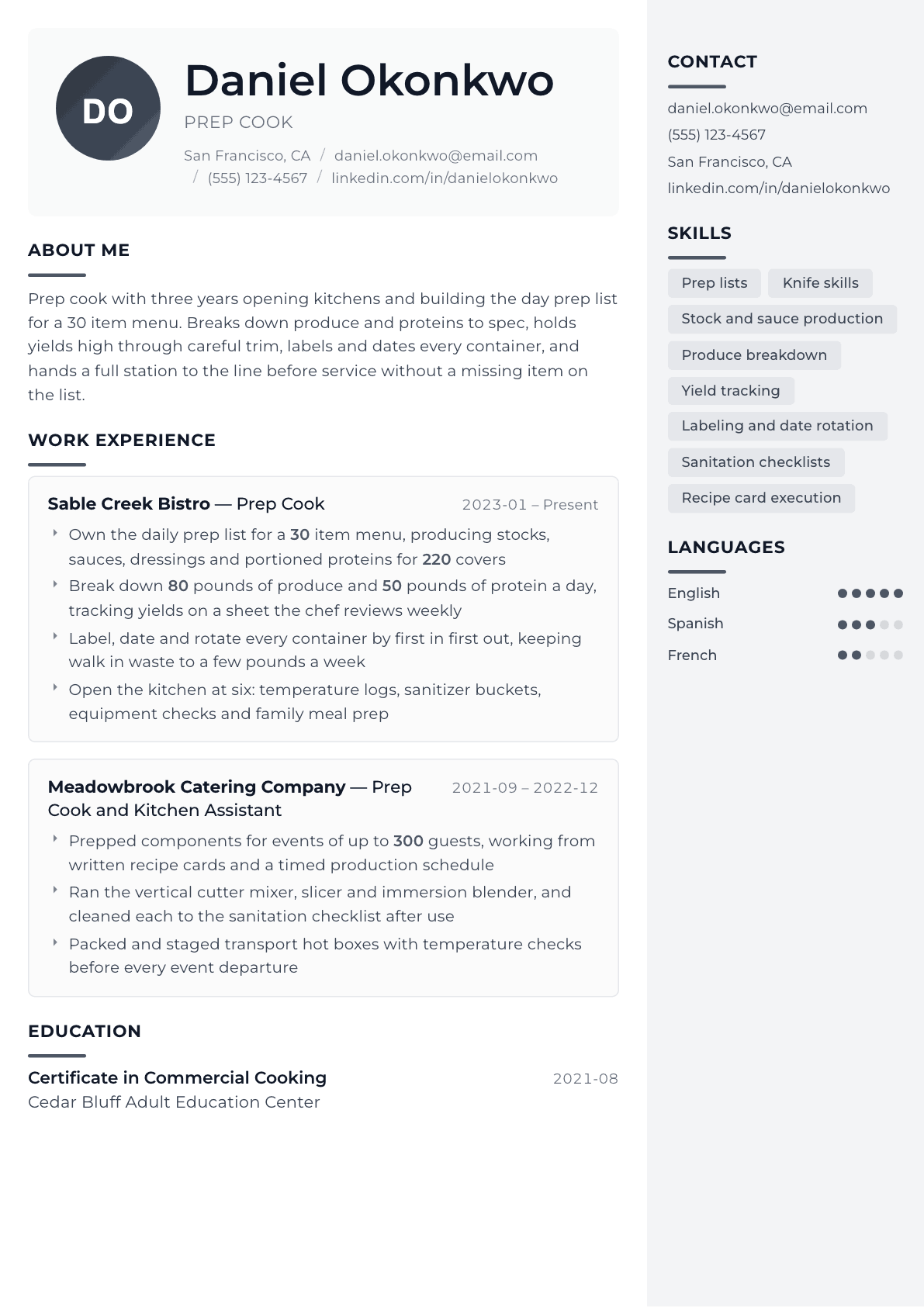
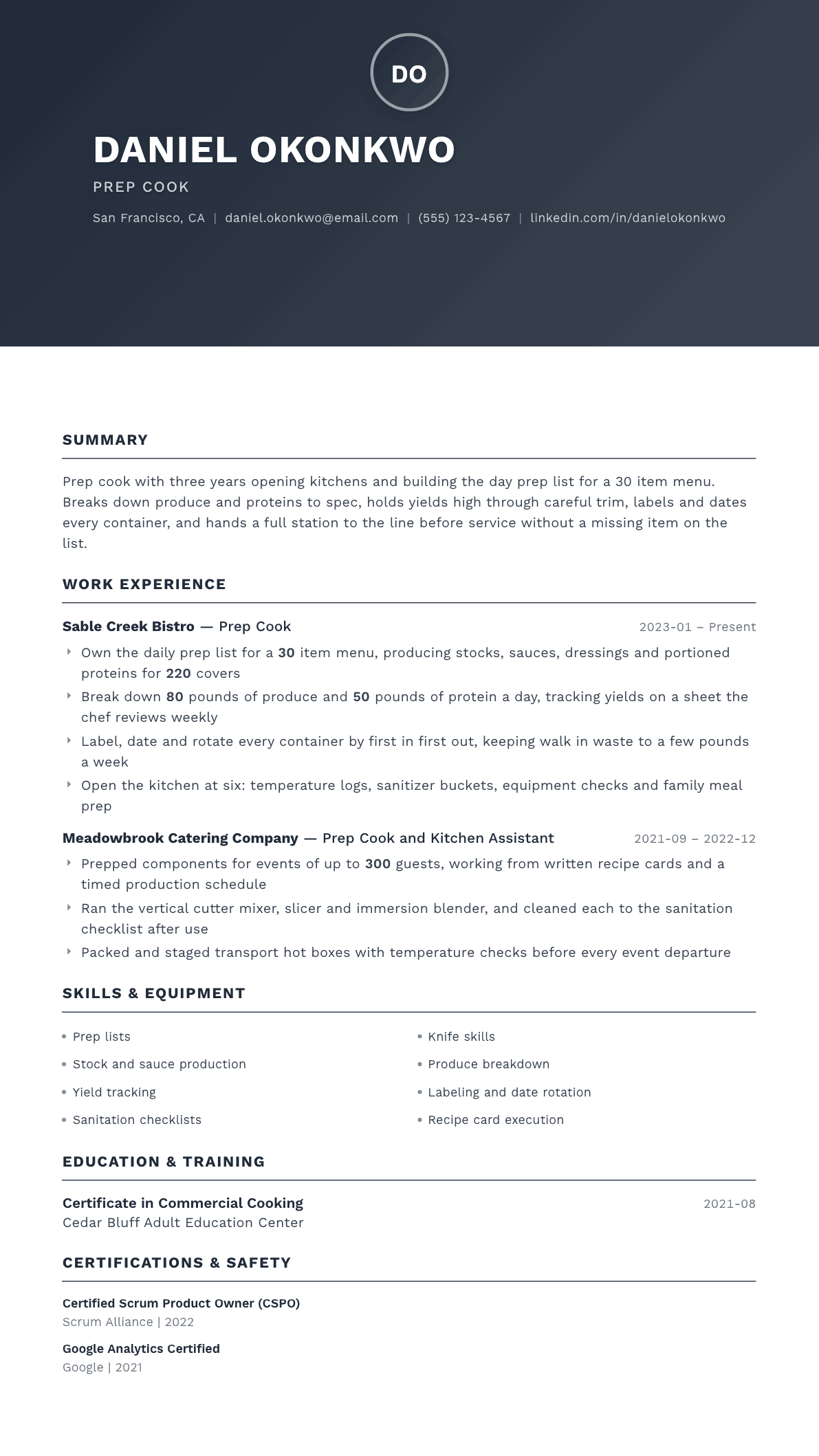
Example Prep Cook summary
Prep cook with three years opening a scratch kitchen and owning the daily prep list for a 30 item menu. Breaks down produce and protein by the case, tracks yields on a sheet the chef reviews, and rotates the walk in by first in first out so waste stays low. Runs slicer, robot coupe and tilt skillet safely and keeps every temperature log current.
Skills to list on a Prep Cook resume
- Prep list execution
- Knife skills
- Produce and protein breakdown
- Stock and sauce production
- Portioning to spec
- Yield and waste tracking
- First in first out rotation
- Labeling and dating
- Walk in organization
- Food safety and sanitation
- Temperature logging
- Commercial equipment operation
- Recipe card following
- Kitchen opening duties
What actually gets this resume read
- Show the size of the prep list you own: number of menu items, covers it feeds and how early you finish it.
- Quantify the volume you break down in a day in pounds or cases, because that is how a chef measures prep speed.
- Mention yield tracking and trim, since a prep cook who protects food cost is the one who gets promoted.
- Name the equipment you can run safely: slicer, robot coupe, vertical cutter mixer, immersion circulator, tilt skillet.
- Put labeling, dating and first in first out rotation on the resume, because that is what a health inspector opens the walk in to check.
- List your food handler card or manager level food safety certification with the issuing program.
How to write a prep cook resume
A prep cook is judged on what the kitchen finds when service starts. If the sauces are made, the proteins are portioned, the containers are labeled and dated and nothing on the list is missing, the line never notices you. If one item is short, the whole night bends around it. That is the standard a chef has in mind while reading applications, and it is why a prep cook resume should be built around a list and a clock rather than around a description of chopping vegetables.
The other half of the job is money. A prep cook decides how much of a case of produce ends up on the plate and how much ends up in the trash, and how much of the walk in gets thrown out on a Monday because nobody labeled it. Yields, trim, rotation and dating are food cost, and a chef who reads those words on a page is reading about someone who protects the number he answers for.
What follows is how to write each part of the page for a prep cook, including the equipment list a chef checks, the food safety detail an inspector checks, three example summaries and the bullet rewrites that turn a task list into evidence.
Format: one page, plain, list driven
One page, single column, reverse chronological. A prep cook application does not need design and a chef will not reward it. Use the space instead for the size of the prep list, the volume you break down and the equipment you can run.
Header carries name, city, phone, email, the shift you want and your food safety credential. Prep is often an early morning role, so stating that you can start at six and finish before service reads as a genuine fit rather than a compromise.
- Header: name, city and state, phone, email, available shifts, food handler card.
- Order: summary, experience, skills, education, certifications.
- Name the shift explicitly, because early morning availability is part of the hire.
Summary: the size of the list and how early it is finished
Open with the scope of the prep list you own: the number of menu items it supports and the covers it feeds. A prep cook who owns the daily list for a thirty item menu feeding two hundred twenty covers has described a real workload in one line.
Then add the discipline: yields tracked on a sheet the chef reviews, labeling and rotation by first in first out, temperature logs current. Finish with the equipment you run safely. Those three sentences answer the chef's whole question, which is whether the list will be done and whether the walk in will be right.
Experience: volume, yields, and the state of the walk in
Start each job with the kitchen and the menu size, then quantify the daily breakdown in pounds or cases. Eighty pounds of produce and fifty pounds of protein a day is a fact a chef can convert into hours, and no adjective does that work.
Make one bullet about yield. Tracking trim on a sheet, using frames and scraps for stock or staff meal, and keeping walk in waste to a few pounds a week are the sentences that tell a chef you understand food cost without having to be taught it.
Make another bullet about the open. Temperature logs, sanitizer buckets, equipment checks, family meal, and handing a full station to the line before service. That routine is the reason a prep cook is trusted with a key, and it belongs on the page in that order.
If you have catering or banquet prep experience, keep it. Working from written recipe cards against a timed production schedule for an event of three hundred guests shows you can hit a deadline that does not move, which is a different discipline from daily restaurant prep.
Skills: knives, equipment, and food safety in the same block
Hard skills here are prep list execution, knife skills, produce and protein breakdown, stock and sauce production, portioning to spec, yield and waste tracking, first in first out rotation, labeling and dating, walk in organization, temperature logging and recipe card following.
Name the equipment separately and only what you can run and clean without supervision: slicer, robot coupe, vertical cutter mixer, immersion blender, tilt skillet, immersion circulator. Chefs ask about the slicer specifically because it is the machine that sends people to the emergency room, so a cook who lists it with confidence is worth an interview.
- Break the block into knife and technique work, equipment, and food safety.
- Give quantities anywhere a number exists: pounds, cases, containers, batches.
- List the food safety practices by name, because that is the walk in an inspector opens.
Certification, first jobs, and the move to the line
A food handler card is the baseline and ServSafe Manager is a real advantage for anyone who wants to own an opening shift alone. List the program name and the credential. A commercial cooking certificate or a culinary program belongs on the page with the institution and field, but a chef will weigh the volume you have prepped above either.
Coming from outside a restaurant, use grocery deli or butcher counters, catering kitchens, school or hospital food service, or any job with sharp equipment and a production schedule. Moving to the line is the natural next step, so add any station cover you have done, plus your speed on portioning and your comfort with a ticket, and lead with those bullets when the posting says line cook.
Cook prep resume sample, start to finish
Searches for a cook prep resume usually want to see a whole page, so here is one for a prep cook with three years in a busy full service restaurant, moving to a larger kitchen. The person and restaurants are invented. Notice that every bullet carries a quantity, a time or a standard, because that is how a chef judges prep work before tasting any of it.
- Header: Luis Moreno, Prep Cook. City, phone, email, food handler card.
- Summary: Prep cook with three years in a full service restaurant doing about two hundred and fifty covers on a Friday. Finishes a forty item prep list before the line arrives, labels and dates everything, and keeps the walk in organized by first in, first out. Strong knife skills and comfortable with batch sauces, stocks and portioning proteins.
- Current role, Prep Cook, a neighborhood bistro, three years: works through the full morning prep list for lunch and dinner service; breaks down cases of chicken and whole fish and portions proteins to spec weights; makes stocks, sauces and dressings from house recipes in batches; rotates and labels the walk in and reports low stock to the sous chef before the order goes out.
- Previous role, Dishwasher and Prep Helper, a catering kitchen, one year: moved from dish to prep within six months; peeled, cut and portioned vegetables for events of up to three hundred guests.
- Skills and certification: knife cuts to spec, butchery basics, batch cooking, slicer and food processor, sanitation and allergen labeling, food handler card.
Prep Cook resume summary examples
First kitchen job
Grocery deli worker moving into a prep cook role, with a year slicing, portioning and packing to weight, rotating stock by date and cleaning equipment to a sanitation checklist every night. Food handler card current, comfortable with early starts, and looking for a scratch kitchen that trains.
Three years of prep
Prep cook with three years opening a scratch kitchen and owning the daily prep list for a 30 item menu. Breaks down produce and protein by the case, tracks yields on a sheet the chef reviews, and rotates the walk in by first in first out so waste stays low. Runs slicer, robot coupe and tilt skillet safely.
Lead prep and catering
Lead prep cook with five years across a bistro kitchen and a catering company, producing stocks, sauces, dressings and portioned proteins for 220 covers a day and events up to 300 guests. Works from recipe cards on a timed production schedule, owns the opening logs, and trains new prep cooks on yields and dating.
Work experience bullets: before and after
Before: Prepared ingredients for the kitchen each day.
After: Owned the daily prep list for a 30 item menu, producing stocks, sauces, dressings and portioned proteins for 220 covers before service started.
Menu size, output and the deadline turn a general duty into a workload a chef can staff against.
Before: Cut vegetables and meat.
After: Broke down 80 pounds of produce and 50 pounds of protein a day, tracking yields on a sheet the chef reviewed weekly.
Weight plus yield tracking shows both speed and an understanding of food cost.
Before: Kept the walk in cooler organized.
After: Labeled, dated and rotated every container by first in first out, keeping walk in waste to a few pounds a week across a full menu.
The practice and the result are exactly what an inspector and a chef check when they open the door.
Before: Used kitchen equipment safely.
After: Ran the vertical cutter mixer, slicer and immersion blender daily and broke each down to the sanitation checklist after use.
Naming machines and the cleaning routine answers the safety question a chef would otherwise ask in an interview.
Before: Helped with catering events.
After: Prepped components for events of up to 300 guests from written recipe cards on a timed production schedule, then staged hot boxes with temperature checks before departure.
A fixed deadline and a temperature check show a different discipline than open ended daily prep.
Hard skills
- Prep list execution
- Knife skills
- Produce and protein breakdown
- Stock and sauce production
- Portioning to spec
- Yield and waste tracking
- First in first out rotation
- Labeling and dating
- Walk in organization
- Temperature logging
- Commercial equipment operation
- Recipe card execution
- Kitchen opening duties
Soft skills
- Working alone without supervision
- Time management against a deadline
- Consistency
- Care with sharp equipment
- Communication with the line
- Early shift reliability
Certifications worth listing
- ServSafe Food Handler (National Restaurant Association)
- ServSafe Manager (National Restaurant Association)
- ServSafe Allergens (National Restaurant Association)
- Certified Fundamentals Cook (CFC) (American Culinary Federation)
Mistakes that cost prep cook candidates the interview
- Describing prep as chopping vegetables, which hides the stocks, sauces, portioning and logs that make up most of the shift.
- Giving no volume, so a chef cannot judge whether you can finish a full list before the line arrives.
- Leaving yields and trim off the page, when those are the words that connect prep work to food cost.
- Skipping labeling, dating and rotation, the first things an inspector looks for when the walk in opens.
- Listing equipment you have never run alone, which is exposed on the first trail shift and is a safety problem besides.
- Not stating early morning availability, when the opening shift is usually the reason the position is posted.
Prep Cook resume questions
What should a cook prep resume look like?
One page with a short summary, your kitchen jobs and a skills line. In the summary, name the kitchen type, the covers on a busy night and the size of your prep list. In each job, give quantities and standards: cases broken down, portions to spec, batches of stock and how you label and rotate stock. Catering prep counts and belongs on the page too.
What does a chef look for on a prep cook resume?
The size of the prep list you can own, the volume you break down in a day, and whether the walk in stays labeled, dated and rotated. Those three things predict whether service starts clean, which is all the chef is buying.
How do I quantify prep work?
Use pounds or cases broken down per day, the number of menu items your list supports, the covers it feeds, and the number of batches or containers produced. If you tracked yields on a sheet, say so and note that the chef reviewed it.
Do I need a food safety certification for prep?
A food handler card is required in many jurisdictions and expected almost everywhere. A manager level food safety certification is a real advantage if you want to open the kitchen alone, because it means the chef can hand you the logs.
How do I move from prep cook to line cook?
Add any station cover you have done, your portioning speed, your comfort reading a ticket and any service you have worked during a rush. Lead with those bullets on a line posting and keep the prep detail underneath as proof of discipline.
Related resume examples
- Chef Resume example
- Pastry Chef Resume example
- Line Cook Resume example
- Kitchen Manager Resume example
- Dishwasher Resume example
- Chef de Partie Resume example