Barback Resume Examples: free score, then the gap list
Barback Resume Tips for Getting Behind the Bar
By Mustafa Tarabya, founder of CVBooster · Published · Updated
Barback resume example with keg, ice and prep numbers, the stocking and sanitation skills bars hire for, and how to move up to bartender.
Sample resumes for a barback
The same barback content laid out in three CVBooster templates, so you can see what the finished document looks like before you write a word.
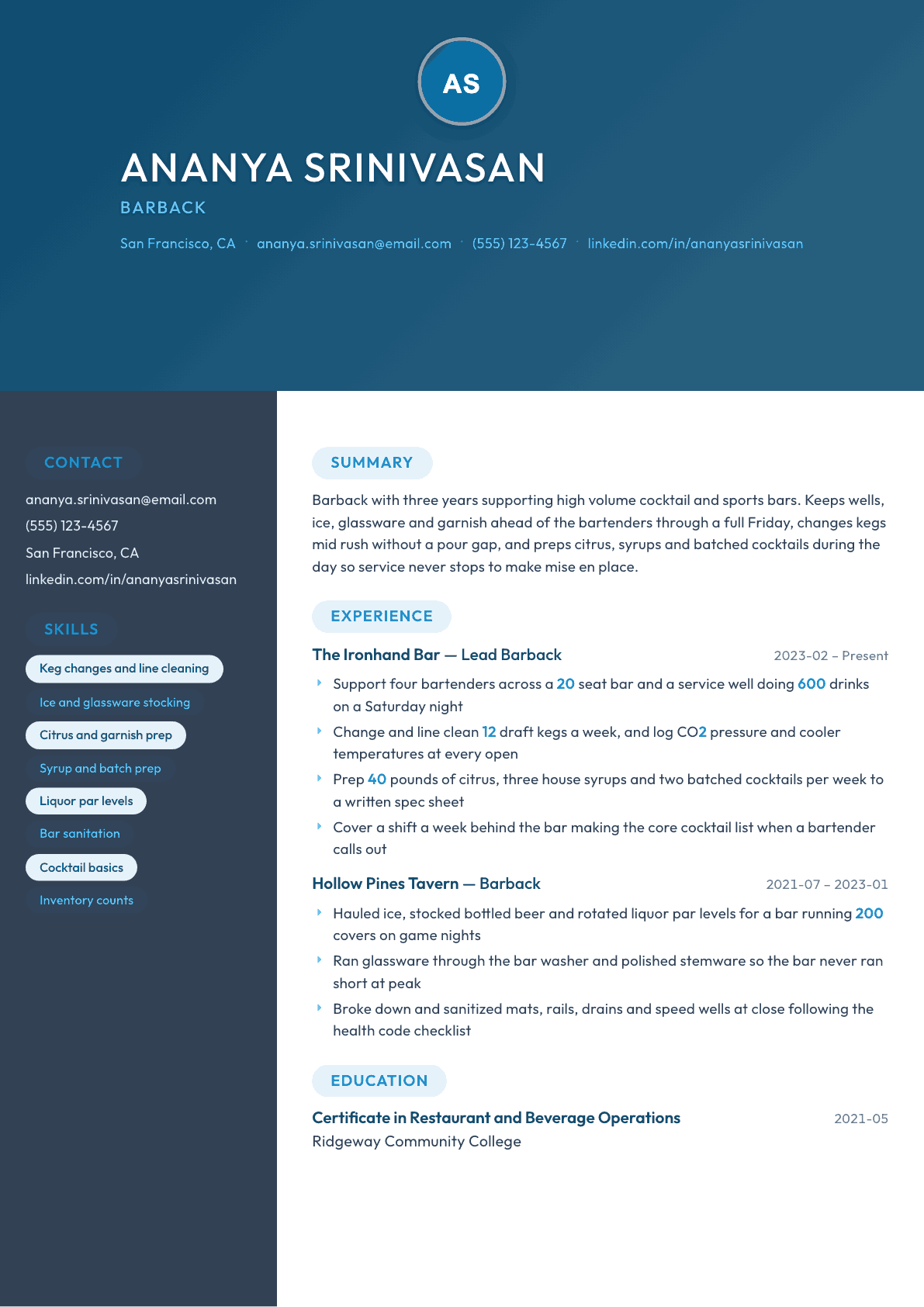
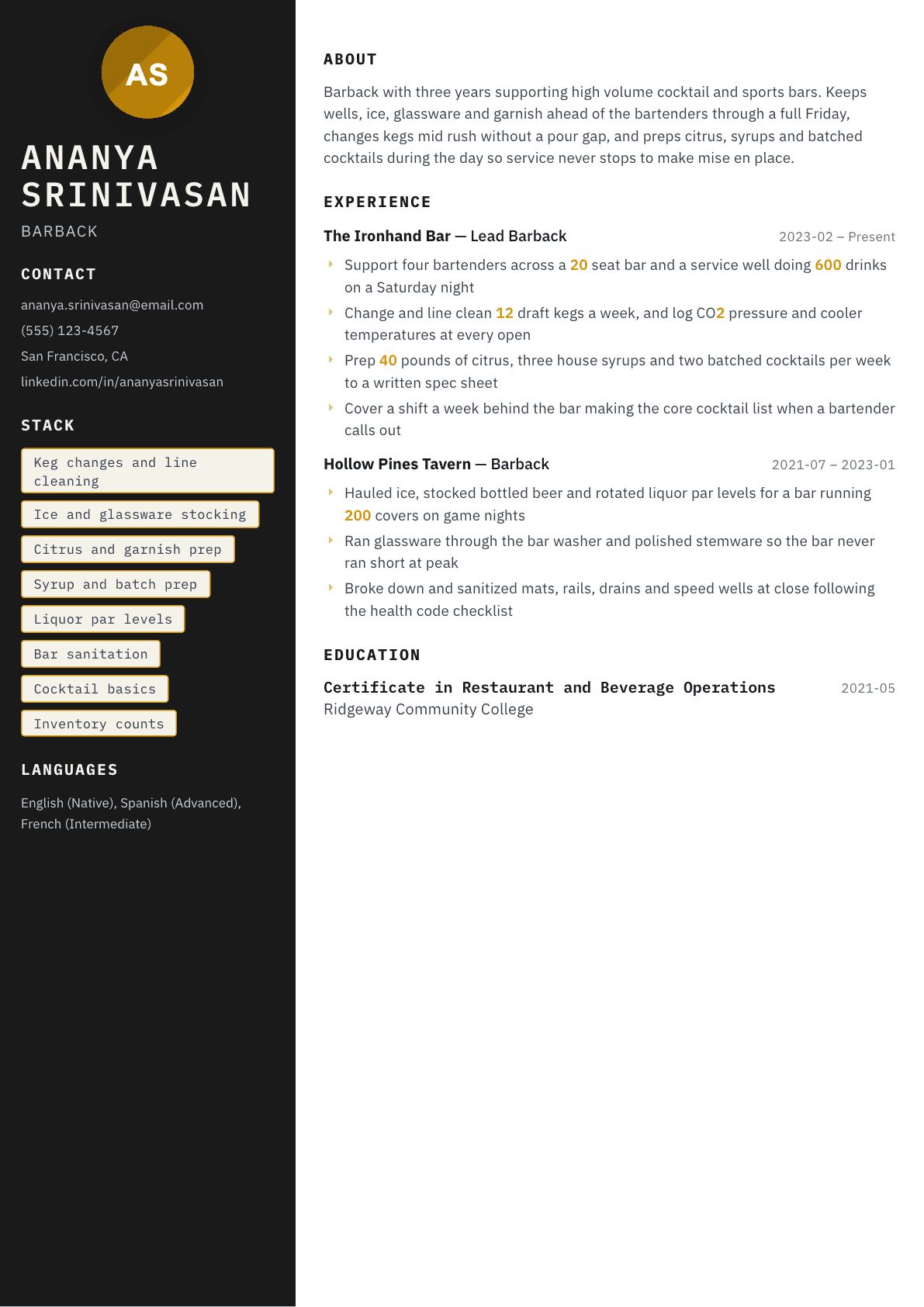
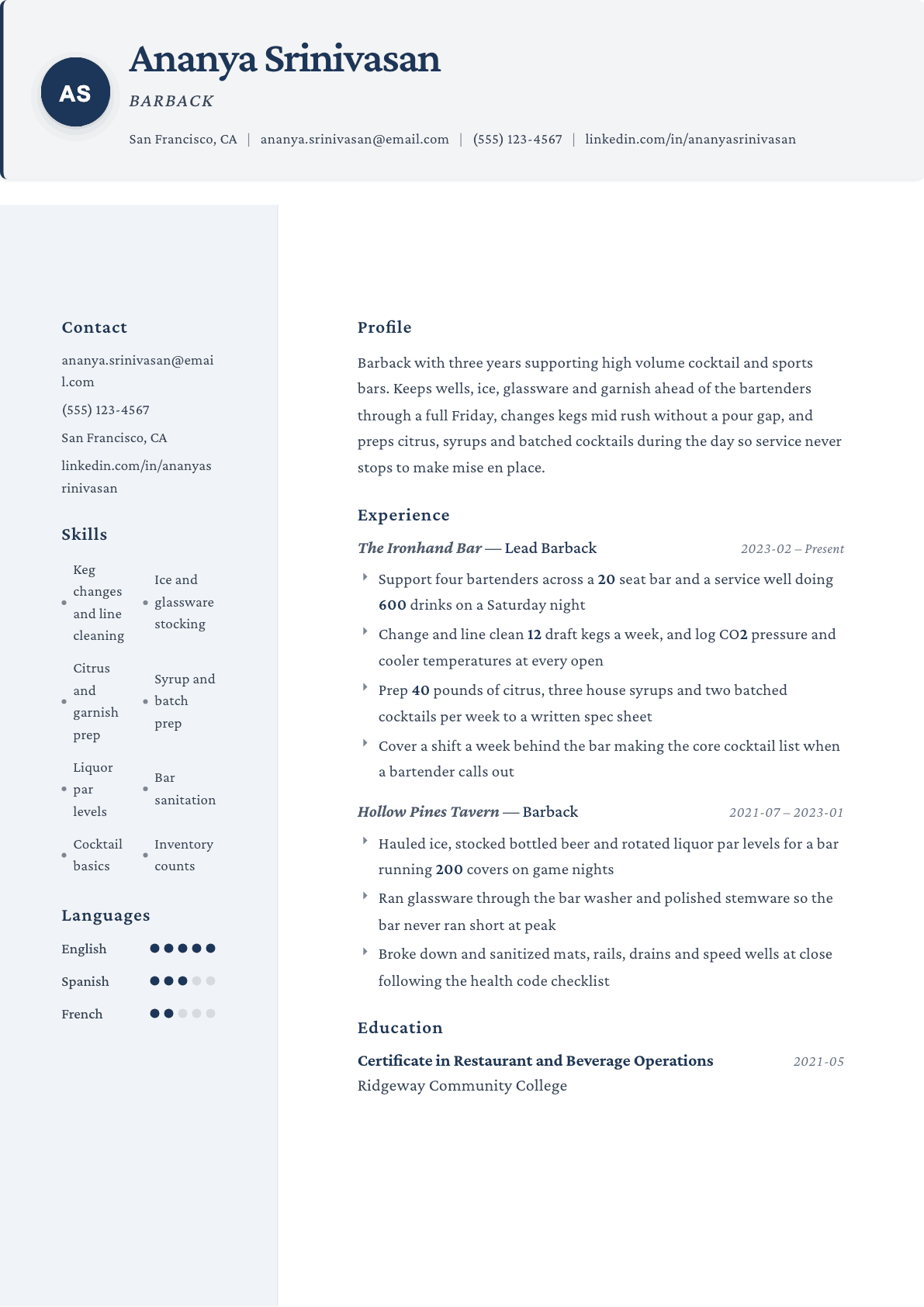
Example Barback summary
Barback with two years supporting a four bartender cocktail bar through 500 drink Saturdays. Keeps ice, glassware, garnish and liquor pars ahead of the well, changes kegs and cleans draft lines weekly, and preps citrus, syrups and batched drinks to written spec. Certified in responsible alcohol service and covering bartender shifts on the core list. Available late nights and weekends.
Skills to list on a Barback resume
- Bar stocking
- Keg changing
- Draft line cleaning
- Ice management
- Glassware handling
- Citrus and garnish prep
- Syrup and batch preparation
- Liquor and beer inventory
- Par level tracking
- Bar sanitation and closing
- Point of sale entry
- Cocktail preparation
- Guest service at the bar
- Heavy lifting and stamina
What actually gets this resume read
- Quantify the bar: seats, drinks per night and number of bartenders you support tells a manager the volume you handle.
- Name the physical work plainly, including keg changes, ice hauling and case stocking, because bar managers screen for it.
- List your prep by item and quantity, since a barback who batches and cuts to spec saves the bartender an hour.
- Add any alcohol service certification with the issuing program, because most states require it before you can pour.
- If you already make drinks on a slow shift, say which cocktails, since that is the path from barback to bartender.
- Include closing tasks like drain, mat and rail sanitation, which is what a health inspection actually checks.
How to write a barback resume
A bar manager hiring a barback is solving a physical problem. On a Saturday with four bartenders behind a twenty seat bar, somebody has to keep ice, glassware, garnish and liquor moving toward the well faster than the drinks go out, change a keg mid rush without a gap in the pour, and still have the citrus cut and the syrups made before the doors open. The application that wins is the one that reads like the writer has done exactly that.
Most barback applications do not. They say stocked the bar, assisted bartenders, cleaned at the end of the night. That leaves the manager guessing about the two things he actually needs to know: how much volume you have carried, and whether you can run draft equipment without being supervised. Kegs, gas pressure, line cleaning and cooler temperatures are technical work, and a page that names them separates you immediately.
This guide covers how to structure a barback resume, what to quantify, how to list prep work and sanitation the way a health inspection reads it, and how to write the page so it argues for your first bartending shift rather than another year of hauling ice.
Format: one page, volume and physical work up front
Single column, one page, reverse chronological. Bar managers read applications in a stack at the end of a shift, so nothing decorative survives and nothing needs to. Give the top third to the bar itself: seats, drinks per night, number of bartenders you support, and the service well if there is one.
Put availability in the header and be honest about late nights. A bar that closes at two in the morning has a staffing problem that daytime applicants cannot solve, so late night and weekend coverage stated plainly is a genuine advantage. Any alcohol service certification belongs in the header area too, because in many states it is required before you can touch a bottle.
- Header: name, city and state, phone, email, late night and weekend availability.
- Alcohol service certification with the issuing program, listed high on the page.
- Order: summary, experience, skills, education, certifications.
Summary: the bar you support and the prep you own
Open with the volume: how many bartenders, how many seats, how many drinks on a peak night. Then name the technical work you own. Keg changes, draft line cleaning, citrus and syrup prep, batched cocktails to spec. Those phrases tell a manager you can be left alone with the equipment.
Close with the direction you are heading. A barback who already covers a shift behind the bar on the core cocktail list is a cheaper hire than a bartender and a safer bet than an untested one, so say it in the summary if it is true.
Experience: kegs, ice, par levels and the close
Every job should open with the bar type and the volume, because a cocktail bar, a sports bar and a hotel lobby bar demand different work. Then write bullets in units. Kegs changed per week, pounds of citrus cut, syrups and batches produced, cases stocked, glass racks cycled, bottles rotated by par level.
Draft work deserves its own bullet and most applicants leave it out. Changing kegs, cleaning lines on a schedule, logging gas pressure and cooler temperatures at open: that is maintenance a manager otherwise has to do himself, and a barback who does it reliably becomes hard to replace.
The close is the other bullet that matters. Mats, rails, drains, speed wells, bar washers and the sanitation checklist are exactly what a health inspector opens the bar to check, so describing the routine rather than saying cleaned the bar tells a manager his inspection score is safe with you.
Skills: prep to spec, inventory, and the drinks you can already make
Hard skills for a barback are keg changing, draft line cleaning, ice management, glassware handling, citrus and garnish prep, syrup and batch preparation, liquor and beer inventory, par level tracking, bar sanitation and point of sale entry. Add cocktail preparation only if you genuinely make drinks, and then name the ones you make.
Prep to a written spec is worth calling out. A barback who cuts, batches and labels to the same numbers every week saves the bartender an hour of setup and keeps the cocktails consistent from one shift to the next, which is the argument for a raise before it is an argument for a promotion.
- Quantify prep: pounds of citrus, number of syrups, batches per week.
- Name the inventory work: par levels, counts, rotation, ordering support.
- List the cocktails you can build unsupervised, since that is the promotion case.
Certification, education, and moving to bartender
Alcohol service training is the one credential that matters here, and it is real: programs such as ServSafe Alcohol and TIPS are recognized across most of the country, and many states require certification before an employee can serve or handle alcohol. List the program by name. A beverage operations certificate or a hospitality course adds context but does not replace it.
To turn the page into a bartender application, weight it differently. Lead with the shifts you have covered behind the bar, the cocktails you can build, point of sale accuracy and guest interaction, then keep the stocking and draft work as supporting evidence of reliability. The same facts, reordered, argue for a different job.
Barback resume summary examples
First bar job
Warehouse and stockroom worker moving into a barback role, used to hauling cases and kegs, rotating stock by date and working a late shift on my feet. Certified in responsible alcohol service, learning the core cocktail list, and available every weekend night.
Two years behind the well
Barback with two years supporting a four bartender cocktail bar through 500 drink Saturdays. Keeps ice, glassware, garnish and liquor pars ahead of the well, changes kegs and cleans draft lines weekly, and preps citrus, syrups and batched drinks to written spec. Certified in responsible alcohol service.
Lead barback
Lead barback with three years across cocktail and sports bars, supporting four bartenders across a 20 seat bar and a service well at 600 drinks a night. Changes and line cleans 12 kegs a week, logs gas pressure and cooler temperatures, and covers a bartending shift a week on the core list.
Work experience bullets: before and after
Before: Stocked the bar and helped the bartenders.
After: Supported four bartenders across a 20 seat bar and a service well doing 600 drinks on a Saturday, keeping ice, glassware and garnish ahead of the pour all night.
Bartender count, seat count and drink volume let a manager size the bar you have actually worked.
Before: Changed kegs when they ran out.
After: Changed and line cleaned 12 draft kegs a week and logged gas pressure and cooler temperatures at every open, so no keg blew mid service.
Draft maintenance with a frequency and a log is technical work a manager otherwise has to do himself.
Before: Prepared garnishes and syrups for the bar.
After: Prepped 40 pounds of citrus, three house syrups and two batched cocktails a week to a written spec sheet, labeled and dated for rotation.
Quantities plus a spec sheet show consistency, which is what keeps cocktails tasting the same on every shift.
Before: Cleaned the bar at the end of the night.
After: Broke down and sanitized mats, rails, drains and speed wells at close following the health code checklist, and ran the final glass racks through the bar washer.
Naming the surfaces an inspector checks turns a chore into evidence you protect the inspection score.
Before: Sometimes made drinks when the bar was busy.
After: Covered a shift a week behind the bar building the core cocktail list and pouring drafts, and rang every ticket accurately at the point of sale.
A regular shift and a named scope of drinks is the argument for a bartender promotion rather than a hint at one.
Hard skills
- Bar stocking
- Keg changing
- Draft line cleaning
- Ice management
- Glassware handling
- Citrus and garnish prep
- Syrup and batch preparation
- Liquor and beer inventory
- Par level tracking
- Bar sanitation and closing
- Point of sale entry
- Cocktail preparation
Soft skills
- Stamina and heavy lifting
- Anticipating the well
- Working in a tight space
- Guest service at the bar
- Reliability on late shifts
- Calm during a rush
Certifications worth listing
- ServSafe Alcohol (National Restaurant Association)
- TIPS Alcohol Certification (Health Communications, Inc.)
- ServSafe Food Handler (National Restaurant Association)
Mistakes that cost barback candidates the interview
- Writing stocked the bar and assisted bartenders, which leaves out every number a bar manager uses to size the job.
- Leaving draft work off the page, when keg changes and line cleaning are the technical skills that make a barback hard to replace.
- Skipping the alcohol service certification, which in many states has to be in hand before the first shift.
- Never quantifying prep, so a manager cannot tell whether you cut a few limes or produced a week of batches to spec.
- Describing the close as cleaning rather than naming the mats, drains and rails an inspector actually checks.
- Hiding the shifts you have already covered behind the bar, which is the strongest argument you have for a promotion.
Barback resume questions
What does a bar manager look for first on a barback resume?
Volume and equipment. How many bartenders you support, how many drinks the bar does on a peak night, and whether you can change kegs and clean draft lines without supervision. Those facts decide the interview before anything about attitude does.
Do I need a certification to work as a barback?
Most states require an alcohol service certification for anyone handling or serving alcohol, and many employers want it before your first shift. Programs such as ServSafe Alcohol and TIPS are widely accepted. List the program name and keep it current.
How do I get promoted from barback to bartender?
Write the page so it shows you already do part of the job: shifts covered behind the bar, cocktails you build unsupervised, point of sale accuracy and guest interaction. Managers promote the barback who has already proven the drinks, not the one who asks.
Should I mention that the job is physical?
Yes, plainly. Hauling ice, stacking cases and moving kegs through a shift is a real requirement and managers screen for it. A line about lifting and stamina, backed by the volume you handled, answers a question they would otherwise ask on the phone.
What if I have only worked in a restaurant, not a bar?
Lead with the transferable pieces: stocking, sanitation, rotation by date, pace during a rush, and any service well or beer pouring you covered. Then add an alcohol service certification, which closes most of the distance for an entry level bar hire.
Related resume examples
- Bartender Resume example
- Restaurant Manager Resume example
- Server Resume example
- Dishwasher Resume example
- Host Resume example
- Bar Manager Resume example