Bar Manager Resume Examples: free ATS score and gap list
Build a Bar Manager Resume That Proves Pour Cost Control
By Mustafa Tarabya, founder of CVBooster · Published · Updated
A bar manager resume example with beverage keywords, sample bullets on pour cost and staffing, and tips for cocktail, hotel and high volume bars.
Sample resumes for a bar manager
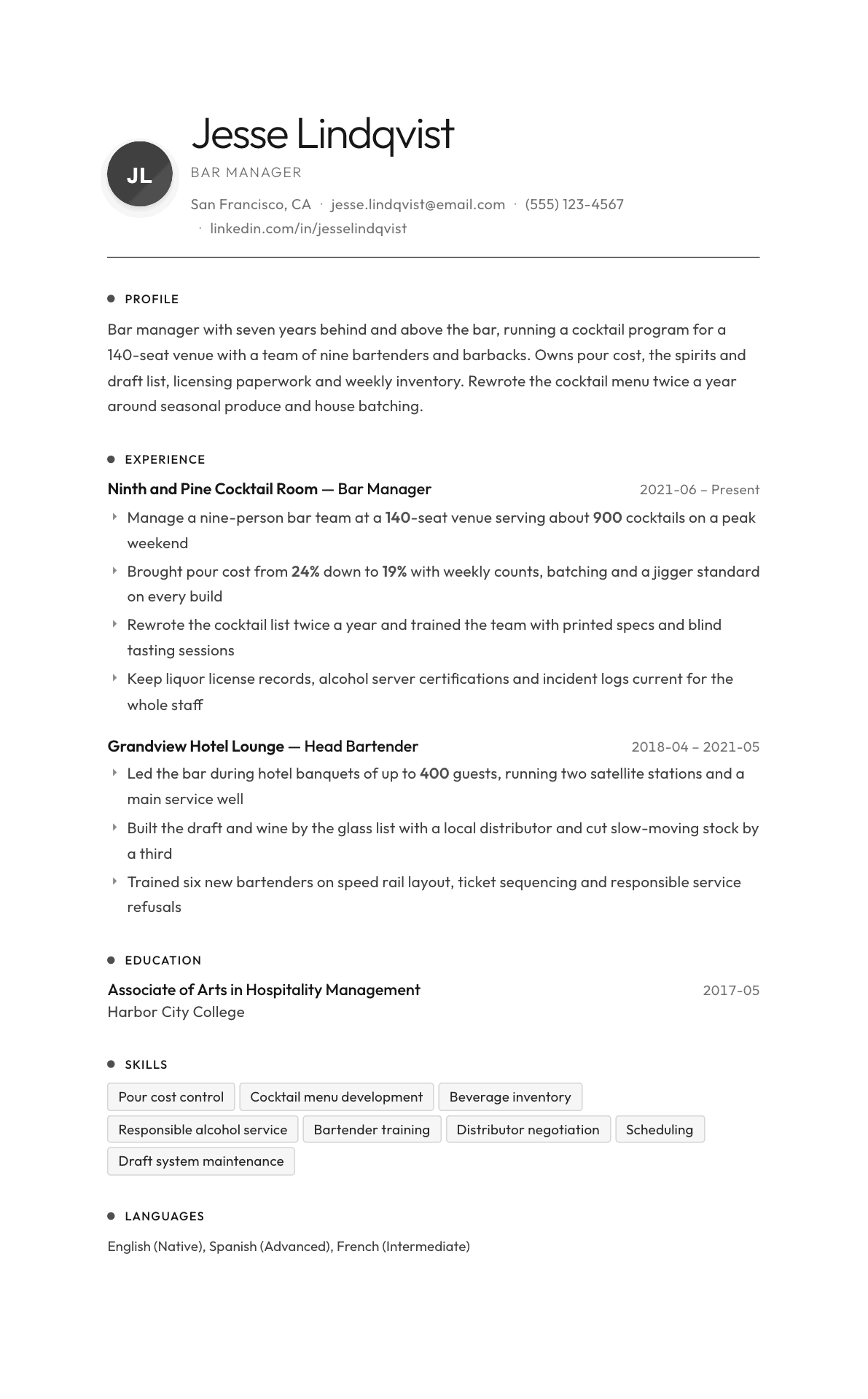
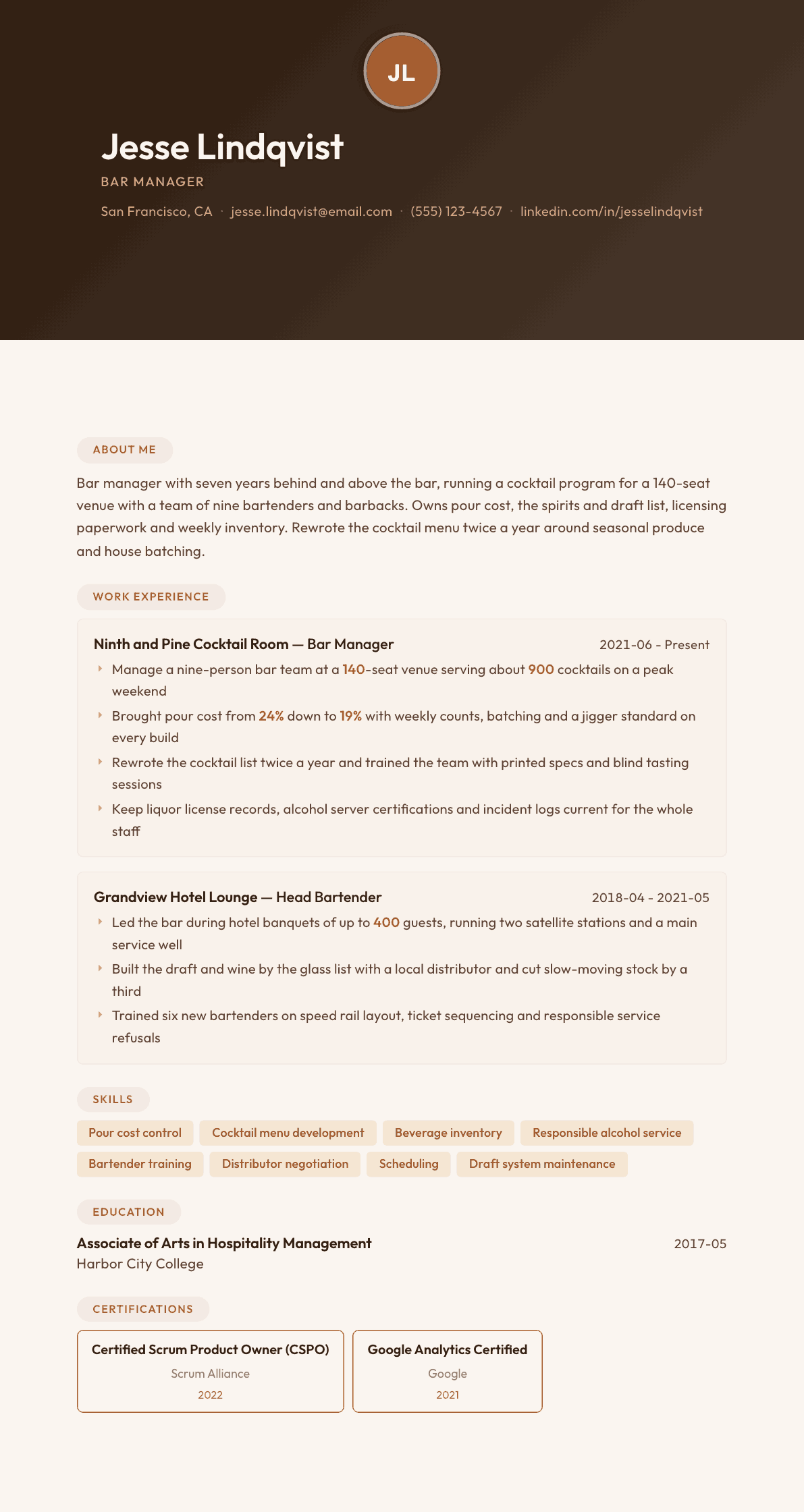
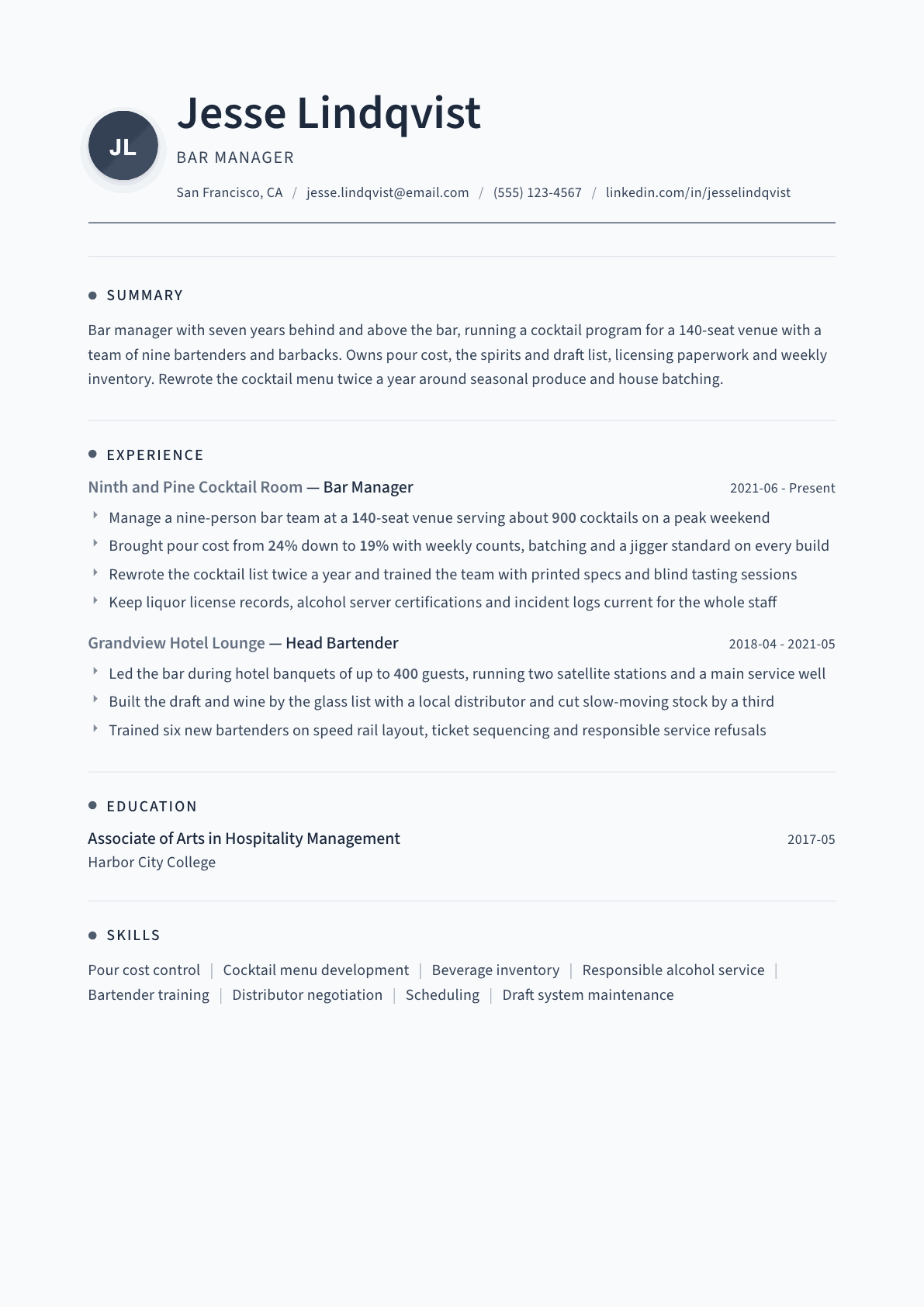
The same bar manager content laid out in three CVBooster templates, so you can see what the finished document looks like before you write a word.
Example Bar Manager summary
Bar manager with seven years in cocktail and hotel bars, currently leading nine bartenders and barbacks at a 140-seat venue. Owns the spirits list, weekly inventory, batching and training, and brought pour cost from 24% to 19% without cutting quality. Handles alcohol licensing records, distributor negotiation and menu changes twice a year. Looking for a beverage director track role in a multi-outlet group.
Skills to list on a Bar Manager resume
- Pour cost management
- Beverage inventory
- Cocktail development
- Batching and prep
- Wine and spirits knowledge
- Draft system maintenance
- Distributor and vendor relations
- Responsible alcohol service
- Bartender training
- Staff scheduling
- Cash and till control
- POS programming
- Health and safety compliance
- Event and banquet bars
What actually gets this resume read
- Put pour cost in the resume, with a before and after number, because it is the metric owners screen on.
- Describe the venue: seat count, style, peak volume, and whether the bar is standalone, hotel or restaurant.
- Show menu development as a cycle you own, including specs, batching, training and the cost of each build.
- List your alcohol server certification and any state license responsibilities with the issuing body named.
- Include inventory frequency and the system you count in, since accurate counts are what make pour cost real.
- Prove people work: bartenders trained, schedule size, and how you handle refusals and incident reporting.
How to write a bar manager resume
Every owner who hires a bar manager is looking at one number before anything else: pour cost. Liquor is the easiest category in hospitality to lose money in, and the manager is the only person standing between a well-run program and quiet theft, over-pouring, dead stock and a spirits list nobody orders from. A bar manager resume that never mentions pour cost is answering a different question than the one being asked.
The second thing the reader wants is the shape of the venue, because bar management splits into different jobs that share a title. A craft cocktail room with twelve seats and a spec book, a high-volume nightclub with four wells, a hotel bar tied to banquet service and room charges, and a restaurant bar carrying a wine list are managed with different instincts. Naming yours prevents the mismatch that ends most bar manager interviews early.
This guide covers the section order beverage directors expect, how to write about inventory so the pour cost figure holds up, three summaries across levels, and rewrites that turn a description of a bar into evidence about the person who ran it.
Format: one to two pages with the venue profile in every job header
Reverse chronological, one page for a first management role, two once you have multiple venues or a beverage program to describe. Under each job title, add a venue line: seats, style, peak volume, number of bar stations, and whether the bar is standalone, inside a restaurant, or part of a hotel with banquet outlets.
Give beverage results their own visual block near the top. Pour cost, inventory frequency, list size and menu change cadence deserve a place where the reader cannot miss them, because they are the entire commercial case for hiring you.
- Header: name, city and state, phone, email, and your alcohol server certification with the issuing body.
- Sections in this order: summary, beverage results, bar management experience, programs and menus, certifications, education.
- Add a programs section for cocktail menus you wrote, with the number of specs and the cost target you built to.
- Keep events and banquet bar experience separate, since it is a different operational skill.
Summary: venue, team, list, and the pour cost you held
Four lines. The venue type and size, how many bartenders and barbacks you lead, what you own in the program, and the pour cost you carried with a before and after when you improved it. State the segment you want next, because beverage careers fork between craft, volume and hotel and the reader is trying to place you.
If you are stepping up from lead bartender, name the manager duties you already hold. Weekly counts, ordering, comps and voids review, and writing the schedule are usually shared before the title changes, and they are the evidence that matters more than the title itself.
Experience: cost, program, people, compliance
Lead with the money. Pour cost by category is more convincing than a single blended figure, because spirits, wine, draft beer and packaged beer behave differently and an owner knows it. Pair the number with the counting rhythm: a weekly count on high-value spirits and a full monthly count is a method a reader can picture.
Then the program. Describe a menu change as a cycle you own end to end: concept, sourcing, specs written to a target cost per build, batching and prep decisions, staff training, and how the menu performed against the one before it. Anyone can list drinks; owning the cycle is management.
Then people and compliance in the same breath, because that is how the job feels. Bartenders trained and certified, schedule size, how you handle a refusal of service, how incidents are documented, and how you keep records that survive an inspection or a license review. A manager who has handled a difficult night calmly and written it up properly is a genuine asset.
- Break pour cost out by spirits, wine and beer where you have the figures.
- State inventory frequency and the system you count in, since the count is what makes the cost real.
- Describe draft maintenance: line cleaning schedule, gas balance and yield on kegs.
- Give menu cycles a cadence, a spec count and a target cost per build.
- Name the compliance work: server certification of the team, incident logs and license record keeping.
Systems, licensing and vendor work
Name the point of sale and how deeply you have worked in it. Programming buttons, building modifiers, running comp and void reports and reading a product mix report are manager-level tasks, and saying so distinguishes you from a bartender who only rang tickets.
Inventory platforms, ordering portals and scheduling tools should appear by name, along with what you did in them. So should distributor relationships: how many suppliers you buy from, how you handle allocations, and whether you have negotiated pricing, samples or staff education visits.
Alcohol service certification is a screening requirement in most states, and some jurisdictions require a manager-level permit as well. List the certification, the issuing body and the expiry, and note any responsibility you held for the license file itself, since that duty is rarely delegated to someone unproven.
Keywords and the mistakes that follow them
Bar manager postings repeat pour cost, beverage inventory, cocktail menu development, bartender training, responsible alcohol service, draft system, wine and spirits knowledge, distributor negotiation, staff scheduling, cash control and banquet bar. Mirror the true ones once in the skills block and once in a bullet that shows the work.
The trap is writing a resume that reads like a cocktail resume rather than a management one. Guest lists, competitions and a talent for hospitality belong in a short final section. The bulk of the page has to prove that money, stock, people and the license were all safe in your hands.
Bar Manager resume summary examples
Lead bartender stepping up
Lead bartender with four years behind a 60-seat restaurant bar, already running weekly spirits counts, placing distributor orders and writing the bar schedule for five bartenders. Wrote two seasonal cocktail lists to a target cost per build and trained three new hires. Certified in responsible alcohol service and seeking a first bar manager role.
Seven years, cocktail and hotel
Bar manager with seven years across cocktail and hotel bars, currently leading nine bartenders and barbacks at a 140-seat venue. Owns the spirits list, weekly inventory, batching and training, and brought pour cost from 24% to 19% without cutting quality. Handles distributor negotiation, license records and two menu changes a year.
Beverage director track
Multi-outlet beverage lead responsible for a lobby bar, a restaurant bar and banquet service across a hotel, with 26 staff and a wine list of 180 selections. Standardized specs and counts across all three outlets, cut blended pour cost by four points, and built the server certification program the property now runs.
Work experience bullets: before and after
Before: Managed bar operations and staff at a busy venue.
After: Managed a 140-seat cocktail bar with three service stations, leading nine bartenders and barbacks through weekend peaks of 400 covers.
Seats, stations, headcount and peak volume tell an owner what kind of bar you have actually run.
Before: Reduced pour cost and controlled inventory.
After: Brought pour cost from 24% to 19% over three quarters through weekly counts on spirits, jigger-and-free-pour standards enforced on every shift, and a rebuilt par list that cleared 40 dead SKUs.
The before and after plus three named mechanisms make the improvement repeatable rather than anecdotal.
Before: Created new cocktail menus each season.
After: Wrote two seasonal menus a year, costing every build to a target, batching four specs for speed, and training the team in a tasting session before launch so ticket times held through the change.
A menu becomes management once costing, batching, training and service speed are attached to it.
Before: Trained bartenders and handled difficult customers.
After: Certified all eleven bartenders in responsible alcohol service, ran a monthly spirits education session, and documented every refusal and incident in a log reviewed with the general manager each week.
Certification, a training rhythm and a documented process turn a soft claim into a compliance record.
Before: Worked with vendors to order products.
After: Bought from fourteen distributors on a weekly order cycle, negotiated case pricing and allocations on core spirits, and consolidated two suppliers to cut delivery days and simplify receiving.
Supplier count, cycle and a specific negotiation outcome show commercial judgment rather than order entry.
Hard skills
- Pour cost management
- Beverage inventory and counts
- Par level and ordering systems
- Cocktail development and costing
- Batching and bar prep
- Wine and spirits knowledge
- Draft system maintenance and line cleaning
- Distributor negotiation
- Responsible alcohol service compliance
- Bartender training and certification
- Staff scheduling and labor control
- Point of sale programming and reporting
- Cash and till control
- Banquet and event bar operations
Soft skills
- Composure at peak volume
- Firmness in refusing service
- Coaching behind the bar
- Negotiation with suppliers
- Guest recovery
- Discretion with cash handling issues
Certifications worth listing
- ServSafe Alcohol (National Restaurant Association)
- TIPS Certification (Health Communications, Inc.)
- Certified Specialist of Spirits (CSS) (Society of Wine Educators)
- Level 2 Award in Wines (Wine and Spirit Education Trust)
- Certified Beer Server (Cicerone Certification Program)
Mistakes that cost bar manager candidates the interview
- Omitting pour cost, which an owner reads as an admission that you never measured it.
- Describing the venue as high volume without seats, stations or peak covers to prove it.
- Writing a drinks list instead of a management record, so the page reads as a bartender resume.
- Leaving alcohol service certification off the header when it is a legal condition of the job.
- Claiming an inventory result with no counting frequency behind it.
- Ignoring compliance work such as refusals, incident logs and license records, which owners treat as the real risk.
Bar Manager resume questions
How do I show pour cost if my venue never tracked it?
Give what you did have: weekly variance on key spirits, usage against sales, or waste and comp levels. Then say plainly that you introduced counting where none existed. Building the measurement is itself a strong management story for an owner who suspects his own numbers.
Does a bar manager resume need cocktail specs on it?
No. Name the menus you wrote, how many specs each carried and the cost target you built to. Specs themselves belong in a portfolio you bring to the interview, where the reader can ask about balance, sourcing and batching in person.
What certification does a bar manager need?
A recognized responsible alcohol service certification is expected almost everywhere, and some states require a manager-level permit on top. Wine or spirits credentials are optional but help for list-driven venues. Always name the issuing body and the expiry date on the resume.
How do I move from a nightclub bar to a craft cocktail bar?
Lead with the parts that transfer: cost control, staffing at volume, compliance and speed. Then add evidence of technique, such as a spec book you wrote, batching work, or education you have taken. Address the segment change directly in the summary.
Should I mention theft or shrink problems I fixed?
Yes, without naming anyone. Write it as a control problem you solved: a variance you found, the counting or audit change you made, and where the number landed afterward. Owners hire for exactly this and rarely see it stated on a resume.
Related resume examples
- Bartender Resume example
- Restaurant Manager Resume example
- Barback Resume example
- Food and Beverage Manager Resume example
- Sommelier Resume example
- Restaurant Owner Resume example