Basketball Coach Resume Examples: the lines they read
Basketball Coaches Resumes Athletic Directors Take Seriously
By Mustafa Tarabya, founder of CVBooster · Published · Updated
Basketball coaches resumes and coach resume examples, with a complete program entry, keywords and a writing guide for school and club coaching jobs.
Sample resumes for a basketball coach
The same basketball coach content laid out in three CVBooster templates, so you can see what the finished document looks like before you write a word.
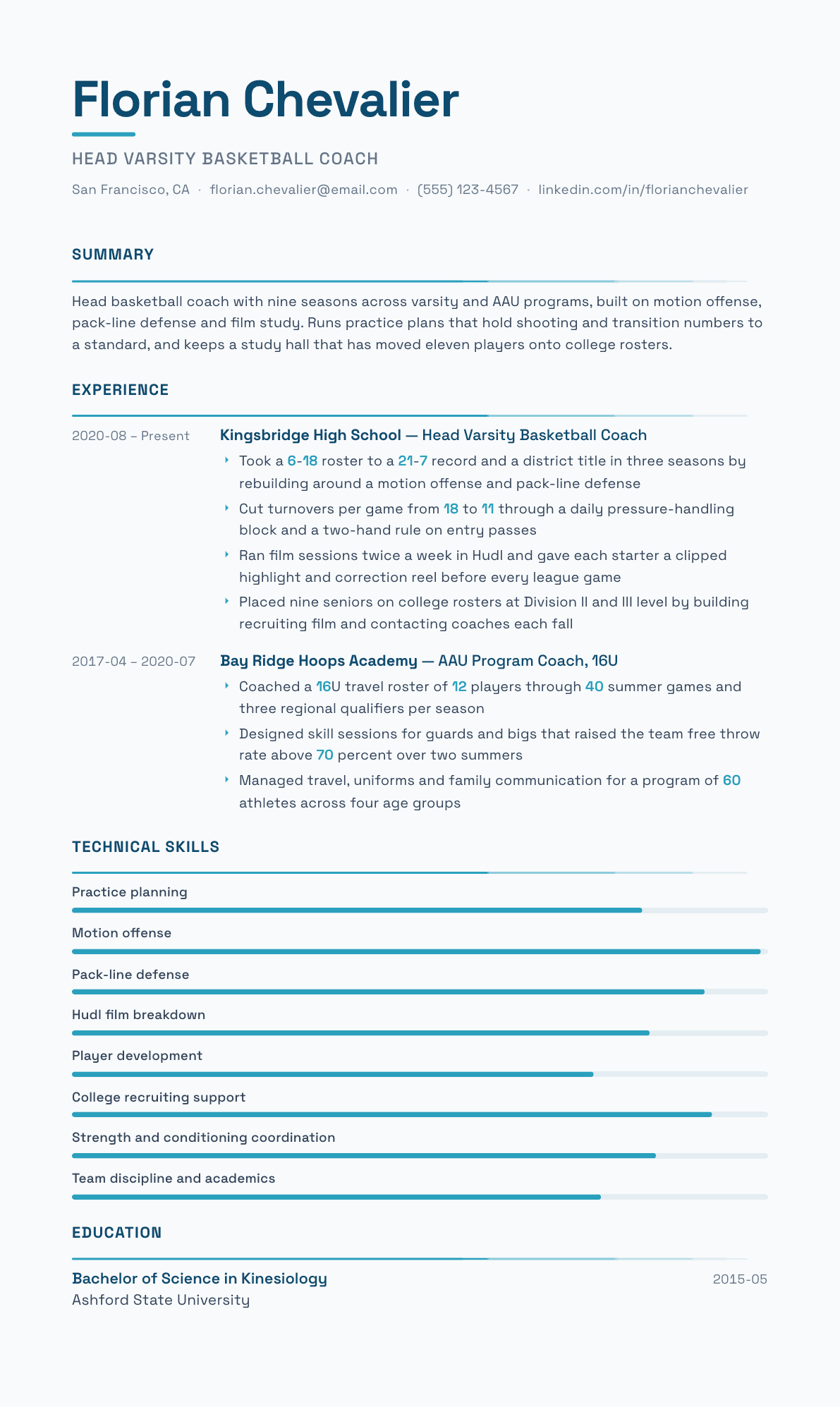
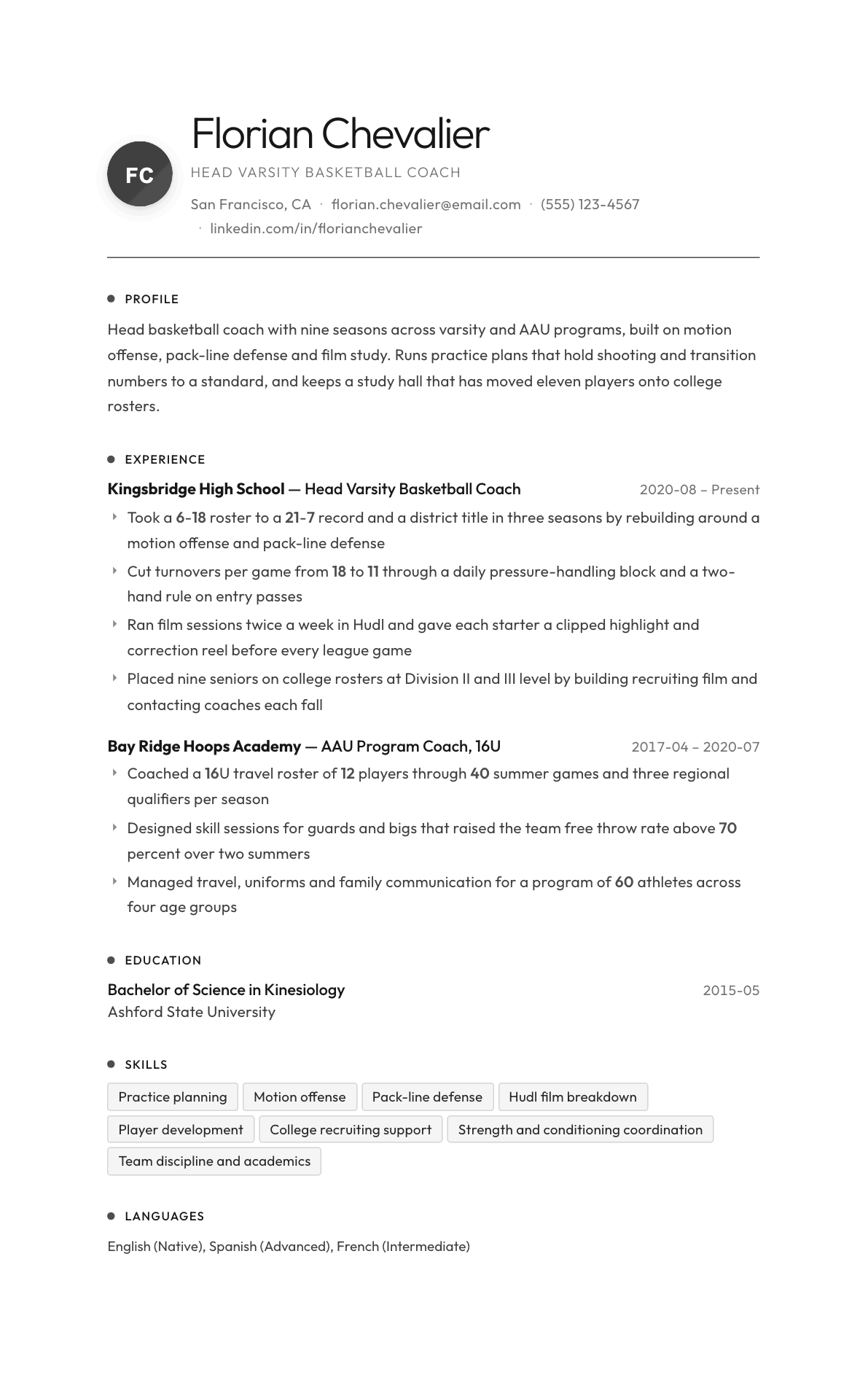
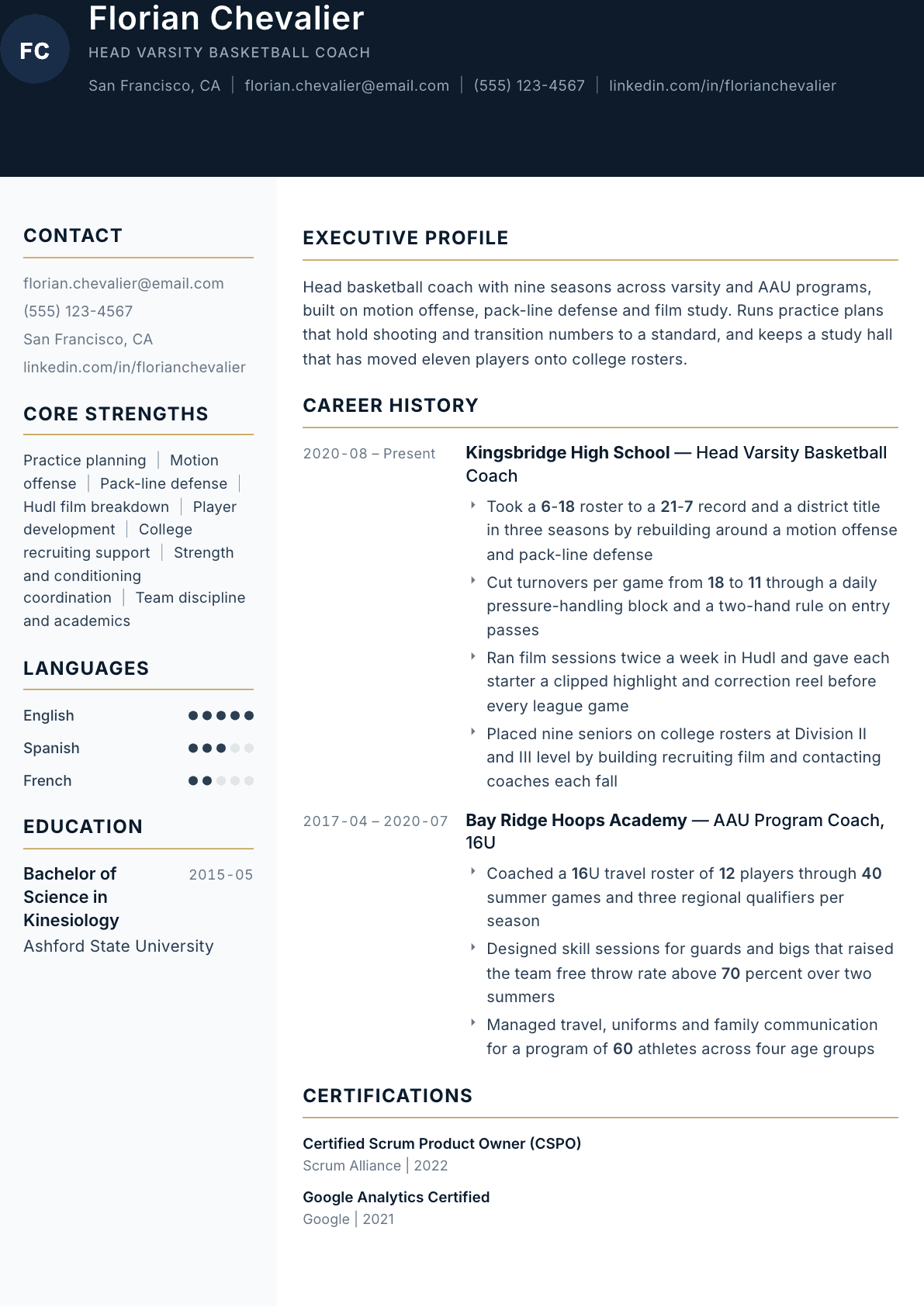
Example Basketball Coach summary
Head basketball coach with eight seasons of varsity experience and a program record of 84 wins and 41 losses, three league titles and fourteen college placements. Teaches motion offense and pack-line defense, runs weekly film review in Hudl, and coordinates a summer lifting block with the strength staff. Certified in first aid and concussion recognition, and looking to lead a program with a strong feeder system.
Skills to list on a Basketball Coach resume
- Practice planning
- Offensive system design
- Defensive schemes
- Film breakdown
- Scouting reports
- Player skill development
- Strength program coordination
- Recruiting and college placement
- Game management
- Roster and substitution planning
- Parent and booster communication
- Budget and equipment management
- Academic eligibility tracking
- Assistant coach supervision
What actually gets this resume read
- Put your win-loss record, playoff finishes and roster size in every coaching job so a director can weigh the program.
- Name the offensive and defensive systems you teach, because a hiring committee is choosing a style as much as a person.
- Show player development with real outcomes: college placements, all-conference selections, scoring or turnover changes.
- List your coaching certification, first aid and concussion training near the top, since districts cannot hire without them.
- Include the film and stat tools you use so the school knows you can run video review without extra training.
- Say who else you can coach or teach, since most school basketball jobs come attached to a class or a second sport.
How to write a basketball coach resume
A basketball coach resume is judged by an athletic director who has to defend the hire to a booster club, a principal and a group of parents. She reads three things before anything else: the level you have coached, what happened to the record while you were there, and whether your certifications are current enough for you to stand on a court on the first day of tryouts.
Basketball coaches resumes fail when they read like a fan biography. A page of philosophy about discipline and family tells the reader nothing, because every applicant writes it. The page that gets a call names the offense and the defense you teach, the roster and staff you managed, the practice structure you run, and the players who left your program better than they arrived.
What follows is the section order a director expects, three summaries written for a first assistant job, a varsity job and a program lead job, before and after bullets pulled from the kind of writing that actually arrives, a complete program entry showing how strong basketball coaching resumes are laid out, and answers to the questions coaches ask when the posting closes on Friday.
Format: coaching history first, teaching history second
Use reverse-chronological order and give the coaching record its own section, separate from any teaching or non-athletic work. Most school basketball openings are attached to a building assignment, so a director needs to see both, but she is filling the bench seat first and the classroom second.
Two pages is normal for a coach with more than five seasons, because seasons stack quickly and each one carries a record. Keep dates as seasons rather than months, because basketball runs across the calendar year and a reader will not translate month ranges in her head.
- Header line: name, city and state, phone, email, and current coaching certification status.
- A coaching record block: season, team, level, record, postseason result, one line each.
- Then teaching or other employment, then education, then certifications, then references from the basketball world.
- Summer and club coaching goes in its own short block so it does not clutter the school history.
Summary: level, seasons, system, one thing you fixed
Four lines at most. Say the level you have coached, how many seasons, the system you teach on both ends, and one specific thing you turned around. A director scanning ten applications is sorting them into piles by level and style, so make both obvious in the first sentence.
If you are applying above your current level, name the bridge. An assistant moving into a head job should point at the parts of the head job she already does: scouting, summer scheduling, running a position group, managing the junior varsity feed.
Experience: record, roster, system, development
Every coaching entry needs the school or club, the level, the roster size and the staff you led or reported to. Then the results, then the development. A line that reads twenty one wins and seven losses with a district title is the fact a booster remembers, so put it first rather than burying it under practice philosophy.
The development bullets are what separate a coach from a scorekeeper. Name what a specific group of players could not do when you arrived and what they could do a season later: a guard rotation that stopped turning the ball over, a big who learned to seal and finish, a team that went from a walk-it-up half court set to a functioning secondary break.
Include the parts of the job nobody puts on the posting: summer league entries, gym scheduling, uniform ordering, fundraising, the study hall, the ride home. A director hires the coach who has already carried that load.
Basketball coaching resumes that get calls lay out each program the same way, so a committee can compare entries at a glance. The sample entry below is invented; keep the order and replace the details with your own.
- Head Varsity Boys Basketball Coach, a public high school, three seasons. Roster of fifteen, two assistants and a junior varsity coach reporting to me.
- Record: rebuilt a program that had not reached the conference tournament in several seasons; reached the conference semifinal in season two and the state sectional final in season three.
- System: five out motion offense with a pack line base defense and a three quarter court press for late game situations; film tagged in Hudl and delivered to players within a day of each game.
- Development: two players signed with college programs; team grade point average rose every season under a weekly study hall.
- Program: ran the summer league entry, youth camp and booster club fundraising that paid for new travel gear.
Systems, film and player development
Name the offense and the defense in the vocabulary other coaches use. Motion, flex, dribble drive, five out, princeton concepts, pack line, one three one, matchup zone, full court press. A hiring committee is deciding whether your style suits the athletes already in the building, and vague words about playing hard leave them guessing.
Say how film works in your program: who cuts it, how often players watch it, whether you send individual reels, and what tool you use for tagging and sharing. Also say how you build individual improvement plans in the offseason, because that is the piece parents ask about at the interview.
- Offensive system and the two or three sets you teach out of it.
- Defensive base plus your press, your zone offense and your late clock package.
- Film workflow: tagging, clip delivery, opponent scouting turnaround time.
- Offseason plan: skill blocks, lifting calendar, summer schedule, open gym structure.
Certifications, safety and eligibility work
Districts will not put a coach on a bench without current first aid, CPR and concussion training, and many states require a coaching education course. List each one with the issuing body and keep the dates current, because an expired card is an administrative problem the director has to solve before the season starts.
Add the compliance work you already do: eligibility checks, physical form collection, transportation paperwork, heat and lightning protocols in summer. It reads as unglamorous and it is exactly what makes a director comfortable handing over a program.
Keywords a school posting repeats
School and club postings recycle the same phrases: player development, practice planning, program building, student athlete academic support, film breakdown, offseason conditioning, parent communication, and the level name. Mirror the exact words once in the summary and once inside a coaching entry so both the tracking system and the reader find them.
Do not stuff a keyword block at the bottom. Basketball hiring runs through people who talk to each other, and a resume that reads like a machine wrote it damages the conversation that comes next.
Basketball Coach resume summary examples
First assistant job
Former college guard and second-year junior varsity coach seeking a varsity assistant role. Runs the freshman skill block, cuts and tags film for the varsity staff, and coordinates the summer league schedule. Holds current CPR and concussion certification and teaches ninth grade math.
Five seasons in
Varsity assistant with five seasons in a program that reached the sectional final twice, responsible for the defensive scouting report and post player development. Teaches pack-line principles and builds individual offseason plans. Ready for a head coaching job at a school that wants a feeder system built from the middle school up.
Program lead
Head basketball coach with eleven seasons, a career record of 187-64, four league titles and nineteen college placements. Teaches motion offense and pack-line defense, manages a staff of six across three levels, and runs a summer program of ninety athletes. Seeking a program with the resources to compete for a state title.
Work experience bullets: before and after
Before: Coached the varsity basketball team and improved the program.
After: Took over a varsity roster that had won 6 games and reached 21-7 with a district title in the third season, using a motion offense and pack-line defense installed from the middle school up.
The record, the timeline and the named system replace an unprovable claim of improvement.
Before: Worked on player development in the offseason.
After: Built individual summer plans for 14 returning players covering shooting volume, ball handling and a lifting block, and tracked make counts weekly in a shared sheet.
Naming the players, the content and the tracking method shows a system rather than an intention.
Before: Helped players get to the next level.
After: Placed nine seniors on college rosters at Division II and III level by building recruiting film, writing coach introductions each fall and taking players to two exposure events per summer.
Placement counts plus the actual process behind them make the outcome credible.
Before: Used film to prepare for games.
After: Cut and tagged opponent film within 24 hours of a scout, delivered a one-page scouting sheet to players and led two film sessions per week on transition defense.
Turnaround time and delivery format tell a director exactly how the week is run.
Before: Improved team statistics.
After: Reduced turnovers per game from 18 to 11 across two seasons through a daily pressure-handling block and a rule requiring two hands on every entry pass.
The before and after numbers are attached to the practice change that produced them.
Hard skills
- Practice planning
- Motion offense installation
- Pack-line and zone defense
- Press and press break design
- Opponent scouting reports
- Film tagging and clip delivery
- Individual skill development plans
- Offseason lifting coordination
- Game and clock management
- Substitution and rotation planning
- College recruiting support
- Summer program scheduling
Soft skills
- Player accountability
- Parent and booster communication
- Staff leadership
- Timeout composure
- Recruiting relationships
- Classroom to court consistency
Certifications worth listing
- Fundamentals of Coaching (National Federation of State High School Associations)
- Concussion in Sports (National Federation of State High School Associations)
- USA Basketball Coach License (USA Basketball)
- First Aid, CPR and AED (American Red Cross)
- SafeSport Trained (U.S. Center for SafeSport)
Mistakes that cost basketball coach candidates the interview
- Writing a coaching philosophy paragraph instead of a record, so the reader never learns what happened while you were there.
- Leaving the level off each job, which makes a middle school season and a varsity season look identical on the page.
- Listing every camp you ever attended as if attendance were a credential.
- Hiding the college placements at the bottom when they are the outcome families judge a basketball program on.
- Naming no offensive or defensive system, which forces a committee to guess whether you fit the roster they already have.
- Sending a resume with a lapsed CPR or concussion card, which stalls the file in the athletic office.
- Padding with playing career details from a decade ago while giving one line to five seasons of coaching.
Basketball Coach resume questions
Should a basketball coach resume include the win-loss record?
Yes, season by season, with the postseason result next to it. Directors compare candidates on the record even when they say they do not, and a coach who omits it looks like someone hiding a bad run rather than explaining it.
How do I write a basketball resume if I have only coached at the youth level?
Lead with volume and structure instead of prestige: number of teams, practices per week, players developed, tournaments managed. Youth coaching that shows written practice plans and a real skill curriculum reads far stronger than an unfilled varsity assistant line.
Do I need a teaching license to get a high school basketball job?
It depends on the district. Many schools prefer a coach who can also fill a classroom or supervisory position, so list any teaching certification, substitute eligibility or building duty you can cover, and say plainly if you are seeking a coaching only contract.
What belongs in the offseason section of a coaching resume?
Summer league entries, open gym structure, the lifting calendar you share with the strength staff, skill camps you run, and exposure events you take players to. Programs are built between March and October, and directors know it.
What do the best basketball coaching resumes have in common?
They give every program the same entry: level, roster and staff, season records with postseason results, the system in coaching vocabulary, and named player development. They stay at one page for an assistant and move to two once there is a real record block, and they list current certifications where an athletic director can find them.
Related resume examples
- Sports Coach Resume example
- Athletic Trainer Resume example
- Head Coach Resume example
- Strength and Conditioning Coach Resume example
- Baseball Coach Resume example
- Soccer Coach Resume example