Behavior Analyst Resume Examples: the lines they read
Write a Behavior Analyst Resume That Shows Data and Supervision Load
By Mustafa Tarabya, founder of CVBooster · Published · Updated
Behavior analyst resume example with assessment, treatment plan and supervision keywords, plus a guide to writing every resume section.
Sample resumes for a behavior analyst
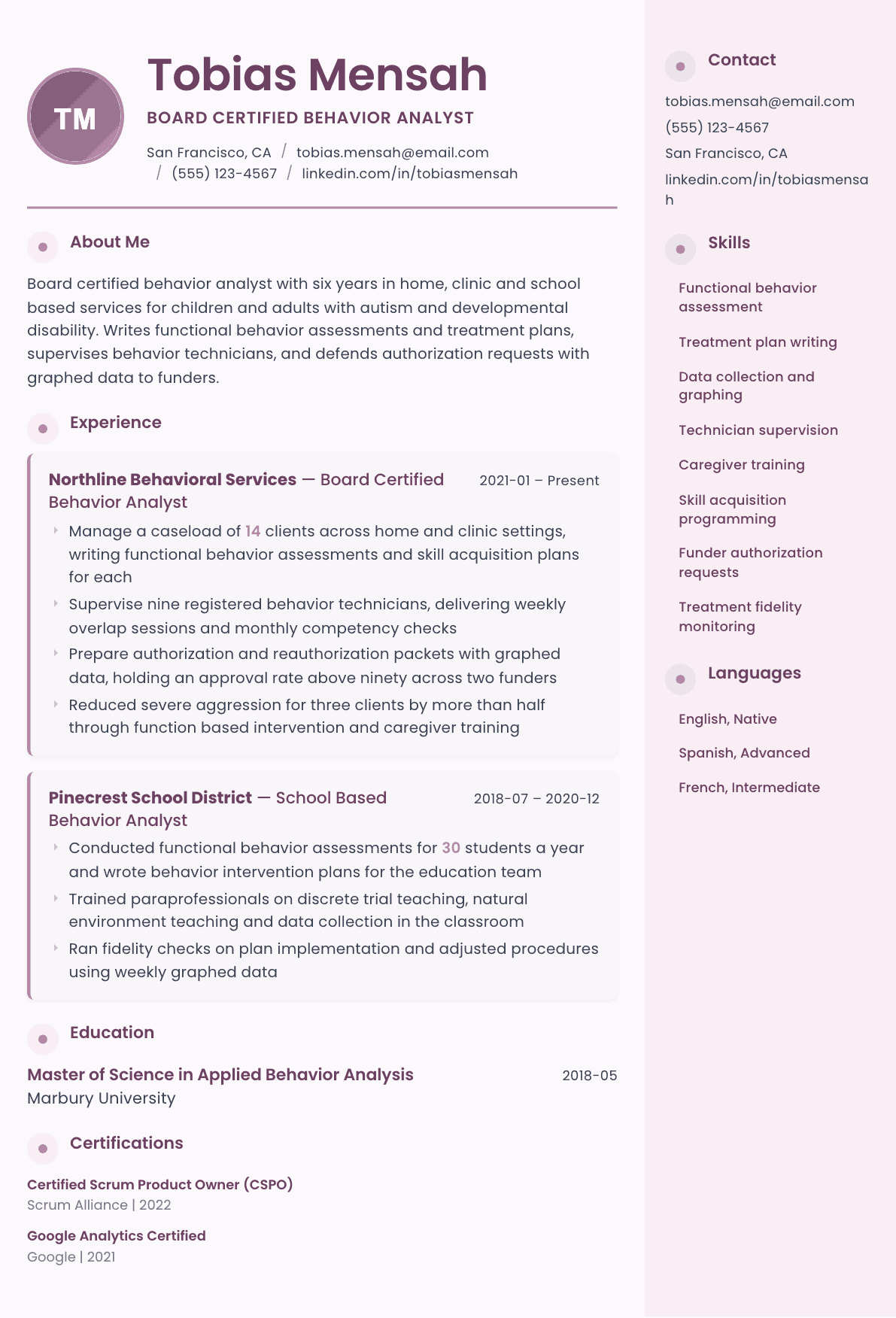
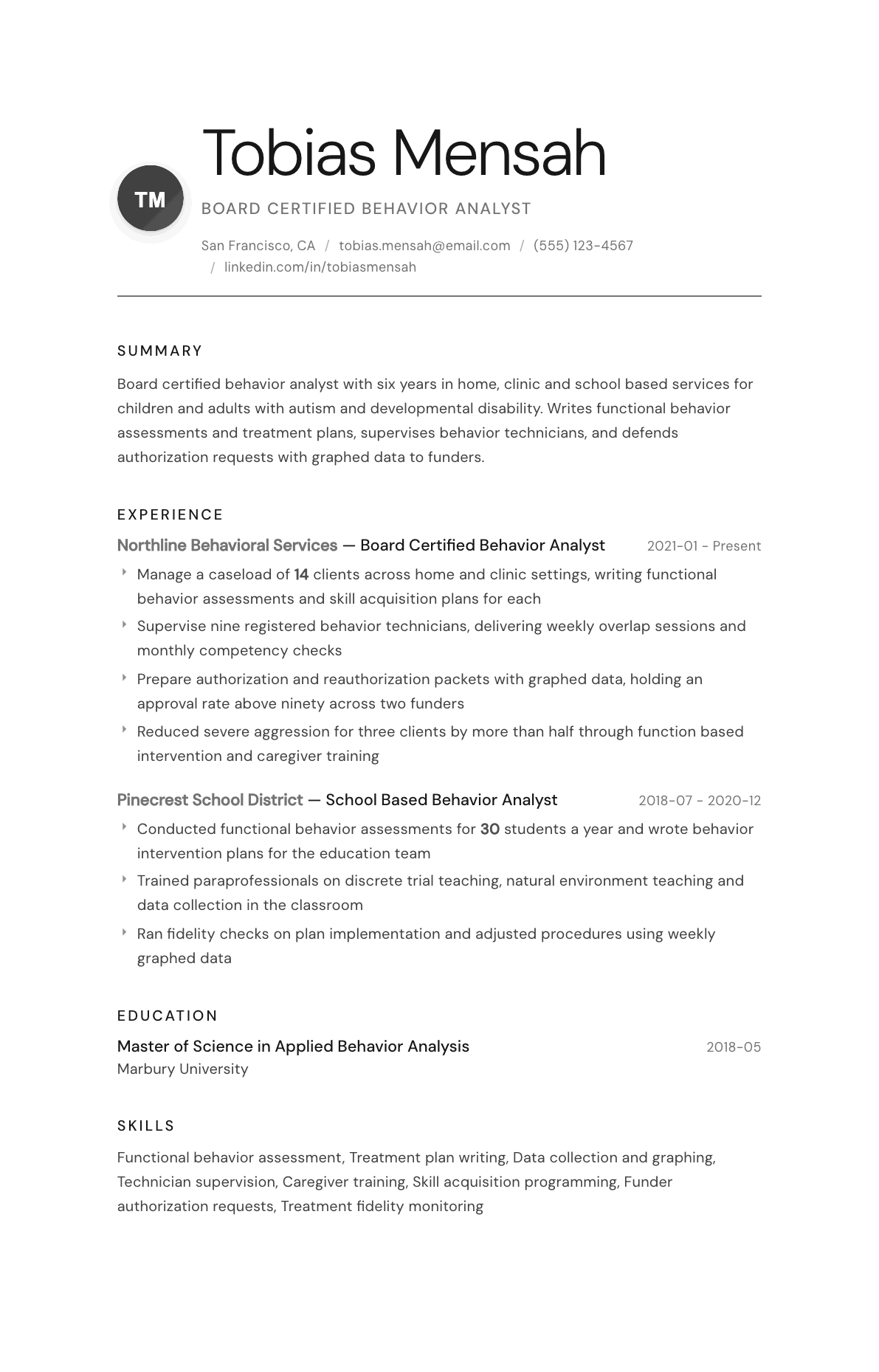
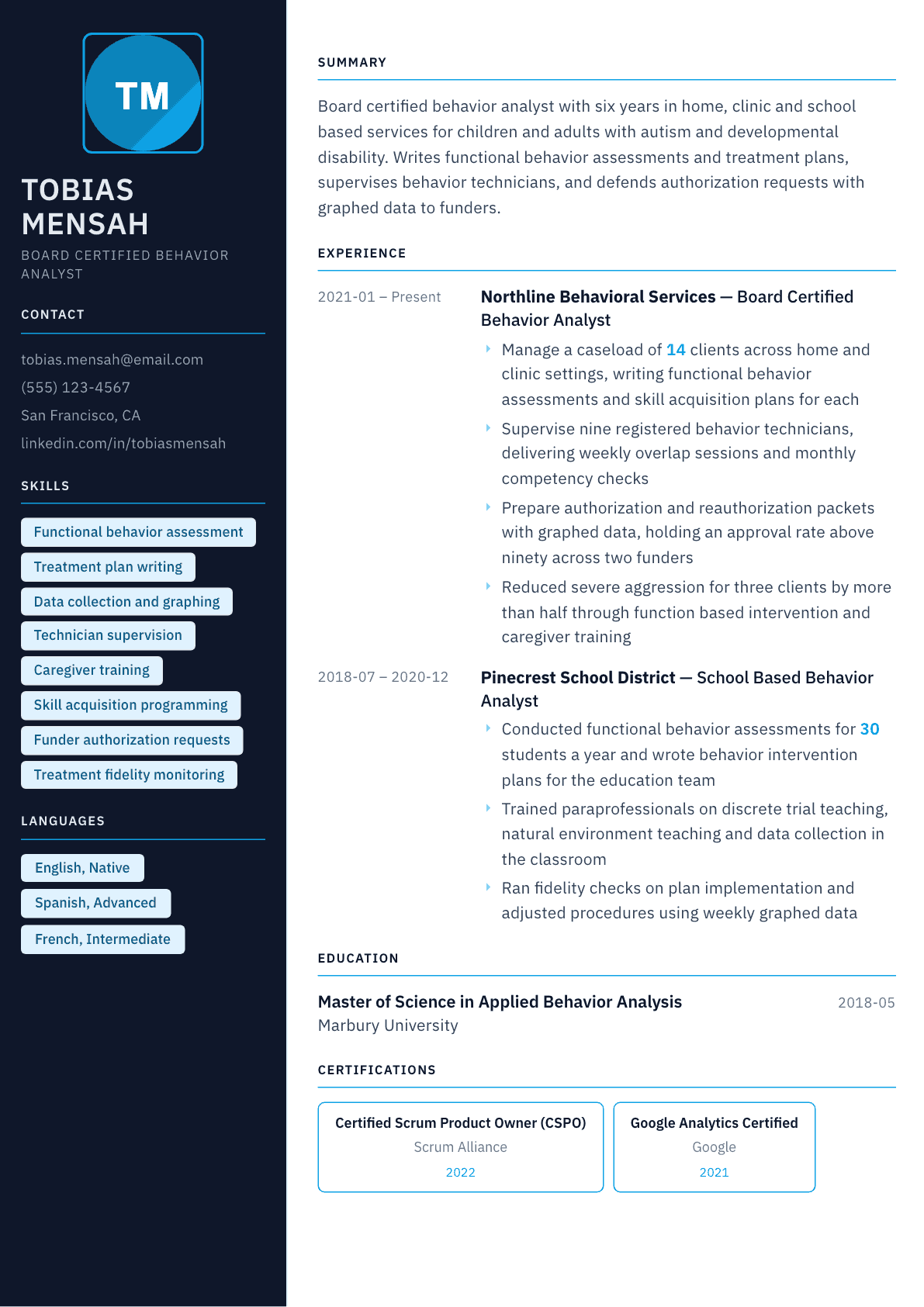
The same behavior analyst content laid out in three CVBooster templates, so you can see what the finished document looks like before you write a word.
Example Behavior Analyst summary
Board certified behavior analyst with six years across home, clinic and school based services for autism and developmental disability. Writes functional behavior assessments and skill acquisition plans, supervises a team of behavior technicians with weekly overlap and competency checks, and supports authorization requests with graphed data. Seeking a clinical director track role in a provider that values supervision quality.
Skills to list on a Behavior Analyst resume
- Functional behavior assessment
- Behavior intervention planning
- Skill acquisition programming
- Discrete trial teaching
- Natural environment teaching
- Data collection and visual analysis
- Single case design
- Technician supervision and training
- Caregiver and parent training
- Treatment fidelity monitoring
- Verbal behavior assessment
- Crisis and safety care planning
- Funder authorization documentation
- Interdisciplinary collaboration
What actually gets this resume read
- Put your board certification and state license in the header, because payors verify both before a client is assigned.
- Give caseload size and setting mix, since home, clinic and school work demand different scheduling and travel.
- Name the assessments you administer, such as VB-MAPP, ABLLS-R, AFLS or the Vineland adaptive scales.
- Report supervision load in technicians supervised and supervision hours delivered, because that drives billable capacity.
- Show funder facing work: authorization packets, reauthorization data, single case graphs and audit responses.
- Describe caregiver training outcomes, not just sessions delivered, since generalization at home is what a clinical director checks.
How to write a behavior analyst resume
A behavior analyst resume is read by a clinical director who has a very concrete problem: she has clients waiting, technicians who need supervision, and a funder who will only authorize hours when the paperwork justifies them. Everything she looks for on your page maps to one of those three. Caseload capacity, supervision load, and whether your assessments and progress reports get authorizations approved.
That last one surprises new analysts. Clinical skill matters, but a provider lives or dies on whether reauthorization packets come back approved with the hours the client actually needs. An analyst who writes tight functional behavior assessments, graphs data honestly and answers funder questions without a fight is worth more than one with a longer publication list.
This guide covers the certification block, how to describe caseload and setting mix, how to write about assessment and supervision so a director can staff you, three summaries from technician-turned-analyst to clinical lead, before and after bullets, and the questions analysts ask when they move between home, clinic and school work.
Format: certification and license block above everything
One to two pages. Put a credential block directly under your contact line: your board certification with the certificant number, your state license for behavior analysis if your state requires one, your graduate degree and whether the coursework sequence was verified, and your supervised fieldwork completion. Payors verify certification and license before a client is assigned to you, so anything ambiguous here delays your start date.
Add a setting line: in-home, center or clinic, school, day program, residential or telehealth. Setting drives scheduling, travel, billing codes and the kind of caregiver work you do, and directors hire against the setting they need covered.
- Credential block: board certification, state license, degree, verified course sequence, supervised fieldwork.
- Setting line: home, clinic, school, residential or telehealth, plus travel radius if you drive to clients.
- Population line: early intervention, school age, adolescents, adults, and severe behavior specialty.
Summary: caseload, supervision, setting, authorization record
Four facts in three sentences. How many clients you carry, how many technicians you supervise, which settings, and how your authorization requests fare. That combination tells a director your billable capacity and your risk profile at the same time.
Name the population precisely. Early intervention with two-year-olds and severe behavior work with adolescents demand different skills, different safety training and different family work, and a summary that says clients with autism hides which of those you can actually do.
Assessment and treatment planning: name the tools
List the assessments you administer and interpret by name, across skills and behavior. Verbal behavior and language milestone assessments, assessment of basic learning and language skills, functional living skills protocols, adaptive scales, preference assessments and the descriptive or experimental functional analysis methods you use.
Then describe what you produce from them. A treatment plan that specifies target behaviors, operational definitions, measurement systems, mastery criteria, generalization plans and discharge criteria is a clinical document. Saying you write treatment plans without describing what is in them tells a director nothing about your standard.
Include severe behavior work explicitly if you have it. Self-injury, aggression and elopement plans carry safety planning, restraint policy, incident review and often a physical management certification, and providers pay attention to analysts who can take those referrals.
- Skills assessments and behavior assessments by name, plus preference assessment methods.
- Functional behavior assessment approach: indirect, descriptive and analog conditions where used.
- Treatment plan contents: definitions, measurement, mastery criteria, generalization, discharge planning.
- Severe behavior: safety plans, restraint policy compliance, incident review participation.
Supervision: the number that sets a provider capacity
Supervision is often the whole reason a post exists. State how many registered technicians you supervise, the format of your overlap sessions, how often competency checks happen, and how you handle fidelity when performance drifts. Add trainees accruing fieldwork hours toward their own certification and whether you sign for those hours.
Say something about how you train. Behavioral skills training with instruction, modeling, rehearsal and feedback is the standard, and describing your process rather than the word training shows a director whether your technicians will run programs correctly when nobody is watching.
Caregiver training belongs here too. Parent and teacher training is where generalization either happens or does not, so describe the format, the frequency and what changed in the home or the classroom afterward.
Data, funders and the documentation that pays for care
Say which data collection platform you use, how often you review graphs, and what triggers a program change. Weekly visual inspection with a written decision rule is a genuine clinical standard and few resumes mention it.
Then cover the funder layer directly. Initial authorization requests, reauthorization packets, medical necessity language, the graphs you include, response to requests for additional information, and appeals. An analyst who can describe an approval record and a low rate of returned packets is describing revenue protection, and directors read that immediately.
Behavior Analyst resume summary examples
Newly certified
Board certified behavior analyst who completed supervised fieldwork as a technician and program supervisor in a center-based early intervention service. Carries eight clients, supervises four technicians with weekly overlap, and writes skill acquisition and behavior reduction plans using milestone and preference assessments.
Four years certified
Board certified behavior analyst managing 14 clients across home and clinic settings, supervising nine registered technicians with weekly overlap and monthly competency checks. Writes functional behavior assessments and treatment plans, and holds an approval rate above ninety across two funders on reauthorization packets.
Clinical director track
Senior behavior analyst with eight years across school and home programs, supervising three analysts and a team of technicians. Owns clinical standards for assessment, plan writing and supervision quality, leads severe behavior referrals, and mentors trainees accruing fieldwork toward certification.
Work experience bullets: before and after
Before: Provided applied behavior analysis services to clients with autism.
After: Managed a caseload of 14 clients aged three to seventeen across home and clinic settings, writing functional behavior assessments and skill acquisition plans for each and reviewing graphed data weekly.
Caseload, ages, settings and review cadence describe capacity a clinical director can compare against her own.
Before: Supervised behavior technicians.
After: Supervised nine registered technicians through weekly overlap sessions and monthly competency checks, using instruction, modeling, rehearsal and feedback to retrain any program running below fidelity.
Naming the training method and the fidelity trigger shows a supervision system rather than a supervision title.
Before: Reduced problem behavior for clients.
After: Reduced severe aggression for three clients by more than half through function-based intervention, differential reinforcement and caregiver training delivered in the home twice a month.
Function-based intervention plus a caregiver component explains how the reduction happened and why it held.
Before: Submitted paperwork to insurance companies.
After: Prepared initial authorization and reauthorization packets with graphed progress and medical necessity language, holding an approval rate above ninety across two funders with few returned for additional information.
Framing documentation as authorization outcomes connects your writing directly to the revenue the provider depends on.
Before: Trained parents on strategies at home.
After: Delivered caregiver training on prompting, reinforcement schedules and safe response to escalation, then measured generalization by scoring parent-run sessions against the same fidelity checklist used with technicians.
Measuring caregiver fidelity with the technician checklist proves generalization instead of assuming it.
Hard skills
- Functional behavior assessment
- Skill acquisition program design
- Behavior reduction plan writing
- Discrete trial teaching
- Natural environment teaching
- Verbal behavior and language milestone assessment
- Preference and reinforcer assessment
- Data collection platforms and visual inspection
- Single case design
- Technician supervision and behavioral skills training
- Caregiver and teacher training
- Authorization and medical necessity documentation
Soft skills
- Calm response during severe episodes
- Family communication about difficult targets
- Collaboration with speech and occupational therapy
- Direct feedback to technicians without demoralizing
- Ethical decision making about restrictive procedures
Certifications worth listing
- Board Certified Behavior Analyst (BCBA) (Behavior Analyst Certification Board)
- Board Certified Behavior Analyst Doctoral (BCBA-D) (Behavior Analyst Certification Board)
- Board Certified Assistant Behavior Analyst (BCaBA) (Behavior Analyst Certification Board)
- Safety-Care Behavioral Safety Training (QBS, Inc.)
Mistakes that cost behavior analyst candidates the interview
- Leaving certification number and state license off the page, which delays payor credentialing and your start date.
- Giving a caseload with no setting mix, so a director cannot tell whether you have driven to homes or worked in one building.
- Writing that you supervise technicians without a count, an overlap cadence or a competency check process.
- Naming no assessment tools, which makes it impossible to judge whether you can take a complex referral.
- Ignoring the funder layer completely, when authorization outcomes are what keep a provider solvent.
- Claiming behavior reduction with no mention of the function, which signals a topography-based rather than analytic approach.
- Using client initials or identifiable case detail, which is a confidentiality failure in a field with tight ethics oversight.
Behavior Analyst resume questions
What goes at the top of a behavior analyst resume?
A credential block with board certification and number, state license where required, your graduate degree, and confirmation that your coursework sequence and supervised fieldwork are complete. Payors verify these first and an unclear line stalls your assignment to clients.
How should I describe my caseload?
Give the number of clients, their age range, the settings and the intensity of hours you oversee. Fourteen clients split between home and clinic is a very different week from fourteen in one center, and directors staff against that difference.
Does supervision experience matter more than clinical skill?
They are weighted together, but supervision load is what sets how much service a provider can bill, so it often decides the hire. State the technician count, your overlap cadence, competency checks and whether you sign trainee fieldwork hours.
Should I mention insurance authorizations on my resume?
Yes. Describe the packets you prepare, the graphs and medical necessity language you include, and your approval record. Providers lose real money to returned requests, so an analyst who documents cleanly is a direct financial asset.
How do I move from school-based work into a clinical provider role?
Translate education vocabulary into clinical terms: education plan goals become treatment targets, paraprofessional coaching becomes technician supervision, and team meetings become interdisciplinary coordination. Then add any authorization or billing exposure you had, since that is the main gap.
Related resume examples
- Psychologist Resume example
- Disability Support Worker Resume example
- Residential Counselor Resume example
- Social Worker Resume example
- Psychotherapist Resume example
- School Psychologist Resume example