School Psychologist Resume Examples: what gets the call
Build a School Psychologist Resume Around Evaluations and Eligibility Work
By Mustafa Tarabya, founder of CVBooster · Published · Updated
School psychologist resume example with evaluation timelines, eligibility and multi tiered support keywords, plus a section by section guide.
Sample resumes for a school psychologist
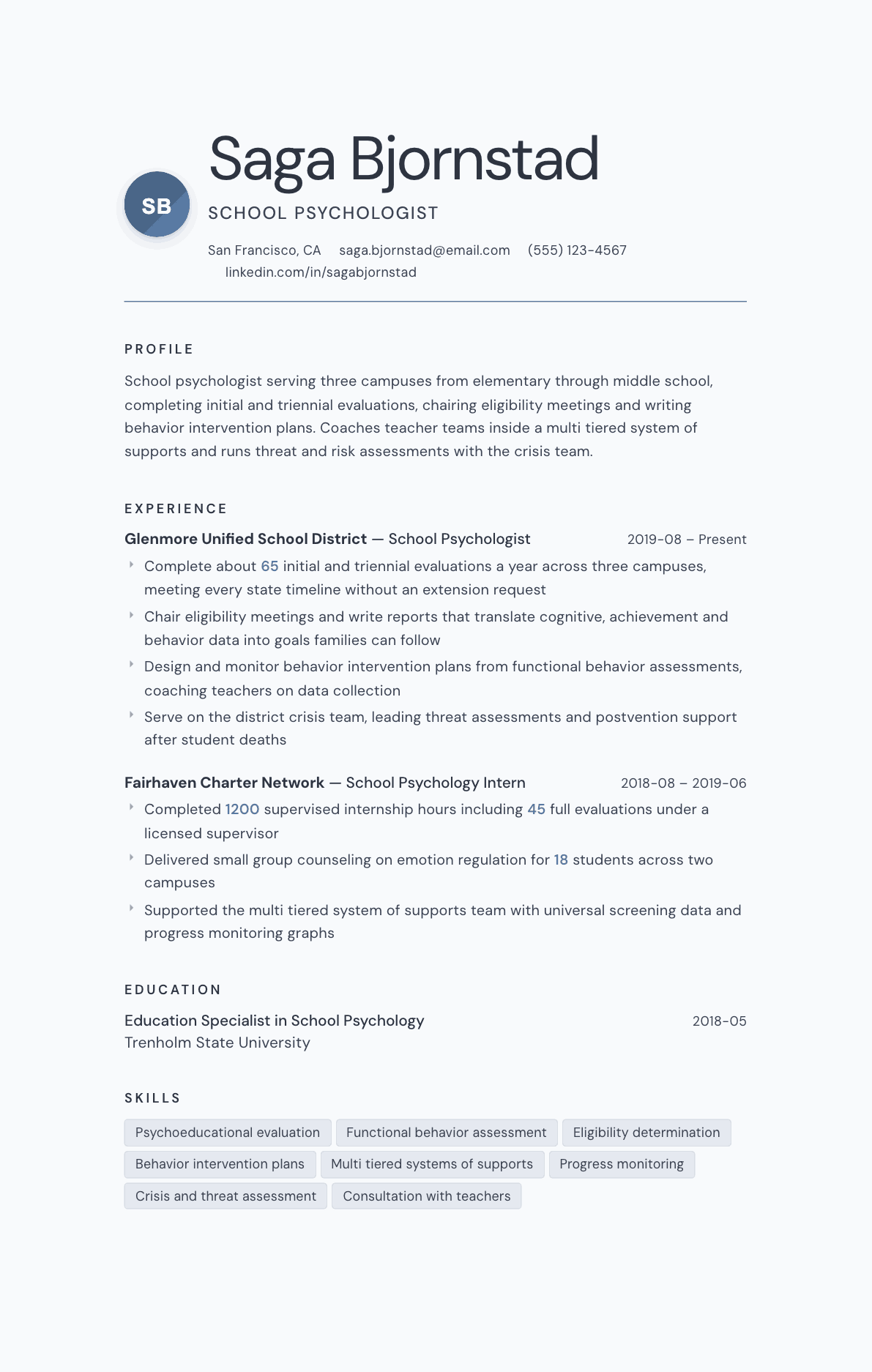
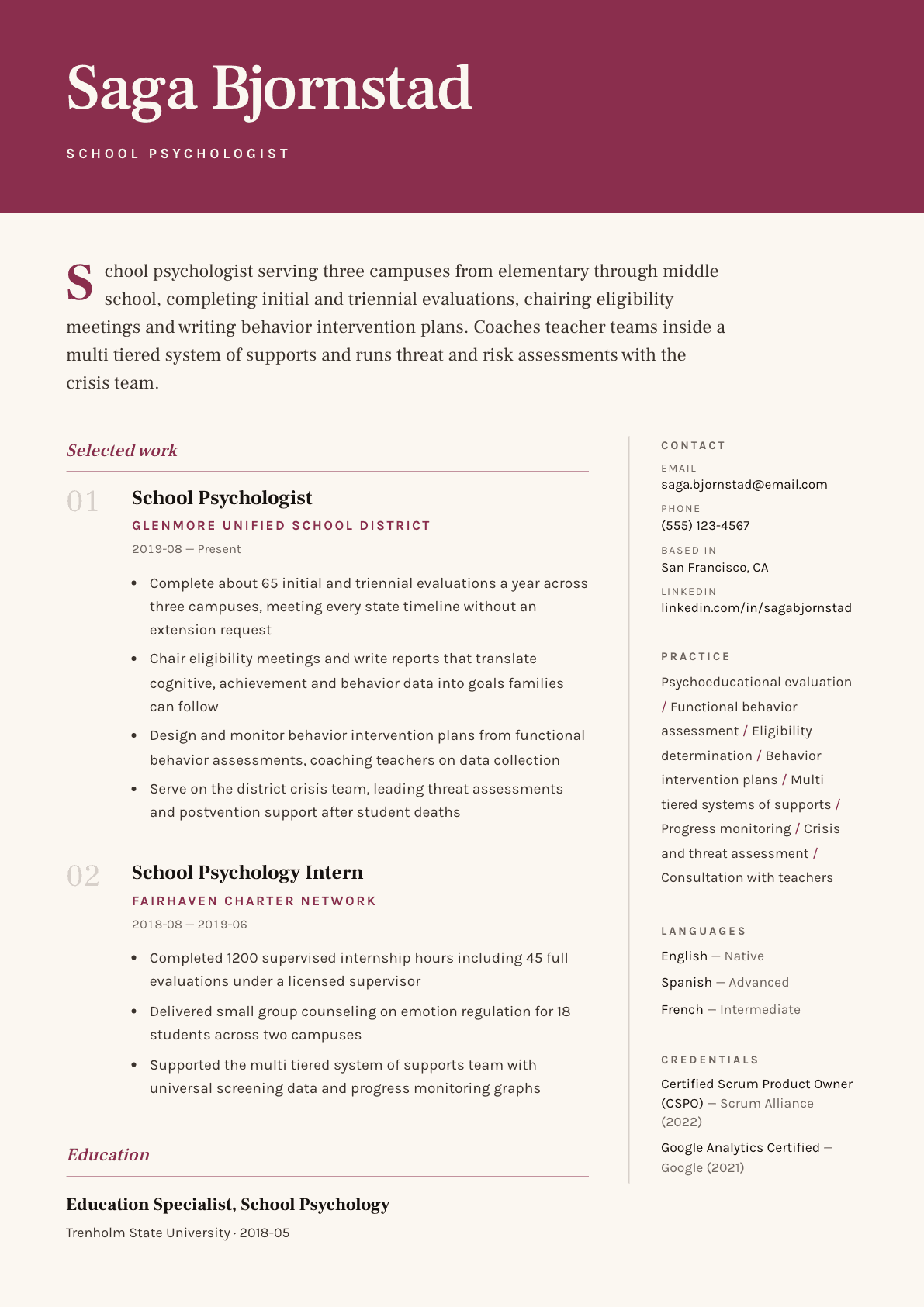
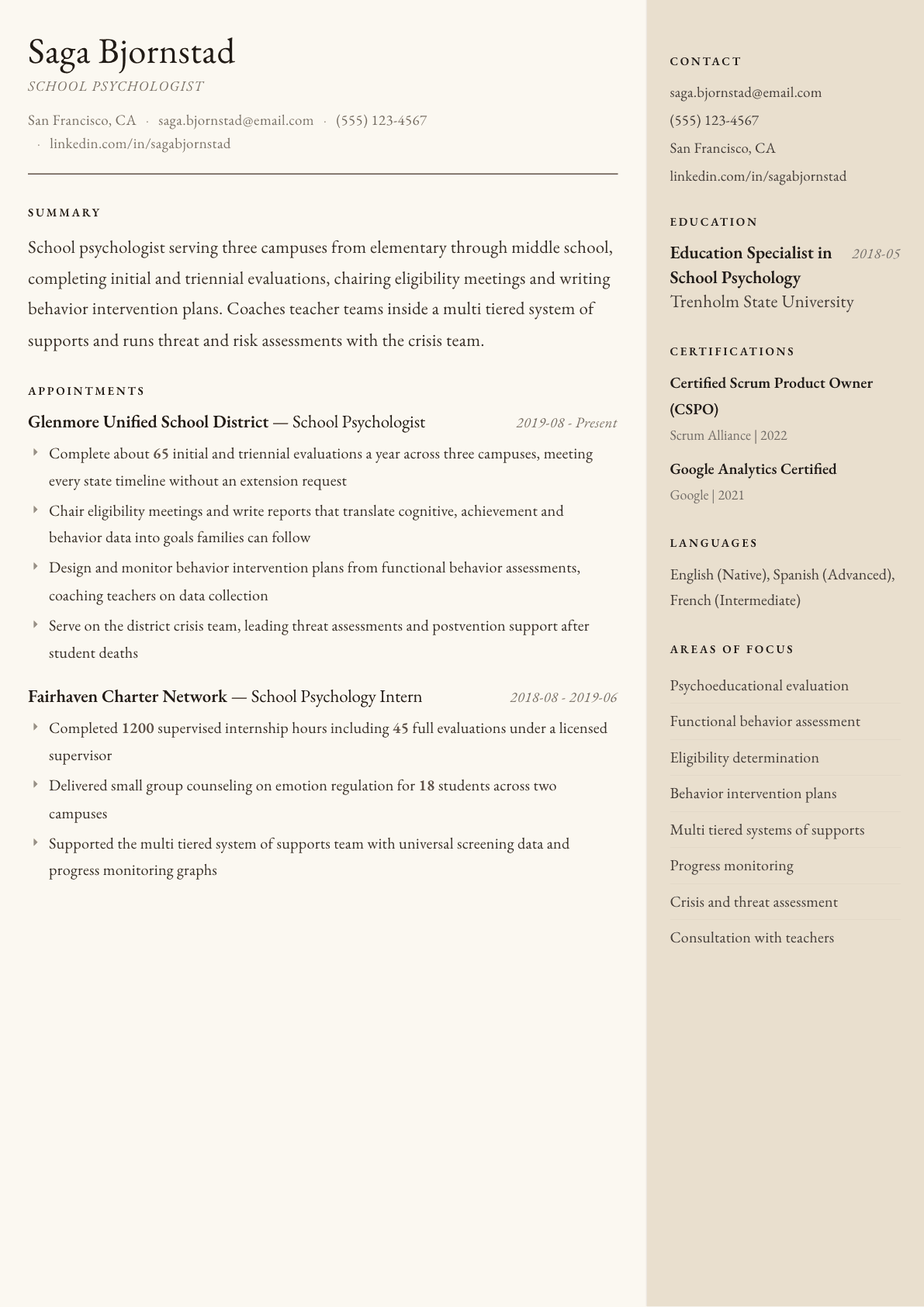
The same school psychologist content laid out in three CVBooster templates, so you can see what the finished document looks like before you write a word.
Example School Psychologist summary
School psychologist covering three campuses, completing initial and triennial psychoeducational evaluations and chairing eligibility meetings within state timelines. Builds behavior intervention plans from functional behavior assessments, coaches teacher teams inside a multi tiered support model, and serves on the district crisis team for threat assessment and postvention. Seeking a lead school psychologist role with district level program responsibility.
Skills to list on a School Psychologist resume
- Psychoeducational assessment
- Cognitive and achievement testing
- Functional behavior assessment
- Behavior intervention planning
- Eligibility determination
- Individualized education program teams
- Multi tiered systems of supports
- Universal screening
- Progress monitoring
- Threat and risk assessment
- Teacher and parent consultation
- Small group counseling
- Report writing
- Data based decision making
What actually gets this resume read
- Give the number of evaluations you complete a year and whether you held state timelines, because caseload is the core question.
- Name the instruments you administer, such as cognitive, achievement, adaptive and social emotional rating scales.
- Show consultation work with teachers and the multi tiered support team, not only testing and report writing.
- List the grade bands and campuses you cover, since serving three schools is a different job from serving one.
- Include crisis team duties such as threat assessment, risk screening and postvention if you have carried them.
- Put your state credential and national certification in the header, because districts verify both before an interview.
How to write a school psychologist resume
District hiring for school psychology runs on one anxiety: the evaluation timeline. Every initial referral and every triennial review has a legal clock on it, and a district that misses those clocks is exposed. So the person reading your file, usually a director of special education or a lead school psychologist, is looking for evidence that you complete a heavy evaluation load on time and write reports that hold up in a meeting with an unhappy parent.
The second thing districts want, and increasingly say out loud in postings, is a school psychologist who does more than test. Consultation with teachers, multi-tiered support systems, universal screening, small group counseling, threat assessment and crisis response are all in the job description now, and candidates who only describe evaluations look like testing technicians.
This guide covers the credentials block, how to report evaluation volume and timeline compliance, how to write consultation and intervention work so it reads as expertise, three summaries from intern to lead, before and after bullets, and the questions school psychologists ask when they change districts or states.
Format: credential block, then caseload and campuses
One to two pages. Reverse chronological. Under your contact details put a credential block: your specialist or doctoral degree, the program and its approval status, your state credential or license for school practice, and national certification if you hold it. Districts verify all of this before an interview and a missing line slows the file.
Then a caseload line for each position: the district or network, how many campuses you covered, the grade bands, total student enrollment served, and whether you worked alone or on a team. Serving one elementary school is a different job from splitting time across three campuses with a middle school on the list.
- Credential block: degree, program approval, state credential, national certification, internship hours.
- Caseload line: campuses, grade bands, enrollment served, team size and supervision arrangements.
- Availability of specialty skills: bilingual evaluation, low incidence populations, early childhood.
Summary: evaluation load, timelines, and what else you do
Lead with annual evaluation volume and timeline record, because that is the number a special education director is staffing against. Then name the campuses and grade bands, then the work beyond evaluation that makes you more than a tester.
Bilingual evaluation capacity belongs in the summary if you have it. Districts struggle to find school psychologists who can assess in a second language or work skillfully with an interpreter, and it moves a file to the top of the pile in many places.
Evaluations: volume, instruments, timelines, reports
Give the annual count of initial and triennial evaluations separately if you can, because initials take longer. State whether you held state timelines and whether you needed extensions. A candidate who says every evaluation was completed within timeline across a school year has said the most persuasive thing available in this profession.
Name the instruments across cognitive, achievement, adaptive, social emotional and behavior rating domains. Add the specialty tools if you use them for autism diagnostic evaluation, English learner assessment or early childhood work. A director reads that list to work out which referrals she can route to you.
Then say something about your reports. Reports are read by parents, teachers and sometimes attorneys, and a school psychologist who writes recommendations a classroom teacher can actually implement on Monday morning is rarer than one who can score a battery.
- Annual volume: initials and triennials, plus any bilingual or specialty evaluations.
- Timeline record: completed within state timelines, extensions required, backlog inherited or cleared.
- Instruments: cognitive, achievement, adaptive, social emotional and behavior rating scales by name.
- Report quality: readability for families, teacher-implementable recommendations, meeting facilitation.
Consultation, tiered supports and intervention
This is the section that decides whether you get the better job. Describe your work with the multi-tiered support team: universal screening administration, data review meetings, intervention selection, progress monitoring design and fidelity checks. Say how many students were tracked and what happened to the referral rate.
Add direct service. Small group counseling on emotion regulation, social skills or grief, individual counseling minutes written into education plans, functional behavior assessment and behavior intervention plan development, and teacher coaching on classroom-level strategies.
Teacher consultation deserves its own bullet. A school psychologist who can walk into a classroom, observe, and give a teacher two changes she can make that week builds the relationships that make everything else in the role possible.
Crisis, threat assessment and district-level work
Crisis team duty is expected in most districts now. Say whether you have led threat assessments, conducted suicide risk screening, run reunification or postvention support after a student death, and whether you trained staff in the crisis model your district uses.
District-level work signals readiness for a lead role: writing evaluation procedure guidance, standardizing report templates, mentoring interns, sitting on curriculum or discipline committees, or presenting data to the board. Give each its own line rather than mixing it into general duties.
School Psychologist resume summary examples
Intern or first year
Education Specialist in school psychology with 1200 supervised internship hours across elementary and middle campuses, including 45 full evaluations under a licensed supervisor. Delivered small group counseling on emotion regulation and supported the tiered support team with screening data. Holds state credential and national certification.
Four years in a district
School psychologist covering three campuses from elementary through middle school, completing about 65 initial and triennial evaluations a year within state timelines. Chairs eligibility meetings, writes behavior intervention plans from functional behavior assessments, and coaches teacher teams inside a tiered support model.
Lead school psychologist
Lead school psychologist supervising a team of six across a district of eleven campuses. Owns evaluation procedure guidance and report standards, mentors interns each year, leads the crisis team through threat assessment and postvention, and presents special education data to the board annually.
Work experience bullets: before and after
Before: Completed psychoeducational evaluations for students.
After: Completed about 65 initial and triennial psychoeducational evaluations a year across three campuses, meeting every state timeline without requesting an extension.
Volume across named campuses plus a clean timeline record answers the question a special education director asks first.
Before: Attended eligibility and education plan meetings.
After: Chaired eligibility meetings and translated cognitive, achievement and behavior data into goals families could follow, including with interpreters for Spanish-speaking parents.
Chairing rather than attending, plus family accessibility, shows the meeting skill that keeps disputes from escalating.
Before: Worked with teachers on student behavior.
After: Conducted functional behavior assessments, wrote behavior intervention plans, and coached teachers on data collection and fidelity checks during weekly classroom visits.
The assessment to plan to coaching chain describes a full intervention cycle rather than informal advice.
Before: Supported the multi-tiered system of supports team.
After: Ran three universal screening windows a year, facilitated grade-level data meetings, and set up progress monitoring graphs that let teams change interventions after four weeks instead of a full semester.
Screening cadence and a shortened decision cycle prove tiered support expertise instead of committee membership.
Before: Part of the district crisis team.
After: Served on the district crisis team, leading threat assessments, conducting suicide risk screening and coordinating postvention support after a student death across two campuses.
Naming the specific crisis duties tells a director you can be assigned the hardest work on the first difficult week.
Hard skills
- Psychoeducational evaluation
- Cognitive and achievement testing
- Adaptive and social emotional rating scales
- Functional behavior assessment
- Behavior intervention plan development
- Eligibility determination and meeting facilitation
- Individualized education program teams
- Multi-tiered systems of supports
- Universal screening and data meetings
- Progress monitoring design
- Threat assessment and suicide risk screening
- Teacher and parent consultation
Soft skills
- Explaining test data to families plainly
- De-escalation in contested meetings
- Time management across multiple campuses
- Collaboration with special education teams
- Discretion with sensitive student information
Certifications worth listing
- Nationally Certified School Psychologist (NCSP) (National Association of School Psychologists)
- Mental Health First Aid (National Council for Mental Wellbeing)
- Nonviolent Crisis Intervention (Crisis Prevention Institute)
Mistakes that cost school psychologist candidates the interview
- Reporting evaluations completed without saying whether the state timelines were met.
- Writing only about testing, which reads as a technician profile in districts that now want consultation and intervention.
- Leaving out the number of campuses covered, so a director cannot judge the travel and scheduling load you have handled.
- Naming no instruments, which prevents a lead psychologist from routing specialty referrals to you.
- Skipping crisis team duties even when you have carried them, since threat assessment capacity is a hiring priority.
- Failing to state bilingual evaluation ability, which is one of the strongest differentiators in this field.
- Listing an expired or out-of-state credential without saying where your application for the new state stands.
School Psychologist resume questions
What credential do I need to work as a school psychologist?
A specialist or doctoral degree in school psychology, a supervised internship, and a state credential or license for school practice. National certification is optional in most states but portable, which helps when you move across state lines.
How many evaluations should I put on my resume?
Give an annual figure and split initials from triennials when you can. Numbers alone are not enough, so pair the count with your timeline record, because a director is buying reliable throughput rather than raw volume.
How do I show that I do more than testing?
Give consultation, tiered supports and intervention their own section with numbers attached: screening windows run, data meetings facilitated, counseling groups delivered, behavior plans written and teachers coached during classroom visits.
Does bilingual assessment experience belong in my summary?
Yes, near the front. Districts consistently struggle to staff bilingual evaluations, so stating the language, whether you assess directly or work through a trained interpreter, and which instruments you use puts your file ahead of most others.
How do I move between states as a school psychologist?
Check the receiving state credential requirements early, note on the resume that an application is pending with a submission date, and lead with national certification if you hold it, since many states use it as part of a reciprocity route.
Related resume examples
- School Social Worker Resume example
- Psychologist Resume example
- Behavior Analyst Resume example
- Counselor Resume example
- Youth Counselor Resume example
- Psychotherapist Resume example