Psychologist Resume Examples: free ATS score and gap list
Write a Psychologist Resume That Leads With License and Clinical Depth
By Mustafa Tarabya, founder of CVBooster · Published · Updated
Psychologist resume example with licensure, assessment battery and evidence based treatment keywords, plus a guide to every section.
Sample resumes for a psychologist
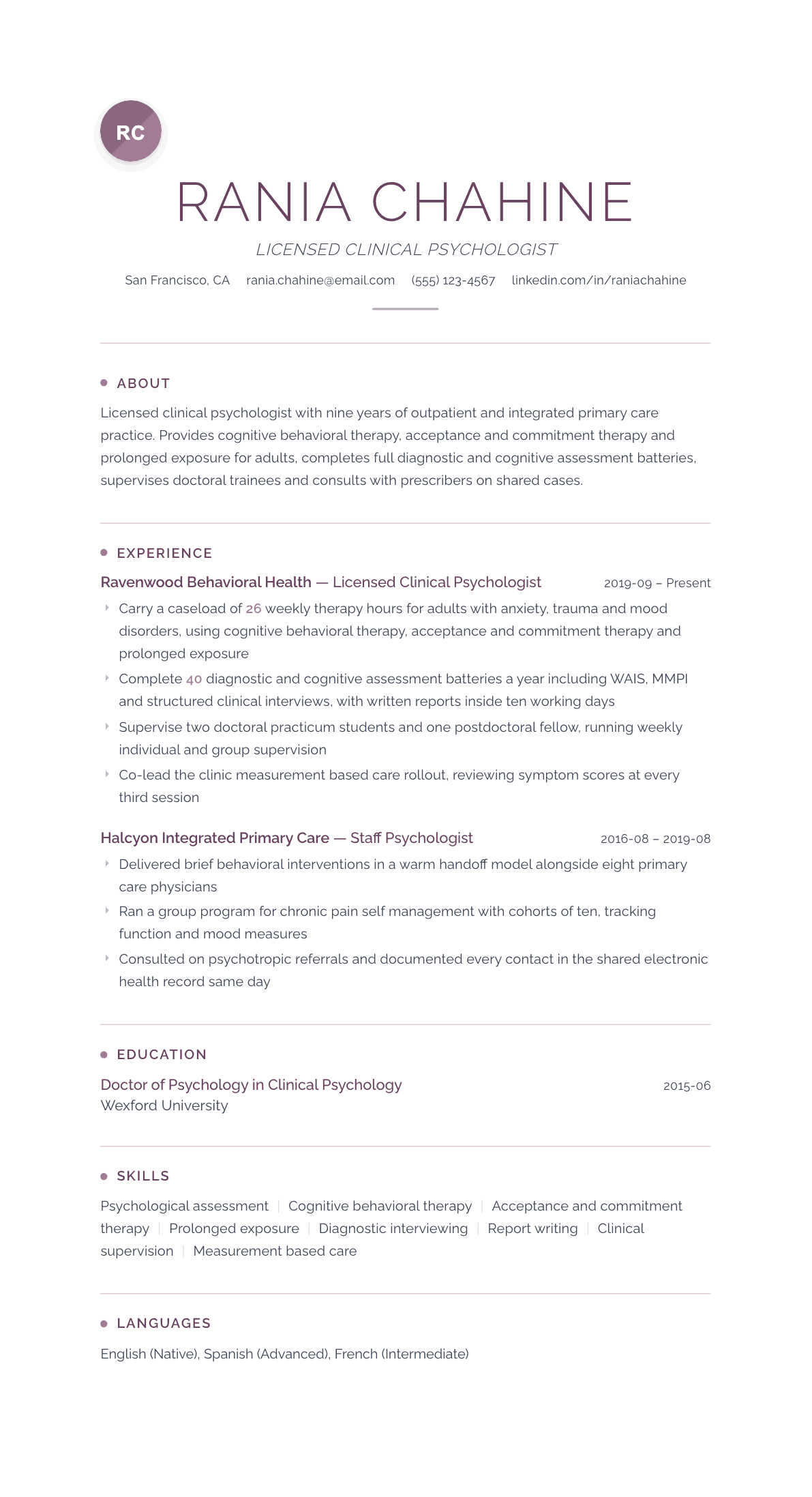
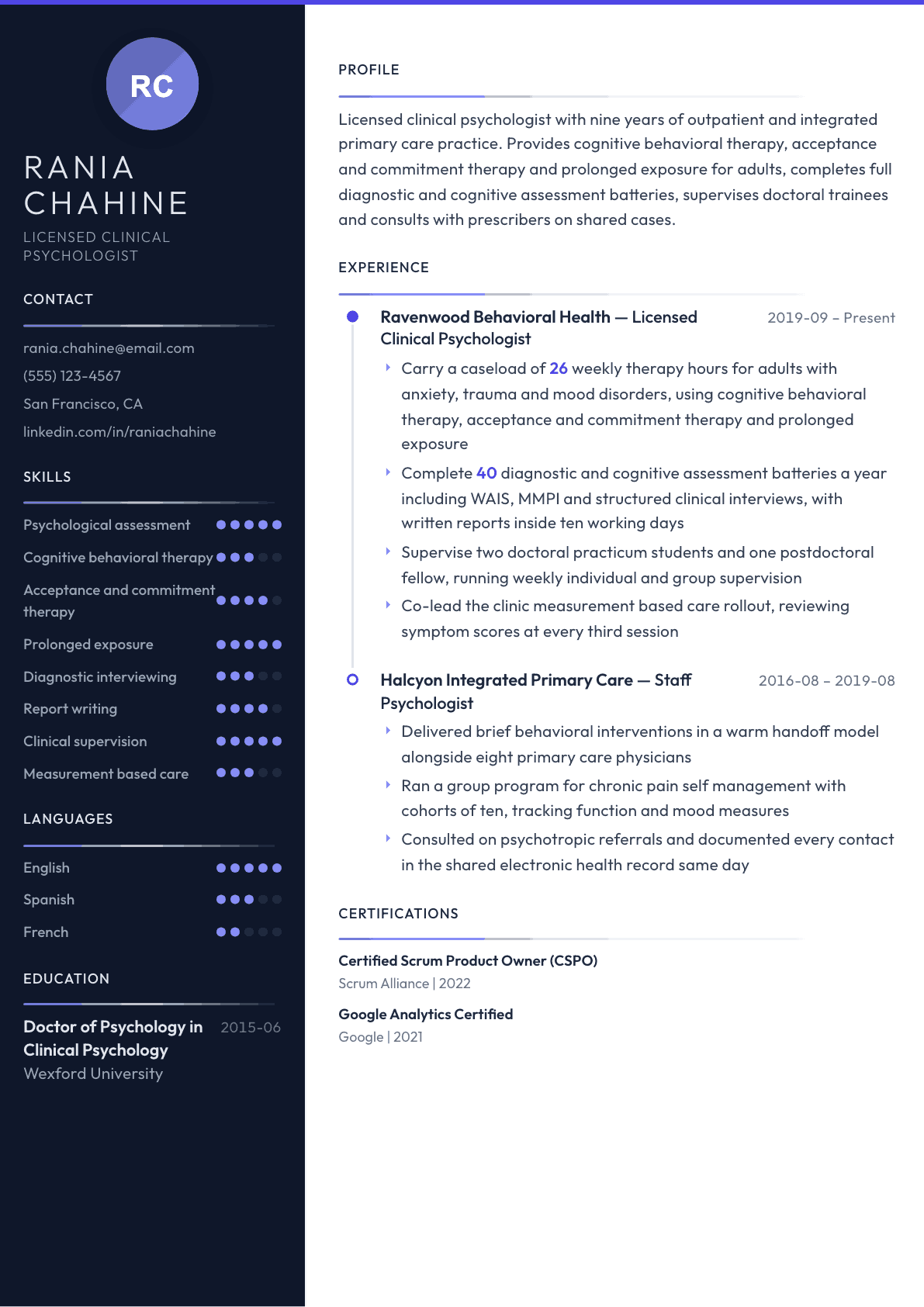
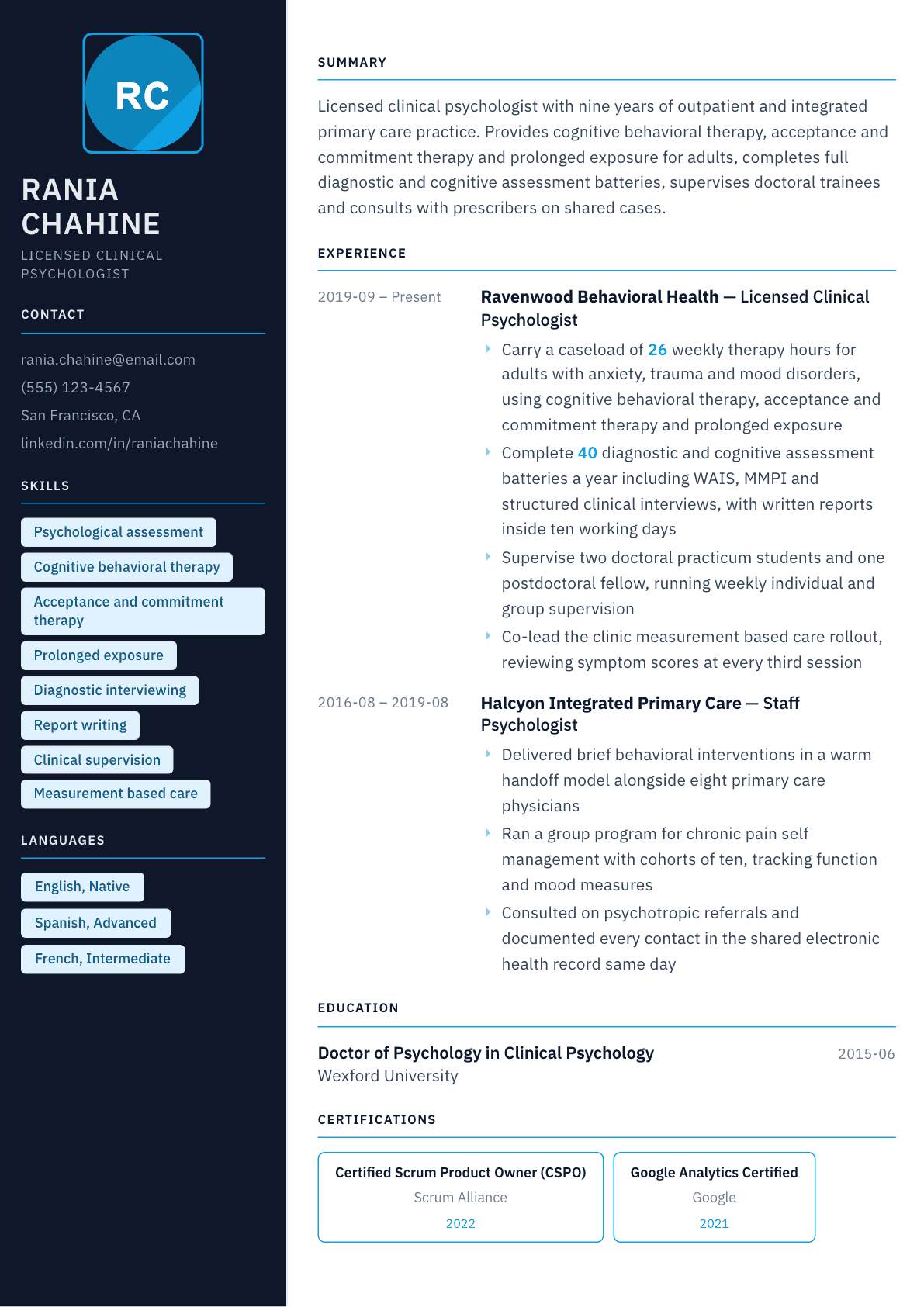
The same psychologist content laid out in three CVBooster templates, so you can see what the finished document looks like before you write a word.
Example Psychologist summary
Licensed clinical psychologist with nine years in outpatient and integrated primary care settings. Delivers cognitive behavioral therapy, acceptance and commitment therapy and prolonged exposure for adults with anxiety, trauma and mood disorders, completes full assessment batteries with reports inside ten working days, and supervises doctoral trainees. Seeking a senior clinical role with assessment and supervision responsibility.
Skills to list on a Psychologist resume
- Psychological and cognitive assessment
- Diagnostic interviewing
- Cognitive behavioral therapy
- Acceptance and commitment therapy
- Prolonged exposure therapy
- Dialectical behavior therapy skills
- Psychological report writing
- Risk assessment and safety planning
- Clinical supervision
- Measurement based care
- Treatment planning
- Integrated primary care consultation
- Group therapy
- Electronic health record documentation
What actually gets this resume read
- Put license type, state and number in the header block, because credentialing staff verify it before anyone reads further.
- Name your assessment battery by instrument, since a psychologist who administers the WAIS and MMPI says more than one who assesses.
- State the treatment modalities you deliver and the training you completed in each, not just a list of acronyms.
- Give weekly clinical hours and population, so a clinic director can see whether your caseload matches theirs.
- List supervision of practicum students, interns and postdoctoral fellows, because supervisory capacity is a hiring priority.
- Keep publications and presentations in their own section if you are applying to academic medical centers.
How to write a psychologist resume
A psychologist resume passes through two very different readers. A credentialing coordinator checks that the doctorate is from an accredited program, that the internship was accredited, that the license is active in the right state, and that the malpractice and background paperwork will clear. She never evaluates your clinical thinking. If the license line is missing or ambiguous, the file stalls there.
The clinical director reads next, and she is doing something specific: sizing your caseload against hers. Weekly therapy hours, assessment volume and turnaround, the populations you treat, the modalities you were trained in and by whom, and whether you can supervise trainees. Supervision capacity is often the deciding factor, because a psychologist who can carry practicum students expands what the clinic can accept.
This guide sets out the header block, how to write about assessment and therapy so a director can staff you, how to present supervision, research and teaching without turning a clinical resume into a curriculum vitae, three summaries across career stages, and the questions psychologists ask when they move between settings.
Format: clinical resume or curriculum vitae, and how to choose
Applying to a hospital, community clinic, group practice, correctional facility or integrated primary care setting means a resume of two pages. Applying to an academic medical center, a university counseling center with a research line or a faculty post means a full curriculum vitae with publications, presentations, grants and teaching. Sending the wrong document is the most common early error in this field.
Either way, a header block goes directly under your name: doctoral degree and program accreditation, internship site and accreditation, postdoctoral fellowship, license type and state with number, and board certification if you hold it. Add states where you hold reciprocity or a mobility credential, because telehealth across state lines depends on it.
- Header block: doctorate, accreditation, internship, fellowship, license type and state, board certification.
- Population line: adults, children and adolescents, older adults, couples, forensic or medical populations.
- Modality line: the therapies you deliver and where you trained in each.
Summary: setting, caseload, assessment, supervision
Four lines of information in three sentences. The settings you have practiced in, your weekly clinical hours and population, your assessment volume and report turnaround, and whether you supervise. Those four decide whether a director calls you.
Skip statements about being committed to evidence based practice. Everyone writes it. Instead name the specific protocols you deliver, because prolonged exposure, cognitive processing therapy and dialectical behavior therapy skills groups are evidence, not a claim about evidence.
Assessment: instruments, volume, and turnaround
Assessment is where psychologists differentiate from other license types, so give it room. List the instruments you administer and interpret by name across cognitive, personality, adaptive, neuropsychological screening and symptom-specific domains. A director reading WAIS, WISC, MMPI, PAI, ADOS or Vineland knows immediately what referrals she can send you.
Then say how many batteries you complete in a year and your report turnaround, because a backlog of unwritten reports is one of the most common problems in an assessment service. A psychologist who reliably returns reports inside a stated number of working days is genuinely valuable.
If you do specialty evaluations, name them: pre-surgical, capacity, autism diagnostic, learning disability, forensic or disability determination. These are referral streams and each has its own report standard.
- Instruments by name across cognitive, personality, adaptive and diagnostic domains.
- Volume: batteries completed per year and the referral sources they came from.
- Turnaround: working days from testing to signed report, and any backlog you cleared.
- Specialty evaluations: the types you are competent to complete independently.
Therapy, supervision and program work
For therapy, give weekly clinical hours, session length, population and diagnoses, and the protocols you deliver. Note whether you carry a no-show risk caseload, run groups, or hold urgent slots, because those affect how a director builds a schedule.
For supervision, count the trainees and name the level: practicum students, doctoral interns, postdoctoral fellows, and license-eligible associates. Say whether you provide individual or group supervision and whether you sign for hours toward licensure, because that authority is what a training clinic needs.
Program work is the third strand and often the reason someone is promoted. Measurement based care rollouts, group program design, consultation to medical teams, case conference leadership and quality projects all belong here in their own bullets.
Documentation, risk and the compliance layer
Directors care about documentation because audits and payor reviews land on them. Say where you chart, whether you complete notes the same day, how you write treatment plans that meet payor criteria, and how you document risk assessment and safety planning.
Risk work deserves an explicit line. Suicide risk assessment, safety planning, mandated reporting, involuntary hold procedures and coordination with crisis services are core competencies, and a resume that never mentions them makes a director wonder how you handle a hard afternoon.
Psychologist resume summary examples
Postdoctoral fellow
Doctor of Psychology from an accredited program with an accredited internship in a community mental health center. Completing a postdoctoral fellowship in adult outpatient care, carrying 20 weekly therapy hours and completing diagnostic batteries under supervision. License eligible and trained in cognitive behavioral therapy and prolonged exposure.
Licensed, six years
Licensed clinical psychologist with six years in outpatient practice, carrying 26 weekly therapy hours for adults with anxiety, trauma and mood disorders and completing 40 assessment batteries a year with reports inside ten working days. Supervises two practicum students each academic year.
Senior or supervising psychologist
Supervising psychologist with twelve years across integrated primary care and specialty outpatient services, leading a team of five clinicians. Owns the assessment service including instrument selection and report standards, signs supervision hours toward licensure, and led the measurement based care rollout across three sites.
Work experience bullets: before and after
Before: Provided individual therapy to adult clients.
After: Carried 26 weekly therapy hours for adults with generalized anxiety, post-traumatic stress and depressive disorders, delivering cognitive behavioral therapy, acceptance and commitment therapy and prolonged exposure.
Weekly hours, diagnoses and named protocols let a director slot you into a schedule and a referral stream.
Before: Conducted psychological assessments and wrote reports.
After: Completed 40 diagnostic and cognitive batteries a year including the WAIS, MMPI and structured clinical interviews, returning signed reports within ten working days of the final session.
Named instruments, annual volume and turnaround address the backlog problem every assessment service worries about.
Before: Supervised graduate students.
After: Supervised two doctoral practicum students and one postdoctoral fellow, running weekly individual supervision plus a group case conference, and signed hours toward licensure.
Trainee levels and signing authority describe supervisory capacity, which is often the reason a post exists.
Before: Worked with the medical team on shared patients.
After: Delivered brief behavioral interventions in a warm handoff model with eight primary care physicians, documenting each contact in the shared record the same day for the treating clinician.
The integrated care model and same-day documentation show you can work at primary care pace, which many cannot.
Before: Handled clients in crisis.
After: Completed structured suicide risk assessments and collaborative safety planning, coordinated with mobile crisis services, and documented each decision and consultation in the record.
Explicit risk vocabulary reassures a director that difficult afternoons are handled by process rather than instinct.
Hard skills
- Cognitive and intellectual assessment
- Personality and symptom inventories
- Structured diagnostic interviewing
- Psychological report writing
- Cognitive behavioral therapy
- Acceptance and commitment therapy
- Prolonged exposure and trauma protocols
- Dialectical behavior therapy skills groups
- Suicide risk assessment and safety planning
- Treatment planning to payor criteria
- Clinical supervision of trainees
- Measurement based care and outcome monitoring
Soft skills
- Diagnostic reasoning under uncertainty
- Feedback delivery to families
- Consultation with medical colleagues
- Self-monitoring for vicarious trauma
- Ethical decision making in dual-role situations
Certifications worth listing
- Board Certification in Clinical Psychology (American Board of Professional Psychology)
- Certificate of Professional Qualification in Psychology (CPQ) (Association of State and Provincial Psychology Boards)
- Certification in Cognitive Therapy (Academy of Cognitive and Behavioral Therapies)
Mistakes that cost psychologist candidates the interview
- Omitting license type, state and status, which stops the file at credentialing before any clinician reads it.
- Sending a curriculum vitae to a community clinic or a two-page resume to an academic medical center.
- Writing that you conduct assessments without naming a single instrument you administer and interpret.
- Leaving report turnaround out, when unwritten reports are a chronic pain point in assessment services.
- Listing modality acronyms with no indication of where the training came from or how often you use them.
- Never mentioning risk assessment, safety planning or mandated reporting anywhere on the page.
- Padding a clinical resume with conference attendance instead of caseload, assessment volume and supervision.
Psychologist resume questions
Should a psychologist send a resume or a curriculum vitae?
Send a two-page resume for clinical positions in hospitals, clinics and group practices. Send a full curriculum vitae for academic, research and training-heavy posts. When a posting is ambiguous, the setting decides it, and a clinic reader will not read ten pages.
Where do license details go on a psychologist resume?
In a header block directly under your name, with the license type, the state, the number and the status. Add reciprocity or mobility credentials, since telehealth across state lines is a practical hiring question for many employers now.
How much detail should the assessment section carry?
Enough that a director knows which referrals to send you. Name the instruments across cognitive, personality, adaptive and diagnostic domains, give annual battery volume, and state your report turnaround in working days.
Do publications belong on a clinical psychologist resume?
Only a selected few, if any, and only when they connect to the clinical role. A community clinic hiring for a full therapy caseload cares far more about your weekly hours, assessment volume and supervision capacity than your publication record.
How do I present supervision experience?
Count the trainees, name their level, describe the format as individual or group, and say whether you sign hours toward licensure. Training clinics hire specifically for that authority, so leaving it implicit costs you the strongest part of a senior application.
Related resume examples
- School Psychologist Resume example
- Licensed Clinical Social Worker Resume example
- Behavioral Health Counselor Resume example
- Social Worker Resume example
- Licensed Professional Counselor Resume example
- Psychology Intern Resume example