Psychotherapist Resume Examples: the lines they read
Write a Therapist Resume That Wins Clinical Interviews
By Mustafa Tarabya, founder of CVBooster · Published · Updated
Build a psychotherapist resume with the right licensure block, modality keywords, caseload examples, and a full writing guide for clinical hiring.
Sample resumes for a psychotherapist
The same psychotherapist content laid out in three CVBooster templates, so you can see what the finished document looks like before you write a word.
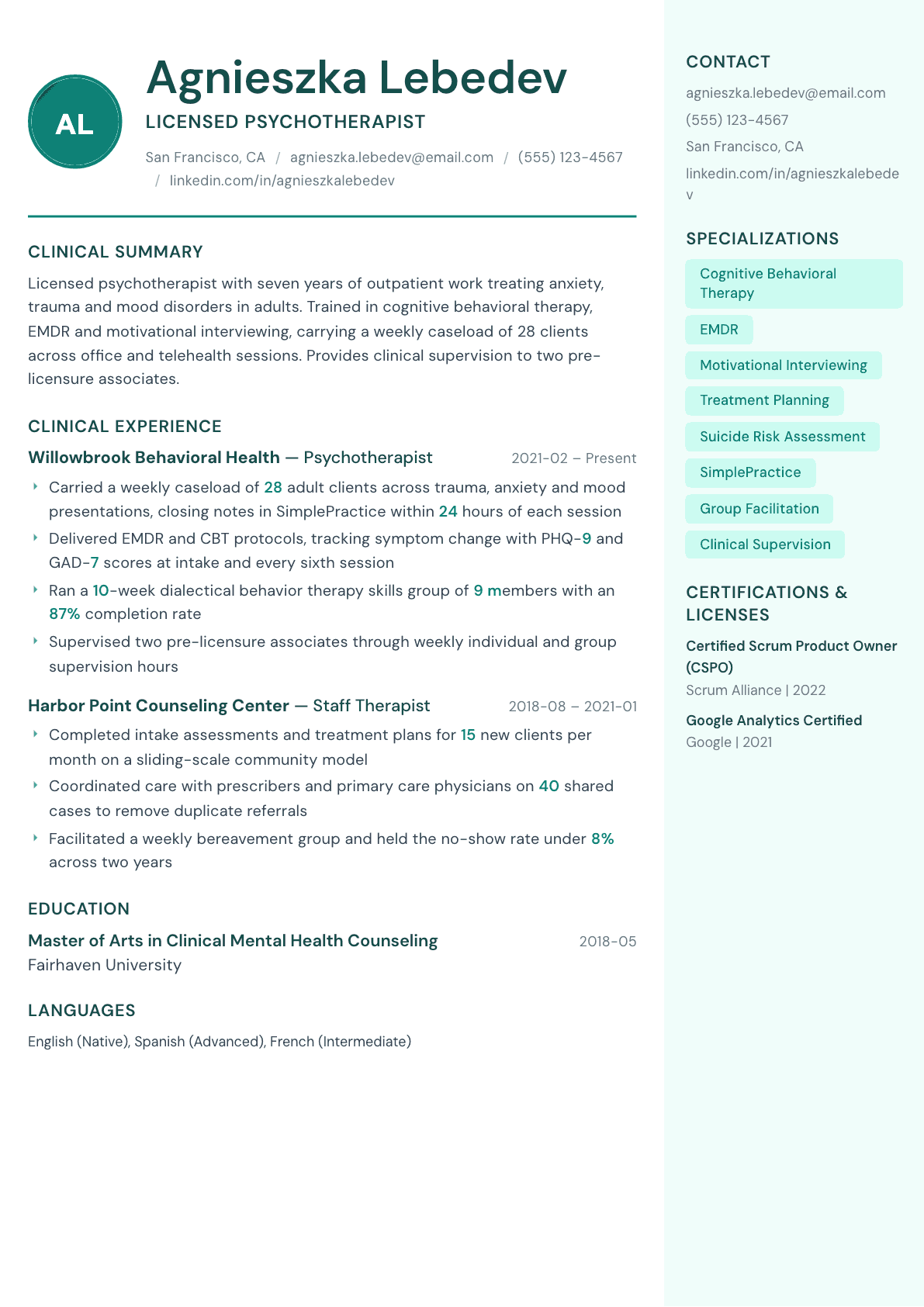
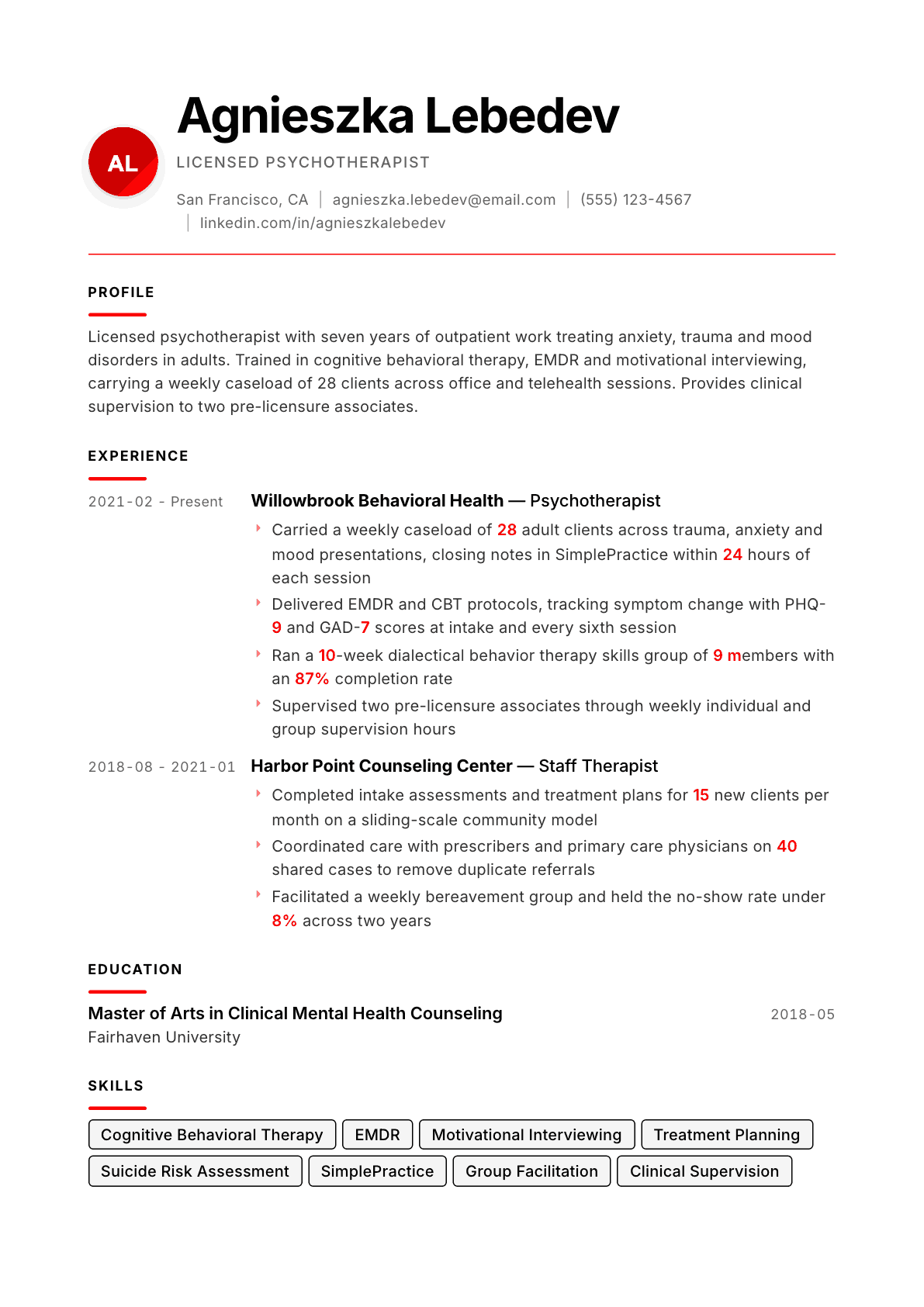
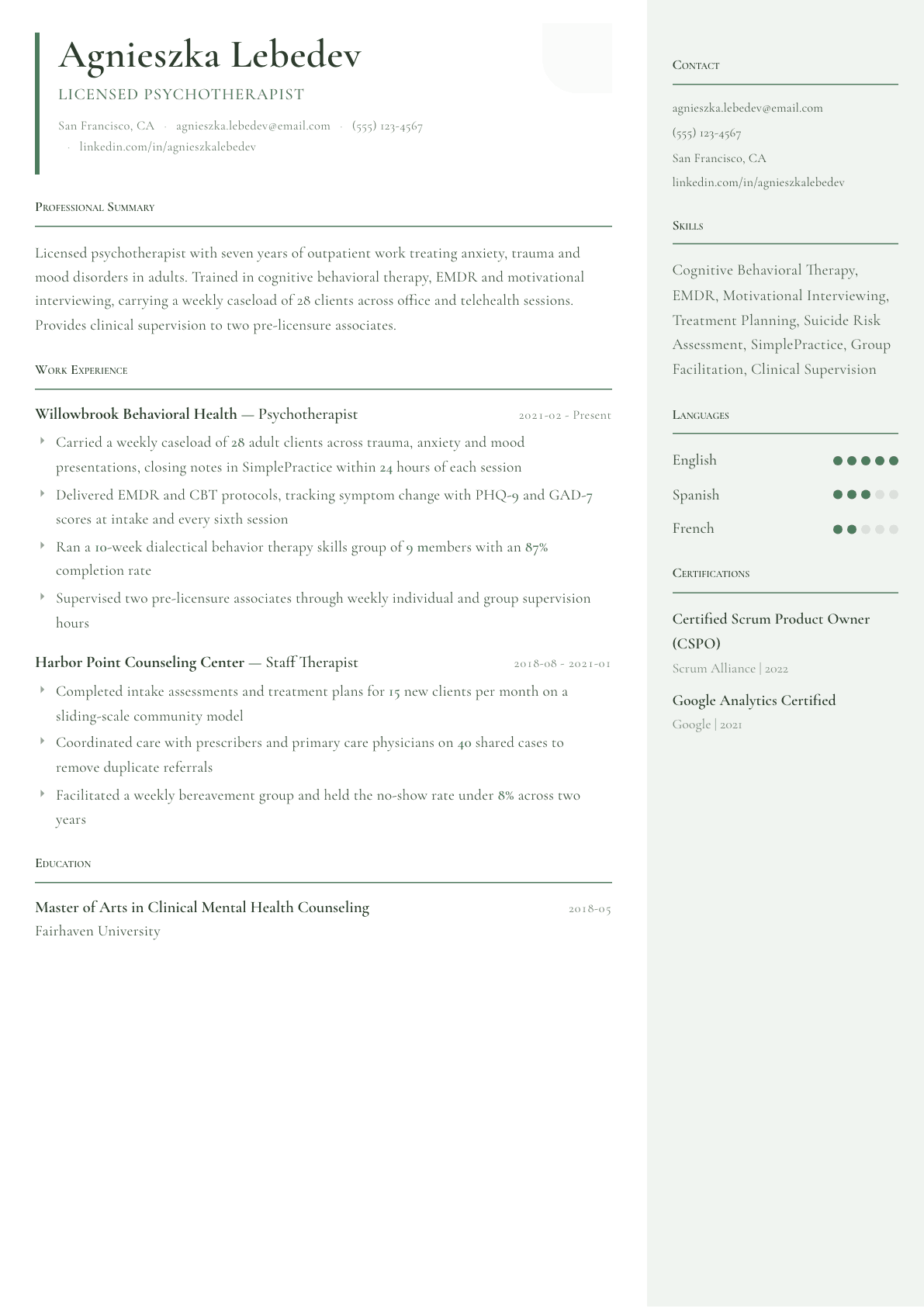
Example Psychotherapist summary
Licensed psychotherapist with seven years of outpatient practice and a steady caseload of adults presenting with trauma, anxiety and depression. Certified in EMDR and fluent in CBT and DBT skills work, with symptom tracking built into every treatment plan. Supervises pre-licensure clinicians and holds documentation compliance at full audit standard. Seeking a group practice role with a trauma focus.
Skills to list on a Psychotherapist resume
- Cognitive Behavioral Therapy
- Dialectical Behavior Therapy
- EMDR
- Motivational Interviewing
- Trauma-Focused Therapy
- Intake Assessment
- Treatment Planning
- Suicide Risk Assessment
- Case Conceptualization
- Group Therapy
- Telehealth Delivery
- Clinical Documentation
- DSM-5-TR Diagnosis
- Clinical Supervision
- Crisis Intervention
What actually gets this resume read
- List your license type, issuing state and expiration in a credentials block sitting directly under your name.
- Name every therapy modality you are trained in, and keep formal certification separate from a weekend workshop.
- Give each role a caseload figure, a session format and a client population instead of the phrase provided therapy.
- Name the electronic health record you chart in, whether SimplePractice, TherapyNotes or a hospital behavioral module.
- Show outcome tracking with named instruments such as PHQ-9, GAD-7 or a structured suicide risk screen.
- State supervision hours you accrued or supervision you provide, because clinics hire on both stage and teaching capacity.
How to write a psychotherapist resume
A therapist resume, whether the title on your license reads psychotherapist, counselor or clinical social worker, is screened for three things before anyone reads a sentence of your prose: the license, the population you treat, and whether your caseload numbers suggest you can hold a full book. Group practice owners, community agencies and hospital behavioral health departments all filter first on licensure stage, because that determines whether you can bill independently or need supervision hours logged against someone else's number.
The second reader is the clinical director. She wants to know what walks into your room and what you do about it. Modalities, populations, acuity, risk work, and how you document. A resume that lists "individual and group therapy" without naming a single protocol, instrument or diagnosis tells her nothing she can staff around.
This guide takes the sections in the order a hiring clinic reads them, gives three summaries for different licensure stages, rewrites five bullets the way clinicians actually submit them, lays out a sample therapist resume from header to skills, and answers the questions therapists ask when they move between agency work, group practice and private practice.
Format: license block first, then caseload evidence
Reverse chronological, one page under eight years of post-degree practice and two pages after that. Put your credential string after your name the way a directory would print it, then repeat the license in full underneath with the state and the expiration month. Independent licensure is the single fact that decides whether a practice can put you on a panel, so it must be visible without scrolling.
Avoid two-column layouts with sidebars. Agency human resources departments often run older parsers, and a credential that lands in a sidebar can be read out of order and lose its state qualifier. One column, plain headings, no icons next to license numbers.
- Credential line under your name: degree, license abbreviation, state, then any modality certification you actually completed.
- A licensure section listing license type, state, status and expiration month, plus supervision credential if you hold one.
- A modalities section that separates certified training from continuing education attendance, so nothing overstates.
- Clinical experience with setting, population, weekly caseload and session format on the header line of each role.
Summary: stage, population, modality, one distinctive thing
Four lines at most. Say your licensure stage, the years since your degree, the populations you treat, the modalities you deliver, and one thing that is true of you and not of every applicant. A summary that opens with "compassionate clinician dedicated to helping people heal" is the most common opening line in the field and it survives no screening.
If you are moving between settings, address it directly. Community mental health to group practice is a shift in pace, documentation and billing pressure, not in clinical skill, and saying so shows you understand what you are walking into. Name the transferable piece: high-volume intake work, complex trauma, or comfort with clients who arrive in crisis.
Experience: caseload, acuity, and what you actually delivered
Head each role with the setting type, the population, and the weekly caseload. "Outpatient group practice, adults and older adolescents, 26 clients weekly, in-person and telehealth" answers the clinical director's first three questions in one line.
Then four bullets. Lead with the clinical work that differs between settings: trauma protocol delivery, structured risk assessment, safety planning, coordination with prescribers, court-involved cases, higher level of care referrals. Say which protocol, not just which orientation. "Delivered prolonged exposure across a twelve-session course" is a claim a supervisor can check; "used a trauma-informed approach" is not.
One bullet should cover documentation and one should cover anything beyond your own caseload: supervision provided, group programming built, intake coverage, a referral relationship you maintained. Practices lose money on unclosed notes, so a clinician who names a note-closure standard stands out immediately.
Modalities, instruments and populations: the keyword layer
This is where the applicant tracking system does its matching, and it is also where clinicians undersell themselves most. List the therapy models you deliver, the measures you administer, and the diagnostic categories you carry regularly. Name the record system too, because onboarding time in a practice is mostly learning the chart.
Be honest about depth. There is a difference between a certified EMDR clinician who has completed consultation hours and someone who sat a weekend introduction. Split the list into completed certifications and training in progress. A director who discovers the gap in the interview stops trusting the rest of the page.
- Models: cognitive behavioral therapy, dialectical behavior therapy skills, acceptance and commitment therapy, EMDR, motivational interviewing, internal family systems.
- Measures: PHQ-9, GAD-7, PCL-5, structured suicide risk screens, and whatever your agency required at intake.
- Populations: adults, adolescents, couples, perinatal, substance use, first responders, veterans, or whichever you truly carry.
- Records: SimplePractice, TherapyNotes, Valant, or the behavioral module of a hospital chart.
Supervision, teaching and the things that make you promotable
Practices are short on people who can supervise associates, because that is how they add clinicians without adding license risk. If you hold an approved supervisor credential, put it in the credential line, not buried in a bullet. If you supervise informally, say how many associates and what the structure was.
The same applies to program work: a skills group you built, an intake protocol you standardized, a referral pathway you opened with a primary care office. These are the bullets that move a psychotherapist from a chair to a clinical lead role, and most resumes leave them out because they do not feel like therapy.
Therapist resume sample, top to bottom
Here is the order a group practice or agency expects, filled in for a licensed therapist five years past graduate school. Use this resume for a therapist as a checklist for your own order, then replace every line with your own facts and numbers.
Keep it to two pages at most. A clinical director reads the first third closely and skims the rest, so the license, the population and the caseload all belong above the first job title.
- Header: Daniel Okoro, LPC, state license number, city and state, phone, email, and telehealth states if you hold more than one license.
- Summary: Licensed professional counselor with five years in community mental health and group practice, treating adults with trauma, anxiety and co-occurring substance use. Trained in CPT and motivational interviewing, carrying 26 clients a week across office and telehealth.
- Licensure and credentials: license type and state, supervisor credential if you hold one, and completed modality certifications with the issuing body.
- Experience: setting, population and caseload in the first line under each job, then four bullets on modalities delivered, measures tracked, documentation and one program or supervision contribution.
- Education and training: graduate degree, practicum and internship sites, then continuing education that changed what you can treat.
Psychotherapist resume summary examples
Pre-licensure associate
Pre-licensure therapist with 1400 supervised clinical hours in community mental health, treating adults with depression, anxiety and co-occurring substance use. Delivers CBT and motivational interviewing, completes structured risk screens at intake, and closes notes within 24 hours. Seeking a supervised position on the path to independent licensure.
Seven years in
Independently licensed psychotherapist with seven years of outpatient practice and a weekly caseload of 28 adults presenting with trauma, anxiety and mood disorders. EMDR certified, fluent in DBT skills work, and tracks PHQ-9 and GAD-7 change across every treatment plan. Looking for a trauma-focused group practice.
Clinical supervisor
Clinical supervisor and licensed psychotherapist with fourteen years across community agency and private practice settings. Supervises six associates toward licensure, built the intake and risk protocol now used across three sites, and maintains a reduced caseload of complex trauma clients. Seeking a clinical director role with program design ownership.
Work experience bullets: before and after
Before: Provided individual therapy to a diverse caseload.
After: Carried a weekly caseload of 28 adults across trauma, mood and anxiety presentations, split between office and telehealth sessions.
A caseload number, the clinical mix and the session format let a director judge whether you can hold her book.
Before: Used evidence-based treatment approaches.
After: Delivered EMDR across an eight-phase course and CBT for insomnia, tracking symptom change with PHQ-9 and PCL-5 scores at every sixth session.
Naming the protocol and the measurement instrument turns a generic claim into something a supervisor can verify.
Before: Assessed clients for safety concerns.
After: Completed structured suicide risk screening at intake and after any acuity change, and wrote collaborative safety plans with 30 clients over two years.
Risk work is the highest-liability part of the role, so the specific screen and the volume matter more than the word assessed.
Before: Ran a therapy group at the clinic.
After: Built and facilitated a 10-week DBT skills group for 9 members, with an 87% session attendance rate and a written curriculum the clinic reused.
Building the group is program work; attending one is not, and the attendance figure proves the group held together.
Before: Kept documentation up to date.
After: Closed all progress notes in SimplePractice within 24 hours of session and passed two payer chart audits with no corrective findings.
Practices lose revenue on unclosed notes, so a documented turnaround standard and a clean audit read as money saved.
Hard skills
- Cognitive behavioral therapy
- Dialectical behavior therapy skills
- EMDR
- Motivational interviewing
- Trauma-focused treatment
- Intake and diagnostic assessment
- Structured suicide risk screening
- Safety planning
- Treatment planning and review
- Group facilitation
- Telehealth delivery
- Clinical documentation and coding
- Clinical supervision
Soft skills
- Therapeutic alliance building
- Boundary setting
- Consultation seeking
- Cultural humility
- Tolerance for clinical uncertainty
- Interdisciplinary communication
Certifications worth listing
- EMDR Basic Training Certification (EMDR International Association)
- Certified Clinical Trauma Professional (CCTP) (International Association of Trauma Professionals)
- Certified Group Psychotherapist (CGP) (International Board for Certification of Group Psychotherapists)
- Master Addiction Counselor (MAC) (NAADAC, the Association for Addiction Professionals)
- Certified Clinical Mental Health Counselor (CCMHC) (National Board for Certified Counselors)
Mistakes that cost psychotherapist candidates the interview
- Hiding the licensure stage, which forces a recruiter to guess whether you can bill independently and usually ends the file there.
- Listing an orientation instead of a protocol, so nobody can tell whether you have delivered a full course of treatment.
- Leaving out caseload size, which is the number a group practice uses to model whether your chair pays for itself.
- Claiming certification for a training you attended but never completed the consultation hours for.
- Writing nothing about risk assessment or safety planning, the two areas a clinical director probes hardest in interview.
- Using client stories or identifying details as evidence, which reads as a confidentiality problem rather than as skill.
- Sending the same resume to a community agency and a cash-pay private practice when the pace and billing pressure differ completely.
Psychotherapist resume questions
Should a therapist resume include a caseload number?
Yes. Weekly caseload is the fastest signal of capacity a hiring practice has. Give the number, the session length and whether it was in person, telehealth or mixed, since a full telehealth book is paced differently from an office one.
How do I show modality training without overstating it?
Separate completed certifications with their issuing body from trainings you attended. Say basic training completed, consultation hours in progress, or continuing education only. Directors verify EMDR and DBT credentials often, and an inflated claim ends the process at reference stage.
Do I list clients seen while unlicensed?
Yes, as supervised clinical experience. Name the supervisor credential type, the setting and the hours accrued toward licensure. Agencies hiring pre-licensure clinicians budget supervision time, so your remaining hours are useful planning information rather than a weakness.
How much detail about diagnosis should appear?
Enough to show the acuity you carry. Name the diagnostic categories you treat routinely, such as post-traumatic stress, mood disorders or co-occurring substance use. Never include a client detail, initials or case narrative that could identify anyone you have treated.
What goes on a resume for a therapist in private practice?
Add the business side: panels you are credentialed with, your no-show and cancellation rate, retention across a treatment course, and whether you have built a referral pipeline. A group practice owner is buying a full and stable book, not only clinical skill.
Related resume examples
- Mental Health Counselor Resume example
- Clinical Psychologist Resume example
- Licensed Professional Counselor Resume example
- Marriage and Family Therapist Resume example
- Licensed Clinical Social Worker Resume example
- Behavior Analyst Resume example