Boxing Coach Resume Examples: free ATS score and gap list
Build a Boxing Coach Resume for Gyms and Amateur Programs
By Mustafa Tarabya, founder of CVBooster · Published · Updated
Boxing coach resume example with corner work, sanctioning body detail, pad and conditioning language, keywords and a full guide.
Sample resumes for a boxing coach
The same boxing coach content laid out in three CVBooster templates, so you can see what the finished document looks like before you write a word.
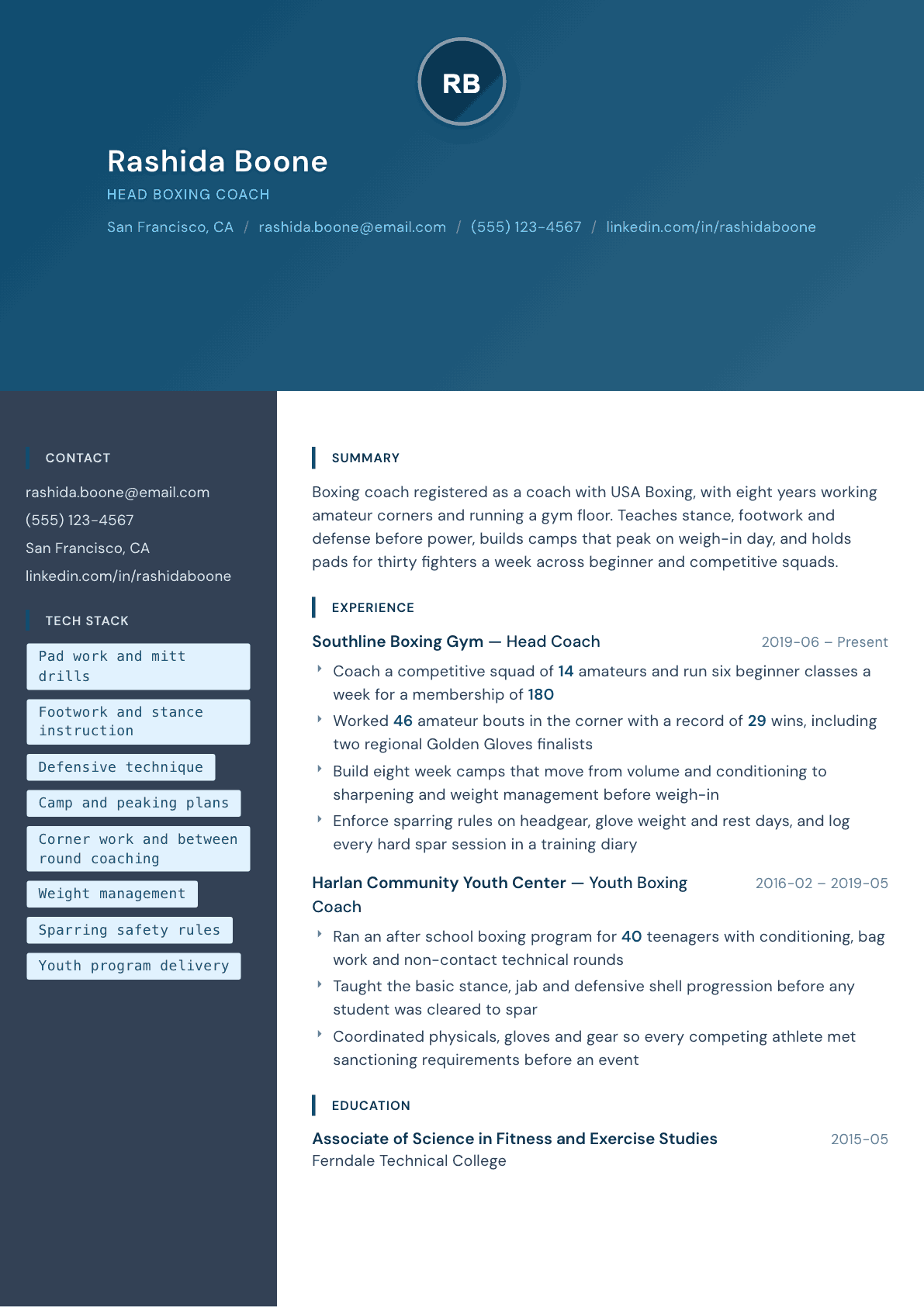
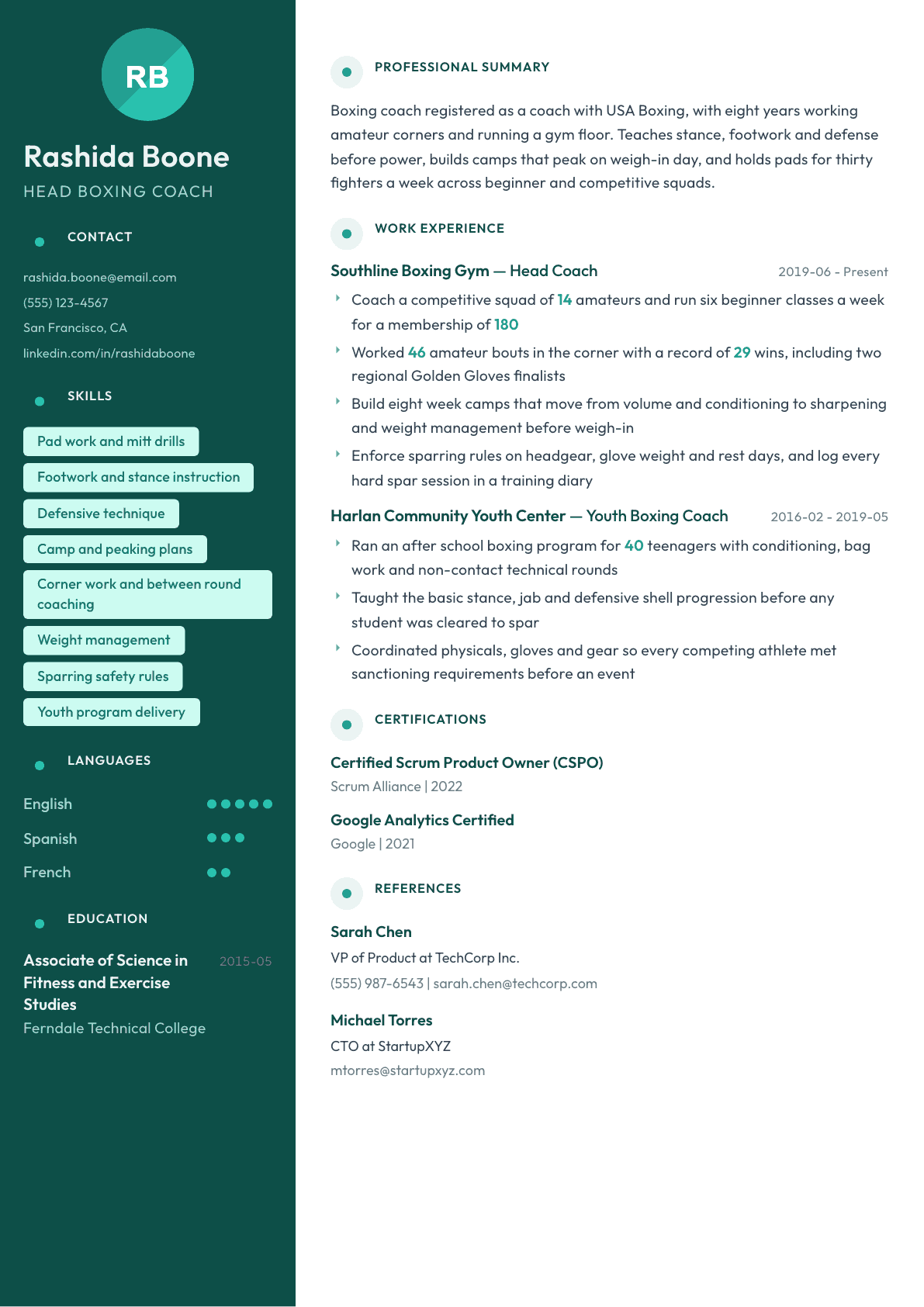
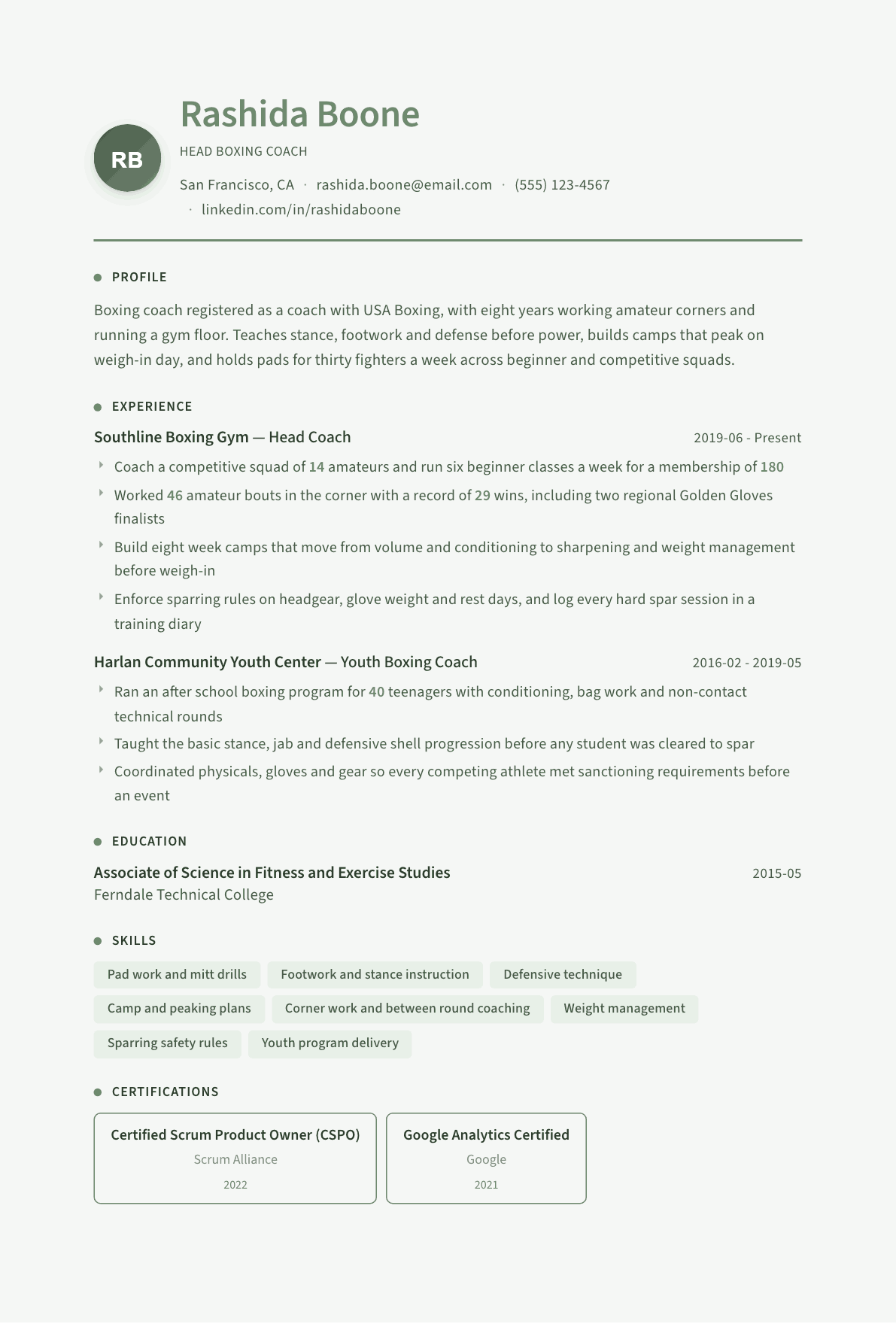
Example Boxing Coach summary
Boxing coach registered with USA Boxing and working amateur corners for eight years, currently leading a competitive squad of fourteen alongside six beginner classes a week. Teaches stance, footwork and defense before power, builds eight week camps that peak on weigh-in day, and manages weight cuts without crash methods. Has worked more than forty amateur bouts in the corner and wants a head coach role at a gym building a competitive team.
Skills to list on a Boxing Coach resume
- Pad and mitt work
- Stance and footwork instruction
- Defensive shell and head movement
- Combination and counter drilling
- Sparring supervision
- Corner work
- Fight camp periodization
- Weight cut management
- Conditioning and roadwork planning
- Bag and circuit class delivery
- Amateur bout matchmaking support
- Gear and glove compliance
- Youth outreach programs
- Training diary and load tracking
What actually gets this resume read
- Name the sanctioning body you are registered with, because amateur corners and events require a current coach registration.
- Give corner numbers plainly: bouts worked, wins, titles and the level, from novice to open to national tournaments.
- Separate competitive coaching from fitness class teaching, since gyms hire for one or both and want to see which you do.
- Describe your camp structure in weeks so a gym owner knows you can peak a fighter rather than just run hard sessions.
- Put sparring safety rules on the page: headgear, glove weight, rest days and how you log contact.
- Show weight management practice, because cutting weight badly is the fastest way a coach loses a fighter and a reputation.
How to write a boxing coach resume
Boxing gyms hire two different coaches with the same job title. One runs the fitness floor: bag classes, circuit rounds, mitt rounds for members who will never compete. The other builds fighters and works corners on show night. A resume that does not say which one you are, or that you do both and in what proportion, leaves the gym owner guessing at the thing she is actually hiring for.
For the competitive side, the registration is the gate. A coach cannot work an amateur corner without current registration and clearance through the sanctioning body, so that credential belongs in the first block on the page along with the first aid card. After that, corner numbers do the persuading.
This guide covers the sections a gym owner reads in order, three summaries for a floor coach, a competitive coach and a head coach, five rewritten bullets, and the questions that come up when a boxing coach applies to a member gym, a youth program and a competitive team at once.
Format: registration block, then two experience streams
Open with registration and safety credentials, then split the experience into two visible streams: competitive coaching and class teaching. Gyms recruit for one of those or both, and a page that mixes them together forces the reader to untangle it herself.
One page is usually enough. A head coach with a long corner record and gym management duties can use a second page, provided it holds bout counts and program numbers rather than a longer list of fighters coached.
- Credential block: coach registration and sanctioning body, background clearance, first aid and CPR.
- Competitive stream: squad size, bouts worked in the corner, results, tournaments attended.
- Class stream: classes per week, average attendance, member headcount, class formats taught.
- Then facility duties, education and references from a gym owner or a matchmaker.
Summary: registration, squad, teaching order
Three or four lines. Name the registration and sanctioning body, the size of the competitive squad you run, the class load you carry, and the order in which you teach the sport. Coaches who say they teach stance, footwork and defense before power immediately distinguish themselves from coaches who describe intensity.
If your background is professional rather than amateur, or the other way round, say so. The two worlds run on different rules, different round lengths and different scoring, and a gym building an amateur team wants a coach who has actually worked amateur corners.
Experience: corner work, camps and the gym floor
Give the corner record as a plain count: bouts worked, wins, the level from novice through open, and the tournaments where those bouts happened. Then say what you do between rounds, because a coach who gives one clear instruction in sixty seconds is worth more than one who shouts five.
Describe camp structure in weeks. How long a camp runs, when volume peaks, when sparring peaks, when the taper starts, how weight comes off, and what the last week before weigh-in looks like. This is the section that proves you can peak a fighter rather than just work him hard.
For the floor, give class formats, weekly count and attendance. Bag and circuit classes, technical rounds, pad rounds by appointment, beginner courses. Member gyms pay salaries out of class attendance, so those numbers are commercial evidence.
Technical teaching and sparring safety
Say what you teach and in what order. Stance and guard, footwork on the front foot and the back foot, the jab as a measuring tool, the defensive shell, head movement, the pivot, and combinations built from a small vocabulary rather than a hundred drills. Naming a teaching order signals a coach who has thought about progression.
Then set out sparring policy in writing. Glove weight by session type, headgear rules, who is cleared to spar and after how long, hard sparring frequency, rest days after a hard session, and how contact is logged. Head trauma is the risk that follows this sport, and a gym owner will read a written policy as a sign of a serious coach.
- Teaching order from stance through defense to combination work.
- Sparring rules: glove weight, headgear, clearance standard, frequency and rest.
- Contact log: what is recorded after each hard session and who reviews it.
- Camp structure by week, including sparring peak and taper.
Weight management and conditioning
Weight is where inexperienced coaches do the most damage. Describe how you manage a fighter into a class: the timeline before weigh-in, what comes out of the diet and when, how much is left to the last week, and what you refuse to allow. A coach who plans weight over eight weeks rather than three days is a coach a gym can trust with teenagers.
Conditioning belongs beside it. Roadwork or intervals, rounds on the bag against a clock, strength work that does not interfere with skill sessions, and how you sequence hard days around sparring. Say what you measure, whether that is round counts, resting heart rate or a repeat test on the bag.
Keywords in boxing coaching postings
Gym listings reuse a compact vocabulary: pad work, mitt rounds, technical instruction, sparring supervision, fight camp preparation, corner work, youth program and member classes. Mirror the exact phrasing once high on the page and once inside a role.
Name the sanctioning body precisely, because a gym running amateur shows will search for registration with that body and not for a general claim about being certified.
Boxing Coach resume summary examples
Floor coach
Registered boxing coach in a second year, teaching five bag and circuit classes a week for a membership of ninety and holding pads for beginners by appointment. Teaches stance, guard and the jab before any combination work, and holds current first aid and CPR certification.
Competitive coach
Boxing coach with five years working amateur corners, currently running a squad of nine and four member classes a week. Has worked 28 bouts, builds eight week camps and enforces written sparring rules on glove weight, headgear and rest days between hard sessions.
Head coach
Head boxing coach with eight years on the pads and in the corner, leading a competitive squad of fourteen amateurs alongside six beginner classes a week for a membership of 180. Has worked 46 bouts including two regional finalists, and manages weight cuts across an eight week camp calendar.
Work experience bullets: before and after
Before: Worked as a boxing coach with amateur fighters.
After: Coached a competitive squad of 14 amateurs and worked 46 bouts in the corner with a record of 29 wins, including two regional Golden Gloves finalists.
Squad size, bout count and results give a gym owner a record she can check with a matchmaker.
Before: Prepared fighters for their bouts.
After: Built eight week camps moving from volume and conditioning through sparring peak into a sharpening week, with weight brought down gradually rather than in the final days.
A camp structure with a weight timeline proves the coach can peak a fighter safely.
Before: Taught boxing technique to beginners.
After: Taught the stance, guard and jab progression before any student was cleared to spar, and ran non-contact technical rounds for teenagers until footwork and the defensive shell held under pressure.
A teaching order with a clearance standard shows a coach who protects new boxers.
Before: Kept sparring safe in the gym.
After: Enforced rules on headgear and glove weight, capped hard sparring to one session a week and logged every hard round in a training diary reviewed before each camp.
Written limits and a log turn a safety claim into an auditable practice.
Before: Ran classes for members at the gym.
After: Ran six beginner classes a week averaging 22 members a session, covering bag rounds, footwork ladders and partner pad work with a rotation that kept every member moving.
Class count and attendance are the commercial numbers a member gym is hiring on.
Hard skills
- Pad and mitt work
- Stance and footwork instruction
- Defensive shell and head movement
- Combination and counter drilling
- Sparring supervision and clearance
- Corner work and between round instruction
- Fight camp periodization
- Weight management planning
- Conditioning and round-based intervals
- Bag and circuit class delivery
- Gear, glove and wrap compliance
- Training diary and contact logging
Soft skills
- One instruction at a time under pressure
- Building trust with new boxers
- Managing fighter nerves on show night
- Youth mentoring
- Honest matchmaking conversations
- Discipline on a busy gym floor
Certifications worth listing
- USA Boxing Coach Certification (USA Boxing)
- SafeSport Trained (U.S. Center for SafeSport)
- Adult First Aid, CPR and AED (American Red Cross)
Mistakes that cost boxing coach candidates the interview
- Never saying whether you coach competitors, members or both, which is the first thing a gym needs to know.
- Claiming a corner record with no bout count, level or tournament attached to it.
- Leaving the sanctioning body registration off the page when it is required to work an amateur corner.
- Writing nothing about sparring policy in a sport defined by head contact.
- Describing conditioning intensity instead of a camp structure that peaks on weigh-in day.
- Ignoring weight management, which is where inexperienced coaches damage young fighters fastest.
- Listing a personal fighting record above every teaching outcome on the page.
Boxing Coach resume questions
What credentials does a boxing coach need on a resume?
Current coach registration with the sanctioning body that governs the shows you work, background clearance, and first aid and CPR. Without registration you cannot stand in an amateur corner, so it belongs in the first block rather than at the bottom.
How do I show a corner record honestly?
Give bouts worked, wins, the level from novice through open, and the tournaments involved. Do not merge fighters you cornered once with fighters you trained through camp, because matchmakers and other coaches talk and the difference gets noticed.
Does teaching fitness boxing classes count as coaching experience?
It counts as its own stream and it pays the gym bills. Give class formats, weekly count and average attendance. Just keep it separate from competitive work so an owner hiring for a team knows exactly what she is getting.
How much detail should I give about sparring rules?
Four lines is enough: glove weight, headgear policy, who is cleared and after how long, and how often hard sparring happens. That level of specificity signals a coach who has thought about head contact rather than one who inherited a gym culture.
How do I describe weight cutting without sounding reckless?
Describe the timeline rather than the tactics. A cut planned across a whole camp, with the last week reserved for small adjustments and a refusal to allow extreme methods, tells a gym owner and a parent everything they need to hear.
Related resume examples
- Personal Trainer Resume example
- Sports Coach Resume example
- Strength and Conditioning Coach Resume example
- Martial Arts Instructor Resume example
- Basketball Coach Resume example
- Horse Trainer Resume example