Market Research Analyst Resume Examples: free ATS score
Create a Market Research Analyst Resume Backed by Data
By Mustafa Tarabya, founder of CVBooster · Published · Updated
Build a rigorous market research analyst resume with survey design, consumer insights, and data analysis skills that research and strategy teams value.
Sample resumes for a market research analyst
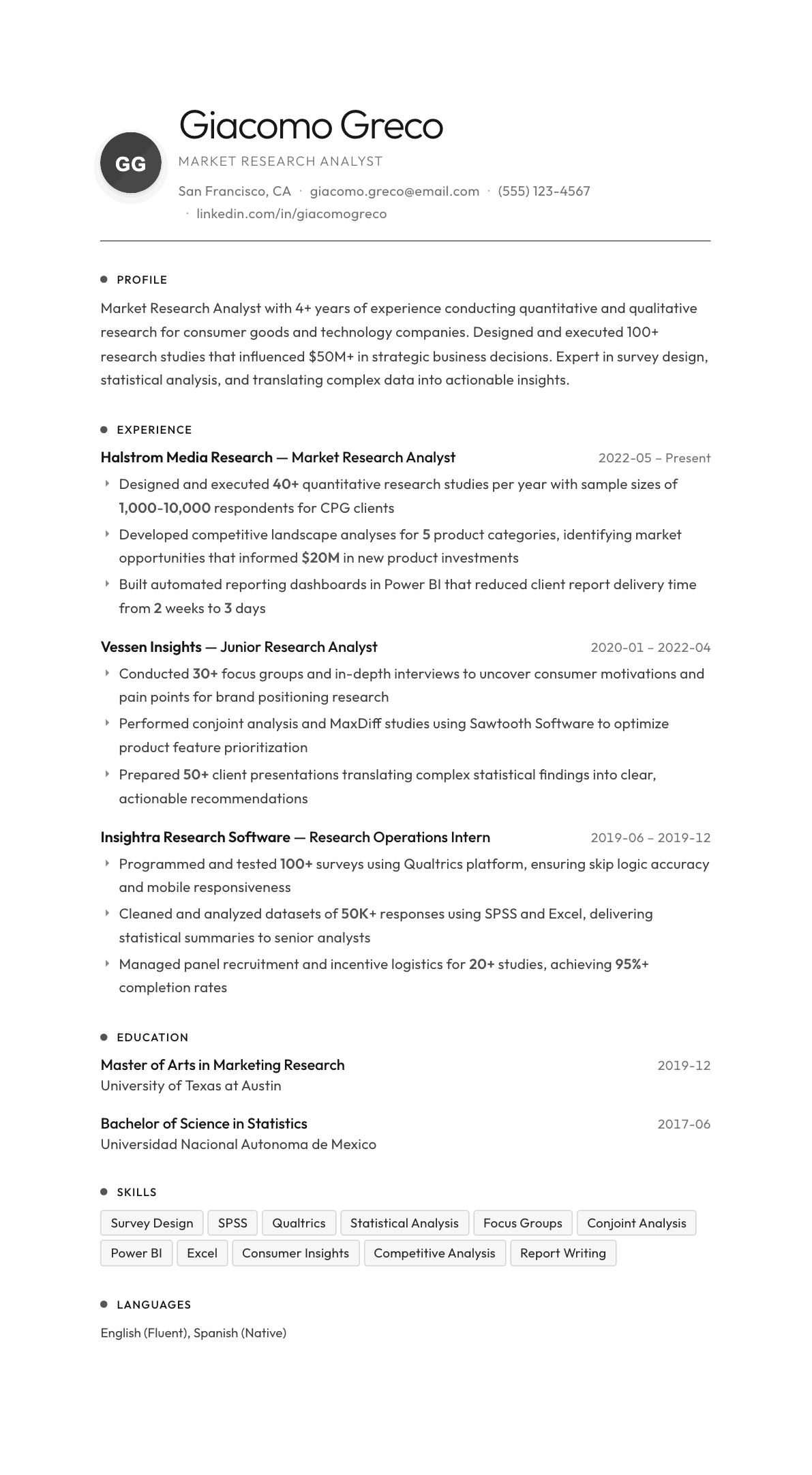
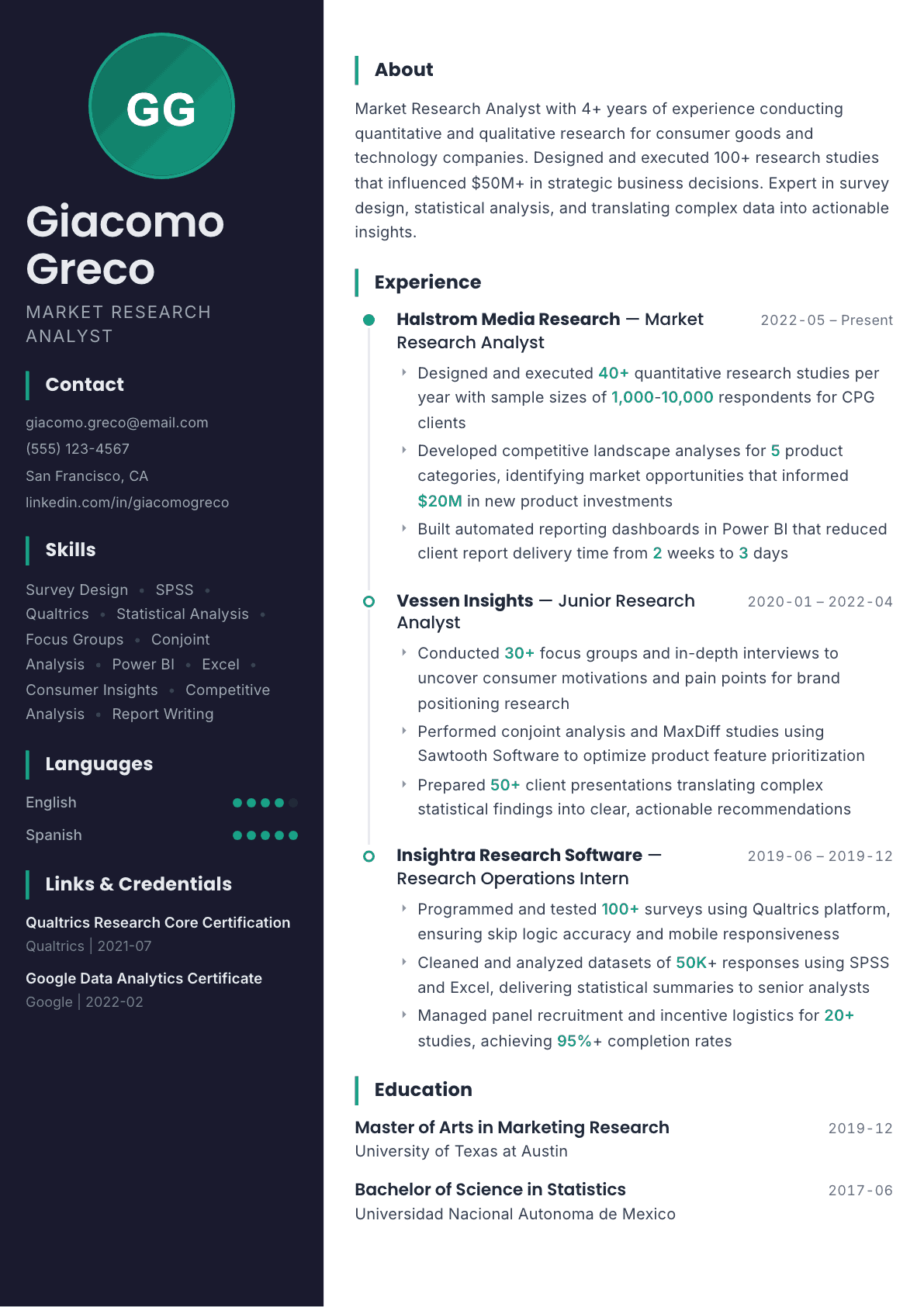
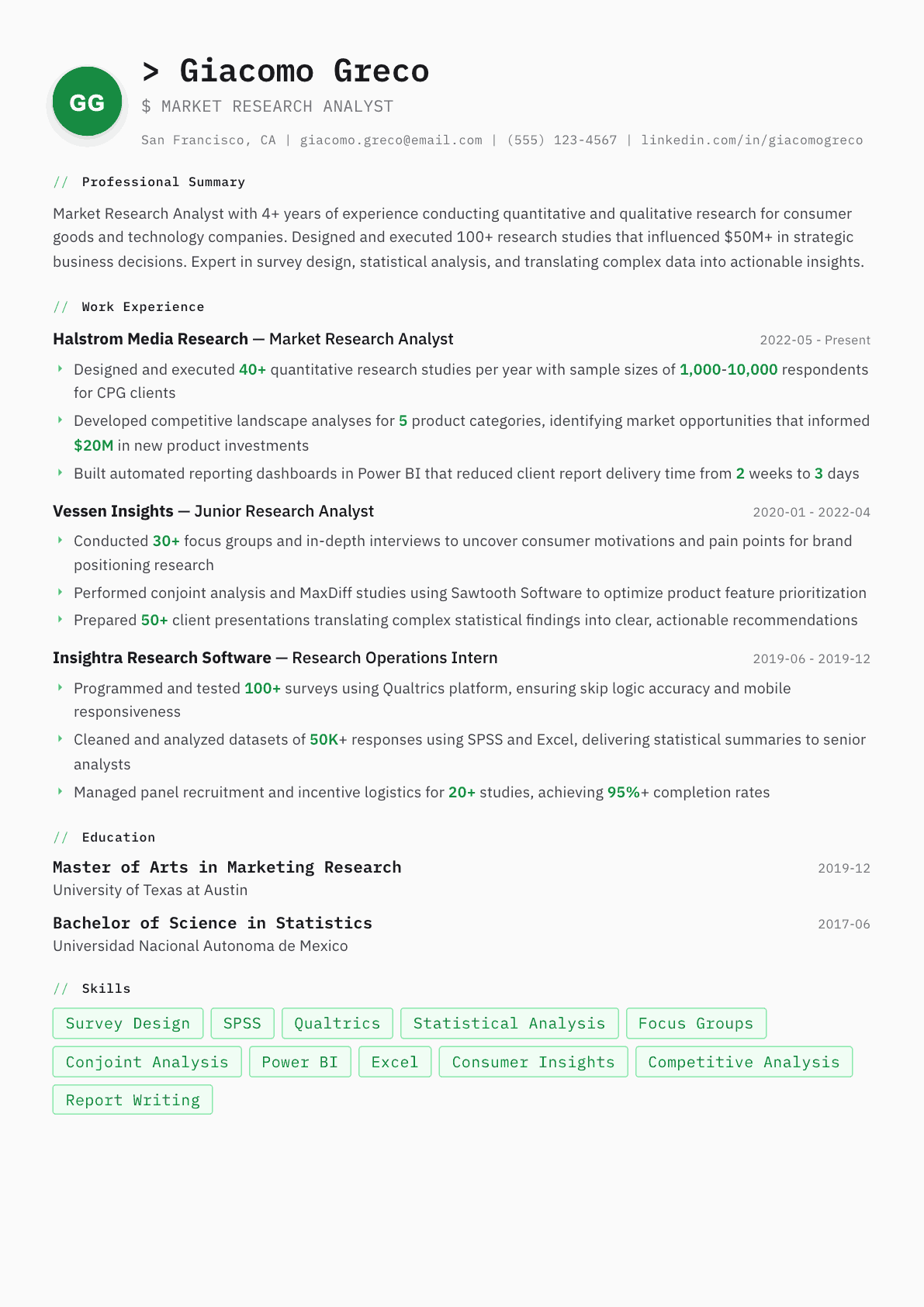
The same market research analyst content laid out in three CVBooster templates, so you can see what the finished document looks like before you write a word.
Example Market Research Analyst summary
Market Research Analyst with 4 years designing quantitative and qualitative studies for CPG and technology clients. Ran 40+ studies a year at sample sizes of 1,000-10,000 and produced category analysis that shaped $20M in new product investment. Works in Qualtrics, SPSS, Sawtooth and Power BI.
Skills to list on a Market Research Analyst resume
- Market Research
- Survey Design
- Statistical Analysis
- SPSS
- R
- Qualtrics
- Sawtooth Software
- Focus Groups
- Conjoint Analysis
- Consumer Insights
- Competitive Analysis
- Power BI
- Data Visualization
- Report Writing
- Excel
What actually gets this resume read
- Quantify your research impact: number of studies conducted, sample sizes, and business decisions influenced.
- List research methodologies: surveys, focus groups, IDIs, conjoint analysis, MaxDiff, ethnography, A/B testing.
- Highlight statistical tools: SPSS, R, SAS, Python, Excel, Qualtrics, Sawtooth Software.
- Demonstrate the ability to translate data into actionable recommendations for non-technical stakeholders.
- Include data visualization and reporting tools: Power BI, Tableau, Google Slides.
How to write a market research analyst resume
A market research analyst resume is read by someone who will judge your methods before your conclusions. Whether the reader sits at an agency, a consultancy or an in-house insights team, they are checking whether you know how a sample was drawn, whether the question wording could have produced the answer you got, and whether you can tell a stakeholder that the data does not support the decision they already made. Those are the failure points in this job, and they are visible on a resume.
The role also splits between quantitative and qualitative work, and the two are screened differently. Quantitative hiring looks for survey design, sampling, weighting, significance testing, and the statistical tools you work in. Qualitative hiring looks for discussion guides, moderating, recruitment screeners, and the discipline to code transcripts rather than cherry-pick quotes. Most analysts lean one way, and pretending to be equally strong at both usually shows up in the interview.
This guide covers the section order an insights manager expects, how to describe studies so a stranger can judge them, three summaries from a first analyst job to an insights lead, before-and-after bullets, and the questions analysts ask when the recommendation, not the research, was what got remembered.
Format: one page early, two with a study record
One page under five years, two once you have a substantial study record. Under the summary, add a methods block: the quantitative methods you have run, the qualitative methods you have moderated or managed, the sectors you know, and the tools you work in for fielding, analysis and reporting.
The methods block matters because postings are written as method lists. An insights manager who needs conjoint work will look for the word conjoint and move on if it is not there, no matter how strong the rest of the document is.
- Header: name, title, city, email, LinkedIn.
- Methods block: quantitative methods, qualitative methods, sectors, and the fielding and analysis stack.
- Sections in this order: summary, methods, experience, selected studies, technical skills, education.
- Education matters more here than in most marketing roles, so keep degrees and any statistics coursework visible.
Summary: methods, sectors and the decisions your work informed
Three lines. Name the methods you own end to end, the sectors and audience types you have studied, and the kinds of business decisions your research informed: pricing, positioning, concept selection, packaging, segmentation, market entry, or product roadmap. Analysts often describe activities and never the decisions, which leaves the reader unable to judge the level of the work.
Add one signal of independence, such as designing and fielding a study without supervision, managing a fieldwork vendor, or presenting to a leadership group. That is the line between an analyst who executes and one who owns a project.
Selected studies: the format that proves method
Add three or four study entries, each written the way a methods note is written: the business question, the design, the sample and how it was drawn, the fielding period, the analysis, and the decision that followed. Even short entries in this shape put you ahead of a page of task bullets.
Give the sample properly. Size alone is not enough; say the population, the screening criteria, the method of recruitment, and the mode. A survey of eight hundred category buyers screened on purchase in the last three months is a different piece of evidence from eight hundred responses on a general panel, and any experienced reader knows it.
Name the analysis honestly. Cross-tabulation with significance testing, regression, factor and cluster analysis for segmentation, conjoint or discrete choice, MaxDiff, driver analysis, or thematic coding for qualitative work. Say which software you ran it in and whether you did the analysis or received it from a supplier.
Turning findings into something a stakeholder acts on
The second half of this job is communication. Show how you deliver: a report structure that leads with implications rather than a chart parade, a topline within days of field close, a workshop where the team works through the findings, or a tracker dashboard the brand team reads monthly without you.
Include an example where the research changed a decision, including a case where it stopped one. Reporting that concept testing sent a product back for reformulation, or that a price test showed the intended increase would lose more volume than it gained, is stronger evidence of value than a list of studies delivered on time.
- Volume and scale: studies per year, largest sample, markets and languages covered.
- Method depth: the techniques you ran yourself versus those you commissioned from a supplier.
- Delivery: topline turnaround, report formats, workshops run, dashboards maintained.
- Impact: decisions informed, concepts screened out, trackers that became a standing input.
Tools, standards and the keywords a screen looks for
List the survey platforms you program in, such as Qualtrics, Decipher or a similar tool, and say whether you script complex logic and quotas yourself. Then the analysis environment: SPSS, R, Python, Excel with pivot work, and any choice modeling software. Then reporting: the dashboard tool and the presentation software your decks live in.
Include the standards side if you have worked to it: data protection requirements for personal data in research, informed consent, incentive handling, and any industry code your employer followed. Regulated sectors and public bodies screen for that, and it rarely appears on competing resumes.
Market Research Analyst resume summary examples
First analyst role
Market research analyst with two years supporting quantitative studies for consumer goods clients, programming surveys in Qualtrics, running quotas and building cross-tabulations with significance testing. Fielded a brand tracker across four waves and wrote the toplines within three days of each field close.
Five years in
Market research analyst with five years across consumer goods and retail, owning studies end to end from question design and sampling through analysis and presentation. Runs segmentation and driver analysis in R, moderates focus groups, and manages two fieldwork vendors across six markets and three languages.
Insights lead
Consumer insights lead managing three analysts and an annual research plan covering trackers, concept testing and pricing work. Built the segmentation the commercial team now plans against, introduced a conjoint approach for pricing decisions, and reduced average project cost by consolidating panel suppliers.
Work experience bullets: before and after
Before: Conducted market research surveys for clients.
After: Designed and fielded a survey of 800 category buyers screened on purchase within three months, programmed in Qualtrics with quotas on age, region and purchase frequency, and weighted the sample to the client target profile.
Population, screening, quotas and weighting let a reader judge the quality of the study rather than take it on faith.
Before: Analyzed data and presented findings to stakeholders.
After: Ran driver analysis on tracker data to identify the three attributes moving consideration, and presented the implications to the brand team as two recommended positioning routes with the evidence behind each.
Naming the technique and the decision offered turns analysis into an input a stakeholder can act on.
Before: Ran focus groups with consumers.
After: Wrote the screener and discussion guide, moderated six focus groups across three markets, and coded the transcripts thematically so the findings could be compared with the quantitative wave that followed.
Instrument authorship, moderation and coding show qualitative craft rather than attendance at a session.
Before: Helped the company make better pricing decisions.
After: Ran a discrete choice study on four price points and two pack sizes, which showed the proposed increase would lose more volume than margin gained, and the launch price was held.
A specific method and a decision that changed as a result is the clearest proof that research had value.
Before: Built reports and dashboards for the marketing team.
After: Rebuilt the quarterly tracker report into a dashboard with significance flags on wave-over-wave movement, which the brand team now reviews monthly without an analyst in the room.
Self-service adoption and a statistical safeguard show reporting designed for misuse resistance, not just for looks.
Hard skills
- Survey design and questionnaire writing
- Sampling and quota design
- Weighting
- Significance testing
- Cross-tabulation
- Segmentation and cluster analysis
- Driver and regression analysis
- Conjoint and discrete choice
- MaxDiff
- Qualitative moderation and coding
- Qualtrics
- SPSS
- R
- Dashboard and report building
Soft skills
- Skeptical reading of data
- Explaining method to non-researchers
- Pushing back on leading questions
- Managing fieldwork vendors
- Writing a clear topline under time pressure
- Presenting uncomfortable findings
Certifications worth listing
- Professional Researcher Certification (PRC) (Insights Association)
- Qualtrics Research Core Expert (Qualtrics)
- Professional Certified Marketer (PCM) (American Marketing Association)
Mistakes that cost market research analyst candidates the interview
- Quoting sample sizes with no population or screening criteria, which makes the study impossible to evaluate.
- Listing every method in the textbook rather than the ones you have personally designed and run.
- Describing studies delivered without ever naming a decision that changed as a result.
- Claiming statistical techniques you received from a supplier as analysis you performed yourself.
- Leaving software off the resume, when insights postings are frequently filtered on a named analysis tool.
- Presenting only positive findings, when the studies that stopped a bad decision are the most persuasive evidence.
- Hiding qualitative work because it feels less rigorous, which costs you roles that need mixed method experience.
Market Research Analyst resume questions
Should a market research analyst resume list specific studies?
Yes. Three or four study entries with the business question, design, sample, analysis and outcome show method in a way task bullets cannot, and they give an interviewer something concrete to probe, which usually works in your favor.
How technical does a market research analyst need to be?
You need enough statistics to defend a design: sampling, weighting, significance and the limits of your data. Advanced modeling such as conjoint or segmentation is a differentiator rather than a baseline, but naming the software you use is expected everywhere.
Is a masters degree necessary for market research?
Not usually for analyst roles, where demonstrated method work matters more. A postgraduate degree in statistics, psychology, economics or a related field helps for senior quantitative and modeling positions, and coursework in research methods is worth listing at any level.
How do I show impact when someone else made the decision?
Describe the input you provided and the decision it fed. Saying that a concept test screened out two of five concepts before development, or that pricing work led to a held launch price, credits the research without claiming authority you did not hold.
How do I move from an agency to an in-house insights team?
Reframe around ownership of a business question rather than delivery of a project. Emphasize stakeholder work, trackers and repeated studies, the decisions your findings informed, and any experience commissioning suppliers, since in-house analysts buy fieldwork as often as they run it.