Market Researcher Resume Examples: the lines they read
Build a Market Researcher Resume That Shows Real Method
By Mustafa Tarabya, founder of CVBooster · Published · Updated
Market researcher resume example with survey and interview bullets, the methods and tools to list, ATS keywords, and a practical writing guide.
Sample resumes for a market researcher
The same market researcher content laid out in three CVBooster templates, so you can see what the finished document looks like before you write a word.
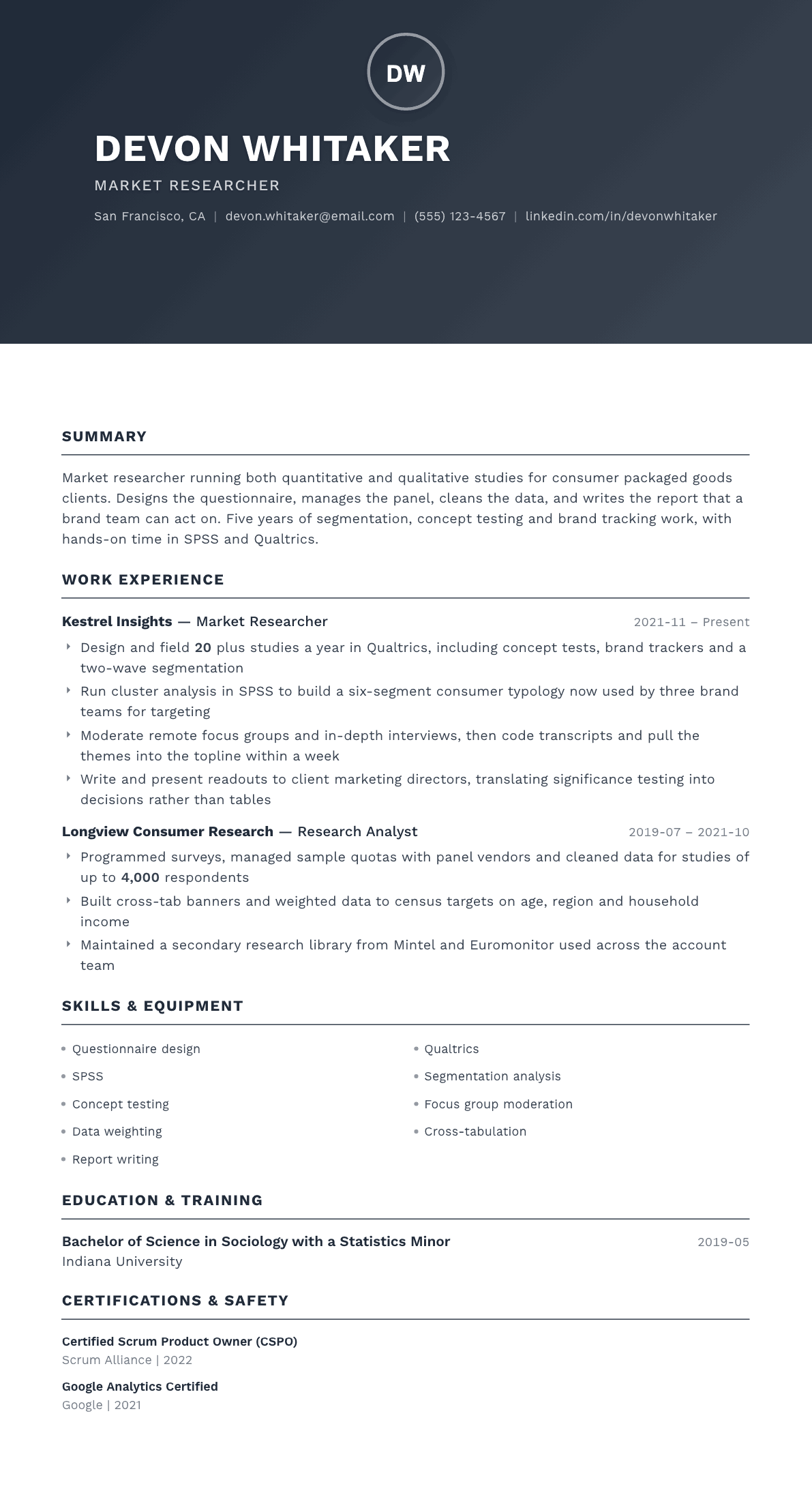
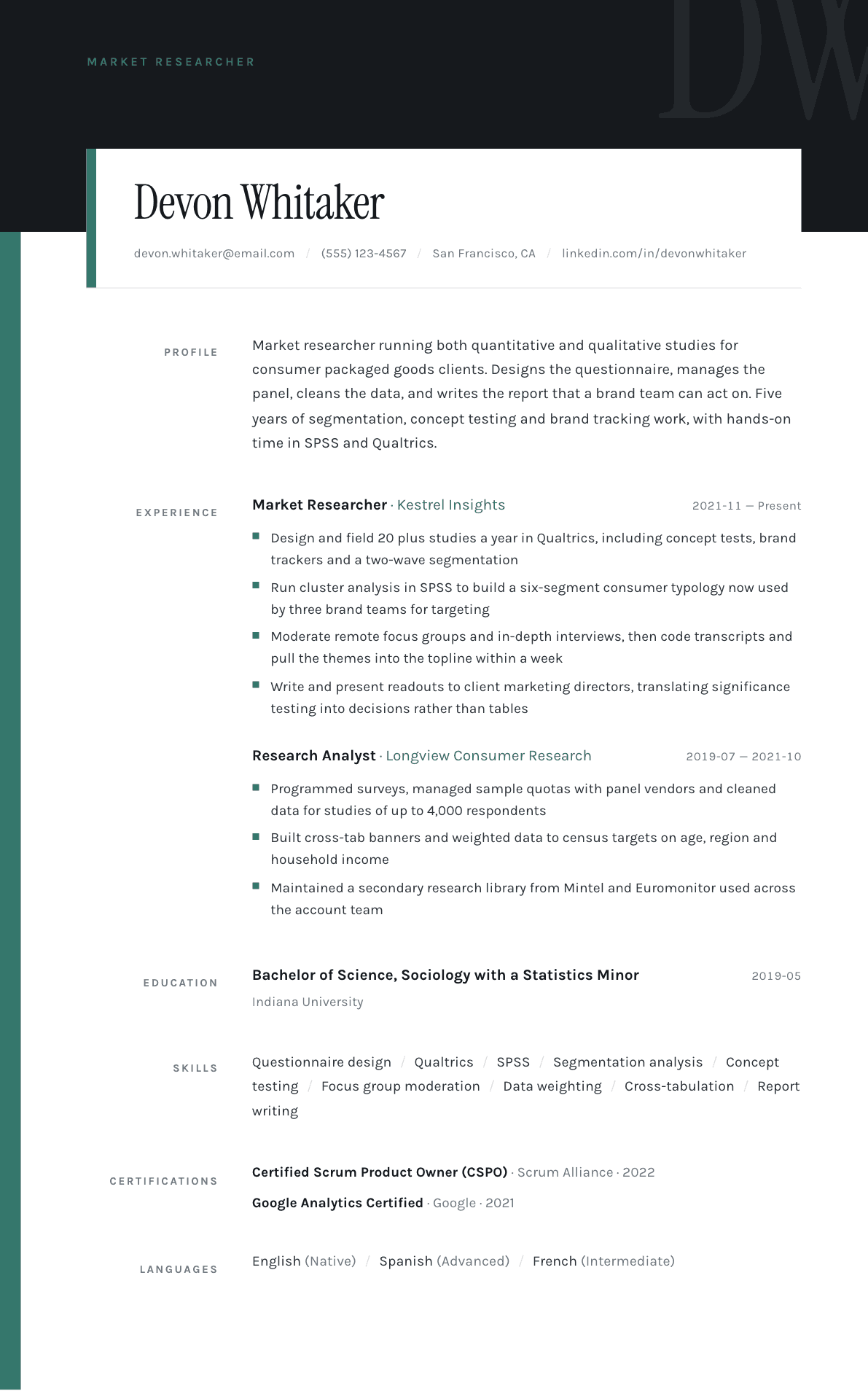
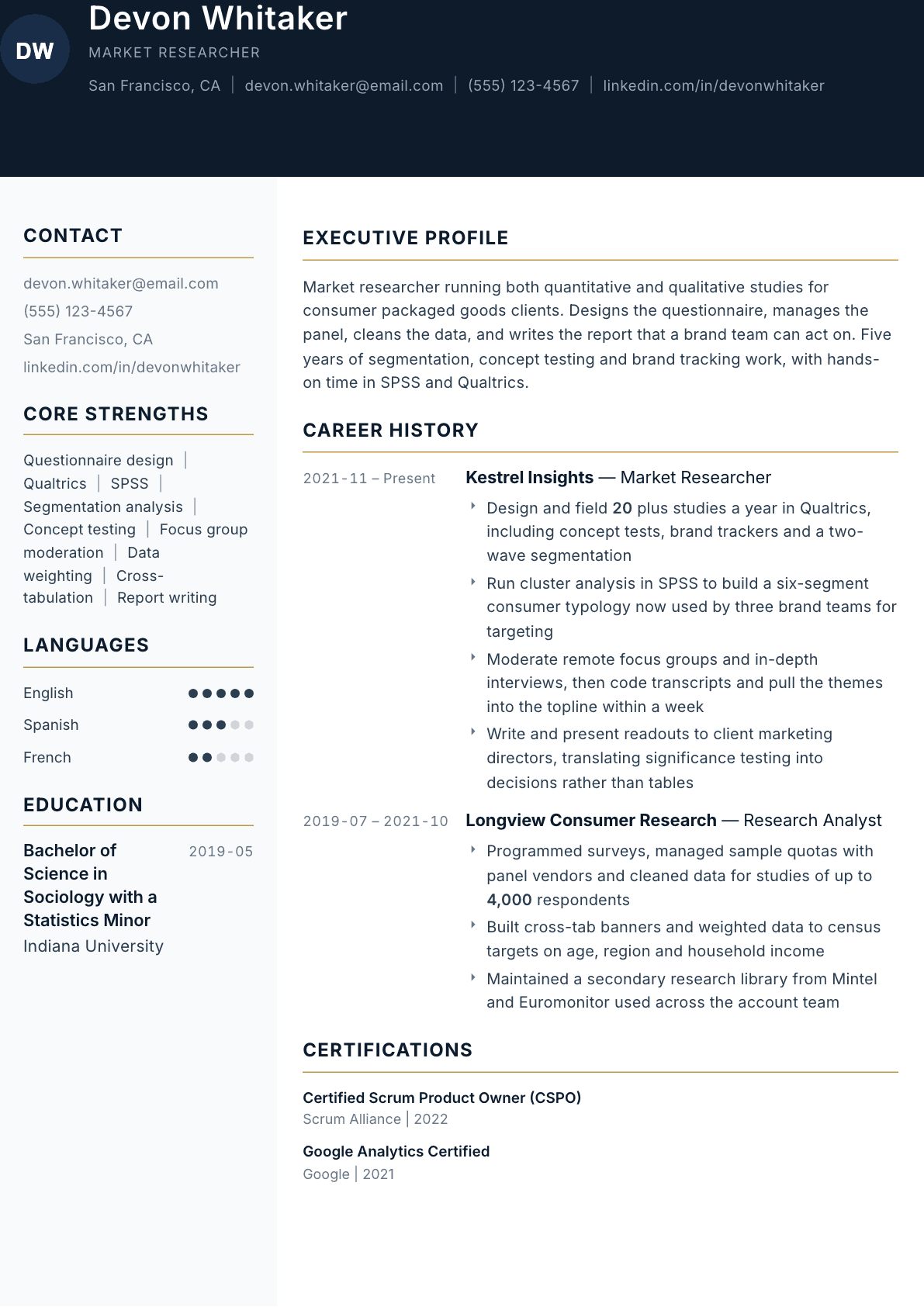
Example Market Researcher summary
Market researcher with five years designing and fielding consumer studies for packaged goods brands, roughly twenty projects a year. Programs in Qualtrics, analyzes in SPSS, and has built a six-segment typology that three brand teams now use for targeting. Equally comfortable moderating a focus group and running cluster analysis, and presents readouts that end in a recommendation rather than a table dump.
Skills to list on a Market Researcher resume
- Questionnaire design
- Survey programming
- Qualtrics
- SPSS
- Segmentation analysis
- Conjoint analysis
- MaxDiff
- Concept testing
- Brand tracking
- Focus group moderation
- In-depth interviews
- Data cleaning and weighting
- Cross-tabulation
- Significance testing
- Report writing
- Secondary research
What actually gets this resume read
- Split your resume by method, because a hiring manager is usually staffing either a quantitative seat or a qualitative one.
- Name the study types you have run: brand tracker, concept test, segmentation, usage and attitude, package test.
- Give sample sizes and fielding volume, since they show whether you have handled real panel logistics or classroom projects.
- List the analysis you personally ran, such as cluster analysis, conjoint, MaxDiff or significance testing, not just the software.
- Show that you present findings, because researchers who cannot deliver a readout stall at the analyst level.
- Include the panel and secondary sources you have worked with so buyers of research know your supplier landscape.
How to write a market researcher resume
Hiring for a market researcher almost always starts with a methods question. The team has a gap on one side of the house, quantitative or qualitative, and the screener is scanning to see which side you sit on and how deep you go. A resume that spreads itself evenly across both without evidence tends to be read as shallow in each, which is the opposite of what the candidate intended.
The second thing a research director checks is whether you have run a study or only supported one. Programming a survey somebody else designed, or taking notes in a group somebody else moderated, is a real job but a junior one. Design, fielding decisions, analysis choices and the readout are what mark the step up, and each of them should be visible on the page.
This guide covers how to organize a research resume by method, how to describe studies without breaching client confidence, which analysis terms carry weight, and the questions researchers ask when they are trying to move from analyst to full ownership.
Format: method groups first, then chronology inside them
Keep the overall structure reverse chronological, but inside each job group your bullets by method so a screener can find her filter fast. Quantitative work in one cluster, qualitative in another, secondary and desk research in a third. A supplier-side researcher who has done all three should still show which one carries the most weight.
Add a short study inventory line under each employer: the study types you fielded and the annual volume. Twenty studies a year in concept testing and brand tracking tells a research director more than five bullets of description.
- Header: name, city and state, phone, email, and a line naming your method focus.
- Sections: summary, methods and tools, experience with study inventory, education.
- Group bullets within each job by quantitative, qualitative and secondary work.
- A statistics minor, a methods course sequence or thesis fieldwork belongs in education, not in skills.
Summary: the studies you run and the analysis you personally do
Three lines. Name the study types, the client sectors, the fielding volume, and the analysis you run with your own hands. There is a wide gap between a researcher who commissions a segmentation and one who runs the cluster solution, and the summary is where you settle it.
If you moderate, say so explicitly and say in what format: in-person groups, remote groups, in-depth interviews, ethnography, shop-alongs. Moderating is a performance skill that clients pay for separately, and it is often the reason one candidate is chosen over another with identical analysis experience.
Experience: design decisions, sample logistics, and the readout
Every strong bullet in this field contains a decision you made about the study rather than a task you executed. The screening criteria you set and why. The quota structure that protected the read. The weighting scheme you applied to hit census targets. The scale you chose and the reason. These choices are how a research director judges whether you understand error rather than just software.
Sample logistics belong on the page too. Panel vendors managed, incidence problems you solved, completion rates you protected, the survey you cut from twenty-two minutes to fourteen because drop-off was climbing. Nobody outside the field appreciates that work, which is exactly why it separates candidates inside it.
End each job with the delivery: who you presented to, in what format, and what changed as a result. A researcher whose work stops at the tabulation file is an analyst. A researcher whose readout redirected a launch is the hire.
- State sample sizes and fielding windows for the studies you designed.
- Name the analysis you ran yourself: cluster, factor, conjoint, MaxDiff, driver analysis, significance testing.
- Show one methodology change you made and the problem it fixed.
- Close with the audience for your readouts and one decision that followed.
Tools and methods: software is the floor, method is the differentiator
List the platforms plainly: Qualtrics, Decipher, Confirmit or Forsta for fielding, SPSS, R, Python or Q for analysis, and whatever charting or dashboard layer you deliver in. Also name the panel and secondary sources you have worked with, because supplier relationships are part of the craft.
Then list methods separately from tools. A skills block that reads only Qualtrics, SPSS, Excel says you can operate software. Adding questionnaire design, quota and weighting design, conjoint, MaxDiff, driver analysis and thematic coding says you can build a study.
Keywords research teams filter on
Postings repeat a stable vocabulary: market research, questionnaire design, survey programming, segmentation, concept testing, brand tracking, usage and attitude, focus group moderation, in-depth interviews, significance testing, weighting, consumer insights, syndicated data. Use only the ones you can defend, and attach a study or a sample size to each so the human read holds up after the filter passes you through.
Market Researcher resume summary examples
Research analyst, first job
Research analyst programming surveys, managing panel quotas and cleaning data for consumer studies of up to 4,000 respondents. Builds cross-tab banners, weights data to census targets on age and region, and maintains the secondary research library the account team works from.
Five years in
Market researcher fielding around twenty studies a year for packaged goods clients, including concept tests, brand trackers and a two-wave segmentation. Runs cluster analysis in SPSS, moderates remote groups and in-depth interviews, and presents readouts directly to client marketing directors.
Research director
Research director owning the methods standard for a six-person insights team and a book of eleven client relationships. Designs segmentation and pricing research, reviews every questionnaire before field, and rebuilt the tracker so quarterly waves reach clients within three weeks of close instead of seven.
Work experience bullets: before and after
Before: Conducted market research studies for clients.
After: Designed and fielded more than twenty studies a year in Qualtrics for packaged goods clients, including concept tests, quarterly brand trackers and a two-wave segmentation.
Volume, platform, client sector and study types replace a generic claim with a verifiable workload.
Before: Analyzed survey data using statistical software.
After: Ran k-means cluster analysis in SPSS on a 3,200 respondent sample to build a six-segment consumer typology now used by three brand teams for targeting.
Naming the technique, the sample and the downstream use proves ownership of the analysis rather than access to the software.
Before: Moderated focus groups and interviews.
After: Moderated eighteen remote focus groups and thirty in-depth interviews on packaging renovation, coded the transcripts and delivered the topline within a week of the last session.
Session counts, the topic and the turnaround show both moderating capacity and delivery discipline.
Before: Improved survey completion rates.
After: Cut a tracker questionnaire from twenty-two minutes to fourteen by collapsing two grids and dropping redundant attribute batteries, raising completion and lowering straight-lining.
The specific edits and the two quality problems they fixed demonstrate judgment about instrument design.
Before: Presented findings to clients.
After: Presented segmentation findings to client marketing directors with a recommended target and sizing, and the brand team rebuilt its media brief around the two segments identified.
A named audience and a decision that followed turn a presentation into evidence of influence.
Hard skills
- Questionnaire design
- Survey programming
- Qualtrics
- SPSS
- Segmentation and cluster analysis
- Conjoint analysis
- MaxDiff
- Concept and product testing
- Brand tracking
- Focus group moderation
- In-depth interviewing
- Data weighting and cross-tabulation
- Significance testing
- Secondary and syndicated research
Soft skills
- Storytelling from data
- Client questioning
- Intellectual honesty about limits
- Presentation delivery
- Project scheduling
- Listening in qualitative sessions
Certifications worth listing
- Professional Researcher Certification (PRC) (Insights Association)
- Qualtrics Research Core Expert (Qualtrics)
- Google Analytics Certification (Google)
Mistakes that cost market researcher candidates the interview
- Listing software without ever naming an analysis technique, which reads as survey operator rather than researcher.
- Hiding whether you designed the study or executed somebody else design of it.
- Leaving sample sizes and fielding volume off the page, so the reader cannot judge the scale you have handled.
- Presenting qualitative and quantitative work as interchangeable when hiring teams staff them separately.
- Stopping the story at the tabulation file instead of naming the decision the research informed.
- Overclaiming causation in bullets when the study design only supports association.
Market Researcher resume questions
Should a market researcher resume emphasize quantitative or qualitative work?
Emphasize whichever one you want your next job to be. Teams almost always recruit for a specific side, so lead with that depth, then present the other as supporting capability rather than splitting the page evenly and looking thin in both.
How do I describe studies covered by client confidentiality?
Describe the category, the study type, the method and the sample size, and leave the brand out. A line reading two-wave segmentation for a national snack brand, 3,200 respondents, tells a research director everything relevant without naming the client at all.
Do I need R or Python, or is SPSS still enough?
SPSS remains standard on the supplier side and is enough for most agency roles. Client-side insights teams and anyone doing advanced modeling increasingly expect R or Python. List what you truly use daily and be honest about the level, since a technical screen will find the gap.
How do I move from research analyst to running my own studies?
Show design decisions on your resume before you have the title. Screening criteria you proposed, a questionnaire section you drafted, a quota structure you fixed, a topline you wrote. Those details tell a hiring manager you are already operating a level above your job description.
Is user research experience relevant for a market researcher role?
Partly. Interviewing, recruiting and thematic coding transfer directly to qualitative work. Sampling, weighting and significance testing usually do not come from user research backgrounds, so name the quantitative training you do have and be specific about what you would be learning.