Brewer Resume Examples: what a hiring manager reads first
Build a Brewer Resume Around Your System and Your Beers
By Mustafa Tarabya, founder of CVBooster · Published · Updated
Brewer resume example, keyword list and writing guide covering brewhouse size, cellar work, yeast handling, lab checks and packaging.
Sample resumes for a brewer
The same brewer content laid out in three CVBooster templates, so you can see what the finished document looks like before you write a word.
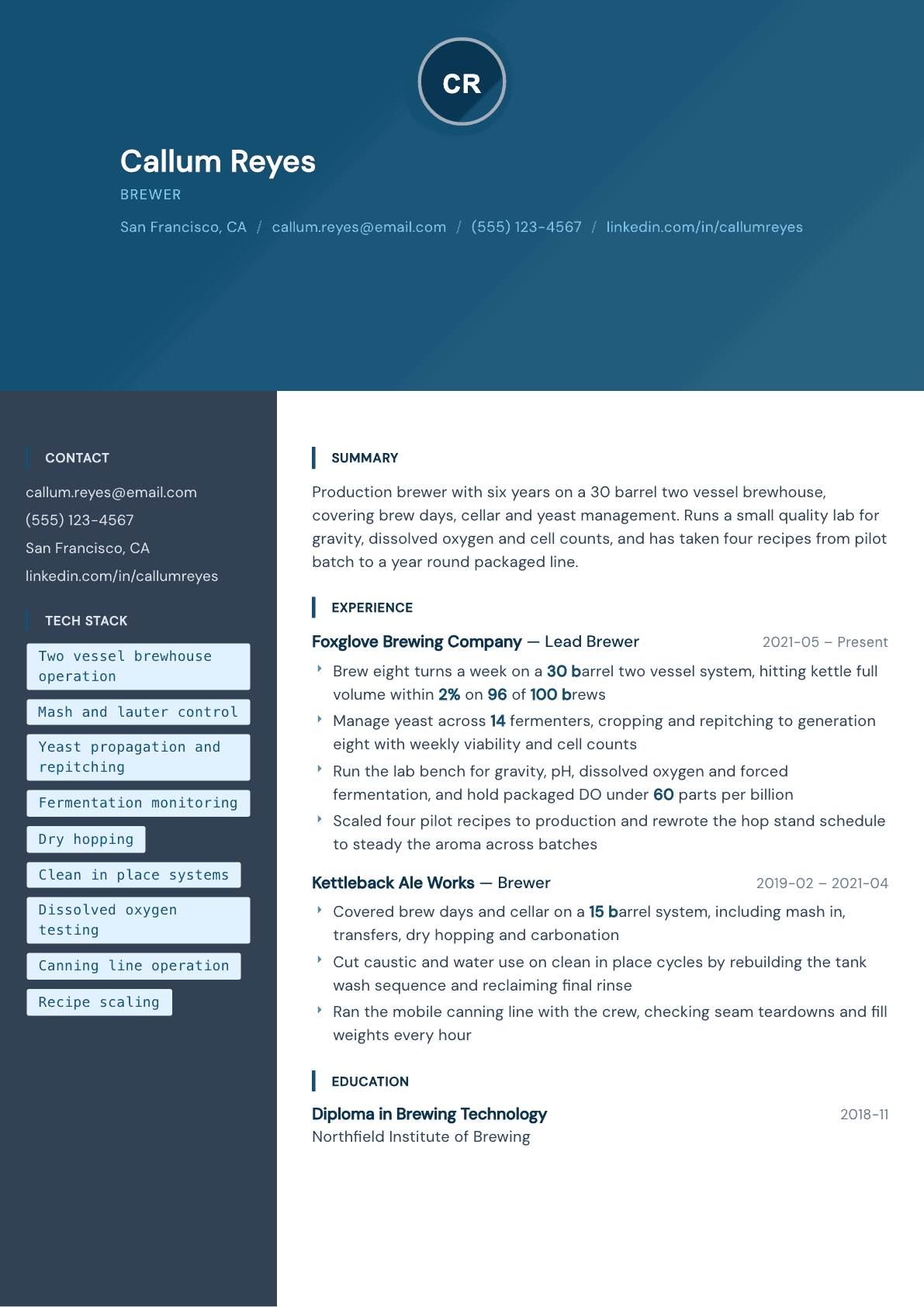
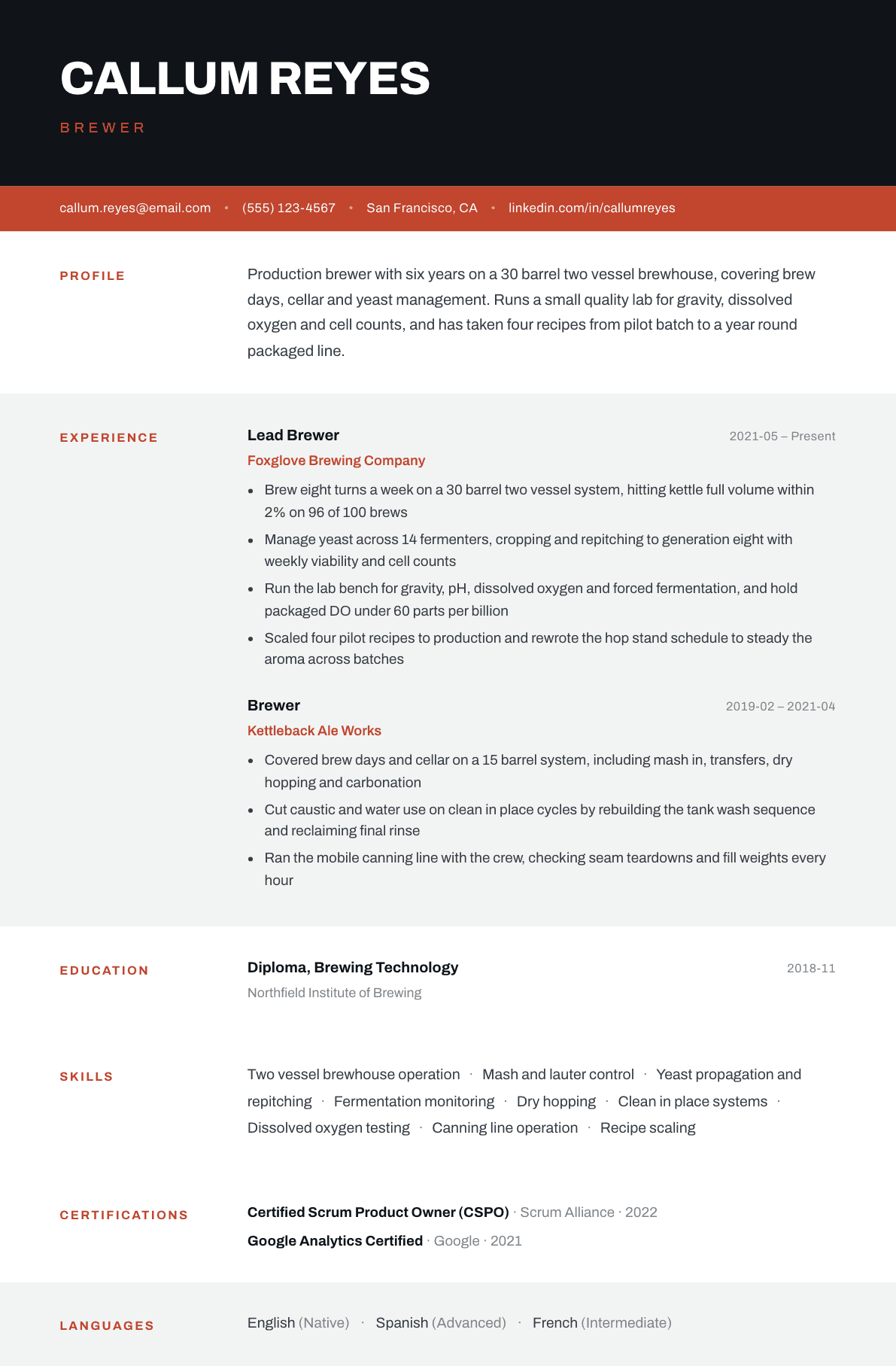
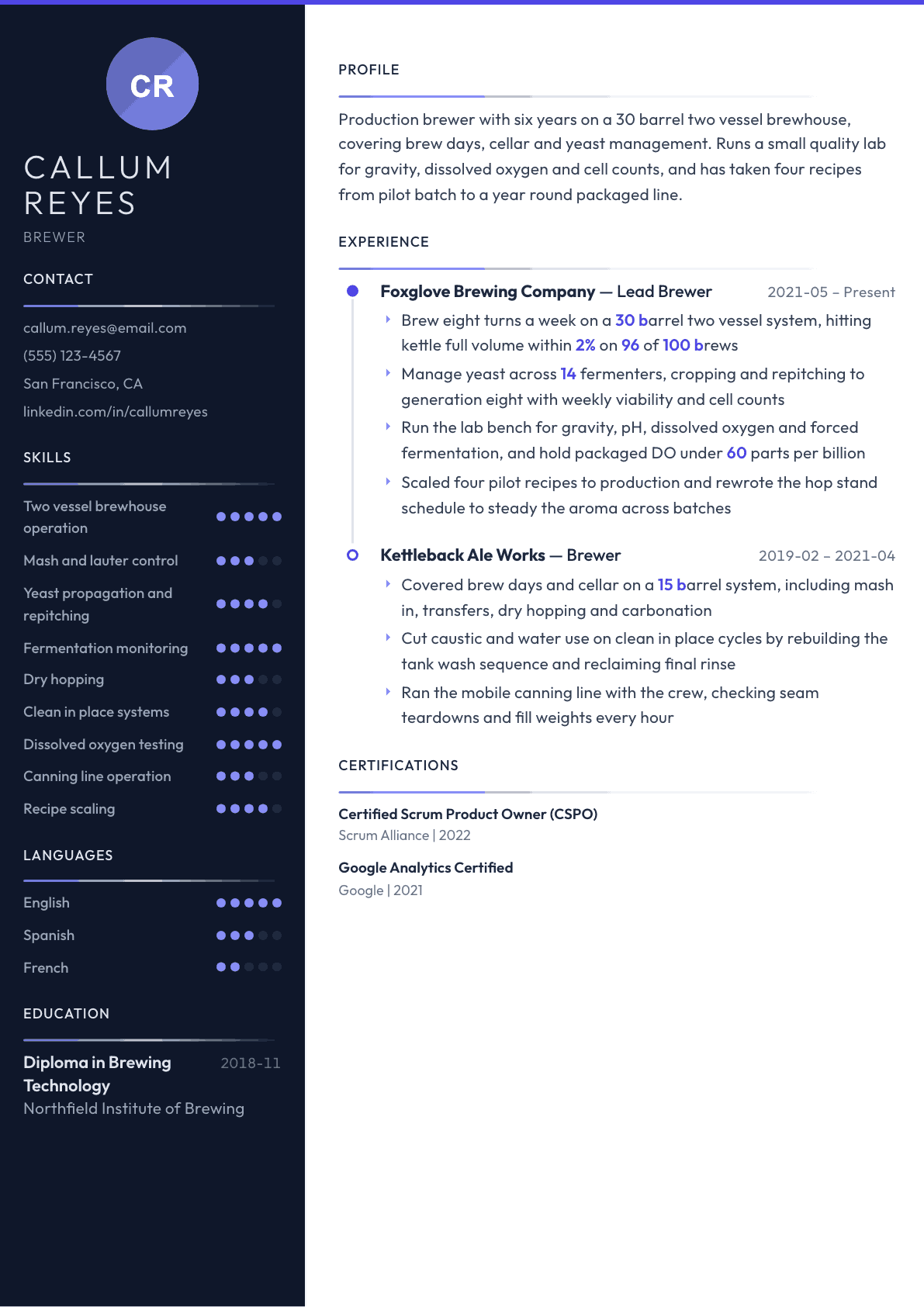
Example Brewer summary
Production brewer with six years on a 30 barrel two vessel system, turning eight brews a week across brew day and cellar. Manages yeast to generation eight with weekly viability counts, runs the bench lab for gravity and dissolved oxygen, and keeps packaged oxygen low enough to protect hop character. Scaled four pilot recipes into the year round lineup and trains new cellar staff on clean in place chemistry.
Skills to list on a Brewer resume
- Brewhouse operation
- Mash and lauter control
- Wort boiling and whirlpool
- Hop stand and dry hopping
- Yeast propagation
- Yeast cropping and repitching
- Fermentation and diacetyl rest control
- Centrifuge and filtration
- Carbonation and blending
- Clean in place chemistry
- Dissolved oxygen measurement
- Sensory panel participation
- Canning and kegging lines
- Grain and hop inventory
- Recipe scaling and pilot batches
What actually gets this resume read
- Name the brewhouse size in barrels or hectoliters and the vessel count, because that number sets the job.
- Say how many brews a week you turn, since a brewer doing eight turns is a different hire from one doing two.
- Separate brew day work from cellar work, because many breweries hire for one side and train the other.
- Give your yeast practice in detail: generations, cropping method, viability checks and propagation if you do it.
- List your lab measurements with the instrument, from gravity and pH to dissolved oxygen and forced fermentation.
- Include packaging experience with the format and line speed, since canning knowledge often decides the offer.
How to write a brewer resume
Breweries hire on system size and on trust. The head brewer or production manager reading your resume wants to know what scale you have worked, whether you can be left alone with the yeast, and whether the beer that leaves the building would carry the name on the label. Everything else on the page is decoration.
This is why a resume that lists "assisted with all aspects of the brewing process" goes nowhere. A brewery runs on specifics: barrels per brew, turns per week, vessel count, yeast generations, dissolved oxygen at package, clean in place chemistry. A brewer who writes those numbers reads as someone who has been responsible for them.
Below is how to build the page: the format a small production team actually reads, how to separate brew day from cellar work, how to prove quality practice without a laboratory degree, and what to say when you are moving up in system size or coming in from another food and beverage job.
Format: system size at the top, brew day and cellar kept separate
One page, reverse chronological. The first thing under your name should be the systems you have run, given in barrels or hectoliters with the vessel configuration. A head brewer scanning applications sorts them by that number before reading a word of prose.
Then split your work into brew day and cellar rather than mixing them. Many breweries hire for one side, and a candidate who shows depth on both is visibly more flexible than one whose bullets blur the two together. Packaging is a third block whenever you have run a line.
- Opening line for a brewer: system size, vessel configuration, annual volume and the styles you have produced at scale.
- Three grouped blocks: brew day, cellar and yeast, then packaging and quality, each with its own bullets.
- Every employer entry names the brewery type, annual volume, fermenter count and how many brewers were on the team.
- Keep a short quality block: the instruments you use, the tests you run and how often you sit on the sensory panel.
Summary: scale, turns and what you own
Three lines. Say your years, the system size, the weekly turns and the part of production you own outright. Owning something is the point: yeast management, quality release, a recipe, the packaging line or the whole schedule.
Add one line about the styles you have brewed at production scale. A brewery moving into lager needs someone who has run diacetyl rests and long conditioning, and that is a different brewer from one who has only made hazy ales. Say which you are.
Brew day: the numbers that show consistency
A brew day bullet should carry a rate and a tolerance. Turns a week, mash and lauter times, kettle full volume, original gravity accuracy, hop stand temperature and hold time all say more about you than any adjective. Consistency is what a production manager is buying, so quantify it.
Grade the difficult parts honestly. Stuck mashes, slow runoff, a lauter tun with a tired rake mechanism and a decoction schedule are the moments where experience shows. If you rebuilt a mash profile to fix runoff or adjusted a grist to make a wheat beer behave, that is a bullet.
Cellar, yeast and quality: where the real risk sits
Yeast handling is the single most revealing section on a brewer resume. Say how you crop, how many generations you push, how you check viability and vitality, whether you propagate from slant or bank, and how you decide a pitch is no longer fit. A brewery that has lost a tank to a tired pitch will read this section twice.
Then the quality bench. Gravity, pH, dissolved oxygen at transfer and at package, microbiological plating if you do it, and forced fermentation samples. Give the numbers you hold rather than the equipment you own, because a low package oxygen figure tells a head brewer more about your practice than a list of instruments.
Clean in place chemistry belongs here too. Caustic strength, temperature, contact time, acid rinse and verification method are the details that separate a brewer who cleans from a brewer who validates cleaning.
- Yeast bullet: cropping method, generation limit, viability check and repitch rate decisions.
- Fermentation bullet: temperature schedule, diacetyl rest practice and how you decide a tank is ready.
- Quality bullet: dissolved oxygen at package, plating routine and sensory panel participation.
- Cleaning bullet: caustic concentration, temperature, contact time and how you verify the result.
Packaging, keywords and the practical realities
Packaging experience often decides a hire at a small brewery, because a line that runs badly costs more than a mediocre recipe. Give the format, the line speed, the filler type and the checks you run: fill weight, seam teardown, torque, oxygen pickup and date coding.
Postings recycle a small vocabulary: brewhouse, mash, lauter, whirlpool, knockout, pitch, crash, dry hop, centrifuge, carbonation, clean in place, cellar, canning line and sensory. Use those words once in your skills list and once inside a bullet. Add the physical realities too, including hose work, tank entry, forklift authorization and early starts, because a brewery would rather see them early.
Brewer resume summary examples
Cellar hand moving up
Brewing technology graduate with 18 months as a cellar hand on a 15 barrel system, covering transfers, dry hopping, carbonation and clean in place. Runs gravity and pH checks daily and has assisted on 90 brew days. Seeking a full brewer seat on a production system.
Six years in
Production brewer with six years on a 30 barrel two vessel system, turning eight brews a week across brew day and cellar. Manages yeast to generation eight with weekly viability counts, runs the bench lab, and holds packaged dissolved oxygen low enough to protect hop aroma through the code date.
Head brewer
Head brewer with eleven years across a 30 barrel and a 60 barrel brewhouse, responsible for recipes, schedule, quality release and a team of five. Built a yeast bank and a propagation routine, brought a lager program to production scale, and holds a General Certificate in Brewing.
Work experience bullets: before and after
Before: Brewed beer on the production system.
After: Brewed eight turns a week on a 30 barrel two vessel system, hitting kettle full volume within 2% on 96 of 100 brews across the year.
Turns, system size and a consistency tolerance are the three facts a production manager sorts on.
Before: Took care of the yeast.
After: Managed yeast across 14 fermenters, cropping and repitching to generation eight with weekly viability and cell counts, and banked two house strains from single colony.
Generation limits and viability checks show a yeast practice rather than a yeast chore.
Before: Cleaned tanks and lines regularly.
After: Rebuilt the clean in place sequence to reclaim final rinse water, cutting caustic use by a third while holding the same verification result on swab checks.
Cleaning becomes evidence when it names the chemistry, the saving and the verification.
Before: Helped with new beers.
After: Scaled four pilot recipes to production and rewrote the hop stand schedule so aroma held steady from batch to batch across a full year of releases.
Recipe work reads as ownership when the scaling and the consistency problem are both named.
Before: Worked on the canning line.
After: Ran a mobile canning line with the crew at 30 cans a minute, checking seam teardowns and fill weights hourly and holding package oxygen under 60 parts per billion.
Line speed plus the checks plus the oxygen figure prove packaging discipline, not just attendance.
Hard skills
- Two and three vessel brewhouse operation
- Mash profiles and lauter management
- Wort boiling, whirlpool and knockout
- Hop stand and dry hop scheduling
- Yeast propagation and banking
- Cropping, repitching and viability testing
- Fermentation temperature schedules
- Diacetyl rest and crash cooling
- Centrifuge and filtration
- Carbonation and blending to spec
- Clean in place chemistry and verification
- Dissolved oxygen measurement
- Microbiological plating and sensory panels
- Canning, bottling and kegging lines
- Raw material inventory and yield tracking
Soft skills
- Calling a batch bad when the schedule says otherwise
- Working a hot brew day without losing precision
- Teaching a cellar hand why a step exists
- Coordinating with sales on release timing
- Palate honesty on a sensory panel
Certifications worth listing
- General Certificate in Brewing (Institute of Brewing and Distilling)
- Certified Cicerone (Cicerone Certification Program)
- ServSafe Food Handler (National Restaurant Association)
Mistakes that cost brewer candidates the interview
- Leaving the system size off the page, which makes every other claim impossible to weigh.
- Blurring brew day and cellar work together when breweries usually hire for one of the two.
- Describing yeast handling in a single word instead of generations, viability and pitch decisions.
- Claiming a focus on quality with no dissolved oxygen number, plating routine or sensory practice behind it.
- Omitting packaging experience, which is often the deciding factor at a small production brewery.
- Listing home brewing awards above paid production work when applying to a production role.
Brewer resume questions
Do I need a brewing qualification to get hired?
Not always, but it helps once you are competing for a brewer rather than a cellar seat. Many production brewers came up through the cellar and added a brewing certificate later. If you have no formal training, make the systems and the volumes you have run carry the page.
How do I move from a small system to a large one?
Talk about process control rather than volume. Yeast management, cleaning verification, fermentation scheduling and consistency tolerances scale with the brewery, so a brewer who can show tight numbers on a small system is a credible hire on a bigger one.
Does home brewing belong on the resume?
Only briefly, and only near the bottom. It shows motivation and recipe curiosity, which matters for a first cellar job. Once you have paid production experience it takes space away from the numbers a head brewer actually needs to see.
What if I have never run a canning line?
Say so and show the adjacent work you have done, such as kegging, tank to tank transfers, carbonation to spec and quality checks at package. Breweries train packaging faster than they train yeast handling, so do not let the gap hide your stronger side.
How should I present taproom or serving experience?
Keep it short and frame it as product knowledge and customer feedback rather than as production work. It can support a case for sensory ability and style range, but a production manager reading a brewer resume is looking for cellar hours above all.
Related resume examples
- Winemaker Resume example
- Food Production Worker Resume example
- Food Scientist Resume example
- Quality Control Technician Resume example
- Production Supervisor Resume example
- Manufacturing Supervisor Resume example