Winemaker Resume Examples: free ATS score and gap list
A Winemaker Resume That Shows Fruit, Vessel and Vintage
By Mustafa Tarabya, founder of CVBooster · Published · Updated
Winemaker resume example, keyword list and writing guide covering crush volume, fermentation choices, barrel work, blending and lab analysis.
Sample resumes for a winemaker
The same winemaker content laid out in three CVBooster templates, so you can see what the finished document looks like before you write a word.
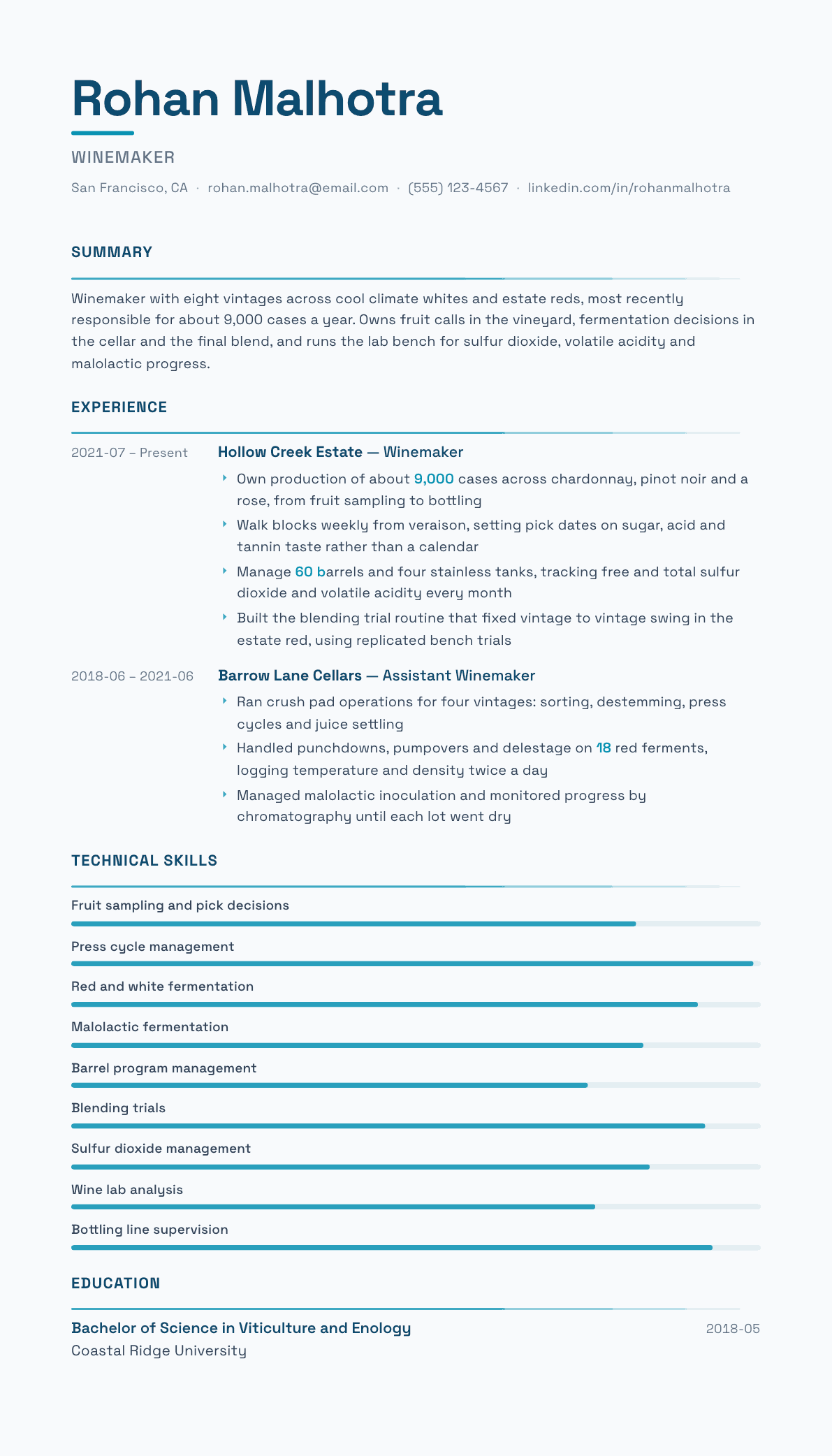
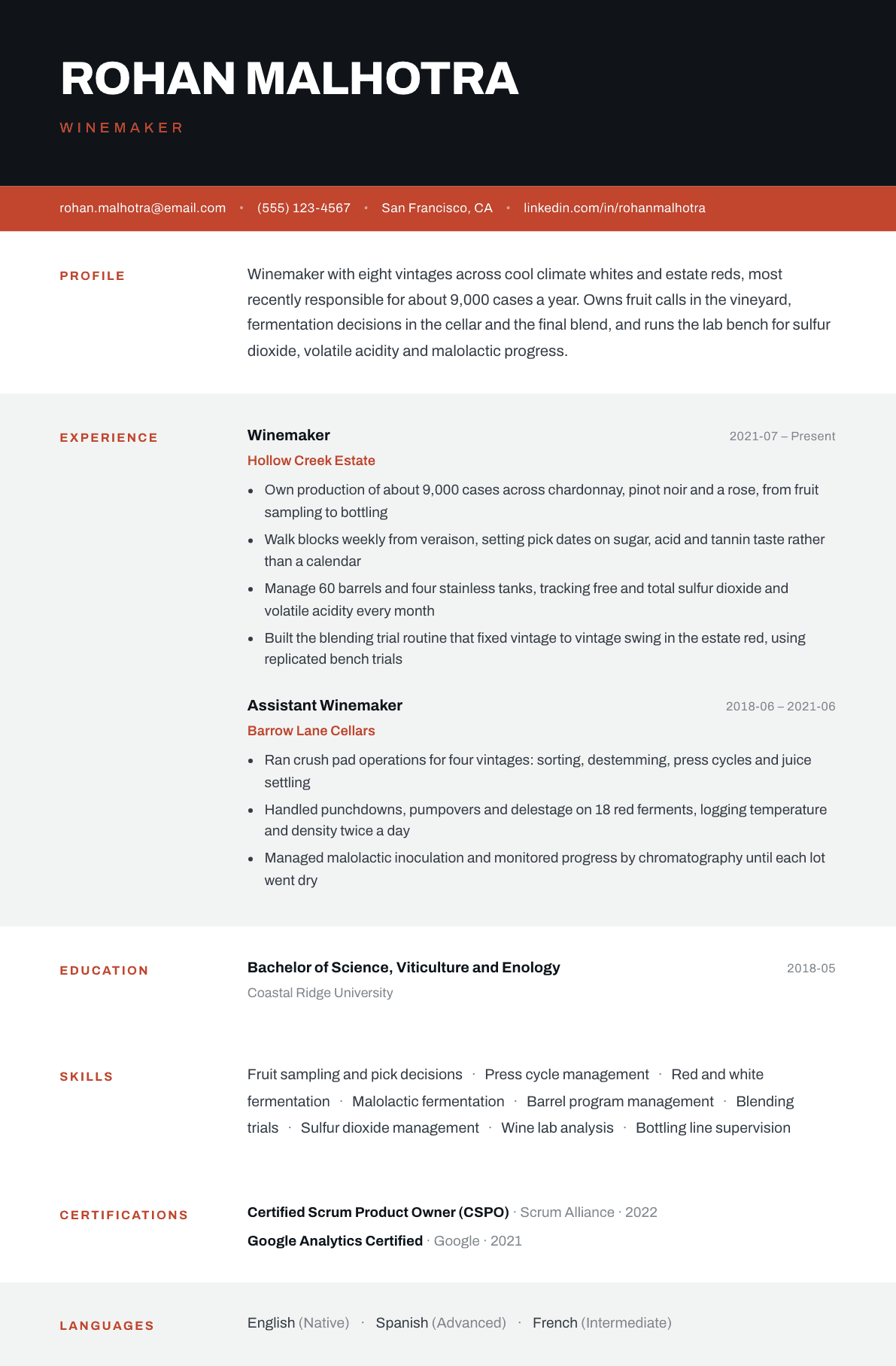
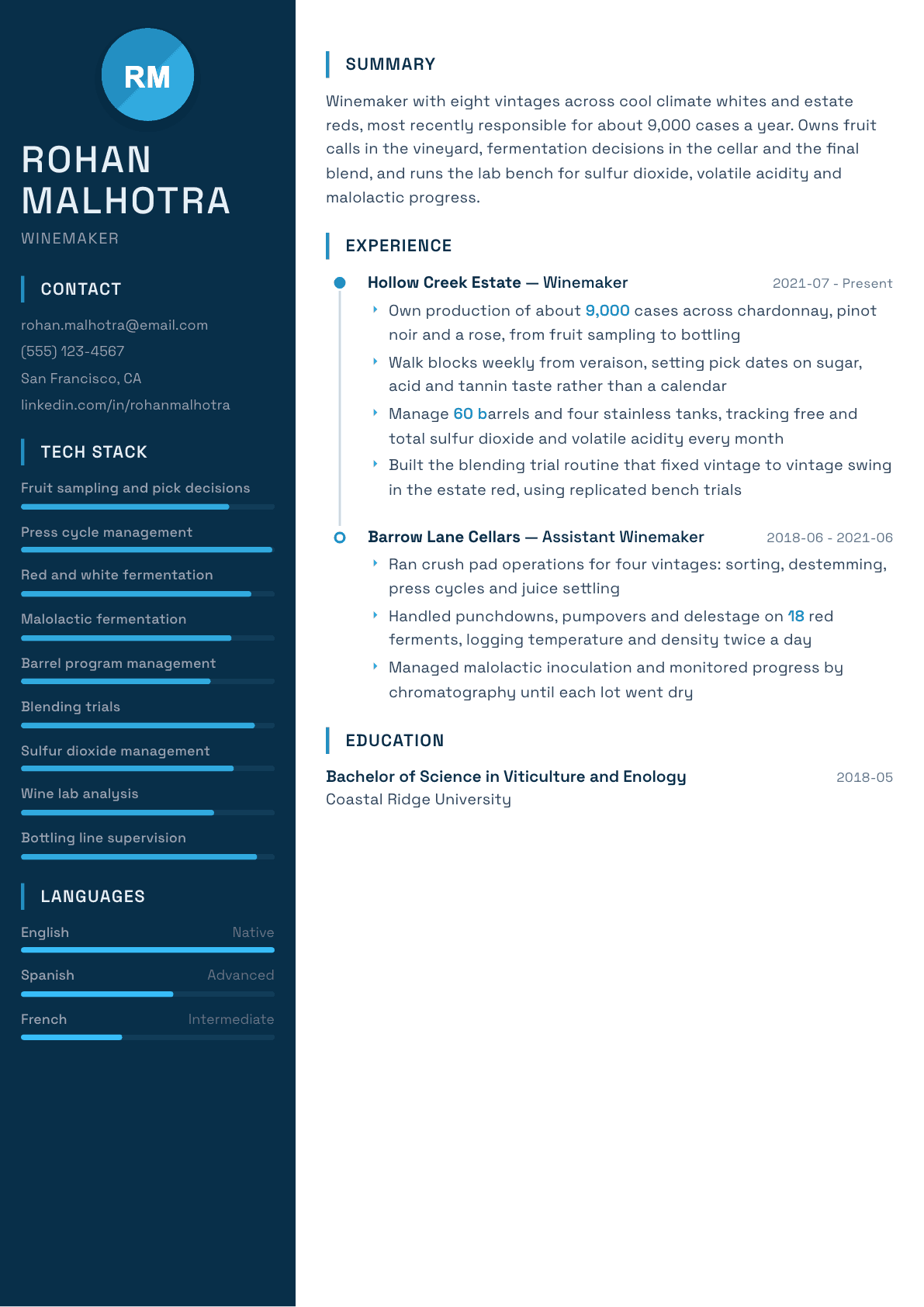
Example Winemaker summary
Winemaker with eight vintages behind cool climate whites and estate reds, currently responsible for about 9,000 cases a year. Sets pick dates from block walks and bench numbers, manages sixty barrels and four tanks through malolactic and aging, and runs replicated blending trials that hold the house style steady across vintages. Comfortable with lab analysis, compliance records and a small harvest crew.
Skills to list on a Winemaker resume
- Fruit sampling and maturity assessment
- Crush pad and press operation
- White juice settling and clarification
- Red cap management
- Temperature controlled fermentation
- Yeast and nutrient selection
- Malolactic fermentation
- Barrel selection and topping
- Racking and lees management
- Fining and stability trials
- Blending and bench trials
- Sulfur dioxide and volatile acidity control
- Cross flow filtration
- Bottling line supervision
- Cellar records and compliance reporting
What actually gets this resume read
- Count your vintages rather than your years, because a winery reads vintages as the unit of real experience.
- Give annual case production and the varieties, since a boutique cellar and a regional winery need different hands.
- Separate vineyard involvement from cellar work, and say who made the pick call at your last property.
- Name your vessels: stainless, concrete, amphora, neutral oak and new oak, with the cooper if it matters to the style.
- List the lab tests you run yourself, from free sulfur dioxide and volatile acidity to malolactic chromatography.
- Mention any awards, scores or wholesale placements only where you were the one making the wine.
How to write a winemaker resume
Wineries count experience in vintages, not years. A vintage is a complete cycle: fruit decisions, crush, fermentation, aging, blending and bottling. Someone with six vintages has made six sets of irreversible calls, and that is the number an owner or general manager wants at the top of your page.
The second question is scope. A winemaker at a small estate touches the vineyard, the cellar, the lab and often the tasting room, while a winemaker at a larger house may only own fermentation and blending. Neither is better, but they are different jobs, and a resume that leaves the scope vague gets filtered out by both.
What follows is how to shape a winemaker resume around vintages, fruit, vessels and blending, with summaries for an assistant, an established winemaker and someone running a whole production program, plus the questions that come up when moving regions or styles.
Format: vintages first, then volume, region and style
One page for most winemakers, two once you have run production at several properties. Under your name, give the vintage count, the annual case volume you have been responsible for, the regions and the varieties. Those four facts place you instantly for anyone in the trade.
Then structure the page by responsibility rather than by task. Vineyard involvement, cellar production, laboratory and quality, and blending and bottling make four clear blocks. An owner reading quickly can then see where your ownership ends and where the previous winemaker's began.
- Opening line for a winemaker: vintages completed, annual cases, regions worked and the varieties you have made at production scale.
- Four responsibility blocks: vineyard and fruit, cellar and fermentation, lab and quality, blending and bottling.
- Each property entry names the production size, the vessel inventory and how many cellar staff you directed at harvest.
- Add a line on harvest work abroad if you have done it, since a second hemisphere vintage doubles your practice per calendar year.
Summary: vintages, cases, style and the decision you own
Three lines. Vintage count and where, annual case production, the varieties and style direction, then the decision that is yours. In most cellars that decision is the pick date, the fermentation regime or the final blend, and stating which one signals your real level more clearly than a job title does.
If you work closely with the vineyard, say it here. Wineries with estate fruit want a winemaker who walks blocks and argues with the vineyard manager, and that is a different candidate from one who receives fruit at the pad and starts there.
Fruit and fermentation: the decisions that cannot be undone
Write the fruit section as a set of judgments. Sampling rhythm from veraison, what you measure and what you taste, how you weigh sugar against acid and tannin ripeness, how you handle a forecast that threatens the pick. This is where a winemaker either has a philosophy or has been following a calendar.
Fermentation bullets should name the vessel, the regime and the reason. Whole cluster share, cold soak length, yeast selection or native ferments, cap management by punchdown, pumpover or delestage, temperature ceilings, and how you decide to press. Give the ferment count so the reader can judge how much of this you have done.
Malolactic fermentation, aging and topping deserve their own lines: barrel program by cooper and toast, neutral to new ratio, concrete or amphora if you use them, lees decisions and the racking schedule you keep.
- Fruit bullet: sampling cadence, the measures you take and who makes the pick call.
- Ferment bullet: number of lots, vessel types, cap management method and press decisions.
- Aging bullet: barrel count, cooper and toast choices, neutral to new ratio and topping routine.
- Blending bullet: trial method, replication and how you resolve disagreement about the final wine.
Laboratory, stability and compliance
Say which analyses you run yourself. Free and total sulfur dioxide, titratable acidity, pH, volatile acidity, residual sugar, malolactic progress by chromatography or enzymatic assay, and protein and cold stability trials all belong on the page. A small winery is buying a winemaker who does not need to send everything out.
Compliance is unglamorous and worth a line. Federal and state reporting, bond records, harvest weight tags, label approvals and export documentation take real time in a small cellar, and an owner who has been burned by a late filing will notice that you mentioned it.
Skills, keywords and the honest bits
Postings reuse a stable vocabulary: crush pad, destemmer, press cycle, cold soak, punchdown, pumpover, delestage, malolactic, racking, fining, bench trial, cold stability, cross flow, bottling line and cellar records. Use the words the posting uses once in the skills block and once in a bullet where the work is visible.
Be honest about scale and equipment. A winemaker who has only worked with small open top fermenters should not imply comfort with rotary fermenters or a high capacity press. Owners find out in the first harvest, and the reputation cost in a small trade is worse than the missed interview.
Winemaker resume summary examples
Two vintages, harvest intern
Viticulture and enology graduate with two northern and one southern hemisphere harvest, working crush pad, punchdowns and barrel work. Runs sulfur dioxide, titratable acidity and pH at the bench and logs ferment curves daily. Seeking a full time cellar hand or harvest enologist role.
Eight vintages
Winemaker with eight vintages across cool climate whites and estate reds, responsible for about 9K cases a year. Walks blocks weekly from veraison and owns the pick call, manages sixty barrels and four tanks through malolactic and aging, and runs replicated bench trials for the final blends.
Director of winemaking
Director of winemaking with eighteen vintages across two regions, overseeing production of about 45K cases and a cellar team of nine at harvest. Sets the fruit contracts, the fermentation program and the barrel budget, and rebuilt the house red blend into a wine that now holds steady across vintages.
Work experience bullets: before and after
Before: Made wine at the winery each vintage.
After: Produced about 9K cases a year across chardonnay, pinot noir and a rose, owning every decision from fruit sampling through bottling.
Volume, varieties and the span of ownership are what an owner sorts applications on.
Before: Decided when the grapes were ready to pick.
After: Walked blocks weekly from veraison and set pick dates on sugar, acid and tannin taste together rather than on a target number alone.
It describes a method for the hardest call in the job instead of asserting that you make it.
Before: Managed the barrels in the cellar.
After: Managed 60 barrels and four stainless tanks through malolactic and aging, tracking free and total sulfur dioxide and volatile acidity monthly on every lot.
A vessel count with a monitoring cadence proves an aging program rather than storage.
Before: Worked on blending the wines.
After: Built a replicated bench trial routine for the estate red that removed most of the vintage to vintage swing buyers had complained about.
Naming the problem and the method shows blending as a discipline, not a tasting session.
Before: Ran the crush pad during harvest.
After: Ran crush pad operations for four vintages across sorting, destemming, press cycles and juice settling, directing a seasonal crew of eleven at peak.
Vintage count plus crew size tells a general manager whether you can hold harvest logistics.
Hard skills
- Fruit sampling and maturity assessment
- Pick date decisions and harvest scheduling
- Crush pad, destemmer and press operation
- White juice settling and clarification
- Cold soak and cap management
- Native and inoculated fermentation
- Malolactic fermentation and monitoring
- Barrel selection, topping and racking
- Fining, filtration and stability trials
- Replicated blending bench trials
- Sulfur dioxide and volatile acidity control
- Cross flow filtration and bottling
- Cellar records and regulatory reporting
- Harvest crew supervision
Soft skills
- Holding a pick decision against commercial pressure
- Tasting with the same standard in year one and year ten
- Directing a tired crew at three in the morning
- Arguing productively with a vineyard manager
- Explaining a wine to a buyer without jargon
Certifications worth listing
- Certified Specialist of Wine (Society of Wine Educators)
- WSET Level 3 Award in Wines (Wine and Spirit Education Trust)
- ServSafe Food Handler (National Restaurant Association)
Mistakes that cost winemaker candidates the interview
- Counting years instead of vintages, which hides how many complete cycles you have actually run.
- Leaving out annual case volume, so an owner cannot tell a garage project from a commercial cellar.
- Being vague about who made the pick call and who signed off on the final blend.
- Listing scores and medals for wines that were made before you arrived at the property.
- Skipping the laboratory work, which is exactly what a small winery cannot afford to outsource.
- Ignoring compliance and cellar records even though they consume real hours every month.
Winemaker resume questions
How many vintages do I need to be called a winemaker?
There is no fixed threshold, but most properties expect several vintages of cellar responsibility before handing over production. What matters more is whether you have owned decisions rather than executed them, so describe your scope precisely at each property.
Do harvest internships abroad count?
Yes, and they are one of the best ways to build vintages quickly. A southern hemisphere harvest gives you a second full cycle in the same calendar year. List the property, the region, the varieties and what you were responsible for rather than just the country.
How do I change region or style?
Lead with the transferable craft: fermentation control, lab analysis, blending method and cellar management move anywhere. Then name what you would be learning, such as a new variety, a different acid profile or an unfamiliar regulatory framework, because candor reads as competence here.
Should I list the wines I have made?
A short list of programs helps, with the variety, the style and your role in each. Avoid claiming credit for wines released in your first months at a property, since those were made by whoever was there before you and the trade tends to know.
What does an assistant winemaker resume need that a cellar hand resume does not?
Evidence of judgment rather than execution. An assistant is expected to run a fermentation schedule, catch a problem lot, manage a crew during crush and speak sensibly about blending. Show at least one decision at each of those levels that was genuinely yours.
Related resume examples
- Brewer Resume example
- Food Scientist Resume example
- Horticulturist Resume example
- Quality Control Technician Resume example
- Production Manager Resume example
- Wastewater Treatment Operator Resume example