Manufacturing Supervisor Resume Examples: free ATS score
Craft a Manufacturing Supervisor Resume That Drives Results
By Mustafa Tarabya, founder of CVBooster · Published · Updated
Create a manufacturing supervisor resume that highlights your production leadership, safety record, and continuous improvement expertise.
Sample resumes for a manufacturing supervisor
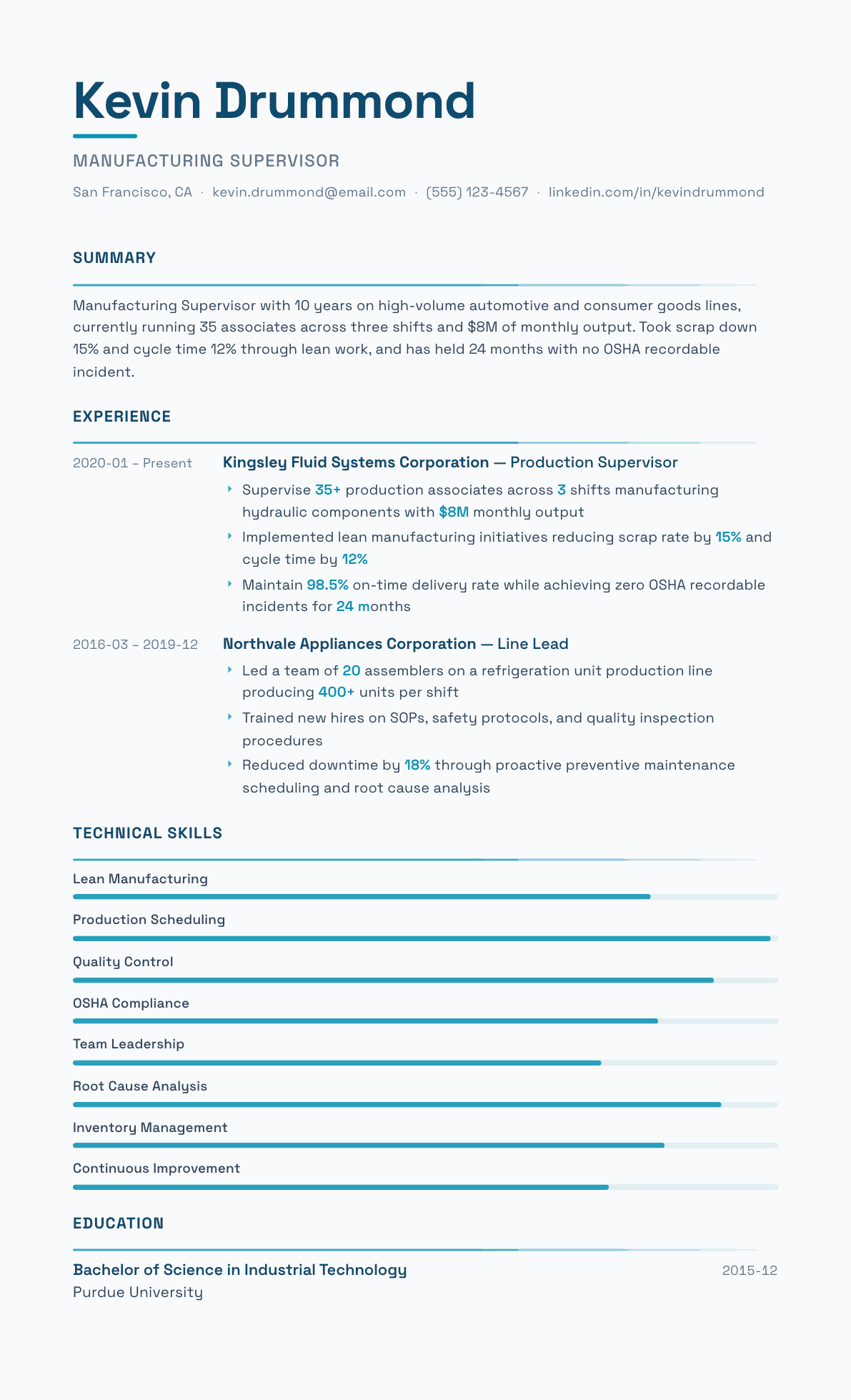
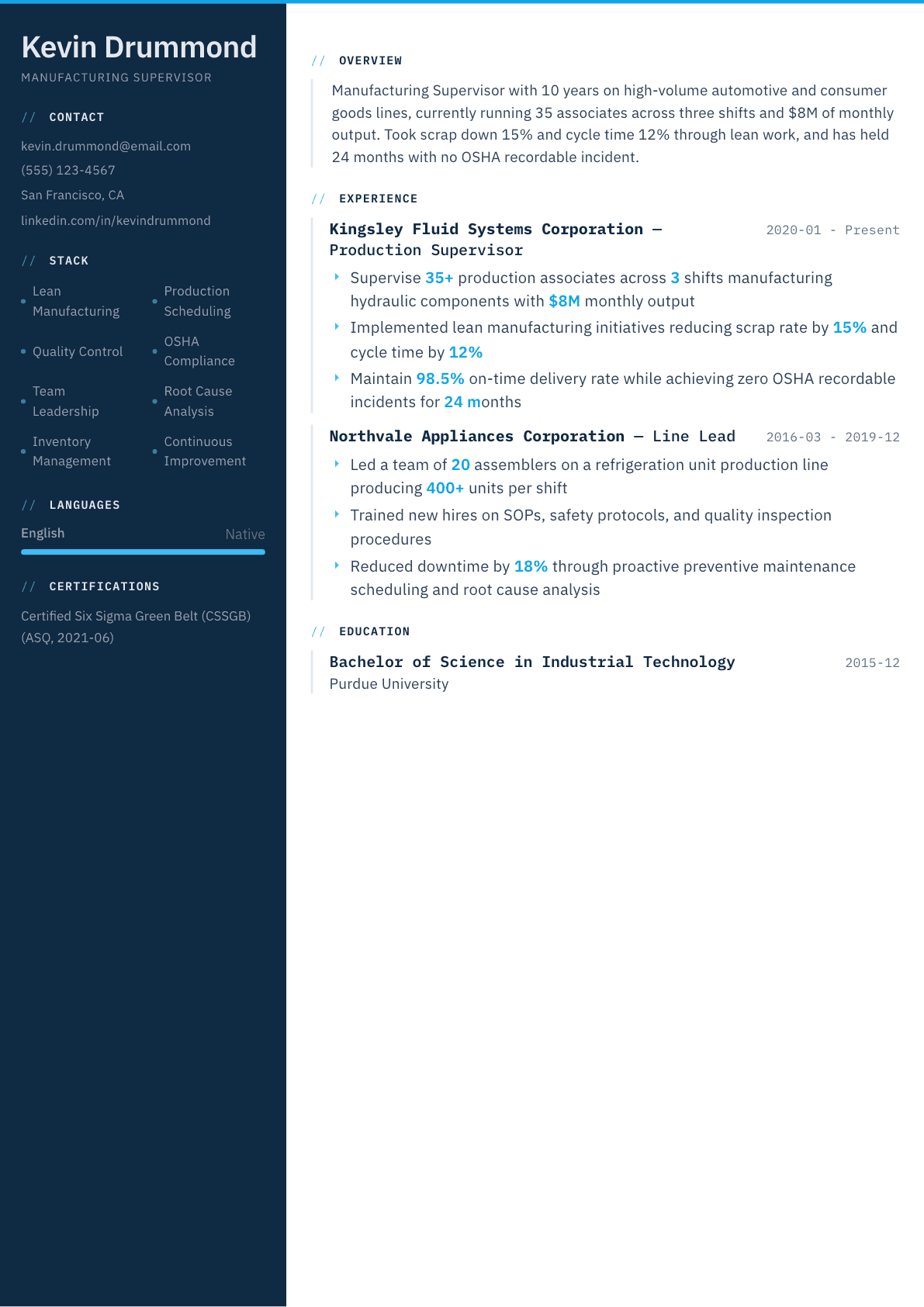
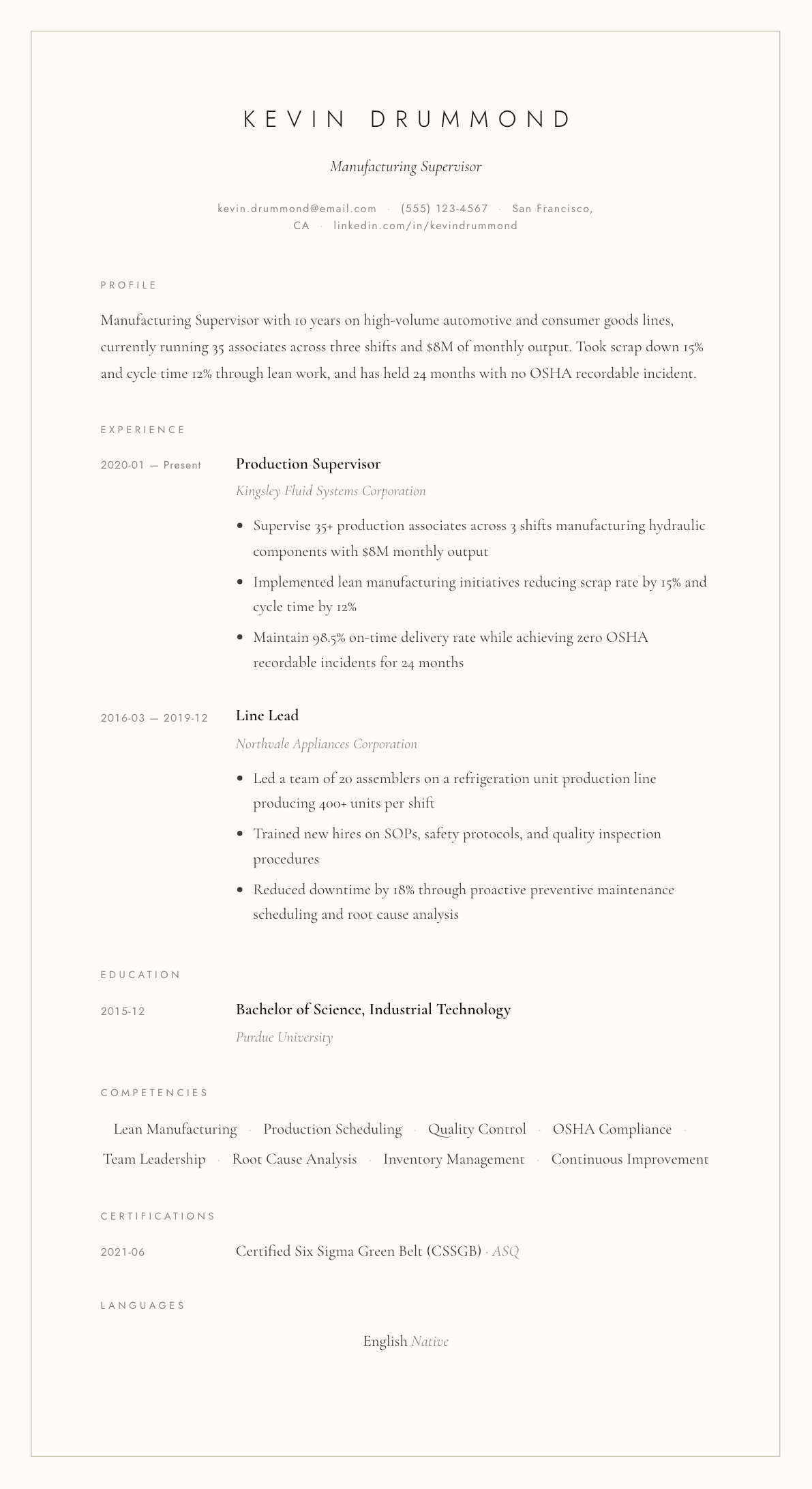
The same manufacturing supervisor content laid out in three CVBooster templates, so you can see what the finished document looks like before you write a word.
Example Manufacturing Supervisor summary
Production supervisor, 10 years, 35 associates over three shifts on hydraulic component lines at 98.5% on-time delivery. Runs the daily board, the preventive maintenance schedule and the training matrix, and holds a Six Sigma Green Belt used on the scrap and downtime projects.
Skills to list on a Manufacturing Supervisor resume
- Lean Manufacturing
- Production Planning
- Quality Assurance
- OSHA Safety Compliance
- Team Supervision
- Six Sigma
- Root Cause Analysis
- Preventive Maintenance
- Inventory Control
- Continuous Improvement
What actually gets this resume read
- Quantify production output: units per shift, monthly revenue, and on-time delivery rates.
- Highlight safety achievements with specific metrics like OSHA recordable incident rates.
- Showcase lean or Six Sigma projects with measurable efficiency or cost improvements.
- Include team size and shift coverage to demonstrate leadership scope.
How to write a manufacturing supervisor resume
A manufacturing supervisor resume is read by a plant manager who has one question in front of everything else: can this person hold a shift. Headcount supervised, shift pattern, the process being run, the output the line has to make and the safety record are the five facts she needs, and they should be visible without scrolling.
The second read is about the floor itself. Discrete assembly, injection molding, machining, food processing under federal inspection, pharmaceutical work under good manufacturing practice, and welded fabrication are different worlds with different failure modes. A supervisor who has run a regulated food line knows sanitation validation and allergen changeovers. One from automotive assembly knows takt time, andon response and layered process audits. Name the world you come from.
This guide covers the layout plant managers read, three summaries from lead to shift superintendent, before-and-after bullets built on output, scrap and safety, and the questions supervisors ask when moving between industries.
Format: a scope line under every job title
Reverse chronological, one page under ten years, two after that. The important structural move is a scope line directly under each job title: plant type, product, shift, headcount supervised, lines or cells owned, and output per shift. A plant manager can then compare you against her own floor in one glance.
Keep it single column and plain. Manufacturing employers run older applicant tracking systems, and a graphical layout that hides the headcount is worse than a plain one that shows it.
- Header: name, city and state, phone, email, and any certification such as a green belt or a safety credential.
- Order: summary, core competencies, experience with a scope line under each title, certifications, education.
- Working supervisors moving up from lead should keep the machine and process list, because it proves technical credibility.
Summary: process, headcount, shift, and the number you moved
Three sentences. Name the process and product, the size of the crew and the shift pattern, and one measurable result. Manufacturing rewards specificity more than almost any other field because every plant tracks the same handful of numbers, so a supervisor who cites scrap, downtime, throughput or recordable incidents is speaking the reader's language immediately.
Avoid the word results-driven and every relative of it. A plant manager reading twenty resumes for a night shift opening skips those sentences and looks for the crew size.
Experience: the metrics every plant tracks
Write bullets against the numbers on the plant scoreboard. Output per shift against the standard, overall equipment effectiveness, scrap and rework rate, first pass yield, unplanned downtime, changeover time, on time delivery, and labor efficiency against the standard hours. Give a before and after where you have it.
Safety belongs high, not last. Recordable incident rate, days without a lost time incident, near miss reporting rate, lockout and tagout audit compliance, and machine guarding projects are the bullets that make an employment offer easier for the plant manager to defend.
Then the people work, because that is most of the job. Crew size, absenteeism and turnover on your shift, cross training matrices you built, corrective action and coaching you handled, and whether you worked under a collective bargaining agreement, which changes the disciplinary process entirely.
Continuous improvement: name the method and the result
Lean and Six Sigma language is everywhere on manufacturing resumes and mostly unearned. Make yours earned by naming the tool and the outcome together: a kaizen event on a changeover that removed setup minutes, a five S rollout on a cell with an audit score behind it, standard work written for an operation, a value stream map that redirected a bottleneck, or a root cause analysis that closed a repeat defect.
The same applies to maintenance. Preventive maintenance schedule compliance, autonomous maintenance by operators, and spare parts availability are supervisor-controllable and directly visible in downtime numbers.
Systems, compliance and the keyword block
Name the systems: the enterprise resource planning package such as SAP or Oracle, the manufacturing execution system, the computerized maintenance management system, and the quality system you record nonconformances in. Then the compliance regime: occupational safety standards, the quality standard the plant is certified to, and any food or pharmaceutical requirement that governs the line.
Postings for a manufacturing supervisor reuse a narrow vocabulary: production scheduling, throughput, scrap reduction, root cause analysis, corrective action, standard work, cross training, safety compliance, preventive maintenance. Use each once where you can prove it.
Manufacturing Supervisor resume summary examples
Lead moving into supervision
Production lead with 4 years on a consumer goods assembly line, running a cell of 12 operators on nights and covering the shift supervisor during absences. Trained 9 new hires against standard work, led a 5S rollout on the packaging cell, and holds a Six Sigma yellow belt.
Shift supervisor
Manufacturing supervisor with 7 years running an injection molding department, supervising 22 operators and 3 setup technicians across 2 shifts. Cut scrap from 6.1% to 3.4% through mold changeover standard work and held zero recordable injuries across 18 consecutive months.
Shift superintendent
Shift superintendent with 14 years in automotive and hydraulic component manufacturing, overseeing 35 production associates and 4 line leads across 3 shifts. Owns the shift scoreboard for output, scrap, downtime and safety, and led the layered process audit rollout across 6 cells.
Work experience bullets: before and after
Before: Supervised production employees on the manufacturing floor.
After: Supervised 35 production associates and 4 line leads across 3 shifts on a hydraulic component line running to a fixed daily build schedule.
Headcount, structure, product and schedule are what a plant manager compares against her own floor.
Before: Reduced scrap on the line.
After: Cut scrap from 6.1% to 3.4% by rewriting mold changeover standard work and adding a first-piece inspection gate before the run released.
A before and after with the mechanism explains how the number moved, which is the difference between a claim and a method.
Before: Maintained a good safety record.
After: Held zero recordable injuries across 18 consecutive months while raising near miss reporting and closing all lockout and tagout audit findings within the shift.
Leading and lagging safety indicators together show a supervisor who manages safety rather than one who got lucky.
Before: Reduced machine downtime.
After: Brought unplanned downtime down by 18% by moving preventive maintenance into the shift handover window and putting daily autonomous checks on the operator standard work.
Naming the schedule change makes the improvement repeatable and therefore credible.
Before: Trained new employees on the line.
After: Built a cross training matrix covering 6 stations and qualified 9 operators on at least 3 each, which removed overtime coverage on the two hardest positions.
The matrix and the overtime result turn training into a staffing outcome a plant manager values.
Hard skills
- Production scheduling
- Lean manufacturing and kaizen
- Standard work and 5S
- Root cause analysis and corrective action
- Scrap and yield improvement
- Overall equipment effectiveness tracking
- Preventive maintenance coordination
- Occupational safety compliance
- Lockout and tagout procedures
- Cross training matrices
- ERP and manufacturing execution systems
- Changeover and setup reduction
Soft skills
- Shift handover discipline
- Coaching and corrective conversations
- Working within a collective bargaining agreement
- Escalation to maintenance and quality
- Holding a crew through a schedule change
- Written shift reporting
Certifications worth listing
- Certified Production Technician (CPT) (Manufacturing Skill Standards Council)
- Certified Six Sigma Green Belt (CSSGB) (American Society for Quality)
- Certified Manager of Quality/Organizational Excellence (CMQ/OE) (American Society for Quality)
- OSHA 30-Hour General Industry Card (OSHA Training Institute)
- Certified in Planning and Inventory Management (CPIM) (Association for Supply Chain Management)
Mistakes that cost manufacturing supervisor candidates the interview
- Leaving out headcount supervised and shift pattern, which are the first two facts a plant manager looks for.
- Claiming lean or Six Sigma experience without naming a single event, tool or result behind it.
- Putting safety in the last bullet of the last job, when it is often the reason the position is open.
- Describing the product without describing the process, so a reader cannot tell molding from machining from assembly.
- Writing improved efficiency with no baseline, which reads as a guess rather than a measurement.
- Omitting whether the plant is union, which changes how a supervisor handles attendance, discipline and overtime assignment.
Manufacturing Supervisor resume questions
What numbers should a manufacturing supervisor put on a resume?
Headcount supervised, output per shift against the standard, scrap and first pass yield, unplanned downtime, changeover time, on time delivery and the recordable incident rate. Give a baseline and a result rather than a single figure floating alone.
How do I move from operator or lead into a supervisor role?
Show the supervisory work you already do: covering the shift, running a cell, training new hires, holding the handover, running a five S or kaizen event. Then keep the machine and process list, because technical credibility is what earns a crew's respect.
Does industry experience have to match the posting?
It helps, because regulated food and pharmaceutical lines carry sanitation and documentation requirements that discrete assembly does not. When the industries differ, lead with the process similarity, the metrics you managed and the compliance systems you worked under.
Should I list a Six Sigma belt on a supervisor resume?
List it if you hold it from a recognized body, and attach a project to it. A belt with no named project reads as a training certificate, while a belt with a defect reduction and a documented method reads as a capability the plant can use.
How do I show safety leadership without an incident-free record?
Use leading indicators instead. Near miss reporting rate, safety observation counts, audit findings closed within the shift, machine guarding projects completed and toolbox talk participation all show active safety management even in a year where an injury occurred.
Related resume examples
- Quality Assurance Inspector Resume example
- Warehouse Manager Resume example
- Operations Manager Resume example
- Production Lead Resume example
- Brewer Resume example
- Winemaker Resume example