Generator Technician Resume Examples: what gets the call
Write a Generator Technician Resume Around Standby Power That Starts
By Mustafa Tarabya, founder of CVBooster · Published · Updated
Generator technician resume example with standby power, transfer switch and load bank keywords, plus a guide to writing service history and controls skills.
Sample resumes for a generator technician
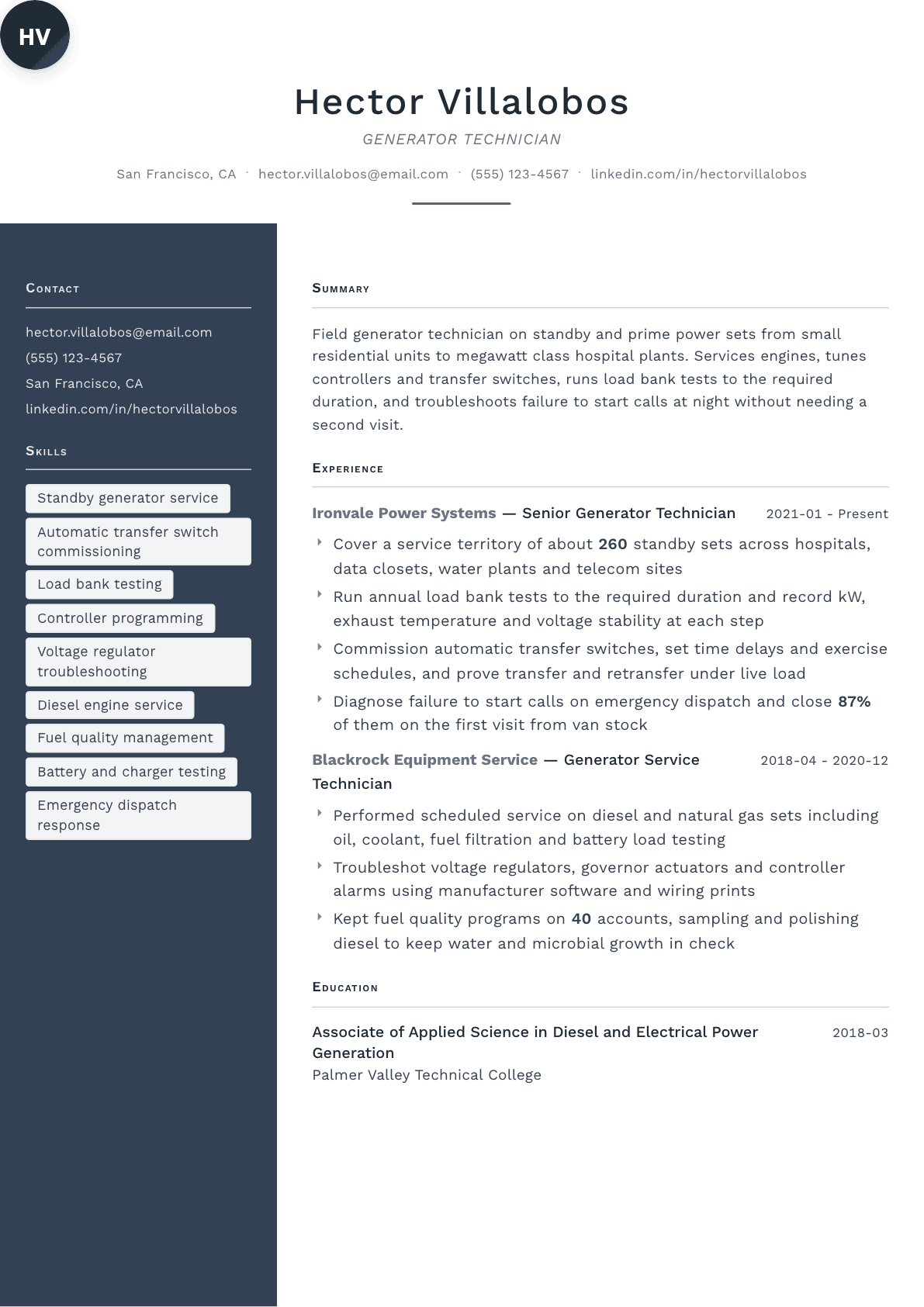
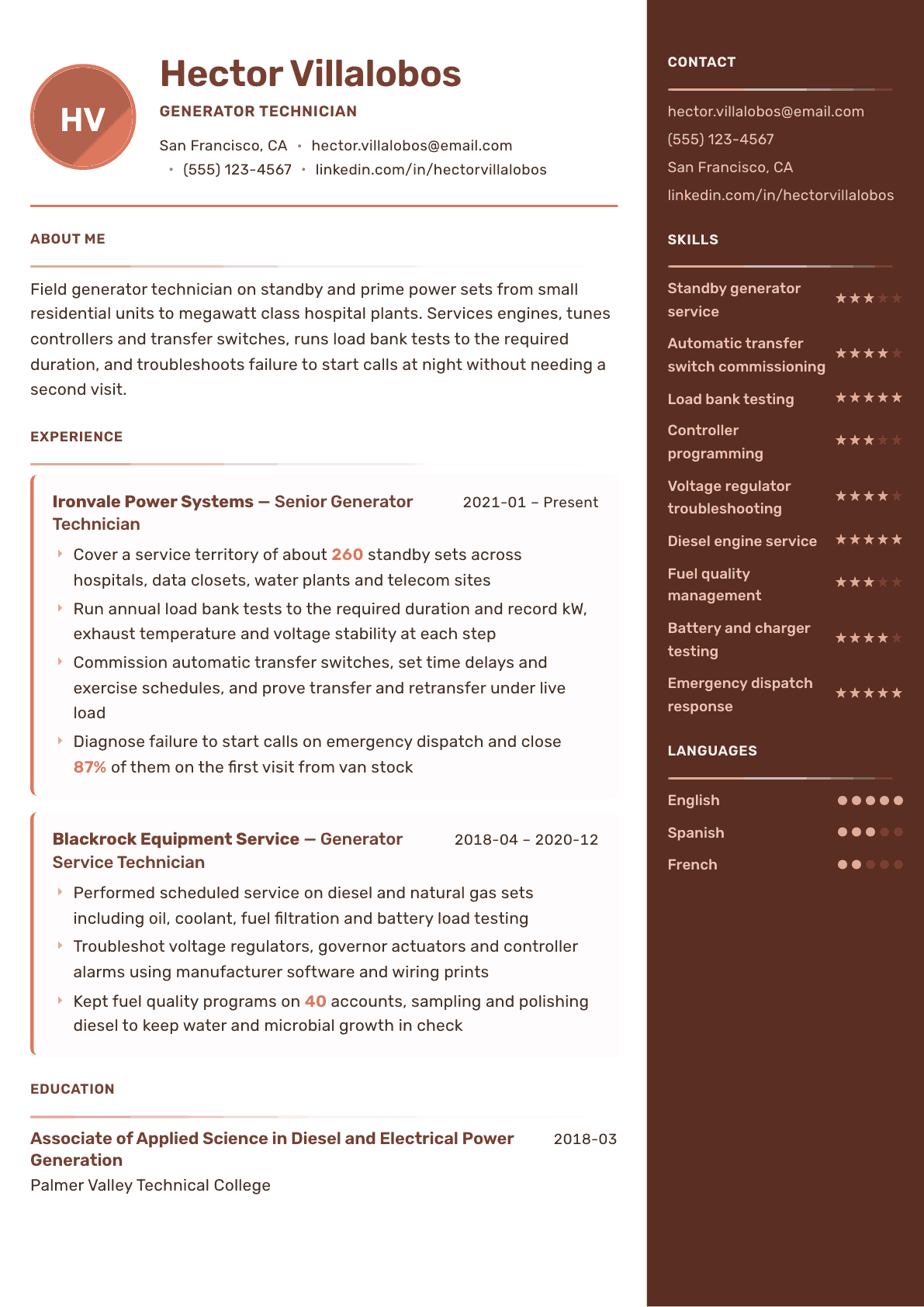
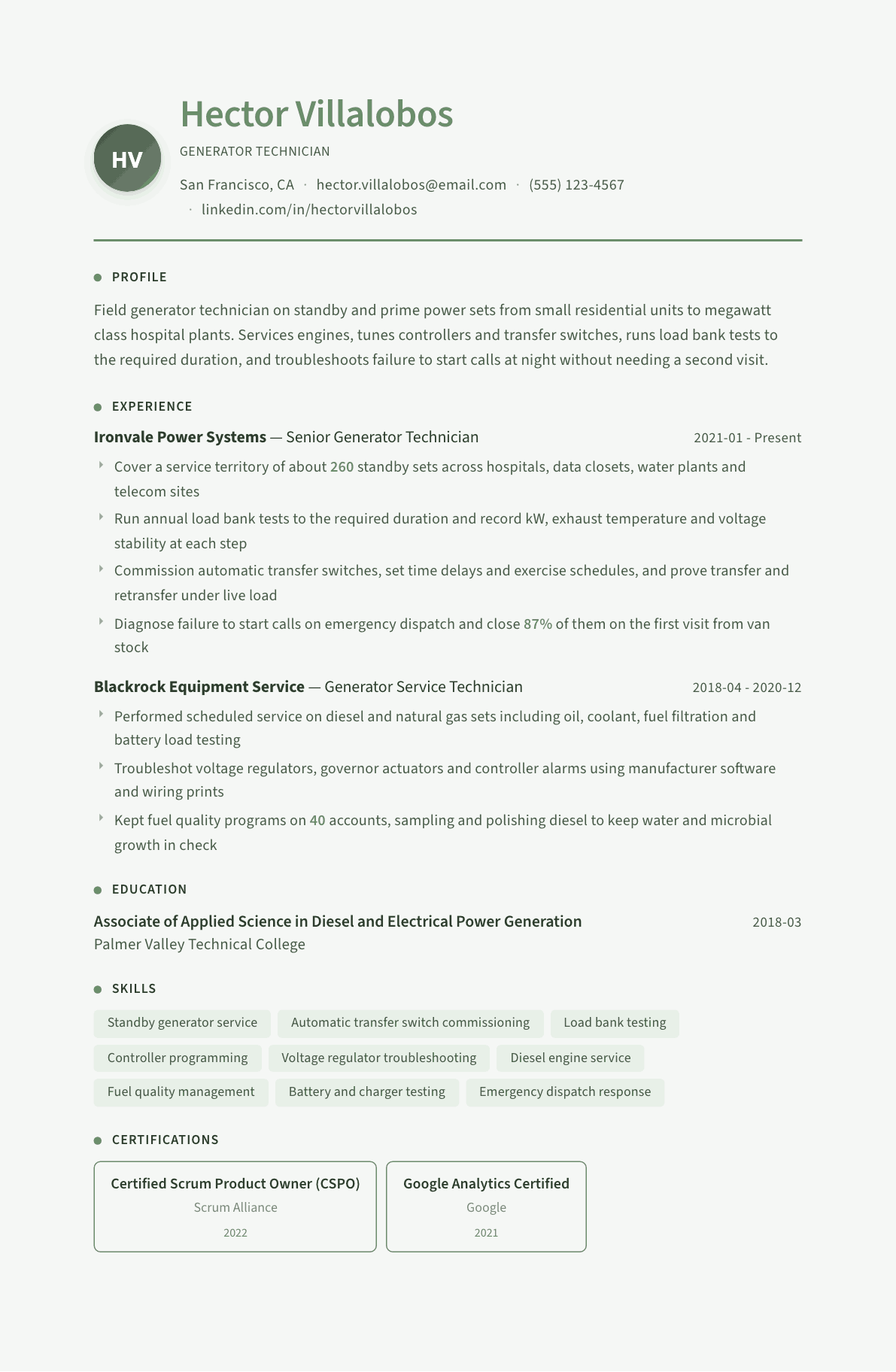
The same generator technician content laid out in three CVBooster templates, so you can see what the finished document looks like before you write a word.
Example Generator Technician summary
Generator technician with seven years on standby and prime power across hospitals, water plants and telecom sites, covering sets from small units to megawatt class plants. Commissions transfer switches, programs controllers, runs load bank tests to required duration and records readings at each step, and closes most emergency failure to start calls on the first visit. Maintains fuel quality programs and keeps battery and charger records that hold up in an inspection.
Skills to list on a Generator Technician resume
- Standby and prime power sets
- Diesel engine maintenance
- Natural gas and propane engines
- Automatic transfer switch service
- Generator controller programming
- Automatic voltage regulator setup
- Governor and actuator tuning
- Load bank testing procedure
- Paralleling switchgear basics
- Battery bank and charger testing
- Fuel polishing and sampling
- Cooling system and block heater service
- Exhaust and aftertreatment checks
- Wiring print troubleshooting
- Emergency call response
What actually gets this resume read
- State the size range you have worked in kW, because a technician on small home sets is not a hospital plant hire.
- Name the controllers and transfer switches you can program, since controls are where most service calls actually end.
- Show your first visit fix rate on emergency calls, which is the number a service manager watches every month.
- Put load bank testing on the page with the durations and the readings you record at each load step.
- Say which fuel types you service, diesel, natural gas and propane, and whether you handle paralleling switchgear.
- Include your driving record, on call rotation availability and any electrical safety training you have completed.
How to write a generator technician resume
Standby power is a promise that only gets tested when everything else has already failed. That is the frame a service manager uses when reading generator technician resumes. She is not hiring someone to change oil on engines. She is hiring the person who will be woken at two in the morning because a hospital transferred to emergency power and the set did not pick up the load.
This shapes what belongs on the page. Size range matters because a residential air cooled unit and a megawatt class plant with paralleling switchgear are different trades wearing the same title. Controls matter because most failures are electrical rather than mechanical. First visit fix rate matters because a second truck roll on an emergency call is the most expensive thing the branch does.
What follows is how to lay out a generator technician resume, how to write engine, controls and transfer switch work so a service manager can price you, how to describe load bank testing properly, three summaries by level, before and after bullets, and the questions technicians ask when moving between engine work and power generation.
Format: size range, fuel types, controls, then history
One page, reverse chronological, with a capability block above the job history. The block answers the four questions a service manager has before she reads anything else: what size sets you work on, which fuels, which controllers you can program, and which transfer switches you can commission. Everything else can wait until those are answered.
In the history itself, name the customer types. Hospitals, water treatment plants, data closets, telecom sites, correctional facilities and commercial buildings all have different testing regimes, access rules and tolerance for downtime. A branch serving critical facilities looks for that word before it looks at anything technical.
- Size line: the kW range you service, stated honestly, and whether you have worked paralleled sets.
- Fuel line: diesel, natural gas, propane, bi fuel, and any fuel storage and polishing work you have done.
- Controls line: the generator controllers and transfer switch families you can program and commission.
- Response line: on call rotation experience, travel radius, driving record and license class for the service truck.
Summary: size range, customers, testing, first visit fix rate
Four lines. Give the size range and fuel types, the customer types you have served, the testing you perform, and your first visit fix rate on emergency calls. That last number carries more weight than anything else on the page, because it directly predicts the cost of putting you on call.
Say what you carry on the truck. A technician who stocks common controllers, sensors, relays, belts, filters and battery gear closes calls that another technician has to return for. That habit is worth stating because it is the practical explanation behind a good fix rate.
Experience: territory, testing, and the call you closed at night
Give the territory in units serviced and the customer mix for every field role. Then separate the routine work from the emergency work, because they are graded differently. Scheduled service is judged on completeness and documentation. Emergency work is judged on how many calls end without a return trip.
Load bank testing deserves a full bullet. Describe the procedure honestly: connecting the bank, stepping the load, holding each step, and recording kW, voltage stability, exhaust temperature and coolant behavior at every step. A technician who records data at each step and interprets it is doing engineering work. One who runs the set and signs the form is not.
Then write one bullet about a difficult diagnosis. A set that cranks and does not start, one that starts and drops on load, one that transfers and then retransfers on its own, or a controller alarm that turned out to be a sensor rather than the fault it reported. That narrative shows the reasoning a service manager cannot test on a resume any other way.
Transfer switches, controls and the electrical half of the job
Many resumes for this role read as diesel mechanic resumes with a generator attached. Correct that by giving the electrical work equal space. Transfer switch commissioning, time delay settings for engine start, transfer, retransfer and cool down, exercise schedules, and proving transfer under live load rather than in test mode are the tasks that separate the trade from engine service.
Controls detail matters just as much. Programming a controller, setting protection parameters, configuring remote annunciation and monitoring, calibrating a voltage regulator and tuning a governor actuator are all named skills, and naming them tells a branch that you can be sent to a controls fault instead of only a mechanical one.
- Say whether you commission transfer switches or only service them after someone else has set them up.
- Name the protection and timing parameters you set, since incorrect delays cause repeat nuisance transfers.
- Mention remote monitoring work, which is increasingly how branches manage large fleets of sets.
- Note any paralleling switchgear exposure, including synchronizing and load sharing, and be honest about the depth.
Documentation, safety and the terms screeners match
Emergency power systems are inspected, and the record is part of the deliverable. Describe what your service reports contain: readings taken, exercise history, battery test results, fuel sample results and any deficiency listed with a recommendation. Facilities that undergo accreditation surveys care enormously about this and will keep the technician whose paperwork survives the review.
Safety on this job is electrical as much as mechanical: working near live switchgear, arc flash boundaries, isolating a set before service and controlling stored energy in batteries and block heaters. State the training you hold and the practice you follow. Screeners look for standby power, transfer switch, load bank, controller, voltage regulator, governor, fuel polishing, emergency power and on call response.
Generator Technician resume summary examples
First field role
Generator technician with 14 months performing scheduled service on diesel and natural gas standby sets, covering oil, coolant, filters, belts and battery load testing. Trained on controller alarms and basic transfer switch operation, and assists on load bank tests. Holds a clean driving record and works an on call rotation.
Five years, field service
Generator technician covering about 260 standby sets across hospitals, water plants and telecom sites, from small units to megawatt class plants. Commissions transfer switches, programs controllers, runs annual load bank tests with readings at each step, and closes 87% of emergency failure to start calls on the first visit.
Senior technician and commissioning lead
Senior generator technician with 12 years across engine service, controls and commissioning, including paralleled sets with load sharing. Leads startup and acceptance testing on new emergency power systems, resolves the calls other technicians return from, and writes the service standards the branch trains new hires on.
Work experience bullets: before and after
Before: Serviced generators for commercial customers.
After: Covered a territory of roughly 260 standby sets across hospitals, water treatment plants, telecom sites and commercial buildings, running scheduled service, annual testing and emergency response on rotation.
Unit count and customer mix show the scale and the criticality a branch is actually staffing for.
Before: Performed load bank testing.
After: Ran annual load bank tests to the required duration, stepping load in stages and recording kW, voltage stability, exhaust temperature and coolant behavior at each step, then flagged sets that could not hold rated load.
Recording and interpreting data at each step is the difference between running a test and performing one.
Before: Worked on automatic transfer switches.
After: Commissioned automatic transfer switches, set engine start, transfer, retransfer and cool down delays, configured exercise schedules, and proved transfer and retransfer under live load rather than in test mode.
Naming the timing parameters and the live load proof shows commissioning rather than routine inspection.
Before: Responded to emergency service calls.
After: Diagnosed failure to start and drop on load calls during night dispatch, closing 87% on the first visit from van stock by tracing the fault through the controller, sensors and starting circuit before ordering parts.
The fix rate plus the diagnostic path is exactly what a service manager uses to decide who goes on call.
Before: Took care of generator fuel systems.
After: Maintained fuel quality programs on 40 accounts, sampling stored diesel for water and microbial growth, polishing when results required it, and documenting each sample so a facility survey had a record to review.
Sampling, action and documentation turn a vague duty into a program an inspected facility can rely on.
Hard skills
- Standby and prime power set service
- Diesel engine maintenance and repair
- Natural gas and propane engine service
- Generator controller programming
- Automatic transfer switch commissioning
- Automatic voltage regulator setup
- Governor and actuator tuning
- Load bank test procedure and data recording
- Paralleling and load sharing basics
- Battery bank and charger testing
- Fuel sampling and polishing
- Cooling system and block heater service
- Starting circuit and sensor diagnosis
- Wiring print and schematic troubleshooting
- Remote monitoring configuration
Soft skills
- Thinking clearly on a night call in a building without power
- Explaining a failed test to a facilities manager who is about to be inspected
- Working near live switchgear without taking shortcuts
- Writing a service report someone else can act on
- Handling on call rotation without letting quality slip
Certifications worth listing
- EGSA Certified Technician (Electrical Generating Systems Association)
- OSHA 30-Hour General Industry (OSHA Outreach Training Program)
- First Aid, CPR and AED (American Red Cross)
- Commercial Driver License Class B (State department of motor vehicles)
Mistakes that cost generator technician candidates the interview
- Writing a diesel engine resume with a generator attached and leaving out controls, transfer switches and testing.
- Giving no size range, which leaves the reader unable to tell a residential unit technician from a plant technician.
- Claiming load bank experience without describing the steps, the duration or the readings recorded.
- Omitting the first visit fix rate, the number that decides whether you go on the emergency rotation.
- Listing controller brands without saying whether you program them or only read the alarm on the display.
- Skipping service report content when the paperwork is half of what a facility under survey is paying for.
Generator Technician resume questions
I come from truck repair. How do I move into generator work?
Keep the engine credibility and add the electrical half deliberately. Show any controls, wiring or transfer switch exposure, name the training you are pursuing, and be direct that the diagnostic side is where you want to grow. Branches hire engine people and teach power, but only when the intent is stated.
How much does size range really matter?
A great deal. Small air cooled residential units, mid range commercial sets and megawatt class plants with paralleling switchgear are staffed by different technicians at different rates. Give your honest range and a branch can place you immediately instead of screening you out for uncertainty.
Should I list manufacturer factory training?
Yes, with the course and the equipment family it covered. Factory training is how this trade signals depth on a specific product line, and a branch with a service contract on that line will move your resume up for it.
What if I have never worked paralleled sets?
Say what you have done and leave the rest out. Overstating switchgear experience is exposed on the first commissioning job. If you have observed synchronizing or supported a paralleling startup, describe it as exactly that and note your interest in the training.
How do I show reliability for on call work?
Give the rotation you have carried, the response time you held and the fix rate on those calls. Add anything about van stock and preparation, because being ready is what makes night calls resolve. Concrete rotation history beats any statement about being dependable.
Related resume examples
- Electrician Resume example
- Maintenance Technician Resume example
- Industrial Maintenance Technician Resume example
- Field Service Technician Resume example
- Elevator Mechanic Resume example
- Building Engineer Resume example