CAD Designer Resume Examples: free ATS score and gap list
Write a CAD Designer Resume That Shows Real Modeling Depth
By Mustafa Tarabya, founder of CVBooster · Published · Updated
CAD designer resume examples, sample bullets, ATS keywords and a writing guide covering SolidWorks, tolerancing and drawing release.
Sample resumes for a cad designer
The same cad designer content laid out in three CVBooster templates, so you can see what the finished document looks like before you write a word.
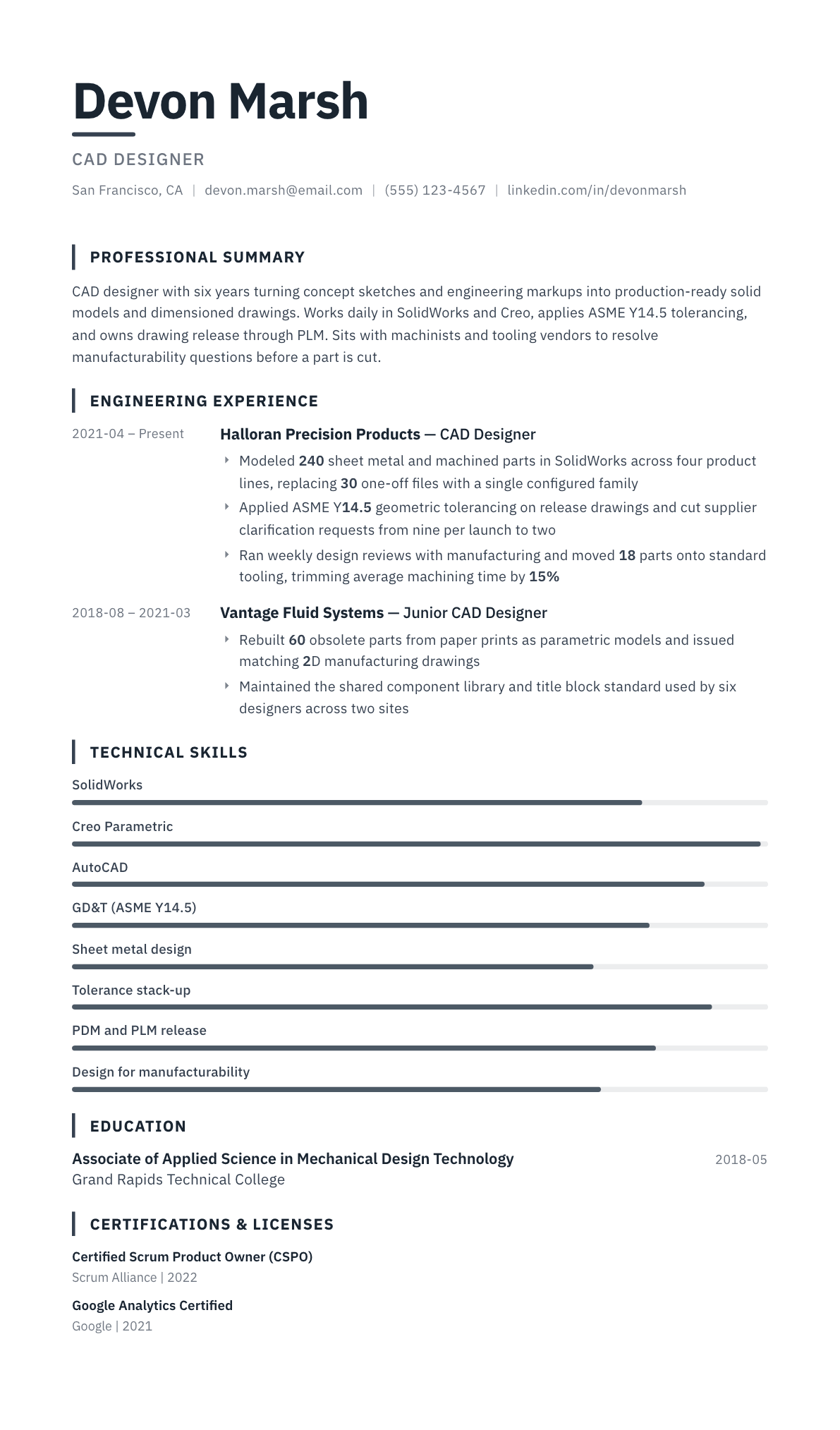
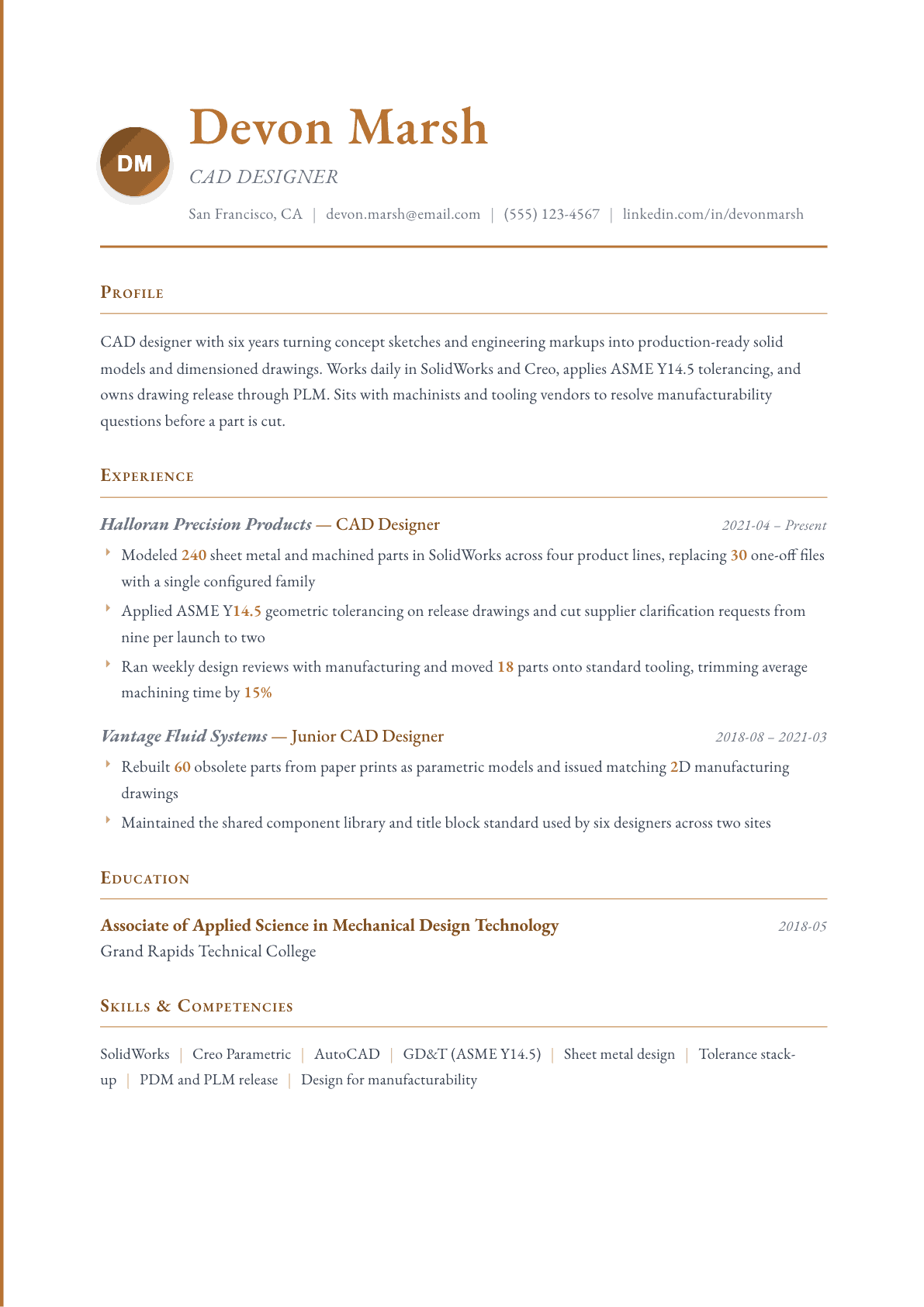
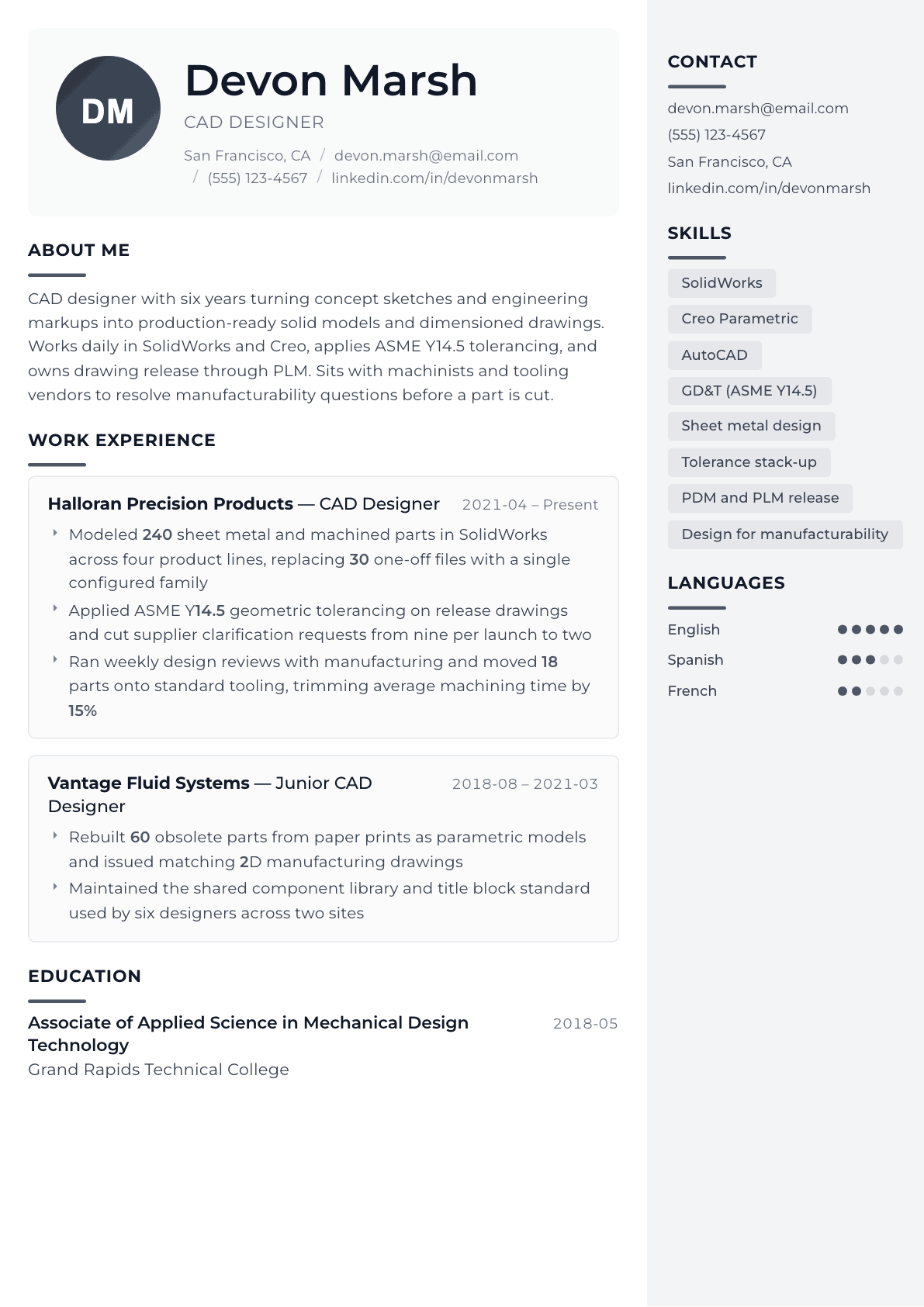
Example CAD Designer summary
CAD designer with six years of parametric modeling for machined and sheet metal assemblies. Fluent in SolidWorks and Creo, releases drawings to ASME Y14.5, and manages revisions through PDM. Reduced supplier questions on new launches by tightening tolerancing practice and standardizing the part library. Looking for a design role in industrial equipment where the drawing set is owned end to end.
Skills to list on a CAD Designer resume
- SolidWorks
- Creo Parametric
- AutoCAD
- Inventor
- CATIA
- GD&T
- Tolerance stack-up analysis
- Sheet metal design
- Weldment design
- Injection molded part design
- Assembly modeling
- Engineering change orders
- SolidWorks PDM
- Technical documentation
- Design for manufacturability
What actually gets this resume read
- Name every CAD package you have modeled in, and say which one you used daily versus occasionally.
- Give the parts you designed a size, a material and a process: machined aluminum housings, welded steel frames, injection molded covers.
- Say who consumed your drawings, whether that was an in-house machine shop, an overseas supplier or a sheet metal fabricator.
- Mention the drawing standard you work to, because ASME Y14.5 and ISO tolerancing are screened for separately.
- Show that you release work rather than only draw it: PDM check-in, revision control and engineering change orders.
- Put one bullet on cost or manufacturability savings, since design managers read CAD resumes looking for judgment.
How to write a cad designer resume
A CAD designer resume is judged on two questions that get asked in the first thirty seconds: what have you modeled, and does anyone build from your drawings. Engineering managers have seen too many resumes that list six software packages and never say whether the applicant designed a bracket or a machine. The resume that moves forward names the parts, the materials, the processes and the standard the drawings were released to.
The screening path is usually short. A recruiter matches the CAD package in the posting, an engineering manager reads the experience section, and a lead designer decides whether you can be handed a project folder without supervision. Each of them is looking for evidence in a different place, so the software has to appear in a skills block, the modeling depth in the bullets, and the release discipline in both.
This guide covers the section order design teams expect, how to write a summary that separates a designer from a drafter, before and after bullets drawn from real design office work, and the questions CAD designers ask when they sit down to rewrite their resume.
Format: one page, software block high, no decorative columns
Use reverse chronological order and keep the whole thing to one page unless you carry more than ten years across several industries. Manufacturers run older applicant tracking systems that mangle two column layouts, and a CAD designer who submits an unreadable file has already answered a question about attention to detail.
Put a compact technical block directly under the summary listing CAD packages, data management systems and the drawing standard you work to. That block is where the parser finds SolidWorks, Creo, Inventor, CATIA, NX or AutoCAD, and where a human confirms the match before reading further.
- Header: name, city and state, phone, email, and the discipline you design in.
- Order: summary, technical skills, experience, education, then certifications and training.
- Skip the objective. A design manager wants to see modeling scope, not intent.
- Save the file as a PDF with a plain name that includes your last name and the role.
Summary: what you model, in what, released to whom
Three lines. Name the product family you design, the modeling environment you live in, the tolerancing standard you apply, and who receives the drawings. A summary that opens with detail oriented and hardworking wastes the only lines a reader gives you unprompted.
The word designer carries an expectation of ownership. If you take an engineer sketch and produce the model, the drawing, the bill of material and the change order, say that in the summary. If your work is closer to detailing to instruction, be accurate about it and let the bullets show the depth instead, because a mismatch surfaces immediately in a technical interview.
Experience: parts, processes, and how the drawings performed
Every job needs the product, the manufacturing processes involved, and the size of the drawing set. A line such as designer for machined aluminum housings and welded steel frames on packaging equipment gives more information than a paragraph of duties, because it tells a manager which tolerances and which shop conversations you have already had.
Then write three to five bullets per role. Lead with modeling work that carries judgment: configured part families, top down assemblies, skeleton sketches, weldments, sheet metal flat patterns, mold ready plastic parts with draft and shutoffs. Follow with the release side: tolerance stack analysis, drawing checking, change orders and data management.
Close each role with one bullet on outcome. Manufacturability savings, a supplier question count that dropped, a part count reduction, a first article that passed without a deviation. Design work is easy to describe and hard to prove, so a single measurable result raises the credibility of everything above it.
- Name the CAD package used per job, not just once in a skills list.
- Give part counts, assembly depth and typical sheet counts per release.
- Say whether the drawings went to an in-house shop, a domestic supplier or an overseas vendor.
- Include prototype and test involvement if you had it, since designers who touch hardware are preferred.
Tolerancing and drawing standards: the section most resumes skip
Geometric dimensioning and tolerancing is the sharpest separator between a modeler and a designer. Say which standard you apply, whether you build stack up analyses before setting tolerances, and whether you have defended a print in a supplier call. A designer who can explain why a position callout replaced a coordinate dimension will out interview a faster modeler every time.
Add the release process alongside it. Product data management check in, revision letters, engineering change requests and orders, deviation handling and obsolete part control are the daily reality of a design office, and a resume that never mentions them reads like a student portfolio.
Skills and keywords the parser is matching
Manufacturing postings recycle the same phrases: solid modeling, parametric design, detail drawings, assembly drawings, bill of materials, design for manufacturability, tolerance analysis, sheet metal, weldments, injection molding, and the specific CAD and data management systems. Mirror the wording from the posting once in the skills block and once inside a bullet where it is demonstrated.
Keep the skills block honest and layered. Separate the packages you use daily from the ones you have touched, and drop anything you could not open in a live test. Design interviews frequently include a modeling exercise, so an inflated skills list is a short lived advantage.
CAD Designer resume summary examples
First design job
Mechanical design graduate with 800 hours of SolidWorks modeling across coursework and a co-op detailing sheet metal enclosures. Produced 40 released drawings under a senior designer, applied ASME Y14.5 callouts, and checked flat patterns against shop bend tables. Seeking an entry level CAD designer role in equipment manufacturing.
Six years in
CAD designer with six years modeling machined and sheet metal assemblies for packaging equipment. Works in SolidWorks and Creo, releases drawings through PDM to ASME Y14.5, and builds tolerance stack studies before setting print callouts. Cut supplier clarification requests by 70% by standardizing a configured part library.
Lead designer
Lead CAD designer with twelve years across machined, molded and fabricated products. Owns full drawing packages from concept layout to release, mentors three designers, and chairs drawing checks. Rebuilt a legacy assembly of 900 parts into configured families, removing 240 duplicate part numbers and shortening new variant releases from three weeks to four days.
Work experience bullets: before and after
Before: Created 3D models and drawings in SolidWorks.
After: Modeled 240 machined and sheet metal parts in SolidWorks across four equipment lines, converting 30 one-off files into a single configured part family.
The counts and the family consolidation show modeling strategy, not just tool use.
Before: Used GD&T on drawings.
After: Applied ASME Y14.5 position and profile controls after running tolerance stack studies, which removed the coordinate dimensioning that had caused two supplier rejections.
Naming the controls and the stack work proves the tolerancing was reasoned rather than copied.
Before: Worked with manufacturing on part designs.
After: Held weekly manufacturability reviews with the machine shop and moved 18 parts onto standard tooling and stock sizes, trimming average cycle time by 15%.
A named forum plus a measured production result turns collaboration into evidence.
Before: Responsible for engineering changes.
After: Processed 60 engineering change orders through PDM, including revision letters, affected assembly checks and obsolete part control on active service inventory.
The change process is spelled out, so a reader sees release discipline instead of a title.
Before: Helped with prototypes.
After: Built and fitted three prototype assemblies on the bench, logged 22 interference and clearance findings, and revised the models before the first production release.
Hands-on verification with a finding count shows the designer closes the loop on hardware.
Hard skills
- SolidWorks solid and surface modeling
- Creo Parametric
- Autodesk Inventor
- AutoCAD
- Geometric dimensioning and tolerancing
- Tolerance stack-up analysis
- Sheet metal and flat pattern design
- Weldment design
- Injection molded part design
- Top down assembly modeling
- Bills of material
- SolidWorks PDM and Windchill
- Engineering change orders
- Design for manufacturability
Soft skills
- Drawing check discipline
- Supplier and shop communication
- Design review presentation
- Working from incomplete input
- Mentoring junior designers
- Deadline management across parallel releases
Certifications worth listing
- Certified SolidWorks Professional (CSWP) (Dassault Systemes SolidWorks)
- Certified SolidWorks Expert (CSWE) (Dassault Systemes SolidWorks)
- Autodesk Certified Professional: Inventor for Mechanical Design (Autodesk)
- Autodesk Certified Professional: AutoCAD for Design and Drafting (Autodesk)
- Geometric Dimensioning and Tolerancing Professional (GDTP) (American Society of Mechanical Engineers)
Mistakes that cost cad designer candidates the interview
- Listing eight CAD packages with no indication of which one you actually design in every day.
- Describing drawings without ever naming a material, a process or a tolerance standard.
- Writing bullets that stop at model creation and never mention release, revision or change control.
- Using a heavily styled two column template that manufacturing applicant tracking systems parse out of order.
- Claiming design ownership for work that was detailing to a senior engineer instruction, which unravels in interview.
- Leaving out shop and supplier interaction, which is the part hiring managers use to separate designers from modelers.
- Filling the page with soft skills while the reader is hunting for assembly size and part counts.
CAD Designer resume questions
What is the difference between a CAD designer and a drafter on a resume?
A drafter produces and controls drawings from someone else's design intent. A designer decides geometry, materials and tolerances within engineering direction. Show the difference by writing bullets about design decisions you made and defended, not only sheets you produced.
Should I list every CAD package I have ever opened?
No. Split the list into packages you use professionally and packages you have trained in. Anything you cannot demonstrate in a live modeling exercise should come off, because design interviews for this role often include one at a workstation.
How do I show GD&T experience if I never took a formal course?
Write bullets that name the controls you applied and the reason you applied them, such as replacing coordinate dimensions with a position callout on a bolt pattern. Practical evidence with correct terminology reads stronger than a course line with no application.
Do I need a portfolio as a CAD designer?
Many employers ask for sample drawings or screenshots, so prepare a small set you have permission to share, with proprietary details removed. Mention on the resume that work samples are available rather than attaching files to an online application.
How much detail should I give about parts I designed under a confidentiality agreement?
Describe the class of part, the process and the size rather than the customer or the exact product. A machined aluminum manifold for a fluid handling assembly communicates scope perfectly well without disclosing anything a former employer would object to.
Related resume examples
- Mechanical Engineer Resume example
- Industrial Engineer Resume example
- CAD Technician Resume example
- Design Engineer Resume example
- Drafter Resume example
- Engineering Technician Resume example