Drafter Resume Examples: free score, then the gap list
Create a Drafter Resume That Proves Drawing Accuracy
By Mustafa Tarabya, founder of CVBooster · Published · Updated
Drafter resume example with real drafting bullets, software and standards keywords, plus a guide to detailing, revisions and checking work.
Sample resumes for a drafter
The same drafter content laid out in three CVBooster templates, so you can see what the finished document looks like before you write a word.
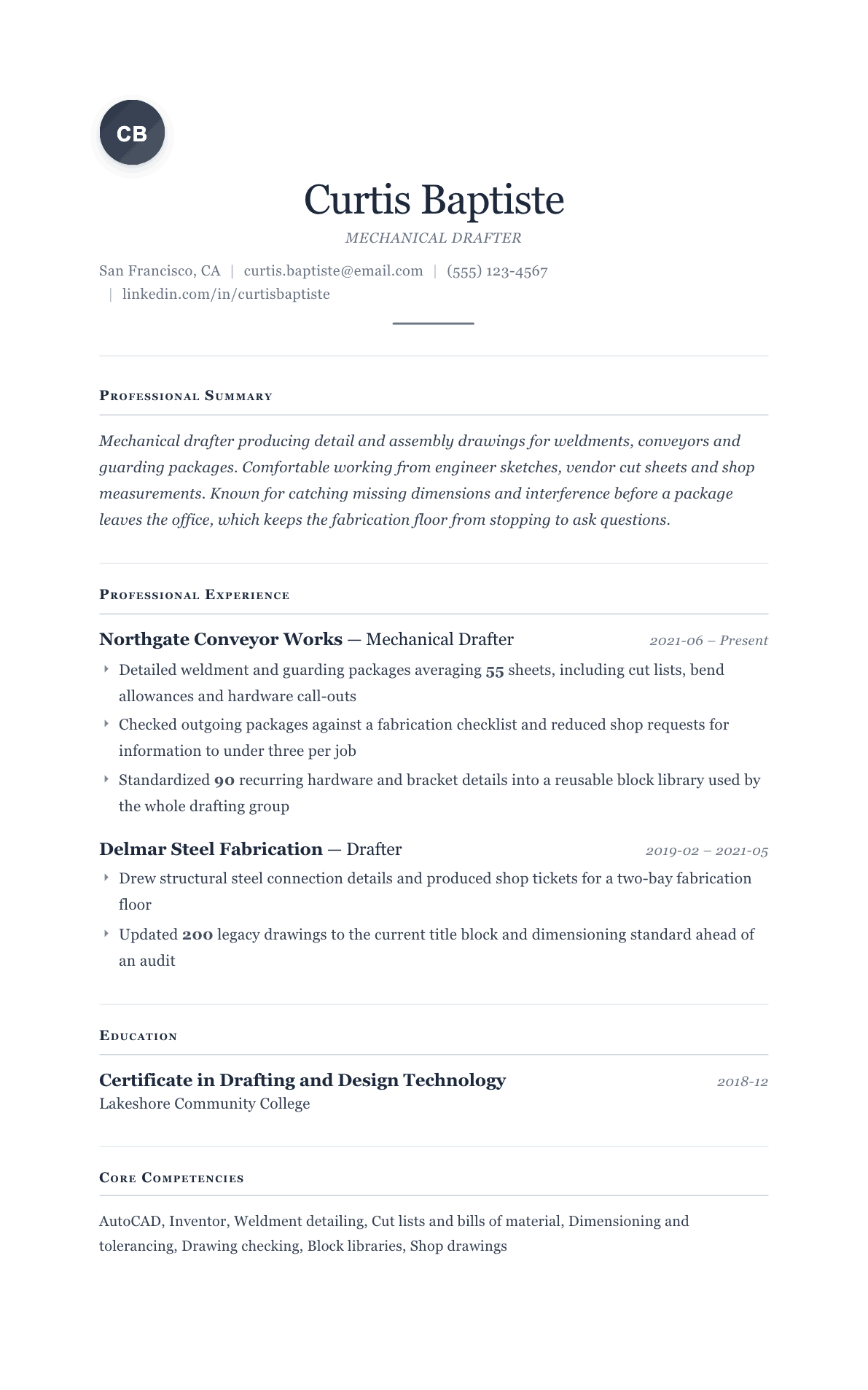
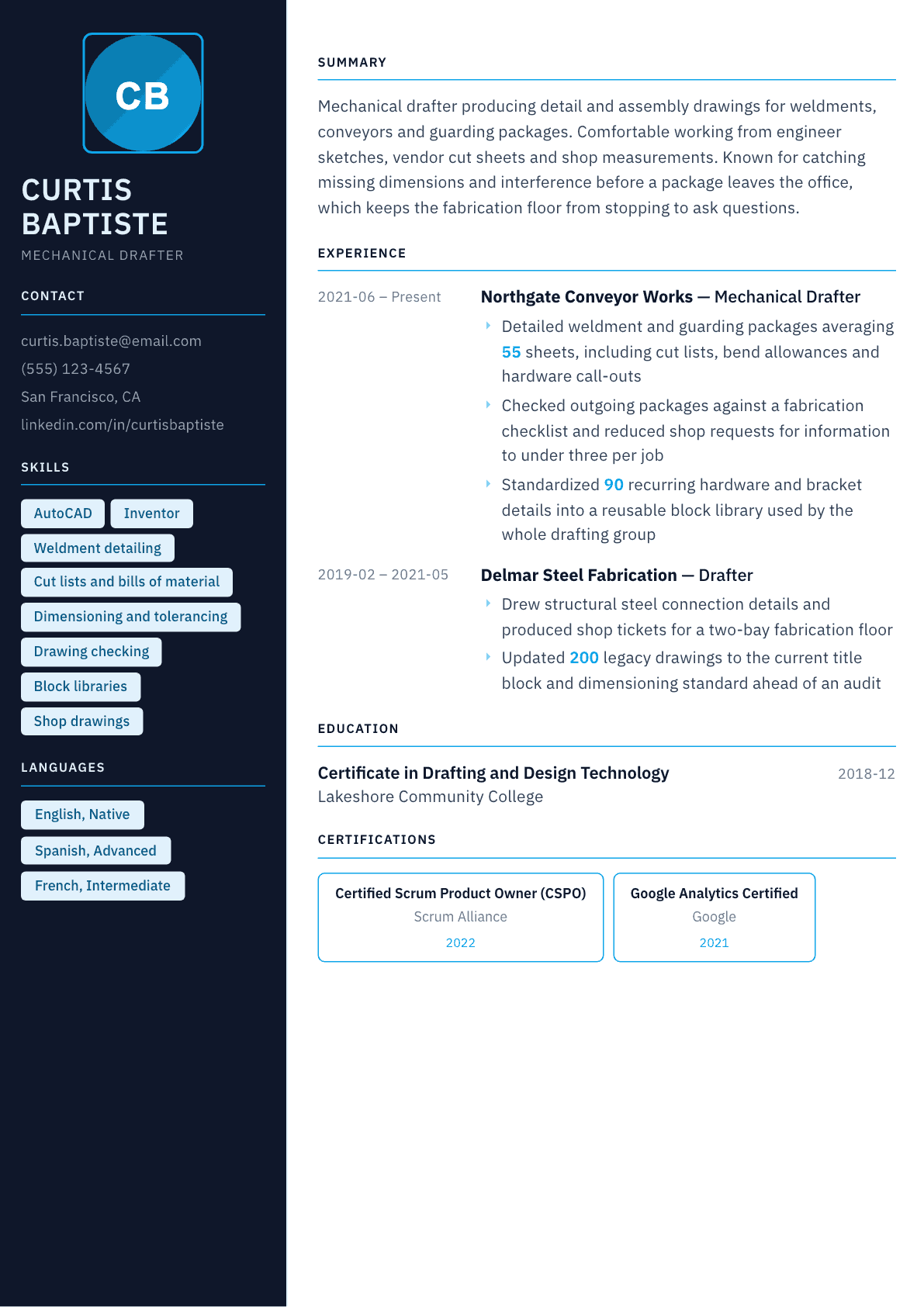
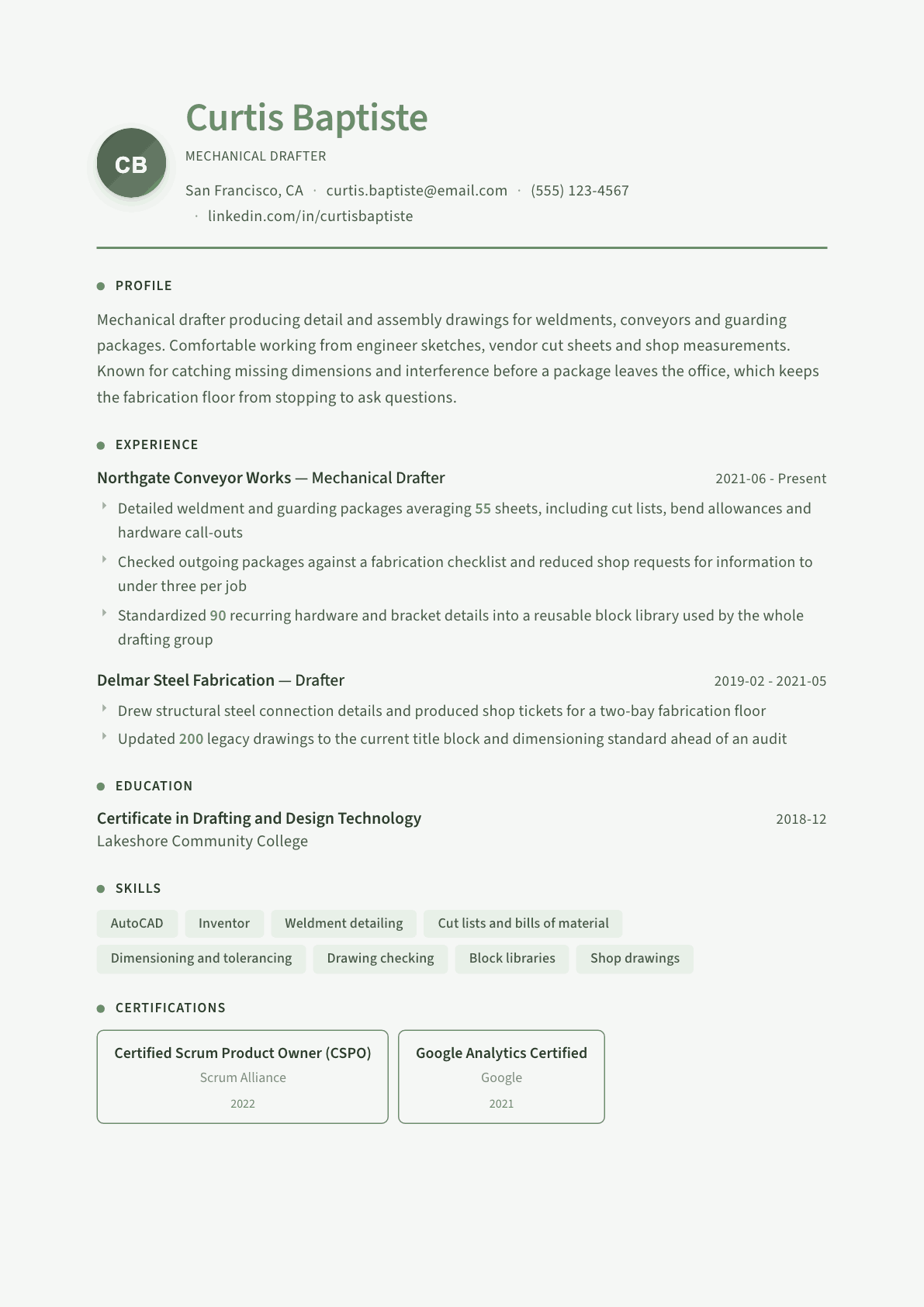
Example Drafter summary
Mechanical drafter with five years detailing weldments, conveyors and guarding for fabrication shops. Works in AutoCAD and Inventor, produces cut lists and bills of material, and checks packages against a fabrication list before issue. Cut shop requests for information to fewer than three per job. Looking for a drafting role supporting an in-house fabrication team.
Skills to list on a Drafter resume
- AutoCAD
- Inventor
- SolidWorks
- MicroStation
- Detail drawings
- Assembly drawings
- Weldment detailing
- Welding symbols
- Bills of material
- Cut lists
- Dimensioning practice
- Drawing checking
- Revision control
- Shop drawings
What actually gets this resume read
- Say what you draft, because mechanical, structural, electrical and civil drafting are hired as different jobs.
- Quantify sheet counts and package sizes, since a drafter who handles 60 sheet packages is a different hire.
- Show that your drawings survive the shop floor: requests for information, rework or scrap avoided.
- List bill of material work explicitly, because many postings expect the drafter to own part numbers and quantities.
- Describe your checking habit, whether that is a printed checklist, a peer check or a self-check routine.
- Include any code or standard you detail to, such as welding symbols, structural connections or piping conventions.
How to write a drafter resume
A drafter resume gets read by whoever runs the drawing room, and often by the shop foreman standing next to him. Between them they want one thing: packages that go to the floor and get built without a single phone call back to the office. Every screening decision follows from that. Can you dimension a weldment so a fabricator can lay it out, produce a cut list that matches the model, call out hardware correctly, and catch the interference before the steel is ordered.
Drafting is also hired by discipline. Mechanical, structural, electrical, piping and civil drafting share software and share almost nothing else. A resume that just says drafter with AutoCAD forces the reader to guess, and guessing usually ends in the reject pile. Name what you draft in the first line.
What follows is the section order a drafting supervisor expects, three summary examples, before and after bullets built from real package work, the mistakes that sink otherwise strong applications, and the questions drafters ask most.
Format: plain, dense, and specific to your discipline
One column, reverse chronological, one page under eight years. A drafter resume can be dense because the reader is used to dense sheets, but it cannot be decorative. Keep the software and discipline near the top and give the experience section the space.
If you have drafted in more than one discipline, split the skills into labeled groups rather than one long list. A supervisor hiring for structural connection details wants to see structural work grouped, not buried between three mechanical software names.
- Header: name, city and state, phone, email, and your drafting certificate or associate degree.
- Order: summary, software and discipline, experience, education, certifications.
- Say whether the drawings went to an in-house shop, an outside fabricator or a field crew.
Summary: what you draft, how big the packages get
Name the discipline and the product in the first six words. Mechanical drafter producing detail and assembly drawings for weldments, conveyors and guarding packages tells a supervisor everything about fit before he reads a bullet. Then package size, then the software.
End with the thing you are known for. Catching missing dimensions and interference before a package leaves the office is a claim a fabrication shop cares about far more than any statement about being a team player.
Experience: package size, bills of material, and shop feedback
Each role opens with the shop or field it fed and roughly what it built. Then bullets on the packages: sheets per package, what was on them, and the supporting data you produced. Cut lists, bend allowances, hardware call-outs, weld symbols and bills of material are the parts that get a drafter hired, because they are where errors cost money and time on the floor.
The strongest evidence is what the shop did with your drawings. Requests for information per job, rework avoided, scrap avoided, or a fabrication run that went through without a stop. A drafter who can point at a low request count has proven checking discipline better than any adjective can.
Include the library and standardization work. Turning ninety recurring brackets and hardware details into reusable blocks used by the whole group is leverage, and supervisors notice drafters who make the other drafters faster.
Checking: name the routine, not the intention
Every drafter says his work is accurate. The ones who get interviewed describe the routine that makes it accurate. A printed fabrication checklist, a peer check before issue, a self check pass against the model with dimensions turned off, a bill of material reconciliation against the assembly tree. Write the routine down as a bullet.
Say who checked you and who you checked. Being the person who reviews a junior package before it leaves is a promotion signal, and it belongs on the resume even when your title never changed.
Skills and keywords a fabrication employer scans for
The recurring terms are detail drawings, assembly drawings, shop drawings, weldment detailing, welding symbols, bills of material, cut lists, dimensioning practice, drawing checking, revision control and fabrication drawings. Put the ones true of you in a skills block and demonstrate at least three of them inside bullets.
Add the standards and conventions you detail to, whether that is welding symbol practice, structural connection detailing, or a client dimensioning standard. Codes and conventions are a real filter, and a drafter who has worked to one is easier to trust with a first package.
Drafter resume summary examples
First drafting job
Drafting and design technology certificate holder with shop floor exposure and a year drawing structural steel connection details and shop tickets. Works in AutoCAD, produces cut lists and hardware call-outs, and checks every package against a printed list before it goes to the fabrication floor.
Five years in
Mechanical drafter detailing weldment, conveyor and guarding packages averaging 55 sheets, including cut lists, bend allowances and hardware call-outs. Works in AutoCAD and Inventor, and holds shop requests for information under three per job by checking against a fabrication list before issue.
Lead drafter
Lead drafter with ten years across mechanical and structural work, owning package release for an in-house fabrication shop and checking every junior drawing before it leaves. Built the block and detail library the group draws from and rewrote the office dimensioning standard ahead of an audit.
Work experience bullets: before and after
Before: Created shop drawings for fabrication.
After: Detailed weldment and guarding packages averaging 55 sheets, including cut lists, bend allowances, weld symbols and hardware call-outs for an in-house fabrication floor.
Naming what was actually on the sheets shows the depth of the drafting rather than the category of it.
Before: Checked drawings before release.
After: Checked every outgoing package against a written fabrication checklist and held shop requests for information to fewer than three per job across two years.
The routine plus the resulting request count turns a claim of accuracy into a number a foreman can trust.
Before: Made a library of standard details.
After: Standardized 90 recurring hardware and bracket details into a reusable block library adopted by the whole drafting group, cutting repeat drawing time on every new package.
Volume and adoption show that the work benefited the team, not only your own output.
Before: Updated old drawings to current standards.
After: Updated 200 legacy drawings to the current title block and dimensioning standard ahead of a customer audit, closing the inconsistency findings before the auditor arrived.
The deadline and the audit outcome give the update work a purpose the reader can measure.
Before: Produced bills of material.
After: Owned part numbers and quantities on bills of material for conveyor packages and reconciled them against the assembly tree, ending short shipments of purchased hardware.
It shows ownership of the data that drives purchasing rather than a passive drafting task.
Hard skills
- AutoCAD
- Autodesk Inventor
- SolidWorks
- MicroStation
- Detail drawings
- Assembly drawings
- Shop drawings
- Weldment detailing
- Welding symbols
- Bills of material
- Cut lists and bend allowances
- Dimensioning and tolerancing practice
- Drawing checking routines
- Revision control
Soft skills
- Methodical checking habit
- Reading engineer sketches
- Talking to fabricators directly
- Steady output under a release date
- Flagging problems early
- Keeping a package consistent end to end
Certifications worth listing
- Certified Drafter (American Design Drafting Association)
- Autodesk Certified Professional: AutoCAD for Design and Drafting (Autodesk)
- Autodesk Certified Professional: Inventor for Mechanical Design (Autodesk)
- Geometric Dimensioning and Tolerancing Professional (GDTP) (American Society of Mechanical Engineers)
Mistakes that cost drafter candidates the interview
- Writing drafter with no discipline attached, which forces the reader to guess whether you detail steel, piping or machine parts.
- Giving no package sizes, so the reader cannot separate a two sheet bracket job from a sixty sheet conveyor package.
- Never mentioning bills of material, even though many postings expect the drafter to own part numbers and quantities.
- Claiming accuracy without describing the checking routine that produces it.
- Leaving out shop feedback entirely, so nothing on the page proves the drawings worked once they left the office.
- Padding the skills list with modeling packages you have not opened since school, which collapses under one interview question.
Drafter resume questions
What is the difference between a drafter and a designer on a resume?
A drafter documents geometry and data so it can be built, while a designer decides the geometry. Apply as what you are, and if you have done sizing or material selection, give it its own bullet rather than blurring the whole resume.
How do I quantify drafting work?
Count sheets per package, packages per month, part numbers detailed, drawings updated, and requests for information received from the shop. Those four numbers describe throughput and quality together and are the ones a drafting supervisor recognizes immediately.
Should I list every CAD version I have used?
No. List the package, not the release year. Version detail dates the resume and tells the reader nothing, while the disciplines you have detailed and the standards you draw to tell him whether you fit the seat.
Do drafters need a certification?
Not usually, but one helps when your experience is short. A drafting certification or a software credential gives a supervisor an external reference point when he cannot yet judge you on package volume or shop feedback.
How should I describe drafting work covered by confidentiality?
Describe the part class, the material and the process without naming the customer or product. Welded steel frames for material handling equipment communicates the drafting skill perfectly and keeps your obligation to a former employer intact.
Related resume examples
- Mechanical Engineer Resume example
- Structural Engineer Resume example
- CAD Technician Resume example
- Architectural Drafter Resume example
- CAD Designer Resume example
- Mechanical Design Engineer Resume example