Campus Security Officer Resume Examples: free ATS score
Write a Campus Security Officer Resume That Fits a University
By Mustafa Tarabya, founder of CVBooster · Published · Updated
Campus security officer resume example with patrol and student welfare keywords, plus a guide to writing escorts, reports and emergency response.
Sample resumes for a campus security officer
The same campus security officer content laid out in three CVBooster templates, so you can see what the finished document looks like before you write a word.
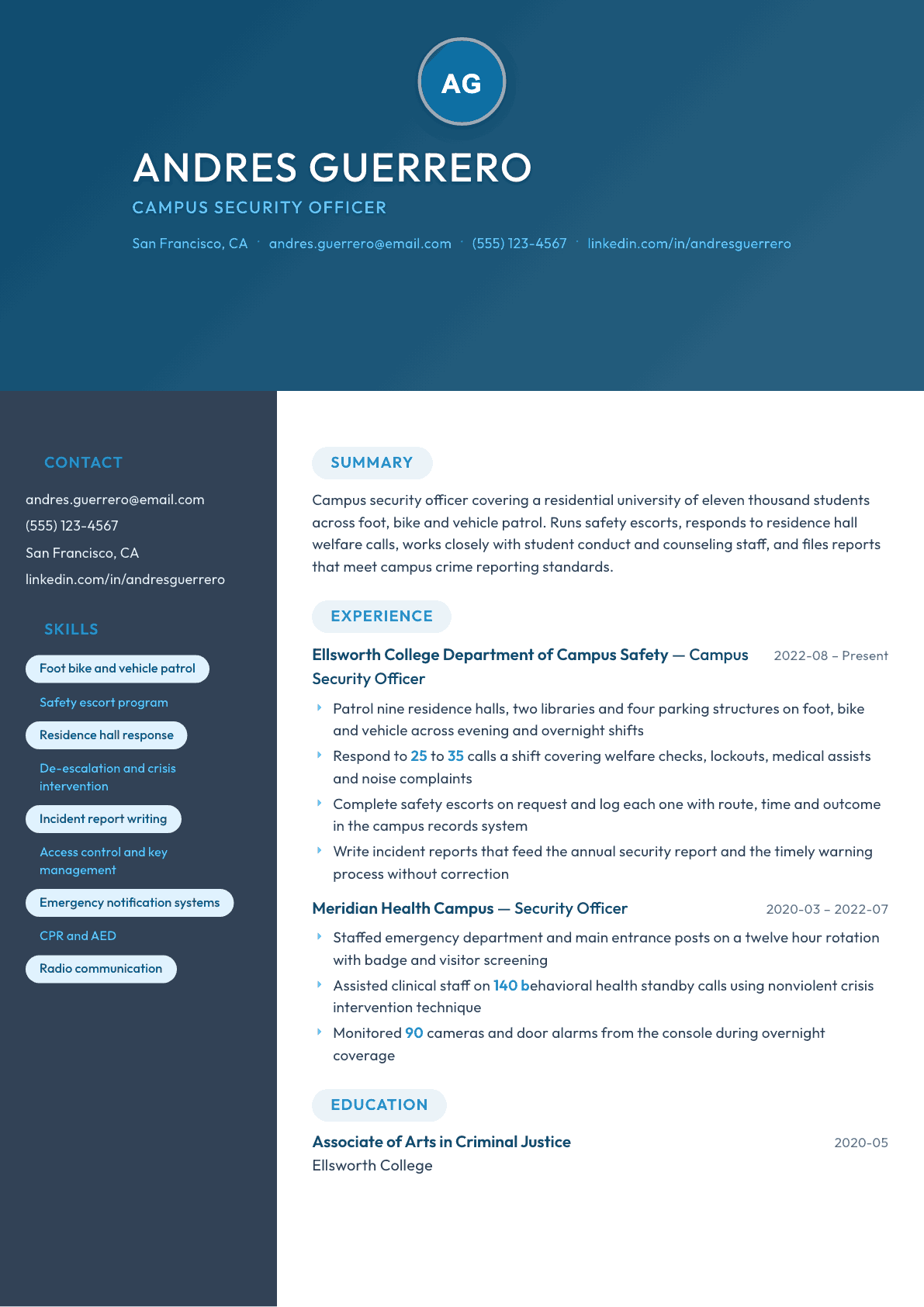
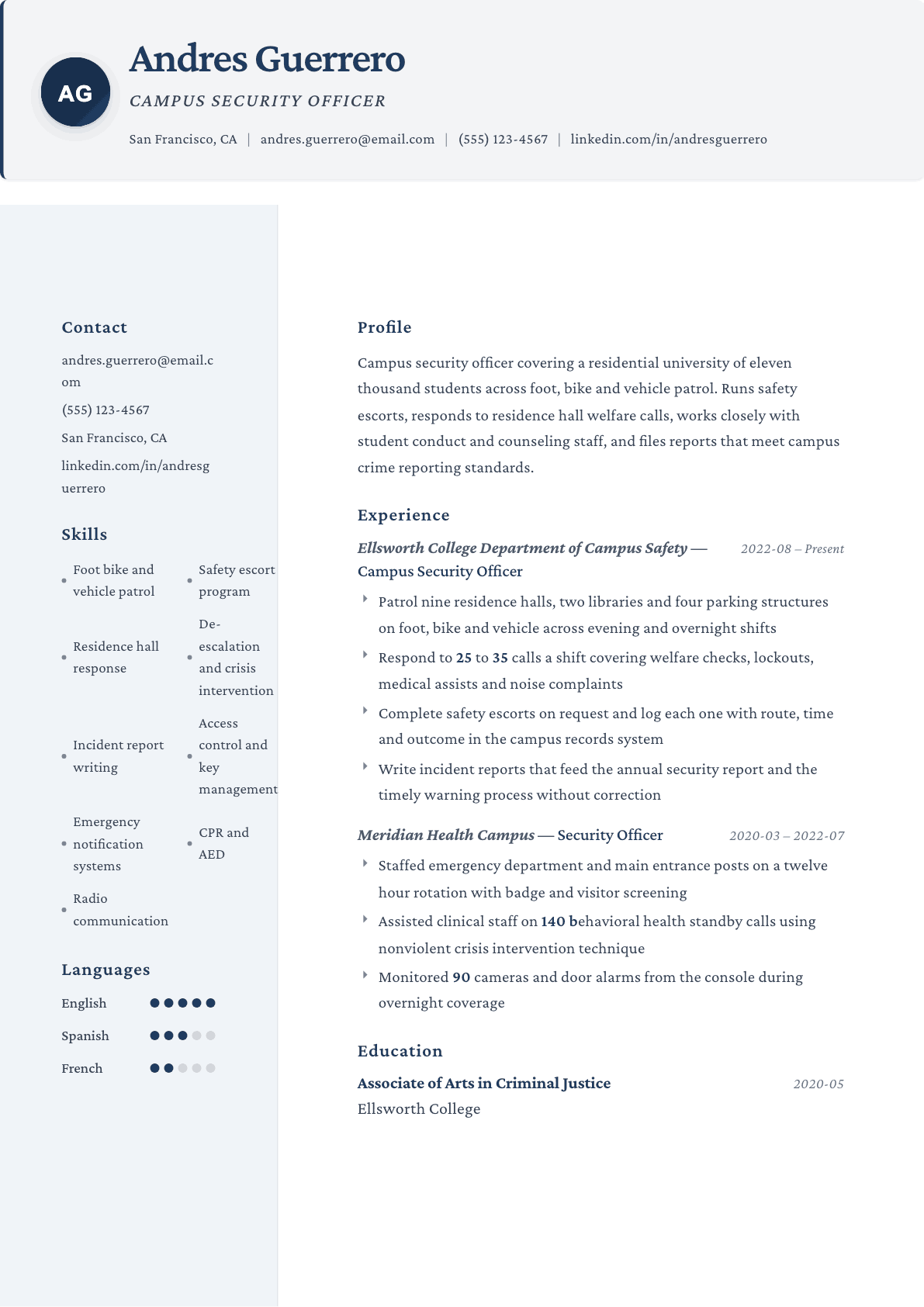
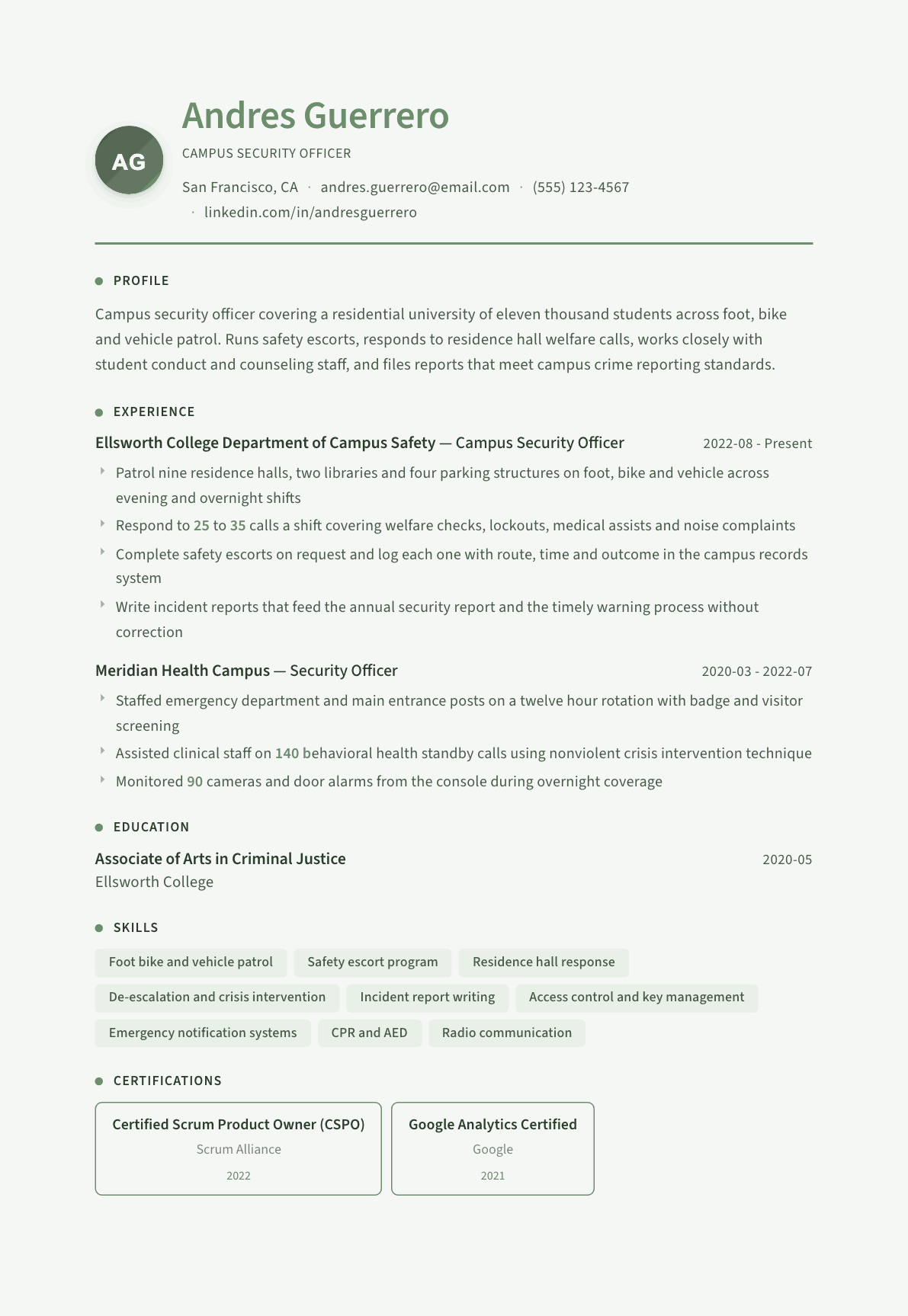
Example Campus Security Officer summary
Campus security officer covering a residential university on foot, bike and vehicle patrol across evening and overnight shifts. Handles welfare checks, residence hall calls, lockouts and medical assists, runs the safety escort program, and writes reports that feed the annual security report and timely warning process without correction. Trained in nonviolent crisis intervention and used to working the seam between residence life, student conduct and counseling staff.
Skills to list on a Campus Security Officer resume
- Foot and bike patrol
- Vehicle patrol
- Residence hall response
- Safety escort program
- De-escalation techniques
- Nonviolent crisis intervention
- Incident and narrative reporting
- Campus crime reporting duties
- Emergency notification systems
- Access control and key management
- CCTV console monitoring
- CPR AED and first aid
- Two way radio communication
- Event and crowd coverage
- Lost property and bike registration
What actually gets this resume read
- Give the campus size and the buildings you cover, because a small college post is not a research university beat.
- Break your calls into welfare checks, lockouts, medical assists and conduct issues so the reader sees the mix.
- Show that you know campus crime reporting and timely warning duties, since that is the compliance risk.
- Name your de-escalation and crisis intervention training with the body that delivered it, not just the idea.
- Say how you work with residence life, student conduct and counseling, because campuses hire for that seam.
- List patrol modes, shift patterns and event coverage, from move in weekend to commencement and game days.
How to write a campus security officer resume
A director of campus safety is hiring for a population that is young, mostly living where it studies, and frequently at its worst hour when it meets you. His officers walk into residence halls at two in the morning, into arguments between roommates, into a student who has drunk far too much, and into a laboratory alarm that turns out to be nothing. He is screening your resume for temperament as much as capability.
Campus work is also compliance work. Reports feed annual crime reporting and the timely warning process, and a report written carelessly becomes an institutional problem months later. A candidate who understands that the narrative has two audiences, the shift supervisor tonight and a compliance officer next year, is immediately more valuable.
This guide covers the format a campus safety department reads, how to write patrol and response work with the right numbers, three summaries across career stages, before and after bullets, and the questions officers ask when moving from corporate, retail or hospital security onto a campus.
Format: one page, campus profile and patrol modes at the top
One page, reverse chronological. Under your summary, put a coverage line describing the campus you have worked: student population, residential or commuter, number of buildings, and whether the department is armed, unarmed or works alongside a sworn police force. Those facts set the entire context for everything below.
Then name your patrol modes and shift patterns immediately. Foot, bike, vehicle and console coverage are different jobs, and a director staffing a bike detail or an overnight rotation is reading for exactly that. Availability is a genuine qualification on a campus, where coverage gaps land on move in weekend, finals and commencement.
- Coverage line: student population served, residential building count, and whether the department is unarmed, armed or partnered with sworn officers.
- Patrol block: foot, bike, vehicle and console coverage, with the shift pattern and the areas you held.
- Call profile: calls handled a shift broken into welfare checks, lockouts, medical assists, alarms and conduct issues.
- Training block: de-escalation and crisis intervention with the delivering body, first aid, and any campus crime reporting instruction.
Calls: giving the mix rather than the total
A shift total tells a director very little on its own. Break it down, because a night of lockouts and escorts is not a night of behavioral health standbys. Welfare checks, medical assists, noise and conduct complaints, alarm responses, escorts, lost property and vehicle assists each demand something different, and the mix describes the campus you have actually worked.
Escorts are worth a line of their own. The safety escort program is one of the most visible services a department offers and the one students judge it by. Give the volume, say how requests reach you, and mention that each one is logged with route, time and outcome, because that logging is what turns a service into a defensible record.
De-escalation, welfare and working alongside student services
Most campus incidents resolve through conversation, and a director wants evidence you can do that rather than a claim. Name your de-escalation or crisis intervention training and the body that delivered it, then give a situation type you handle regularly: a distressed student in a residence hall, an intoxicated first year, a dispute between roommates, a person on campus who has no business being there.
Show the referral seam. Campus safety works with residence life, student conduct, counseling and the dean of students, and knowing when to write a conduct referral rather than escalate to police is a large part of the judgment being hired for. One sentence describing how you hand a student off to the right office says more about your fit than a list of patrol duties.
Behavioral health standbys, if you have done them in a hospital or clinical setting, transfer directly. Say how many and what technique you used, because that experience is unusually valuable on a residential campus.
Reports, compliance and emergency response
Write that your incident reports go into the records system the same shift with time, location, involved parties and disposition. Then connect them to the compliance chain: reports feeding the annual security report, the timely warning process, and the daily crime log. A candidate who understands why the paperwork matters institutionally is rare and instantly credible.
Emergency work belongs on the page too. Fire alarm evacuations, severe weather sheltering, lockdown drills, emergency notification testing and event coverage for commencement or athletics all show that you can operate when the normal routine breaks. Give the drill or event count rather than saying you assisted with emergencies.
Skills and the keywords campus postings use
Campus postings recycle a distinct vocabulary: patrol, safety escort, welfare check, de-escalation, incident report, access control, key management, emergency notification, crowd management, timely warning, daily crime log. Mirror the terms honestly and evidence at least four inside your experience bullets with a number attached.
Add the practical qualifications that decide deployment: a valid driver license, first aid and automated external defibrillator currency, bike patrol training, radio protocol, and any second language. On a campus with international students, language ability is a real operational asset rather than a decoration.
Campus Security Officer resume summary examples
First campus post
Security officer with two years on a corporate lobby and console post, moving into campus work. Monitors 90 cameras and door alarms, screens visitors, writes incident reports the same shift, and completed nonviolent crisis intervention training in 2024. Holds current first aid and defibrillator certification.
Three years on campus
Campus security officer patrolling nine residence halls, two libraries and four parking structures on foot, bike and vehicle. Handles 25 to 35 calls a shift across welfare checks, lockouts, medical assists and noise complaints, runs the safety escort program, and files reports that feed the annual security report without correction.
Shift supervisor
Campus safety shift supervisor leading a five officer overnight team on a residential university. Owns the escort program and the daily crime log, coordinates behavioral health standbys with counseling staff, runs lockdown and evacuation drills, and trains new officers on de-escalation and report standards.
Work experience bullets: before and after
Before: Patrolled the campus and responded to calls.
After: Patrolled nine residence halls, two libraries and four parking structures on foot, bike and vehicle across evening and overnight shifts, handling 25 to 35 calls a shift.
Buildings covered, patrol modes and call volume let a director slot you into a specific beat.
Before: Responded to student welfare issues.
After: Responded to residence hall welfare checks and intoxicated student calls using nonviolent crisis intervention technique, referring 30 students to counseling and student conduct rather than escalating to police.
A named technique plus a referral outcome shows the judgment campus roles are actually hiring for.
Before: Wrote incident reports after each shift.
After: Filed incident reports the same shift with time, location, parties and disposition, feeding the daily crime log and the annual security report with no corrections returned.
Tying reports to the compliance chain proves you understand who reads them after your supervisor.
Before: Provided escorts to students at night.
After: Completed safety escorts on request across evening and overnight coverage, logging each with route, time and outcome in the campus records system.
The logging detail turns a courtesy service into a documented program a director can report on.
Before: Helped with campus events and emergencies.
After: Staffed move in weekend, commencement and 14 athletics events on crowd and access posts, and ran fire evacuation and lockdown drills with residence life staff each term.
Named events and drill cadence show peak coverage rather than general willingness to help.
Hard skills
- Foot and bike patrol
- Vehicle patrol and parking enforcement
- Residence hall response
- Safety escort program operation
- De-escalation and nonviolent crisis intervention
- Incident and narrative report writing
- Daily crime log and annual reporting duties
- Emergency notification systems
- Access control and key management
- Camera console monitoring
- First aid, CPR and defibrillator use
- Two way radio protocol
- Event and crowd coverage
Soft skills
- Talking a distressed student down at three in the morning
- Being approachable enough that students call before it is serious
- Holding a boundary without turning it into a confrontation
- Discretion about what you saw in a residence hall
- Working alongside staff who are not security and do not think like security
Certifications worth listing
- Certified Protection Officer (CPO) (International Foundation for Protection Officers)
- Nonviolent Crisis Intervention (Crisis Prevention Institute)
- Adult First Aid, CPR and AED (American Red Cross)
Mistakes that cost campus security officer candidates the interview
- Giving a single call total instead of the mix, which is what describes the campus you have worked.
- Ignoring campus crime reporting duties, the compliance risk a director carries personally.
- Claiming de-escalation without naming the training or the body that delivered it.
- Leaving out the referral relationship with residence life, conduct and counseling staff.
- Omitting patrol modes and shift patterns when availability is a genuine qualification on a campus.
- Copying a corporate security resume across without translating posts and lobbies into halls and beats.
Campus Security Officer resume questions
Can I move into campus security from retail or corporate security?
Yes, and both transfer well once translated. Rewrite posts as patrol areas, incidents as call types, and console work as camera coverage, then add anything you have done with distressed or intoxicated people, since that is the daily reality of residential campus work.
Do campus security officers need to be armed or sworn?
It varies by institution. Some departments are unarmed and rely on a partnered police agency, some are armed, and some employ sworn campus police. State clearly what you have worked and what you are willing to work, because applying to the wrong model wastes everyone time.
How much should I say about campus crime reporting?
Enough to show you know your reports feed the daily crime log, the annual security report and the timely warning process. You do not need to be the compliance officer, but an officer who writes reports with that audience in mind saves the department months of cleanup.
What training makes the biggest difference on a campus application?
De-escalation and crisis intervention training from a recognized provider, followed by first aid and defibrillator certification. Mental health first aid and bystander intervention instruction also read strongly, because most campus calls resolve through conversation rather than enforcement.
Should I mention working with students specifically?
Yes, because the population is the whole difference. Say how you handle a first year who has drunk too much, a roommate dispute or a student who does not want their family contacted, and a director will recognize somebody who has actually worked the environment.
Related resume examples
- Security Guard Resume example
- Security Officer Resume example
- Hospital Security Officer Resume example
- Unarmed Security Guard Resume example
- Bouncer Resume example
- Surveillance Operator Resume example