Unarmed Security Guard Resume Examples: read this first
Write an Unarmed Security Guard Resume Clients Actually Read
By Mustafa Tarabya, founder of CVBooster · Published · Updated
Unarmed security guard resume example, keyword list and guide covering patrol logs, observe and report duties, access control and de-escalation.
Sample resumes for a unarmed security guard
The same unarmed security guard content laid out in three CVBooster templates, so you can see what the finished document looks like before you write a word.
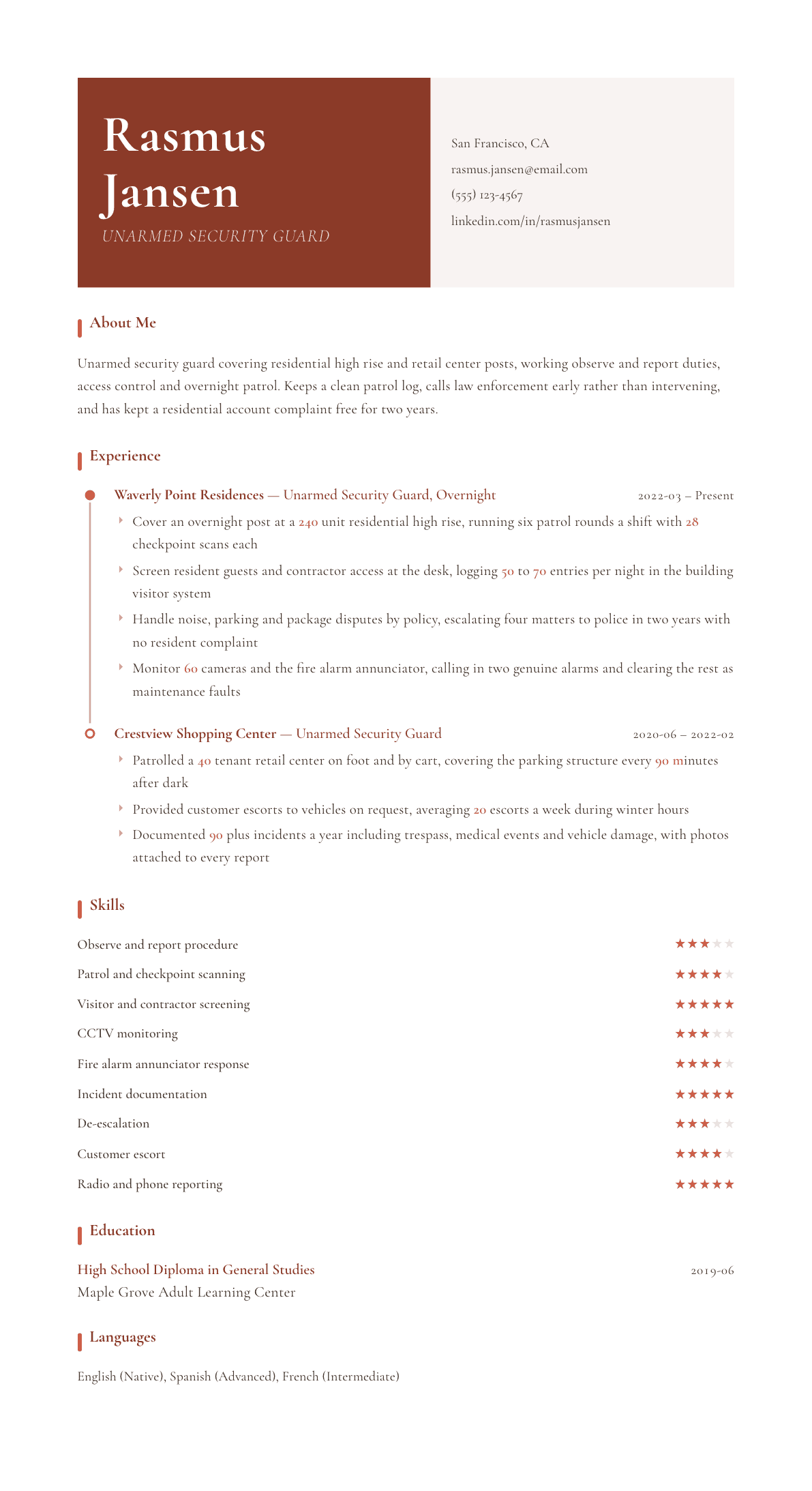
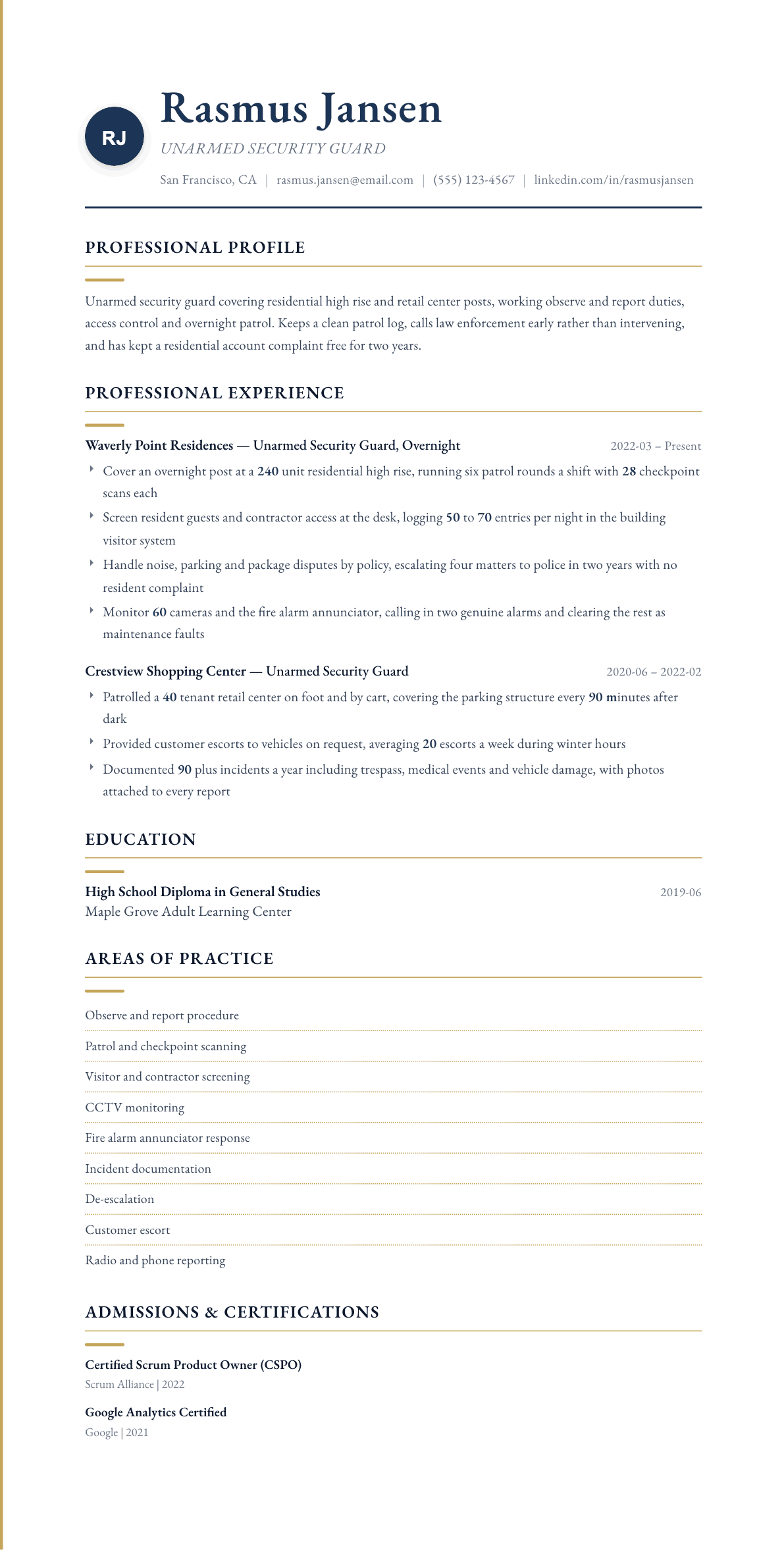
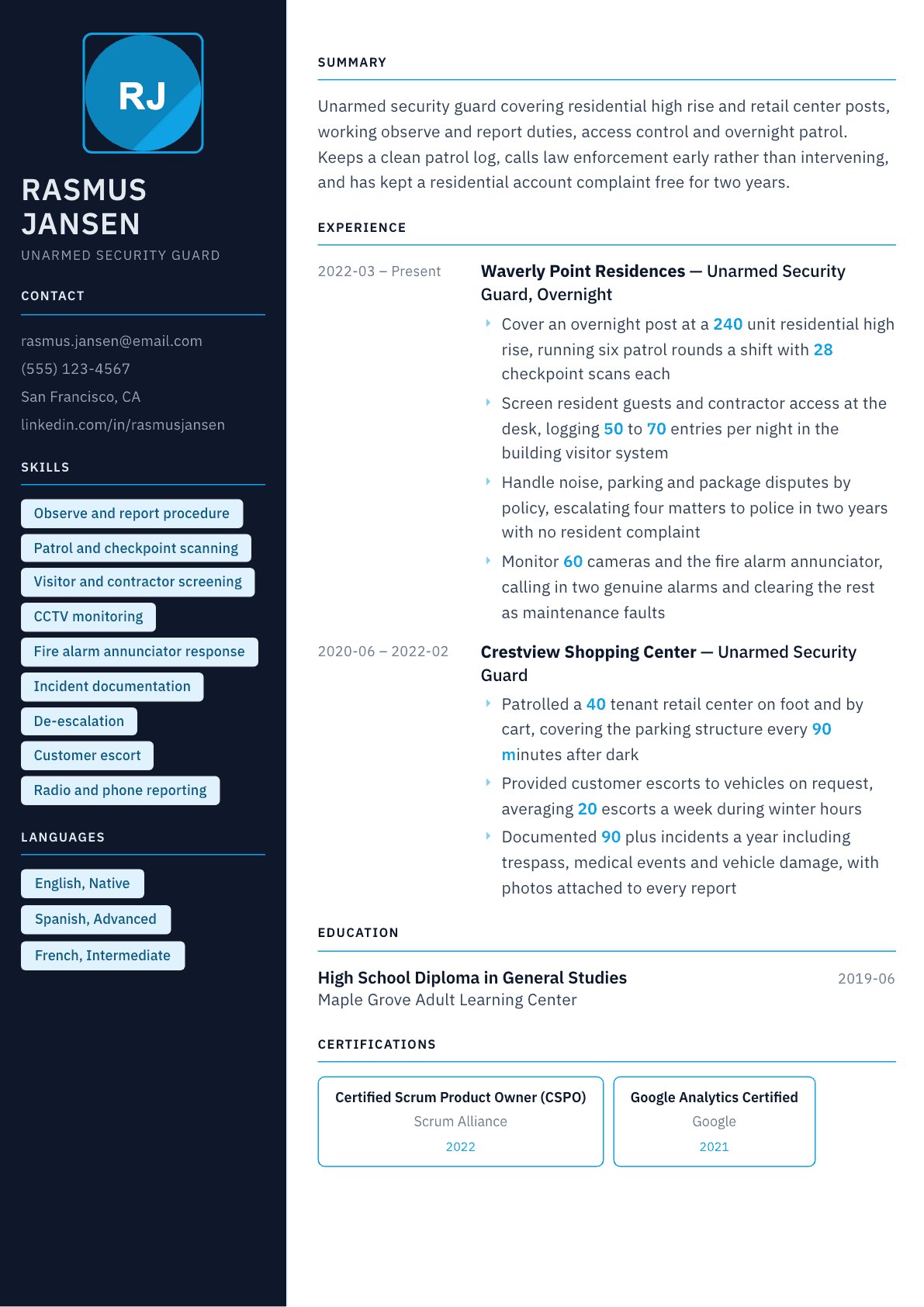
Example Unarmed Security Guard summary
Unarmed security guard with five years covering residential high rise and retail center posts on overnight and weekend shifts. Runs six patrol rounds a shift with checkpoint scans, screens guests and contractors at the desk, monitors cameras and the fire alarm annunciator, and documents every incident with photos. Works a strict observe and report model and calls law enforcement early rather than intervening.
Skills to list on a Unarmed Security Guard resume
- Observe and report protocol
- Foot and cart patrol
- Checkpoint tour systems
- Visitor and contractor logging
- Access control at desk posts
- CCTV camera monitoring
- Fire alarm panel awareness
- Incident report writing with photos
- De-escalation and conflict avoidance
- Parking and towing enforcement
- Customer escort service
- Lost property handling
- Emergency evacuation assistance
- First aid, CPR and AED
- Radio and dispatch reporting
What actually gets this resume read
- Lead with your guard registration and the state that issued it, because posting you without it is not legal.
- Say that you work an observe and report model, since many clients specifically want no physical intervention.
- Name the site type and its size, because a 240 unit residential tower is a different post from a retail lot.
- Give patrol rounds and checkpoint scans per shift, which is what an account manager reviews in the tour report.
- Show that you call police at the right moment, with an example, because judgment is the whole unarmed job.
- Note your overnight and weekend availability, since those are the posts that stay unfilled the longest.
- Include customer service work like escorts and directions, because unarmed officers are the face of the property.
How to write a unarmed security guard resume
Unarmed guarding is the largest part of the security industry and the most misunderstood on paper. Clients who buy unarmed coverage are buying presence, documentation and judgment, and they specifically do not want an officer who intervenes physically. An application that reads as though the candidate is waiting for a chance to grab somebody is the wrong fit for almost every unarmed post there is.
The pages that get overlooked are vague in the same way. They describe patrolling the property, monitoring for suspicious activity and maintaining safety. A property manager cannot tell from that whether you covered a residential tower with a guest list, a retail lot after dark, a construction site with an equipment theft problem or a hospital entrance, and each of those needs a different officer.
This guide covers how to write an unarmed security guard resume that shows observe and report discipline, patrol coverage that stands up to an audit, and the customer facing side of the post that keeps the contract alive, along with the questions unarmed officers ask when they want a better assignment.
Format: registration, site type, coverage model
One page and no more. Put your state guard registration and its expiration in the header area, then a short line stating that you work an observe and report model. That phrase is the exact language many property managers use in their scope of work, and seeing it early tells the reader you understand the boundary of the assignment.
Group your history by property rather than by contract company. An unarmed officer who has covered a residential high rise, a shopping center and a hospital lobby has three distinct competencies, and burying them under one employer name hides all of it.
- Registration and expiration, plus first aid and CPR currency.
- Model line: observe and report, with your escalation path to law enforcement or the property manager.
- Property line for each assignment: type, unit or tenant count, staffed hours and the posts covered.
- Systems line: visitor logging tool, camera platform, tour or checkpoint device and the reporting portal.
- Availability line, including overnight, weekend and holiday coverage you can genuinely commit to.
Summary: property, patrol, documentation, restraint
Say where you have worked, what the post covered, how much patrol it involved and how you document. Then say plainly that you escalate rather than intervene. That combination is what a residential board or a retail property manager is actually looking for, and very few applicants write it explicitly.
If you have a long stretch without a resident or tenant complaint, that belongs here. Complaints are how unarmed accounts get lost, and an officer with a clean record on a property full of people who see him every day is demonstrating something a patrol count cannot.
Experience: rounds, logs, the incidents you did not touch
Patrol is the core of most unarmed posts, so write it precisely. Rounds per shift, checkpoints per round, whether the route covers stairwells, parking structures, roof access and mechanical rooms, and how the tour is verified. A property that has been paying for patrols it cannot prove will read those numbers closely.
Access and guest logging is the other half. Give the entries per shift, the identification you check, how you handle a resident who insists their guest be waved through, and what the log is used for afterward. Unarmed officers spend more time on that friction than on anything dramatic.
Then write the incidents where doing nothing physical was the right answer. A trespasser who left after you called it in, a domestic dispute in a hallway where you kept distance and waited for police, a group in the parking structure that dispersed once you turned on the cart lights. Say what you observed, who you called, and how it ended. That is the whole product.
Include the service side. Escorts to vehicles, package and delivery handling, lockouts, wayfinding, jump starts and the reason a resident asks for you by name. Unarmed officers who make a property feel looked after are the ones the account keeps.
Judgment: knowing when to call and when to keep walking
The single most valuable thing an unarmed officer can prove is calibration. Calling police for everything burns the property relationship and the police relationship. Calling for nothing gets people hurt. A resume that shows how often you escalated across a long assignment, and what the outcomes were, demonstrates that calibration better than any adjective.
Alarm handling is part of the same picture. Distinguishing a genuine activation from a door that never latches properly, and getting the hardware fixed rather than logging the same false alarm sixty times, is judgment with a maintenance work order attached to it.
- Escalation count across an assignment period, with the outcome categories.
- False alarm reduction achieved by identifying the underlying fault.
- Medical events where you cleared access, met responders and documented the timeline.
- Fire alarm panel awareness, evacuation assistance and post evacuation accountability.
- Written statements provided to police or insurers, with what made them usable.
Skills and keywords that get an unarmed resume through screening
Postings repeat a compact set of terms: observe and report, patrol rounds, checkpoint scanning, visitor log, access control, incident report, daily activity report, alarm response, de-escalation, customer service. Use the posting language once in the skills block and once inside a bullet that shows it in action.
Two things belong on the page that applicants often leave off. The first is your comfort with long solo shifts, which is a real requirement on quiet posts. The second is your writing, since the daily activity report is the only thing many clients ever see from the officer, and it is the sample they judge the whole account on.
Unarmed Security Guard resume summary examples
First unarmed post
Unarmed security guard with a current state registration and CPR certification, moving from four years of overnight hotel front desk work. Comfortable working alone on nights, writing clear shift logs, and handling guest disputes by policy rather than confrontation. Available for weekend and holiday coverage.
Three years on residential posts
Unarmed security guard covering an overnight post at a 240 unit residential high rise, running six patrol rounds a shift with 28 checkpoint scans and logging 50 to 70 guest and contractor entries a night. Escalated four matters to police across two years with no resident complaint on file.
Site lead on an unarmed account
Site lead on an unarmed retail account with seven years across residential, retail and construction posts. Rebuilt the patrol route so the parking structure is covered every 90 minutes after dark, trains new officers on report writing, and provides written statements that insurers have accepted without follow up.
Work experience bullets: before and after
Before: Patrolled the property and reported problems.
After: Ran six patrol rounds a shift covering stairwells, the parking structure, roof access and mechanical rooms, logging 28 checkpoint scans per round on a handheld tour device the property manager audits weekly.
Route coverage, scan counts and the audit trail turn patrol into something a client can verify and value.
Before: Checked in guests and visitors at the desk.
After: Logged 50 to 70 resident guest and contractor entries a night against the approved arrivals list, checking photo identification and holding the rule when residents asked for guests to be waved through.
Entry volume, the verification step and the friction you hold show access control as a policy job, not a greeting.
Before: Called police when there was trouble.
After: Escalated four matters to police across two years, including a hallway dispute where I kept distance, cleared bystanders and gave responders a unit number and description on arrival.
A low escalation count with one detailed example proves calibration and observe and report discipline at once.
Before: Responded to alarms during my shift.
After: Cleared every alarm activation on foot before reset and cut recurring nuisance activations at the loading door by reporting a latch fault that had been logged 30 times before anyone traced it.
Fixing the cause rather than logging the symptom is the difference between a reliable officer and a warm body.
Before: Helped residents and customers when needed.
After: Provided about 20 vehicle escorts a week during winter hours, handled after hours package retrieval and lockouts by policy, and was requested by name by the property manager after an account rebid.
Service volume plus a client request is direct evidence that the post relationship, not just the coverage, was working.
Hard skills
- Observe and report protocol
- Foot, cart and vehicle patrol
- Checkpoint tour device operation
- Guest and contractor logging
- Desk post access control
- Camera console monitoring
- Fire alarm panel awareness and evacuation support
- Incident report writing with photographic evidence
- Daily activity log discipline
- Parking enforcement and towing coordination
- Lost property handling and chain of custody
- First aid, CPR and AED response
- Radio and dispatch reporting
- Written statements for police and insurers
Soft skills
- Holding a rule with a resident who outranks you socially on the property
- Staying awake and observant on a long solo overnight
- Reading a situation well enough to know that walking closer is the wrong move
- Writing a log entry a stranger can act on months later
- Being the same person to every tenant regardless of how they treat you
Certifications worth listing
- Certified Protection Officer (CPO) (International Foundation for Protection Officers)
- First Aid, CPR and AED (American Red Cross)
- Basic Security Officer Training Certification (International Association for Healthcare Security and Safety)
Mistakes that cost unarmed security guard candidates the interview
- Writing as though the goal is confrontation when clients buying unarmed coverage want the opposite.
- Never naming the property type, which hides the fact that residential, retail and construction posts are different jobs.
- Giving no patrol or checkpoint numbers, so the client has no way to see the coverage they were paying for.
- Leaving guest logging and access rules off the page when that friction is most of the actual shift.
- Ignoring the service side of the post, which is what property managers cite when they renew or drop an account.
- Failing to show escalation judgment, so a reader cannot tell whether you call police for everything or for nothing.
- Submitting a page with sloppy writing when the daily activity report is the only work product the client ever sees.
Unarmed Security Guard resume questions
Is unarmed guarding a step down from an armed post?
It is a different assignment, not a lesser one. Many high value residential and corporate accounts are deliberately unarmed because the client wants presence and documentation without weapons on site. Write it as a specialty in observation, access rules and reporting rather than as a stage on the way to something else.
How do I show experience when nothing dramatic happened on my post?
Quiet posts are the ones clients renew. Show coverage instead of drama: patrol rounds completed, checkpoints scanned, entries logged, alarms cleared, reports filed without rework, and the length of the assignment. Consistency across a long stretch is its own evidence.
Should I mention that I do not physically intervene?
Yes, phrased as the model you work rather than as a limitation. Say that you observe, document and escalate under post orders. Property managers who have been sued over an officer intervention read that line as a reason to interview you rather than a reason not to.
What experience outside security transfers well?
Overnight hotel front desk, hospital registration, transit staffing, retail closing shifts and bar door work all involve access rules, difficult people and shift logs. Translate them into screening, de-escalation and documentation language rather than leaving them as unrelated job titles.
How do I get moved to a better paying unarmed account?
Ask for the console, the report review or the training role on your current site and then put that on the page. Higher paying unarmed posts want officers who can run a camera room, produce clean documentation and help onboard the next officer, not officers who simply stood longer.
Related resume examples
- Security Guard Resume example
- Loss Prevention Specialist Resume example
- Armed Security Guard Resume example
- Hospital Security Officer Resume example
- Emergency Dispatcher Resume example
- Alarm Technician Resume example