Hospital Security Officer Resume Examples: free score
Write a Hospital Security Officer Resume Clinical Leaders Trust
By Mustafa Tarabya, founder of CVBooster · Published · Updated
Hospital security officer resume example, keyword list and writing guide covering de-escalation, restraint policy, behavioral holds and access control.
Sample resumes for a hospital security officer
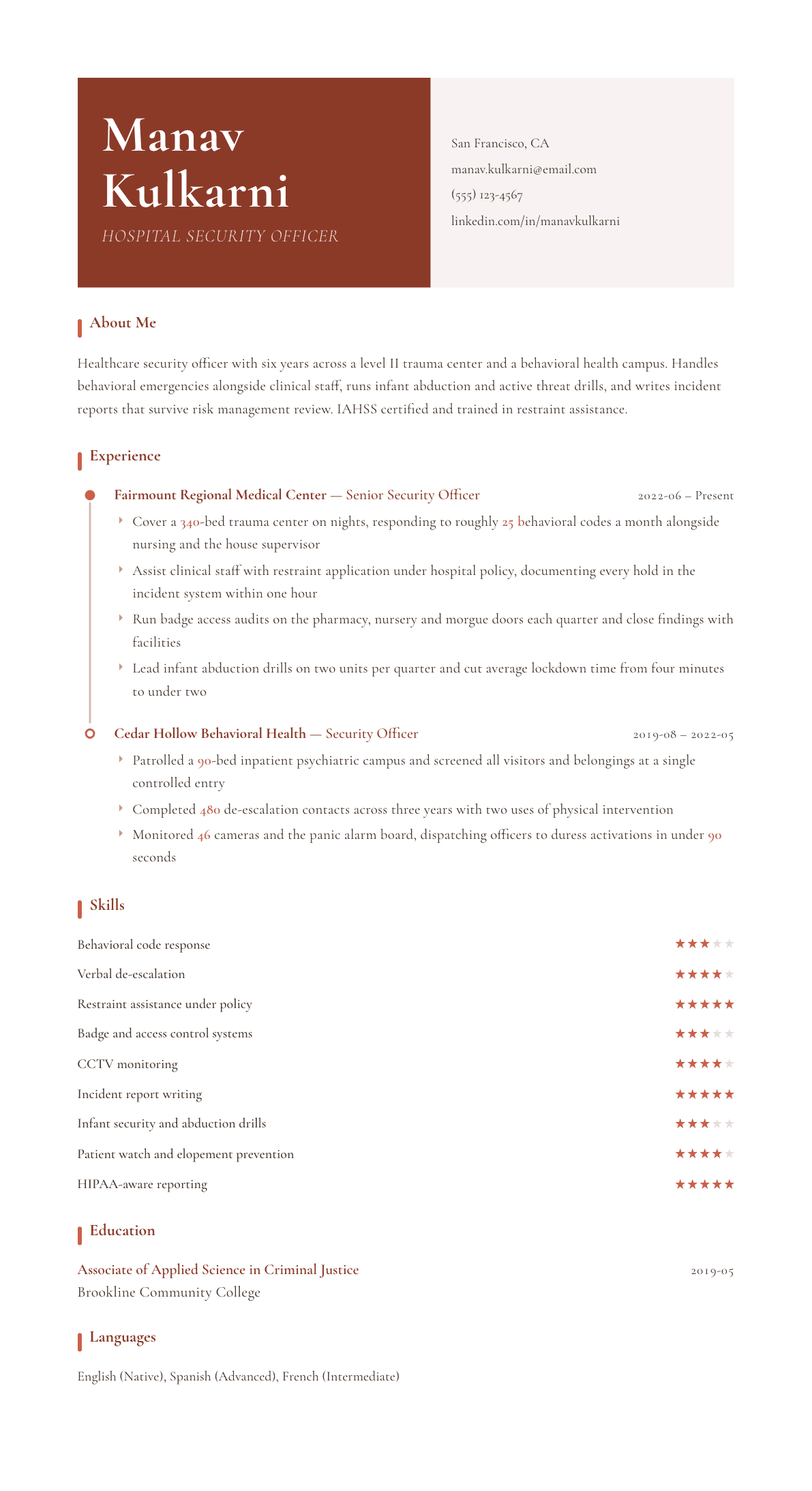
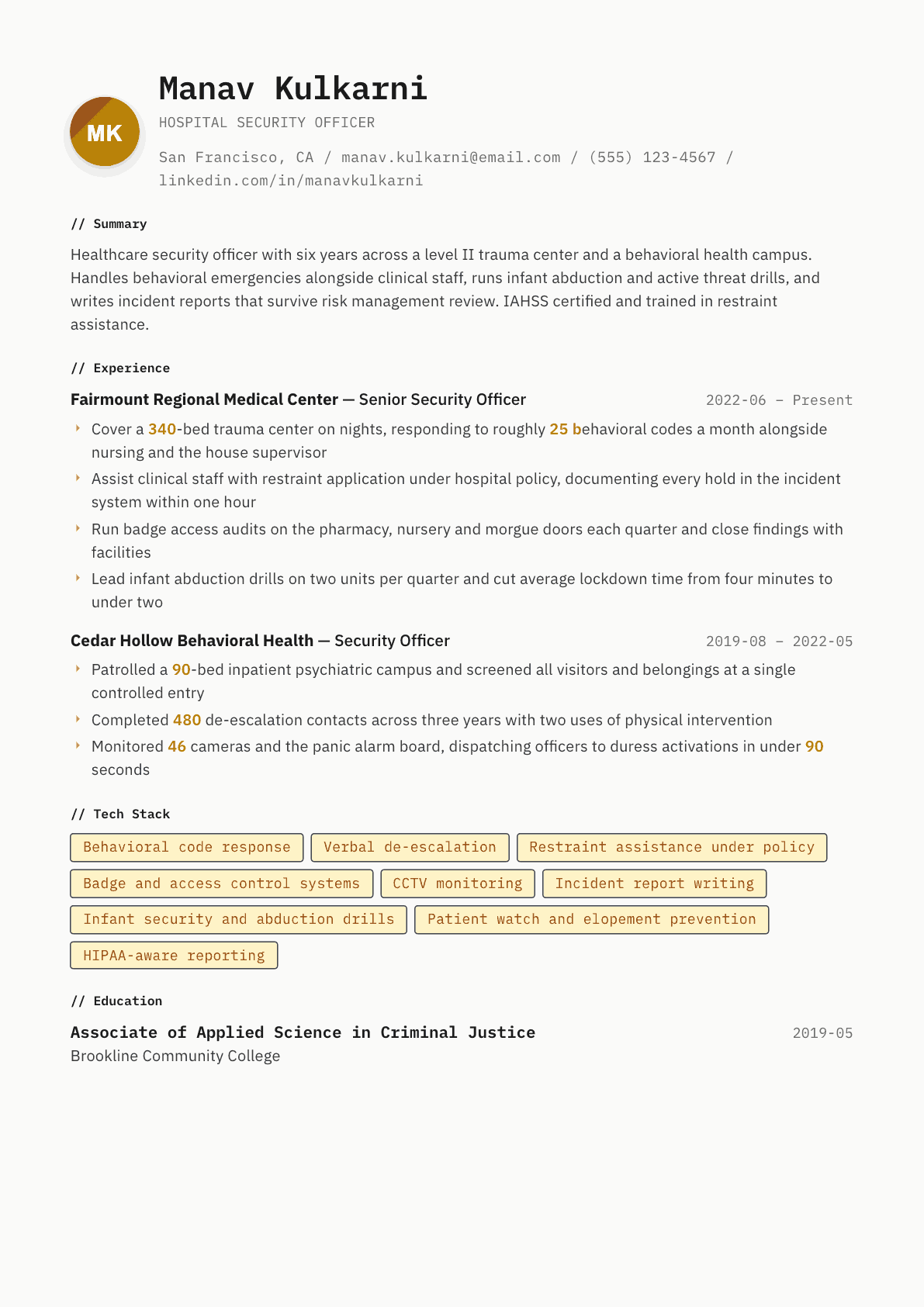
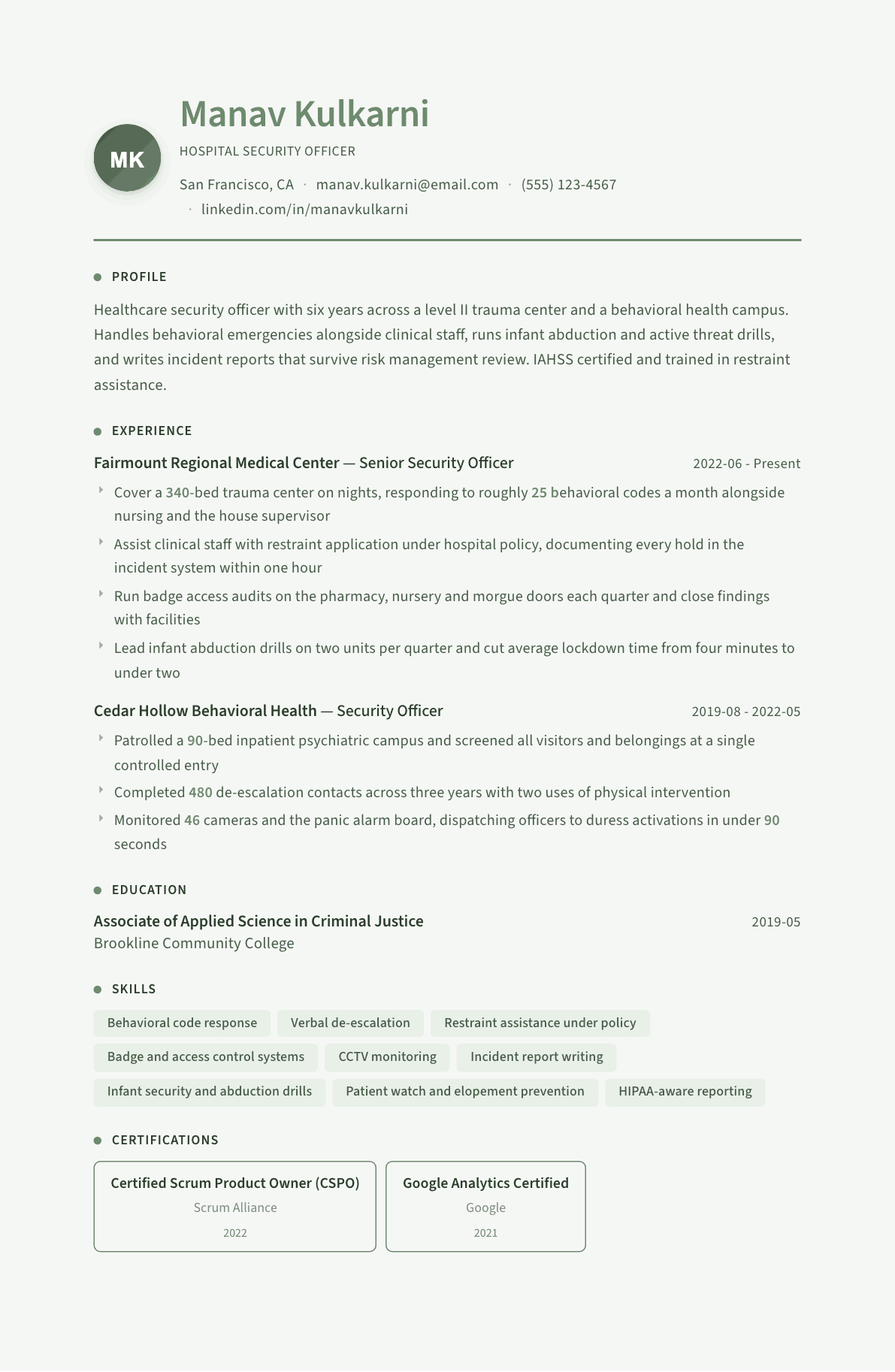
The same hospital security officer content laid out in three CVBooster templates, so you can see what the finished document looks like before you write a word.
Example Hospital Security Officer summary
Hospital security officer with six years across a trauma center and a behavioral health campus, responding to roughly 25 behavioral codes a month with clinical teams. Assists with restraint under hospital policy, runs infant abduction and lockdown drills, audits badge access on restricted doors, and writes incident narratives that hold up in risk management review. IAHSS certified with current basic life support.
Skills to list on a Hospital Security Officer resume
- Verbal de-escalation
- Behavioral emergency response
- Restraint assistance protocol
- Patient watch and sitter support
- Elopement prevention
- Infant abduction response
- Access control administration
- CCTV and duress alarm monitoring
- Incident documentation
- Evidence and property handling
- Emergency code response
- Visitor screening and weapons detection
- Workplace violence prevention
- Joint Commission survey readiness
- Basic life support response
What actually gets this resume read
- Name the facility type and bed count for every post, because a trauma center and a clinic are different jobs.
- Give your behavioral code volume per month so a security manager can judge the pressure you have worked under.
- State your IAHSS certification level and any de-escalation curriculum by name, since hospitals train on specific ones.
- Show that you assist with restraints under clinical direction rather than claiming you apply them on your own authority.
- Put infant security, elopement and active threat drills on the page, because Joint Commission survey readiness depends on them.
- List the access control and camera platforms you have operated, since a switch costs the department weeks of training.
- Write one bullet about report quality, because risk management reads your narratives long after the shift ends.
How to write a hospital security officer resume
Healthcare security is not the same trade as retail or corporate guarding, and the person reading your application knows it inside the first ten seconds. A hospital security manager is looking for someone who can walk into an emergency department at three in the morning, stand next to a charge nurse while she decides whether a patient needs a hold, and add calm instead of heat. Nothing on a generic guard resume proves that.
The second reader is the risk or compliance office. Your incident narratives become part of the record when a family complains or a surveyor asks how the department handles behavioral emergencies. That office wants to see that you write clearly, document restraint assistance the way policy requires, and understand that a patient is a patient before he is a problem.
This guide covers the sections a healthcare security department actually reads, what to put in each one, three summaries pitched at different stages of a security career, before and after bullets drawn from real hospital work, and the questions officers ask when they try to move from a mall post to a medical center.
Format: two pages is fine, credentials near the header
Reverse chronological, one page under five years and two pages after that. Hospitals run applicant tracking systems that read plain single-column documents best, so keep the layout simple and the dates unbroken. Gaps get asked about at interview anyway, and hiding them behind a functional format only makes the question sharper.
Put your certifications and your training in a block that a manager can check against the department matrix. Healthcare security departments keep a training grid covering restraint assistance, de-escalation, defensive tactics and basic life support, and the officer who arrives already holding three of the four is cheaper to onboard than one who holds none.
- Header line for a healthcare officer: name, city and state, phone, email, guard registration number status, and the certification abbreviations you hold.
- Order for this trade: summary, certifications and training, healthcare security experience, other protective experience, education.
- Each post gets its facility type on the same line: trauma level, bed count, behavioral beds, and whether the department is armed or unarmed.
- New officers coming from another security sector list any patient-facing work, ambulance ride time or care aide history above general guard posts.
Summary: setting, volume, and how you handle a behavioral emergency
Three lines is enough. Name the facility type and size, the years, the volume of behavioral calls you handle, and the certification set you carry. A manager staffing a department reads that as a schedule answer, which is what she needs before she reads anything else.
If you are coming in from outside healthcare, say so plainly in the first line and name the transferable half. An officer with four years on a courthouse post who has completed a nonviolent crisis intervention course should say that, rather than hoping a reader will infer that courthouse work involves distressed people all day.
Experience: the unit, the call type, and what you did with your hands
Every hospital post needs the facility described in a way a peer can size: bed count, trauma designation, whether there is a behavioral unit, a pediatric emergency department, a forensic patient population or a locked geriatric floor. Those details change the job more than the job title does.
Then three to five bullets covering the work that separates a healthcare officer from a guard. Behavioral code response and how often it comes. Assisting clinical staff with restraint application under their direction and under policy. Standing a patient watch on a suicide risk or a forensic patient. Elopement searches. Weapon and contraband finds during screening. Property and evidence handling for a patient who arrived unconscious. Infant security and the drills that keep the tags honest.
One bullet should be about documentation. Say how quickly your reports go into the system, and what makes them usable: time stamps, quoted statements, the clinical decision maker named, the outcome. A manager who has watched a weak narrative fall apart at a deposition will read that line twice.
Cut anything that could be pasted onto a warehouse guard resume. Patrolling assigned areas, monitoring cameras and ensuring a safe environment describe every officer alive and prove nothing about you.
Restraint, de-escalation and the language that keeps you out of trouble
Write about restraint carefully, because the wording tells a manager whether you understand the policy or only the physical technique. Security assists with restraint application at the direction of clinical staff. Security does not order a hold and does not decide medical necessity. An officer who writes it the other way around is a liability that a director can see from the parking lot.
De-escalation belongs in numbers as well as words. Count your contacts and count how many required hands. A ratio of hundreds of verbal resolutions against a handful of physical interventions is the strongest single claim a healthcare officer can make, and it is checkable against a department incident log.
Name the curriculum you were trained in rather than saying you are trained in de-escalation. Hospitals buy specific programs, and the training coordinator wants to know whether your muscle memory matches the one the staff already use.
Systems, drills and survey readiness
Name the access control platform, the camera system and the incident reporting software you have worked in. Departments buy these on long contracts, and an officer who already runs the badge system can take on door audits in month one instead of month six.
Drills belong on the page too. Infant abduction, active threat, lockdown, decontamination support and evacuation are all rehearsed on a cycle because a surveyor will ask about them. If you have run a drill, timed it, or brought a clear time down, that is a bullet. If you have only stood in one, leave it in a training list instead.
- Access control and badge administration: name the platform and say whether you ran audits on restricted doors.
- Camera and duress alarm monitoring: give the camera count and the response time you held to.
- Drill participation with a role: designer, controller, evaluator or responder, and the time you improved.
- Weapons detection at controlled entries: the screening method and the volume you moved through it.
Hospital Security Officer resume summary examples
Coming from another security sector
Security officer with three years on a courthouse and campus post, moving into healthcare. Holds a state guard registration, basic life support and a completed nonviolent crisis intervention course. Comfortable with distressed members of the public, controlled entry screening and clean written reports. Seeking a first hospital assignment.
Five years in a medical center
Hospital security officer with five years in a 280-bed acute facility with a level II trauma center. Responds to about 20 behavioral codes a month with nursing, assists with restraint under clinical direction, stands suicide risk watches, and files every incident narrative before the end of shift. IAHSS certified.
Lead officer and trainer
Lead healthcare security officer with nine years across acute and behavioral campuses, running shift briefings for a team of seven. Owns the badge audit cycle on pharmacy, nursery and morgue doors, controls infant abduction drills on two units a quarter, and trains new officers on restraint assistance and report writing.
Work experience bullets: before and after
Before: Responded to disturbances involving patients.
After: Responded to roughly 25 behavioral codes a month in a 340-bed trauma center, arriving with the house supervisor and assisting nursing with restraint application under hospital policy.
Volume, facility size and the clinical chain of authority turn a vague claim into a job a manager can staff.
Before: Used de-escalation with agitated individuals.
After: Completed 480 documented de-escalation contacts over three years on an inpatient psychiatric campus with two of them requiring physical intervention.
A contact count paired with an intervention count proves the skill instead of naming it.
Before: Monitored security cameras and alarms.
After: Monitored 46 cameras and the duress alarm board on nights, dispatching a responding officer to every activation in under 90 seconds.
The camera count and the response standard make the post measurable rather than decorative.
Before: Participated in hospital drills.
After: Controlled infant abduction drills on two units per quarter and cut average unit lockdown time from four minutes to under two by rewriting the door assignment card.
A role in the drill plus a time improvement plus the change that caused it reads as ownership.
Before: Wrote incident reports.
After: Filed every incident narrative within one hour of clearing, with time stamps, quoted statements and the clinical decision maker named, and had no report returned for rework by risk management.
It describes what makes a report survive review, which is the part risk management cares about.
Hard skills
- Behavioral code response
- Verbal de-escalation
- Restraint assistance under clinical direction
- Suicide risk and forensic patient watch
- Elopement search procedure
- Infant security tag systems
- Access control and badge administration
- CCTV and duress alarm monitoring
- Controlled entry weapons screening
- Patient property and evidence handling
- Incident narrative writing
- Emergency code response
- Basic life support
Soft skills
- Staying flat in tone while someone escalates
- Taking direction from clinical staff without ceding safety judgment
- Explaining a refusal to a frightened family member
- Handing over cleanly at shift change
- Discretion around patient information
Certifications worth listing
- Basic Security Officer Training Certification (International Association for Healthcare Security and Safety)
- Nonviolent Crisis Intervention (Crisis Prevention Institute)
- Basic Life Support for Healthcare Providers (American Heart Association)
Mistakes that cost hospital security officer candidates the interview
- Reusing a corporate guard resume and leaving out every word that signals healthcare, which puts the file in the wrong pile immediately.
- Writing that you restrained a patient rather than that you assisted clinical staff with restraint under policy and their direction.
- Leaving out the bed count, trauma designation and behavioral capacity of each facility, so the reader cannot size the work.
- Claiming strong de-escalation skills with no contact volume, no intervention count and no named training curriculum behind it.
- Ignoring documentation entirely, when incident narratives are the product a healthcare security department is judged on.
- Listing drills you attended as if you ran them, which collapses the moment an interviewer asks what your role was.
Hospital Security Officer resume questions
How do I move from retail or corporate security into a hospital?
Lead with any experience involving distressed people, medical emergencies or controlled entry screening, then close the training gap yourself. A completed crisis intervention course and a current basic life support card make a career changer far easier for a healthcare manager to justify.
Should I mention specific patient incidents on my resume?
Describe the type of incident and your action, never identifying details. Say behavioral code in the emergency department, suicide risk watch or elopement search. Any name, room number or clinical detail is a confidentiality problem that a hiring manager will notice and hold against you.
Does an armed hospital post need a different resume?
Yes. An armed department wants your weapon qualification dates, your range scores if the posting asks for them, your use of force training and any less lethal certification. An unarmed department cares more about your verbal intervention numbers and your report quality.
What certifications matter most for healthcare security work?
The healthcare security association certification is the recognized baseline, and a crisis intervention curriculum plus current basic life support are close behind. Beyond those, defensive tactics and a defibrillator or first responder card carry real weight because officers reach a collapse before the code team does.
How long should the resume of an officer with fifteen years be?
Two pages. Give full detail to the last ten years and compress older posts into a short list of employer, title and dates. A manager reads the recent healthcare work closely and only glances at what came before it.
Related resume examples
- Security Guard Resume example
- Loss Prevention Specialist Resume example
- Security Officer Resume example
- Campus Security Officer Resume example
- Unarmed Security Guard Resume example
- Security Supervisor Resume example