Surveillance Operator Resume Examples: read this first
Build a Surveillance Operator Resume That Reads Like a Log
By Mustafa Tarabya, founder of CVBooster · Published · Updated
Surveillance operator resume example with camera platform keywords, detection counts and a guide to writing logs, gaming work and control room shifts.
Sample resumes for a surveillance operator
The same surveillance operator content laid out in three CVBooster templates, so you can see what the finished document looks like before you write a word.
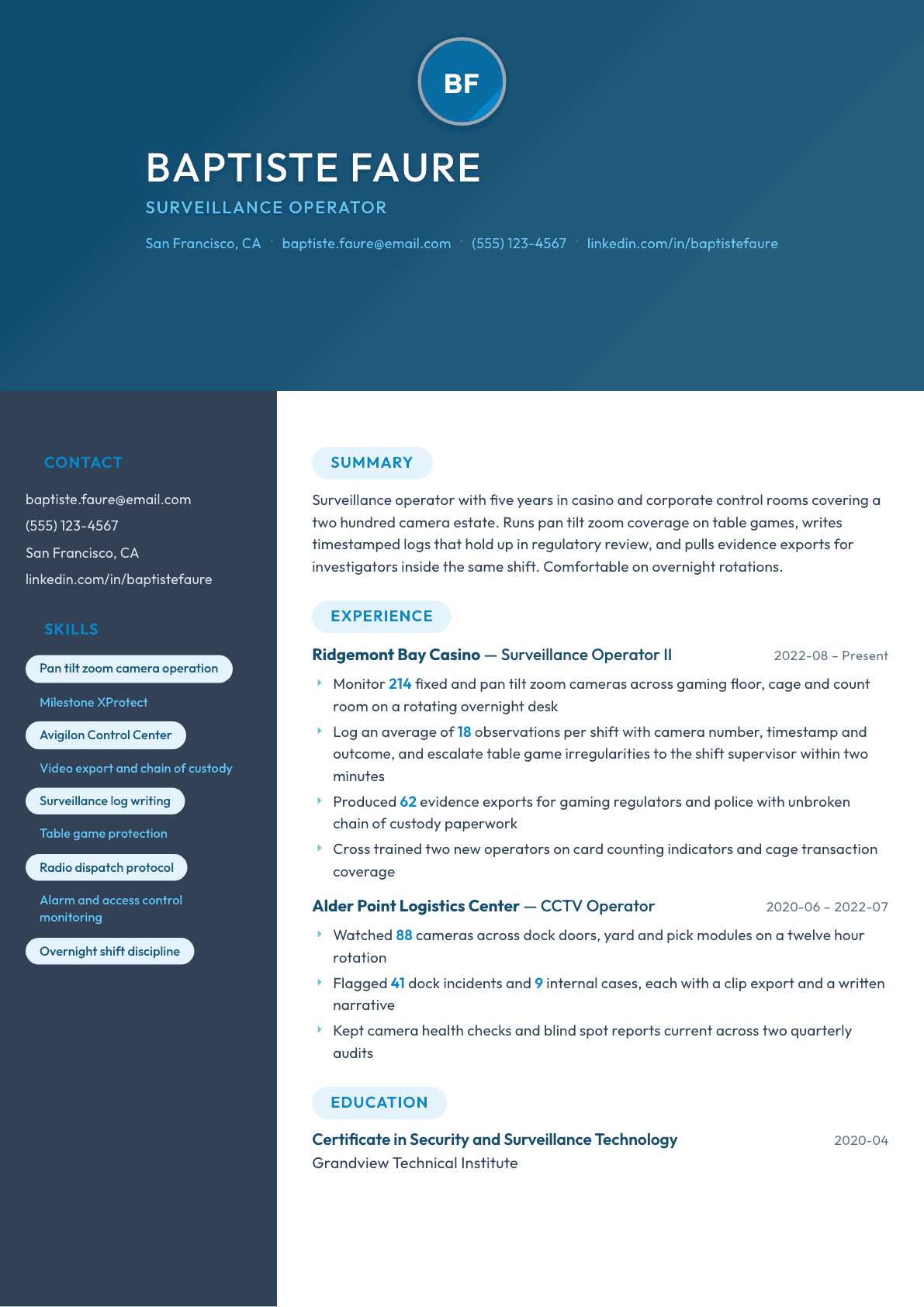
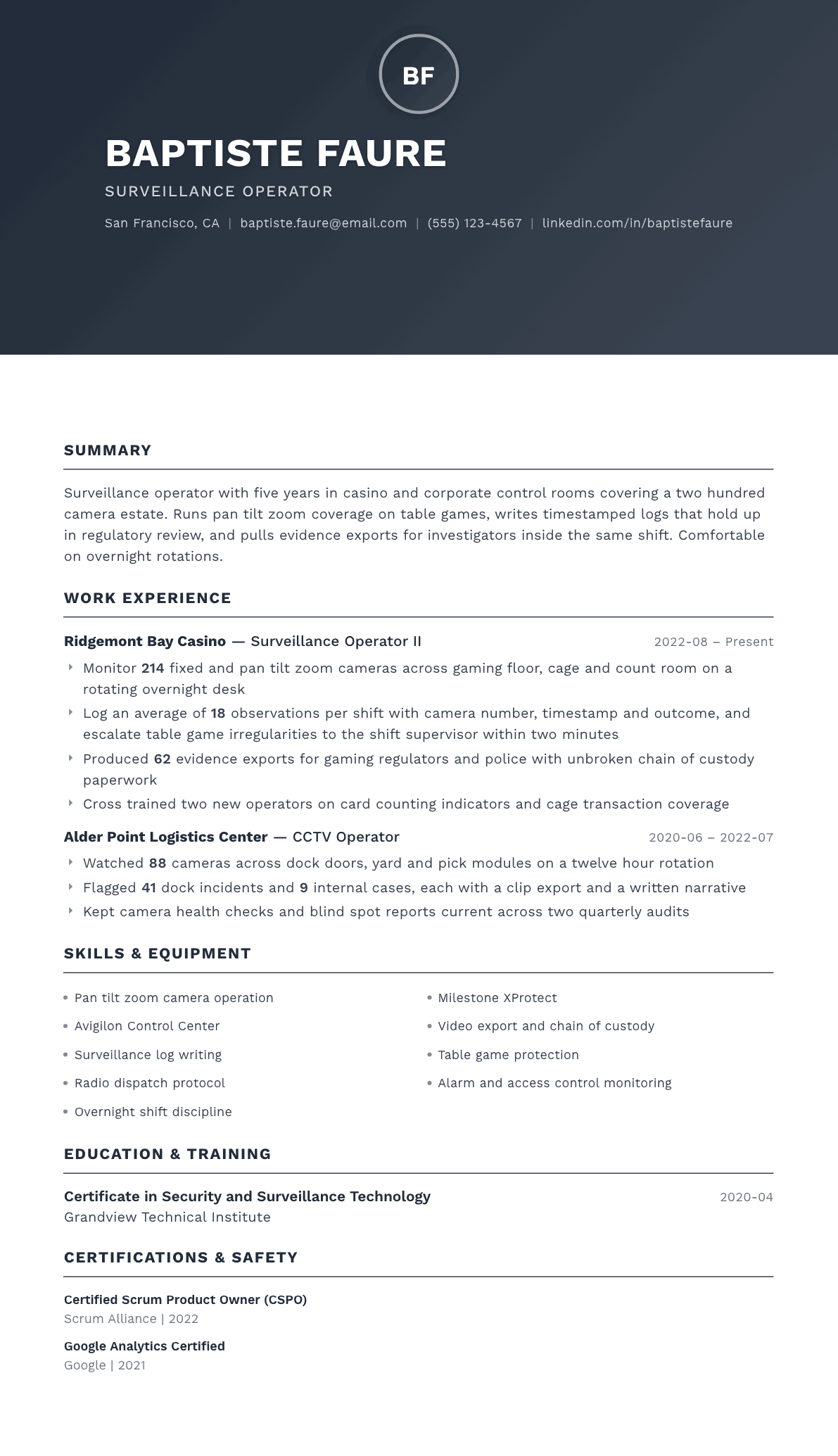
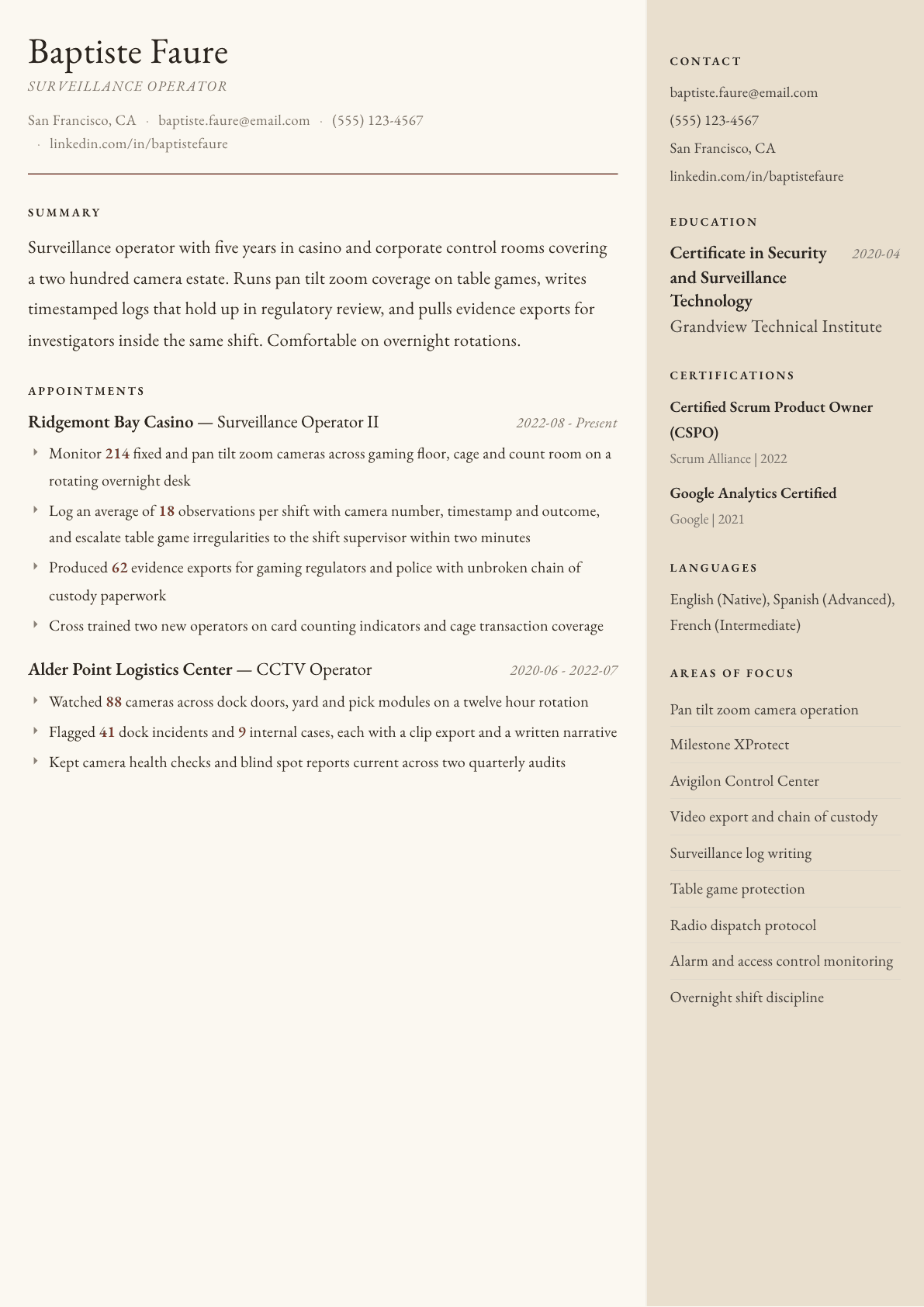
Example Surveillance Operator summary
Surveillance operator with five years on casino and distribution control room desks covering estates above two hundred cameras. Writes timestamped logs that regulators and investigators can follow without a second conversation, runs pan tilt zoom coverage on live table games, and produces evidence exports with clean chain of custody. Holds a steady overnight rotation and trains new operators on what an irregularity actually looks like.
Skills to list on a Surveillance Operator resume
- Video management systems
- Milestone XProtect
- Avigilon Control Center
- Genetec Security Center
- Pan tilt zoom operation
- Camera health monitoring
- Surveillance log writing
- Evidence export and chain of custody
- Table game and cage coverage
- Access control monitoring
- Alarm response coordination
- Two way radio protocol
- Incident escalation procedure
- Blind spot and coverage mapping
What actually gets this resume read
- Give the size of the camera estate you have watched, because a wall of twelve is not a wall of two hundred.
- Name the video management platform by product name, since retraining an operator on a new one costs real weeks.
- Put your observations logged per shift on the page, along with what share turned into a written case.
- Say whether you have handled evidence exports and chain of custody paperwork for police or regulators.
- State the shift pattern you have worked, because control rooms hire specifically for overnight coverage.
- Mention gaming, retail, logistics or corporate settings by name, since each one watches for different behavior.
How to write a surveillance operator resume
A surveillance director is staffing a desk that never goes dark. She has a camera estate, a shift rotation with an overnight nobody wants, and a regulator or an insurer who will one day ask for footage of something that happened at a quarter past three in the morning. Your resume is her evidence that you can sit in that chair and produce.
What she cannot use is a page that says you monitored CCTV and reported suspicious activity. Every operator writes that. She wants the estate size, the platform by product name, what a normal shift log looks like coming from you, and whether you have ever handed an export to somebody who took it into a hearing.
This guide walks the sections a control room reads, how to write logs and detections into bullets, three summaries across career stages, before and after rewrites, and the questions operators ask when they cross from retail or logistics into gaming or corporate work.
Format: one page, estate size and platform above everything
Reverse chronological and one page. Two only if you have worked several sectors with different regulatory regimes. Directly under your contact block, put a short line giving the largest camera estate you have covered, the video management platforms you know, and the shift patterns you have held, because those three facts decide whether the rest gets read.
Each job then opens with the environment rather than the duties. Casino, distribution center, corporate campus, hospital and transit control rooms all watch for different behavior, and an operator who names the setting first is telling a director how much retraining a move would cost.
- Estate line under contact details: camera count, mix of fixed and pan tilt zoom, and the number of monitored sites.
- Platform block: video management software, access control and alarm systems, radio and dispatch tooling, all by product name.
- Every job leads with the sector and the desk configuration, then the shift pattern you actually worked.
- Training block: any operator course, gaming registration, first aid, and evidence handling instruction with the body that ran it.
Writing detections and logs so a director can picture the shift
A log is the product a surveillance operator ships to the rest of the business, so describe yours. Give observations logged per shift, what a typical entry contains, and how many of them turned into a written incident or a case. An operator who logs eighteen observations and escalates two is describing a real desk. One who says he remained vigilant is describing nothing.
Escalation timing is the other number worth having. Say how quickly an irregularity reaches a supervisor or a floor team, because in gaming and in logistics the value of a detection collapses if it arrives after the subject has left. If you have a service standard you hold to, write it down with the figure attached.
Evidence exports, chain of custody and the paperwork nobody teaches
The moment footage leaves the system it becomes evidence, and that is where operators separate. Say whether you export clips yourself, what format and hashing the system produces, how you record the request, and who you have handed exports to: police, regulators, insurers, internal investigators or counsel. Give the annual count if you have it.
Chain of custody paperwork sounds dull on a resume and is the thing a director will ask about in the interview. One concrete sentence about how you log a request, seal a copy and record the handover will do more than a general claim about attention to detail. If you have ever had an export accepted in a hearing without challenge, say so plainly.
Camera health, coverage gaps and the maintenance half of the job
Operators who last are the ones who notice a camera has been sitting on a frozen frame for two days. Write the routine: daily health checks, the number of faults you raise a month, how blind spots get reported, and whether you have contributed to a coverage map or a redeployment after a site change. That work makes you useful to a director who is fighting for capital budget.
If you have any hand in setting presets, tours, motion zones or recording schedules, put it on the page. Those are administrator tasks in some sites and operator tasks in others, and being able to do them without calling a vendor is a genuine cost saving that reads clearly.
Skills, keywords and the sector language screeners match on
Postings recycle a small set of terms: video management system, pan tilt zoom, incident escalation, access control, chain of custody, surveillance log, alarm monitoring, radio protocol. Mirror the exact words in your skills block and show at least one of them inside a bullet with a number attached.
Sector vocabulary matters as much as the general terms. Gaming postings expect table game protection, cage and count room coverage and regulatory reporting. Logistics postings expect dock door coverage, yard checks and internal case support. Corporate postings expect executive protection support, badge exceptions and lobby escalation. Use the vocabulary of the sector you are applying to, not the one you are leaving.
Surveillance Operator resume summary examples
First control room seat
Security officer moving into a full time surveillance desk after eighteen months of console coverage on a 90 camera warehouse estate. Completed operator training on Milestone XProtect in 2024, writes timestamped observation logs, and holds a steady overnight rotation without call outs.
Five years on the desk
Surveillance operator with five years across casino and distribution control rooms covering estates above 200 cameras. Logs roughly 18 observations a shift, escalates gaming irregularities inside two minutes, and produced 62 evidence exports for regulators and police with unbroken chain of custody.
Shift lead
Surveillance shift lead running a four operator overnight desk on a 300 camera estate. Owns the export and chain of custody process, sets pan tilt zoom presets and tours after floor changes, trains new operators on irregularity recognition, and reports monthly camera fault counts to the security director.
Work experience bullets: before and after
Before: Monitored CCTV cameras and reported suspicious activity.
After: Covered a 214 camera estate across gaming floor, cage and count room, logging roughly 18 timestamped observations a shift and escalating irregularities to the floor supervisor inside two minutes.
Estate size, log volume and escalation timing let a director picture the desk instead of imagining one.
Before: Provided footage to investigators when requested.
After: Produced 62 evidence exports for gaming regulators and police, each logged with requester, camera, time range and a sealed copy recorded on the custody form.
It shows the handover process, which is the part that decides whether footage is usable later.
Before: Checked that cameras were working properly.
After: Ran daily health checks across the estate, raised an average of nine faults a month with the integrator, and mapped four blind spots that were closed in the next capital cycle.
Fault volume and a closed outcome turn a routine check into evidence you improved coverage.
Before: Helped train new surveillance staff.
After: Cross trained two operators on card counting indicators, cage transaction coverage and the point at which a hand is escalated rather than watched.
Naming what was taught proves domain knowledge that a general training claim leaves invisible.
Before: Worked night shifts in the control room.
After: Held a permanent overnight rotation on a four operator desk for three years, covering holiday and event peaks with no unplanned absences.
Overnight reliability is the hardest thing for a director to staff, so it deserves a measured line.
Hard skills
- Video management system operation
- Pan tilt zoom camera control and presets
- Multi site console monitoring
- Surveillance log writing
- Evidence export and hashing
- Chain of custody documentation
- Access control and alarm monitoring
- Table game and cage coverage
- Camera health and fault reporting
- Coverage and blind spot mapping
- Two way radio and dispatch protocol
- Incident escalation procedure
Soft skills
- Sustained attention across a long quiet shift
- Describing what you saw without adding what you assumed
- Calm radio voice while an incident develops
- Discretion about what crosses the monitors
- Handing over a desk mid incident without losing the thread
Certifications worth listing
- Certified Protection Officer (CPO) (International Foundation for Protection Officers)
- Certified Security Supervision and Management (CSSM) (International Foundation for Protection Officers)
Mistakes that cost surveillance operator candidates the interview
- Writing that you monitored cameras without ever giving the size of the estate you covered.
- Naming no video management platform, which forces a director to assume full retraining.
- Leaving out log volume and escalation timing, the two numbers that describe your actual output.
- Ignoring evidence exports and custody paperwork, which is the part that reaches a hearing.
- Skipping camera health and fault reporting, so the resume reads as watching rather than maintaining.
- Using retail vocabulary when applying to a casino, or gaming vocabulary when applying to a distribution center.
Surveillance Operator resume questions
How long should a surveillance operator resume be?
One page in almost every case. Directors scan for estate size, platform and shift availability before anything else, so a second page only earns its place when you have worked several regulated sectors and need room for the credentials each one demanded.
Do I need gaming experience to work casino surveillance?
Not always, though it shortens the path considerably. Without it, lead with estate size, log discipline and evidence handling, then say clearly that you would complete the state gaming registration, since properties care more about whether you can be registered than where you learned to watch.
Should I list every camera brand I have used?
List the video management platforms, because that is what an operator has to learn, and mention camera manufacturers only where a site ran an unusual mix. Naming four platforms you have genuinely worked in is stronger than a long hardware inventory nobody will test you on.
How do I show reliability for overnight work?
State the rotation you held and for how long, and add absence or coverage detail if it is good. Overnight staffing is the hardest gap a control room has to fill, so a candidate who volunteers a proven record on that shift moves up the pile immediately.
What if my control room work was part of a wider security officer job?
Split the job into two blocks on the page: the console hours with estate size and log output, and the patrol or post duties underneath. Directors will accept split roles, but only when they can see how many hours a week you actually spent watching monitors.
Related resume examples
- Security Guard Resume example
- Loss Prevention Specialist Resume example
- Security Officer Resume example
- Crime Analyst Resume example
- Campus Security Officer Resume example
- Loss Prevention Detective Resume example