Bouncer Resume Examples: free score, then the gap list
Write a Bouncer Resume That Gets You the Busy Door
By Mustafa Tarabya, founder of CVBooster · Published · Updated
Bouncer resume example, keyword list and writing guide covering ID checks, capacity counts, refusals, ejections and last call floor work.
Sample resumes for a bouncer
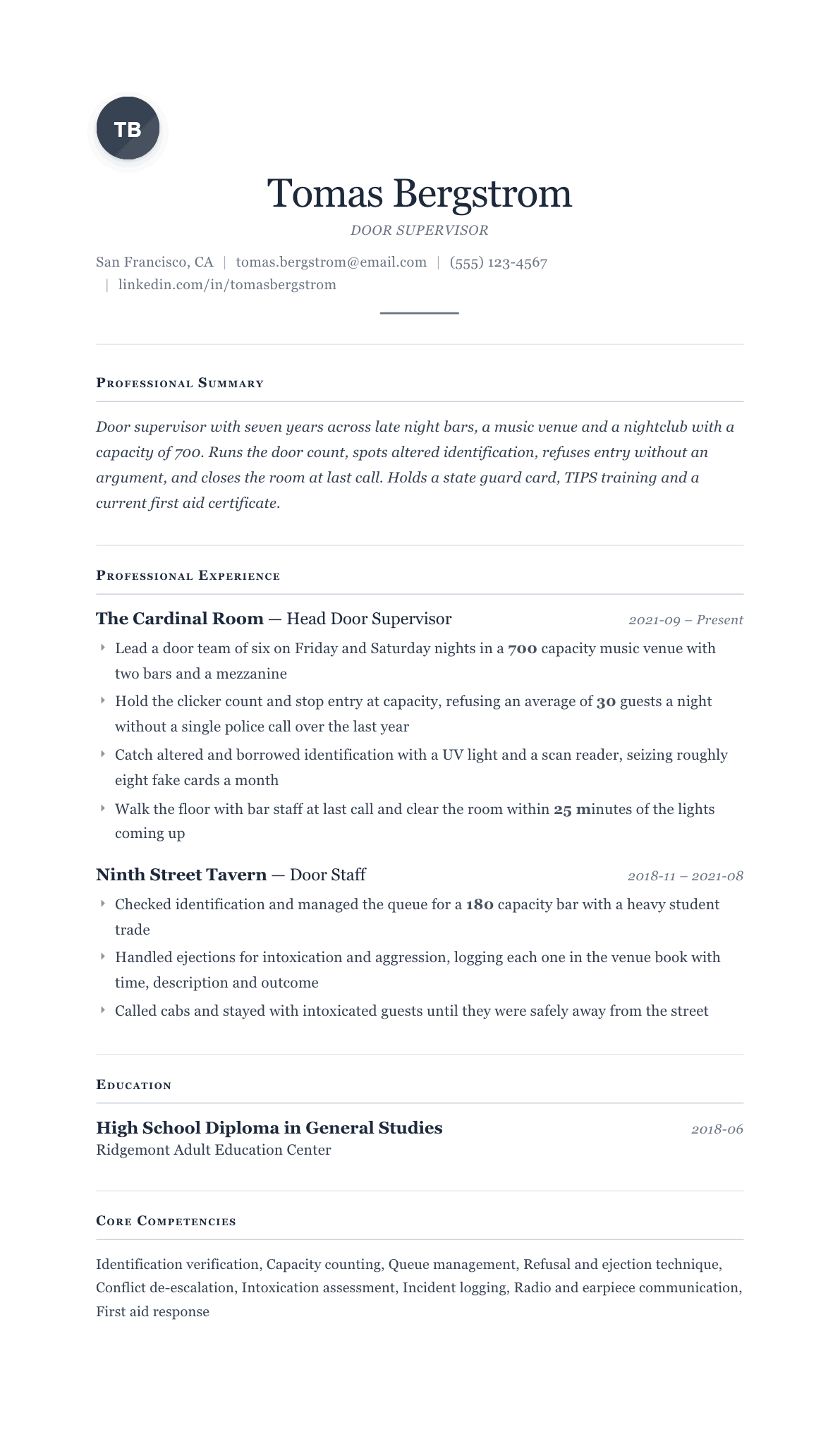
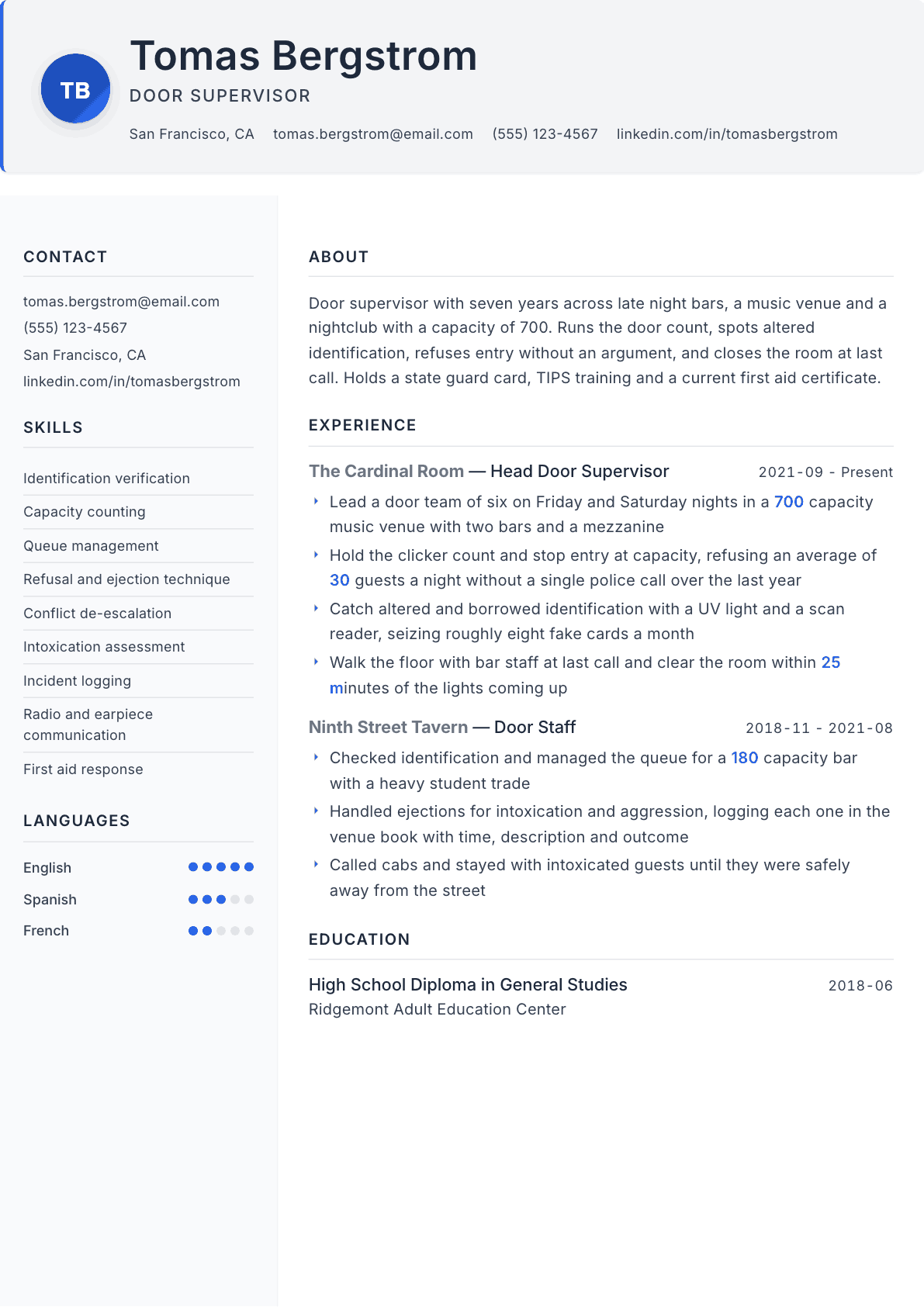
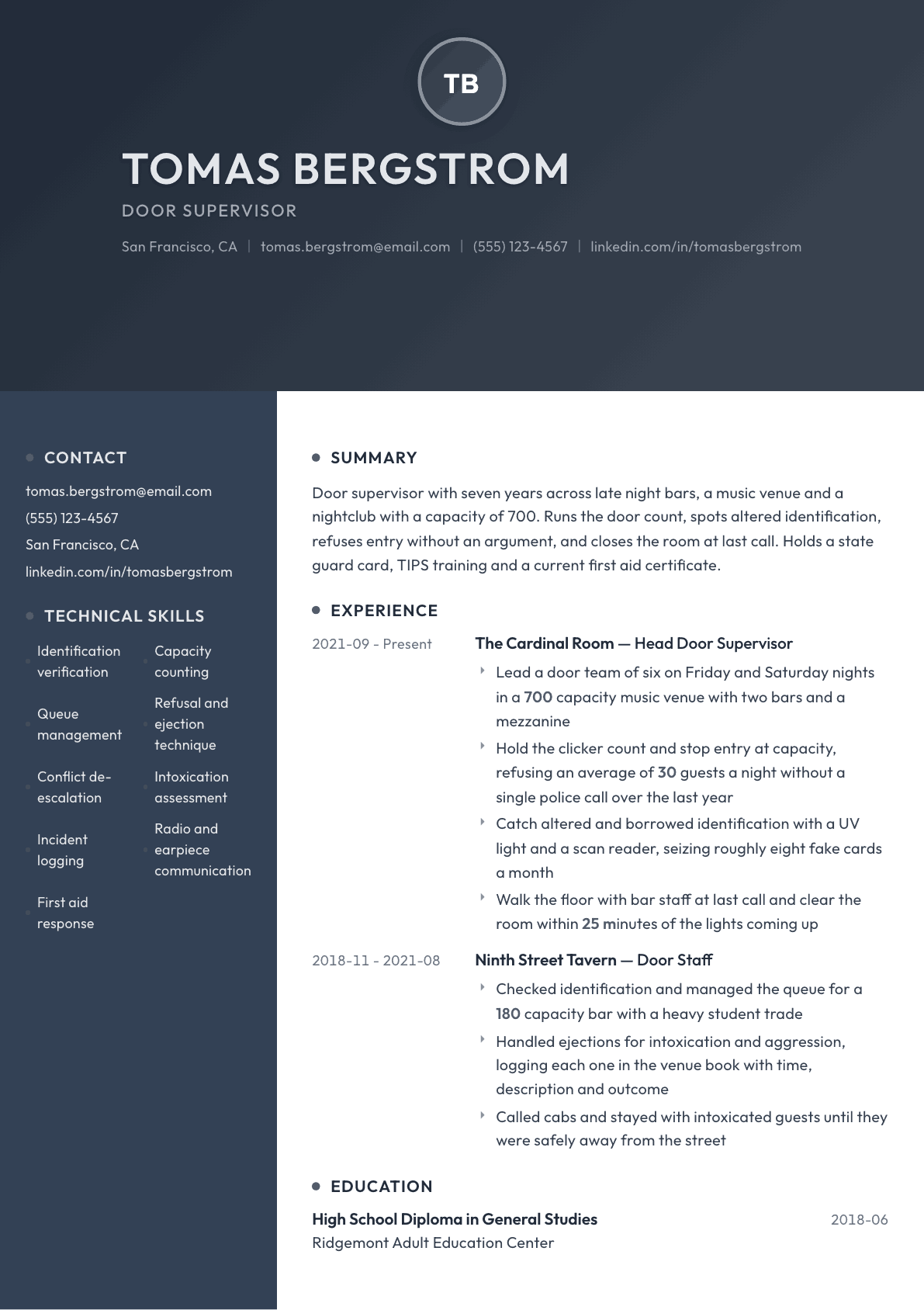
The same bouncer content laid out in three CVBooster templates, so you can see what the finished document looks like before you write a word.
Example Bouncer summary
Door supervisor with seven years on late night doors, currently leading a team of six at a 700 capacity music venue. Runs the capacity count, catches altered identification with a UV light and a scan reader, refuses roughly 30 guests a night without police involvement, and clears the room at last call with the bar team. State guard card, alcohol server training and current first aid.
Skills to list on a Bouncer resume
- Identification verification
- Fake identification detection
- Capacity and clicker counts
- Queue and line management
- Entry refusal
- Ejection procedure
- Verbal de-escalation
- Intoxication assessment
- Incident book logging
- Radio communication
- Last call floor clearing
- Search and prohibited item handling
- First aid and overdose response
- Working with local licensing officers
What actually gets this resume read
- Put the venue capacity and the trading hours on every job, because a late licence room is judged differently.
- Say how many refusals a night you handle and how many ended with a police call, since low numbers are the selling point.
- Name the identification tools you use, from UV lights to scanner apps, and how many fakes you catch in a month.
- Show your ejection method as a process, with the log entry and the handover, not as a story about winning a fight.
- List your guard card, alcohol server training and first aid certificate together where a licensee can check them.
- Mention working with bar staff at last call, because closing a room calmly is what keeps a venue out of hearings.
How to write a bouncer resume
A bouncer is hired by a licensee who is protecting a liquor license, not by a security director protecting an asset. That changes what the resume has to prove. The owner of a late night room wants to know that you can turn people away without the queue turning on you, that you can spot a borrowed identification card at eleven on a Saturday, and that the night ends with the room empty and no police report attached to it.
Applicants usually write the opposite of what wins the job. They write about breaking up fights and handling trouble, which reads to a licensee as a person who generates incidents rather than absorbs them. The strongest door resume is quiet: counts, refusals, catches, logs and clean closes.
This guide covers what to put in each section of a door supervisor resume, how to talk about refusals and ejections without sounding like a hazard, summaries for three stages of a door career, before and after bullets, and the questions door staff ask when they want a busier room and better money.
Format: one page, cards first, venues by capacity
One page, reverse chronological, plain and easy to read on a phone, because a lot of these decisions are made by a general manager reading an attachment between deliveries. There is no advantage to a long document in this trade and every disadvantage to one that buries the facts.
Your guard card and alcohol training belong in the top third. A licensee is legally exposed if he posts an unregistered person on the door, so that block gets checked before anything else. Put the issuing state and the status, and add the first aid card next to it since overdose and injury response happens on doors more than anyone admits.
- Header for door work: name, city, phone, email, guard registration status, and the nights you are available including close.
- Venue block: each room with its capacity, its trading hours and its trade, whether student, sports, live music or late night dance.
- Cards together: guard registration, alcohol server training, first aid and defibrillator, and any conflict management course.
- Job entries with the venue and the position, then bullets covering counts, refusals, identification catches and closing.
Summary: capacity, hours, and how the night ends
Three lines. Name the capacity of the busiest room you have held, the trading hours, whether you led a team, and the cards you carry. Then add the one fact a licensee wants above all: what your nights look like when they finish. Low police involvement is a stronger claim than any adjective.
If you are new to doors but have relevant background, be specific about what carries over. Working a hospital entry, an event gate, a shelter or a bar floor all build the same muscle: refusing a person and then staying calm while he argues about it for four minutes.
Experience: the count, the door, the floor and the close
Describe every venue by capacity, trading hours and trade type, because a bouncer at a 180 capacity neighborhood bar and a bouncer at a 700 capacity music venue are doing different jobs with the same title. Say whether you held the clicker count, whether the room ever hit capacity, and how you managed the one in one out queue when it did.
Then bullets on the real work. Identification checks with the tools you use: a UV light, a scan reader, a book of state formats, and how many altered or borrowed cards you catch in a typical month. Refusals per night. Search and prohibited item handling if the room searches. Floor sweeps for intoxication and for drinks going where they should not. The last call routine with the bar team and how long the room takes to clear.
Add the log. Every serious venue keeps an incident book, and a door supervisor whose entries carry the time, the description, the witnesses and the outcome is the one a licensee wants standing beside him at a license review.
Refusals and ejections: the process, not the story
A refusal at the door is cheap and an ejection from the floor is expensive, so write the resume to show you do most of your work at the door. Give a refusals per night figure. Explain the grounds you refuse on: age, intoxication, a prior ban, dress or behavior at the front of the queue. Say how you record a refusal so a repeat visitor gets the same answer twice.
For ejections, describe the sequence rather than the confrontation: the observation, the quiet word, the walk, the handover outside, the note in the book, and the cab if the person is in no state to leave alone. A licensee reading that sees someone who has thought about the venue after the person is out the door, which is exactly where his exposure actually sits.
What licensees and general managers scan for
The vocabulary of this trade is short and worth using exactly: door supervisor, capacity count, refusal, ejection, identification verification, intoxication assessment, incident book, last call, ban list, queue management, radio and earpiece. Put each once in the skills list and once in a bullet where the work is shown.
Local relationships count too. If you have worked with the licensing officers, given statements to police that stood up, or sat in a venue meeting about a problem night, put a line on it. Doors are a small world and a bouncer who is known to the local authorities as reliable is worth a premium to a room under scrutiny.
- Capacity and queue: clicker counts, one in one out, and how you hold the line at the front without an argument.
- Identification tools by name plus your monthly catch rate for altered or borrowed cards.
- Refusal and ejection numbers with the police escalation count beside them.
- Close routine: floor sweep, glass collection support, and the time the room takes to clear at last call.
Bouncer resume summary examples
New to the door
Door staff with a state guard registration, alcohol server training and current first aid, moving onto doors after two years on a busy bar floor. Confident with identification checks, intoxication signs and refusing service calmly. Available Thursday through Sunday including close.
Three years on late doors
Door supervisor with three years on late night bars trading to three in the morning. Holds the capacity count, refuses about 20 guests a night on age and intoxication, catches altered identification with a UV light and a scan reader, and logs every incident with time, description and outcome.
Head of door
Head door supervisor leading a team of six at a 700 capacity music venue with two bars and a mezzanine. Runs the count, sets post rotation, seizes roughly eight fake cards a month, and closed the last year with no police calls arising from a refusal at the front door.
Work experience bullets: before and after
Before: Checked IDs at the door.
After: Verified identification for every guest using a UV light and a scan reader against a state format book, seizing roughly eight altered or borrowed cards a month.
Naming the tools and the catch rate turns a routine task into evidence of a trained eye.
Before: Kept the club from getting too full.
After: Held the clicker count for a 700 capacity room, stopped entry at the legal number and ran one in one out for up to two hours on peak Saturdays.
The capacity, the method and the duration show that you have actually managed a full house.
Before: Dealt with troublemakers and removed them.
After: Refused an average of 30 guests a night on age, intoxication and ban list grounds, with no police call arising from a front door refusal in the last year.
It shifts the emphasis from confrontation to prevention, which is what protects a license.
Before: Helped close the venue at the end of the night.
After: Worked last call with the bar team, swept the floor and smoking area for stragglers and cleared a full room within 25 minutes of the lights coming up.
A closing time is a measurable outcome that a general manager can compare against his own night.
Before: Wrote up incidents when they happened.
After: Logged every refusal and ejection in the incident book with time, description, witnesses and outcome, and gave two statements to licensing officers that were accepted without follow up.
Documentation quality and a clean statement history are what a licensee needs at a review hearing.
Hard skills
- Identification verification and format knowledge
- Altered identification detection with UV and scan tools
- Capacity counting and queue control
- Entry refusal on legal grounds
- Ejection and escort procedure
- Intoxication assessment
- Search and prohibited item handling
- Incident book documentation
- Ban list administration
- Radio and earpiece communication
- Last call floor sweep
- First aid and overdose response
Soft skills
- Refusing someone without giving him an audience
- Keeping tone flat when a queue is watching
- Reading a group before it splits into a problem
- Working with bar staff instead of around them
- Remembering faces and previous bans across months
Certifications worth listing
- TIPS Alcohol Certification (Health Communications, Inc.)
- ServSafe Alcohol (National Restaurant Association)
- Adult First Aid, CPR and AED (American Red Cross)
Mistakes that cost bouncer candidates the interview
- Writing about fights you handled, which tells a licensee you are near the center of incidents rather than ahead of them.
- Leaving out the capacity and trading hours of each venue, so nobody can judge whether the room matched theirs.
- Skipping the identification detail, when catching altered cards is the single task that protects the license most directly.
- Listing a guard registration without the issuing state or the status, which stops a manager from posting you legally.
- Ignoring the close, even though clearing a room calmly at last call is the part general managers complain about most.
- Presenting yourself by size and strength instead of by counts, logs and refusals that a licensee can verify.
Bouncer resume questions
Do I need a license to work as a bouncer?
In most states paid door work requires a security guard registration, and many cities add their own permit for licensed premises. Put the registration status, the state and the expiry month on the resume so the general manager knows the day you can start.
How do I move from a small bar to a big nightclub?
Show the transferable numbers: refusals a night, identification catches a month, incident book entries and closing times. Then say what you have not done yet. Head door supervisors respect an applicant who admits he has not run a team of eight and wants to learn it.
Should I put physical size or martial arts training on the resume?
Training in restraint or conflict management is worth listing as a course with the provider named. Physical description is not, and it tends to work against you because licensees hire for judgment. The best door staff rarely touch anyone in a whole shift.
What do I write if I have a criminal record?
The resume is not the place for it, but your guard registration application is, and lying there ends the career. Keep the resume factual, get the registration sorted first, and be ready to answer the question directly at the interview.
How do I show experience if most of my work was cash in hand?
Name the venue, the dates and the role anyway, and give the same counts you would for any job. Add a reference from the general manager or the head of door. A licensee cares far more about a name he can call than about the payroll arrangement.
Related resume examples
- Security Guard Resume example
- Event Security Resume example
- Bartender Resume example
- Security Officer Resume example
- Unarmed Security Guard Resume example
- TSA Officer Resume example