Security Officer Resume Examples: the lines they read
Security Officer Resume: Skills, Example and Keywords
By Mustafa Tarabya, founder of CVBooster · Published · Updated
Security officer resume skills, example and keywords: registration, access control, video systems, patrol tours, report writing and de-escalation.
Sample resumes for a security officer
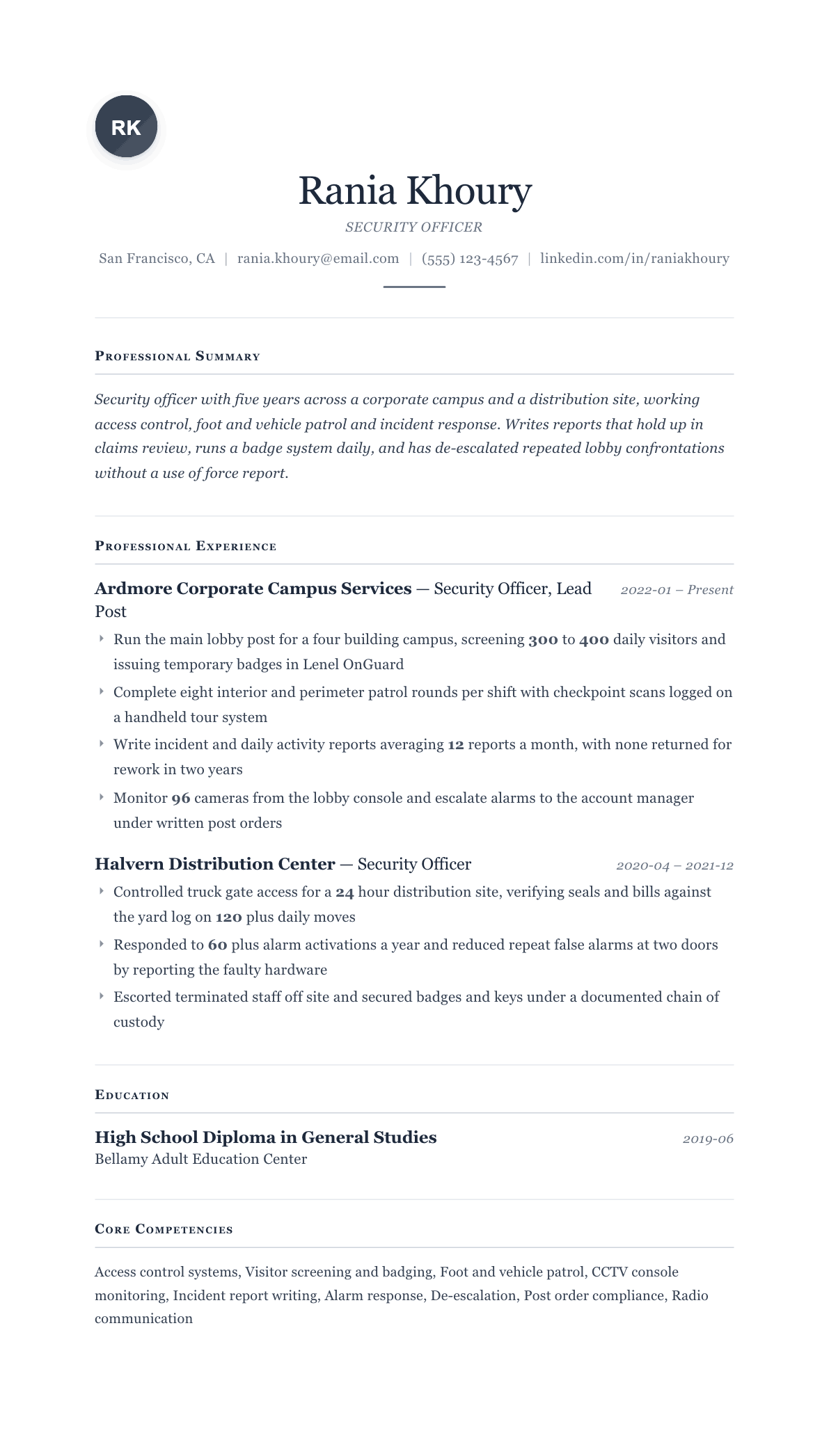
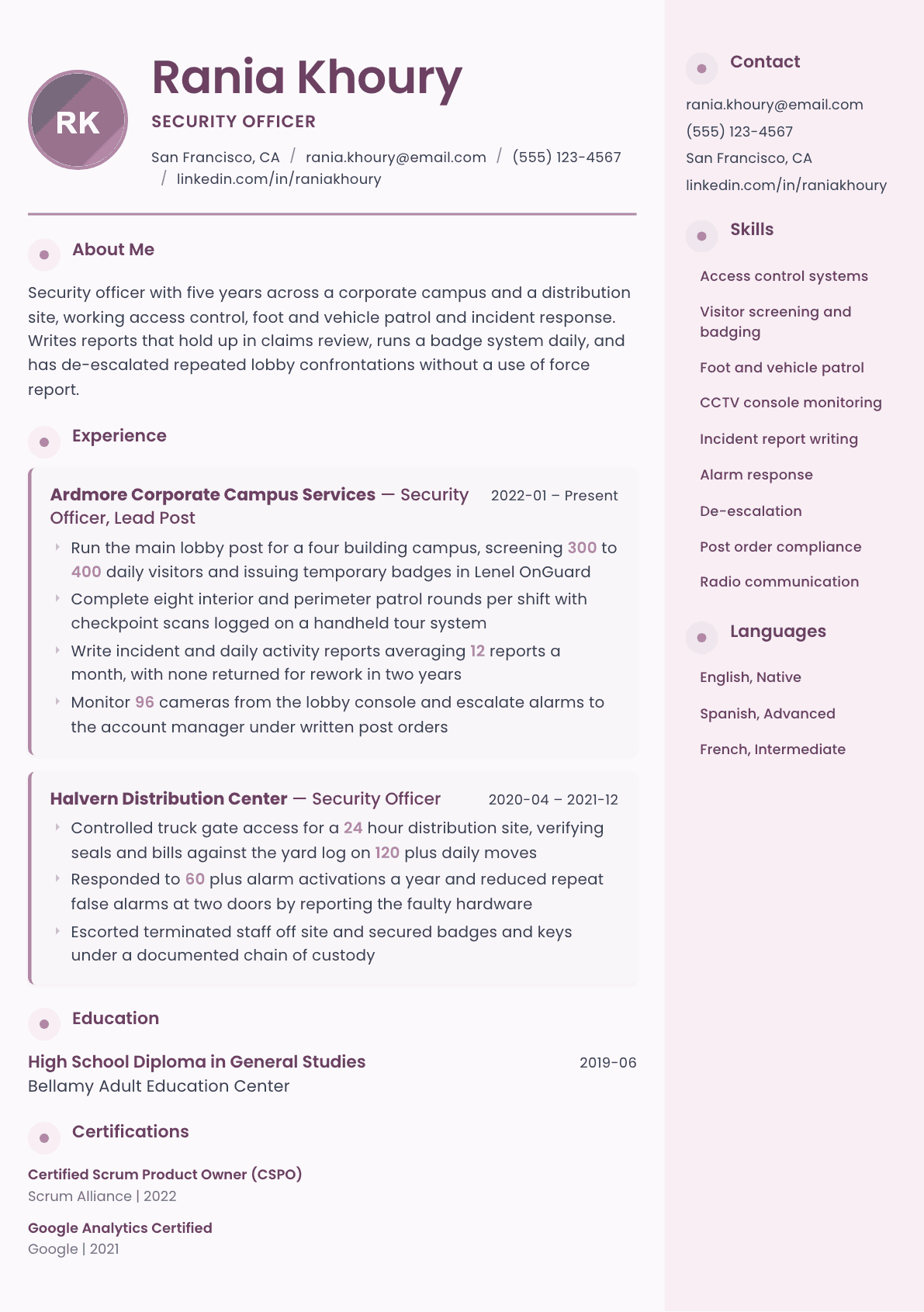
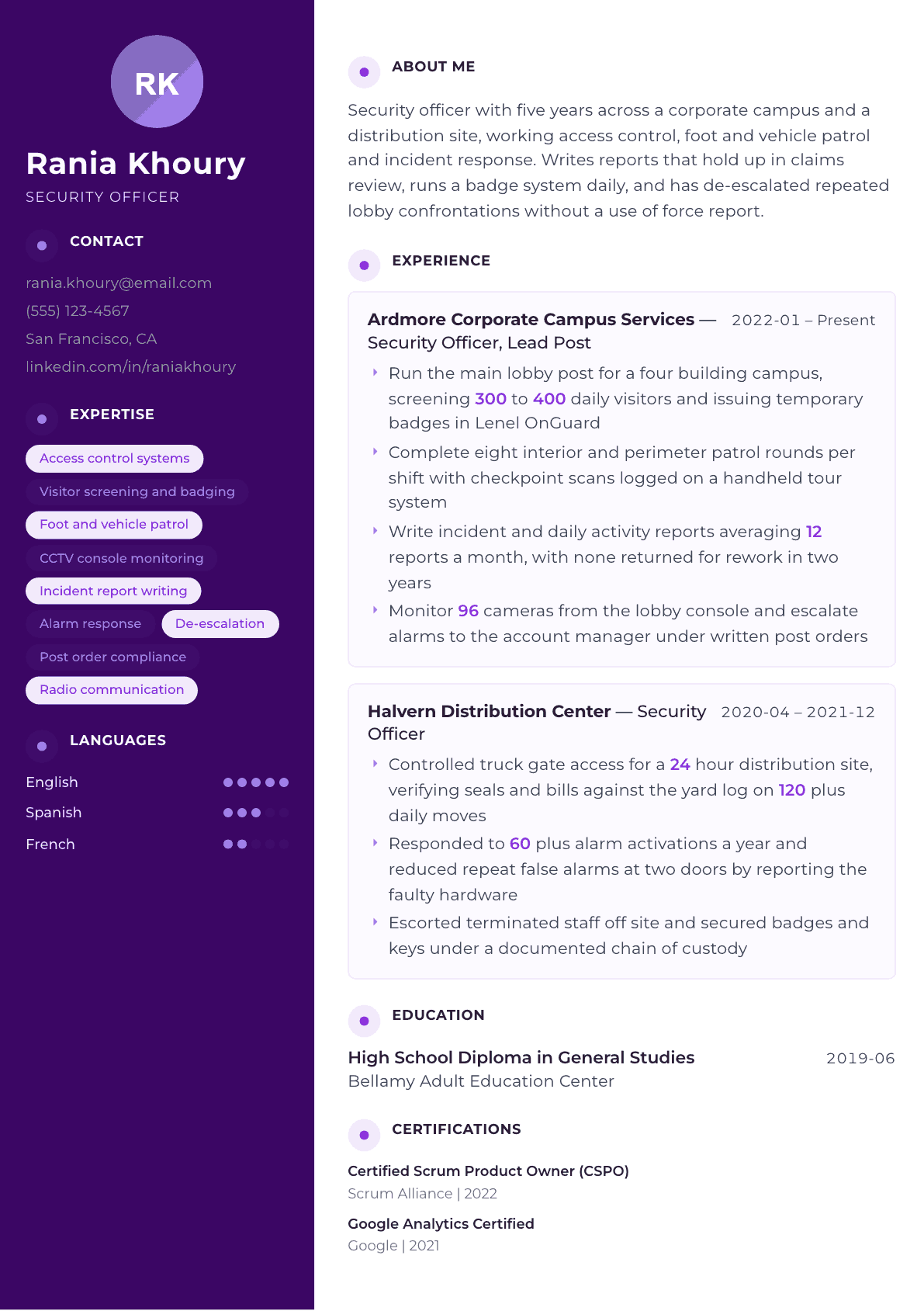
The same security officer content laid out in three CVBooster templates, so you can see what the finished document looks like before you write a word.
Example Security Officer summary
Security officer with five years across a corporate campus and a distribution site, covering lobby access control, interior and perimeter patrol, camera console work and alarm response. Screens hundreds of daily visitors, completes eight patrol rounds a shift with checkpoint scans, and writes incident reports that hold up in claims review. Holds a current state guard registration and a first aid certificate.
Skills to list on a Security Officer resume
- Access control and badging
- Visitor management systems
- CCTV monitoring
- Foot patrol and checkpoint scanning
- Vehicle patrol
- Alarm response and reset
- Incident and daily activity reports
- Post order compliance
- De-escalation and verbal control
- Key and lock control
- Emergency evacuation support
- First aid and AED response
- Two way radio protocol
- Trespass and escort procedures
- Lost and found chain of custody
What actually gets this resume read
- Name your state guard card or registration number status, because a contract cannot post you without it.
- Say what kind of site you guarded, since a hospital lobby and a chemical plant gate need different officers.
- Give the access control and camera platforms you have operated, because clients buy officers who already know theirs.
- Count your patrol rounds and checkpoint scans per shift, which is the metric account managers audit every week.
- Quantify your report writing, because most security hiring turns on whether your reports survive a claim.
- Describe one de-escalation you handled without force, with what you said and what the outcome was.
- List your shift availability plainly, since overnight and weekend coverage is often the reason a post stays open.
How to write a security officer resume
An account manager filling a security officer post is solving a scheduling problem with a compliance problem attached. She needs somebody registered, reliable on the shift nobody wants, able to follow written post orders exactly, and capable of producing a report that will not embarrass the company if a client attorney reads it. Your resume either answers those four or it goes back in the pile.
Most applicants write the same page. They monitored premises, provided a security presence, ensured the safety of staff and visitors. None of that tells a manager what site you covered, how many people you screened, which access control system you operated or what you did the last time someone refused to leave.
This guide covers the sections a contract or in house employer reads for a security officer role, the numbers that make a post history credible, and how to write a page that survives both the client review and the licensing check behind it.
Format: registration first, then site type, then coverage
One page. A security officer resume is read fast and often by someone staffing a schedule this week. Put your state guard registration or license equivalent, its status and its expiration on the first two lines, because an officer who cannot be posted legally is not a candidate no matter how good the rest reads.
Order your history by site type rather than by employer brand. Contract officers often work several accounts under one company, and a manager needs to see that you have covered a hospital lobby, a data center perimeter or a distribution gate. Break the accounts out under the employer so the range is visible.
- Registration line: state guard card or registration, issuing state, status and expiration month.
- Site line under each account: property type, square footage or building count, staffed hours and post count.
- Systems line: access control platform, video management system, visitor management tool and the tour or checkpoint system.
- Availability line: the shifts and days you can actually work, stated plainly rather than implied.
- Training line: first aid, CPR and AED, plus any site specific training such as bloodborne pathogens or workplace violence response.
Summary: site type, post duties, volume, report quality
Lead with where you have stood and what the post required. An officer who has run a lobby screening several hundred visitors a day is a different hire from one who has patrolled an empty construction yard overnight, and both are valid, but only one matches the vacancy in front of the reader.
Close the summary with report quality. Incident documentation is the product a security company actually sells, and an officer who can say that reports left the site complete and were not returned for rework is describing the thing that keeps an account.
Experience: post orders, patrol, access control, incidents
Write each post around what the post orders required. Access control has a volume and a method: how many visitors, contractors and deliveries you processed, what identification you checked, how badges were issued and returned. Patrol has a route and a rhythm: how many rounds per shift, how many checkpoints, whether the route changed after dark and how it was logged.
Console work deserves a bullet of its own if you have done it. Say how many cameras you monitored, what you were authorized to escalate, and whether you handled alarm acknowledgment and reset. Officers who can hold a console and a lobby at the same time are what account managers are short of.
Incidents are where a resume proves judgment. Give the volume, then give one example: a trespass that ended with a police report, a medical event where you cleared a path and met the ambulance, an alarm you traced to failing door hardware and had fixed. Write outcomes, not drama.
Cut the lines that every officer writes. Maintained a visible presence, ensured a safe environment and provided excellent customer service belong to nobody. Replace each with what you actually did on a shift and how much of it there was.
What makes an officer keepable rather than just hireable
The security industry loses officers quickly, so anything that shows durability is worth space. Length of assignment on a single account, the number of shifts covered on short notice, a clean attendance record and the number of consecutive months on nights all read as low risk to a manager who has been burned repeatedly.
Client facing conduct matters as much as security work at most posts. Officers are the first person a visitor meets, and a complaint from a tenant can end an assignment faster than a missed patrol. If you have gone a long stretch with no client complaint, or received a written commendation, put it on the page in one line.
- Assignment length on each post, and any account you were specifically requested for.
- Attendance and coverage record, including short notice shifts picked up.
- Commendations, client compliments or officer of the month recognition, dated to the account.
- Uniform and equipment accountability, including radios, keys and vehicle condition reporting.
- Any training you delivered to newer officers, even informally on post.
Skills and keywords the screening looks for
Postings for a security officer repeat a small set of terms: access control, visitor screening, patrol rounds, checkpoint scanning, alarm response, incident reporting, daily activity report, post orders, de-escalation. Use them in the exact form the posting uses, once in the skills block and once where the work is shown.
Two things get filtered on before anything else and belong high on the page: your registration status and your ability to pass a background and drug screen. You do not need a paragraph, just a clear line, because a recruiter who has to ask about either will often just move on to the next application.
Security officer resume skills: what to list and how to word it
Security officer resume skills fall into three groups: the licensed and technical skills a client contract requires, the post skills that show you can run a shift alone, and the people skills that keep a lobby calm. Most applicants write a list of adjectives. The ones who get posted write each skill with the system, the volume or the result attached.
Lead the skills section with your registration and certifications, then the systems you have operated, then the post skills. Keep soft skills out of the list and show them in experience bullets instead, where a de-escalation or a clean report proves them.
- Access control: Issue and deactivate badges in Lenel OnGuard for around 350 visitors and contractors a day.
- Video surveillance: Monitor 40 cameras on Genetec Security Center and pull footage for incident reports on request.
- Patrol and tour systems: Complete eight patrol rounds a shift with checkpoint scans logged on a handheld tour system.
- Report writing: Write incident and daily activity reports with photographs attached, none returned for rework in two years.
- Emergency response: Lead floor sweeps during evacuation drills and act as the radio contact for the fire panel.
- De-escalation: Trained in verbal de-escalation and used it to resolve trespass and disturbance calls without force.
- First aid: CPR, AED and first aid certified, with on site response to medical calls until EMS arrival.
Security Officer resume summary examples
First security post
Security officer with a current state guard registration and first aid certification, moving from three years of overnight retail stocking and customer service. Comfortable on overnight and weekend shifts, trained on post orders and radio protocol, and seeking a fixed lobby or gate post with a steady schedule.
Four years on post
Security officer covering a four building corporate campus, screening 300 to 400 daily visitors, issuing badges in an access control platform and completing eight patrol rounds a shift with checkpoint scans. Writes about a dozen incident reports a month with none returned for rework across two years.
Lead officer
Lead security officer with eight years across corporate, distribution and healthcare accounts, holding the console and the lobby post on a campus staffed around the clock. Trains incoming officers on post orders and report writing, and has been requested by name for two client accounts after coverage changes.
Work experience bullets: before and after
Before: Monitored the building and checked visitors in.
After: Ran the main lobby post for a four building campus, screening 300 to 400 daily visitors against the expected arrivals list and issuing temporary badges with same day expiry in the access control system.
Visitor volume, the verification method and badge handling show a real access control post instead of a greeting desk.
Before: Patrolled the property on foot.
After: Completed eight interior and perimeter patrol rounds per shift with 28 checkpoint scans logged on a handheld tour system, varying the route order after dark so the pattern was not predictable.
Round count, checkpoint count and route variation prove patrol discipline that a client audit can verify.
Before: Wrote incident reports as needed.
After: Wrote an average of 12 incident and daily activity reports a month covering trespass, medical events and property damage, with photographs attached and none returned by the account manager for rework in two years.
Volume, incident types and the rework record make report quality a measurable claim rather than an assurance.
Before: Responded to alarms in the building.
After: Responded to more than 60 alarm activations a year, clearing each on site before reset, and eliminated repeat false alarms at two loading dock doors by reporting the failing hardware to facilities.
An alarm count plus a root cause fix shows an officer who reduces the problem rather than only reacting to it.
Before: Dealt with difficult people at the front desk.
After: De-escalated repeated lobby confrontations with a former contractor by keeping the desk between us, offering a phone call to his supervisor, and calling police only once across four encounters, with no use of force report filed.
Position, technique, escalation restraint and the reporting outcome are what a manager needs to trust your judgment.
Hard skills
- Access control and badge issuance
- Visitor management systems
- Contractor and delivery screening
- Foot and vehicle patrol
- Checkpoint tour systems
- Video management console monitoring
- Alarm acknowledgment, response and reset
- Incident and daily activity report writing
- Post order compliance
- Key, lock and equipment control
- Emergency evacuation support
- First aid, CPR and AED response
- Two way radio protocol
- Trespass notice and escort procedures
Soft skills
- Staying alert on a quiet post at four in the morning
- Turning away a visitor without making the client look unwelcoming
- Writing plainly enough that a stranger can follow the incident a year later
- Following post orders exactly even when a shortcut looks harmless
- Reporting your own mistake before the client finds it
Certifications worth listing
- Certified Protection Officer (CPO) (International Foundation for Protection Officers)
- Basic Security Officer Training Certification (International Association for Healthcare Security and Safety)
- First Aid, CPR and AED (American Red Cross)
Mistakes that cost security officer candidates the interview
- Leaving the guard registration status off the page, forcing a recruiter to email before she can even consider you.
- Naming only the security company and never the site type, so the range of posts you have covered stays invisible.
- Writing that you maintained a safe and secure environment, a phrase that appears on almost every application received.
- Skipping patrol round and checkpoint counts, which are exactly what a client audit measures the account on.
- Omitting the access control and camera platforms you know, when platform familiarity is what shortens onboarding.
- Failing to state shift availability, which is the most common reason a suitable applicant is passed over.
- Describing conflicts without the outcome, leaving a manager unsure whether your instinct is to talk or to grab.
Security Officer resume questions
Do I need a guard card before I apply?
In most states yes, and in the rest an employer will still prefer it. If yours is in progress, say so with the application date and expected issue, because a manager can sometimes schedule around a known date but cannot plan around silence.
How do I move from an unarmed post to a better paying site?
Show the site complexity you can already handle: access control volume, console monitoring, alarm response and clean report writing. Higher paying posts are usually higher consequence rather than higher risk, so evidence of documentation quality and reliability moves you more than tactical training does.
Should I list every account I worked under one contract company?
List the accounts that show range and length, grouped under the employer, and summarize the rest. Four distinct site types under one company reads as versatility. Twelve short assignments with no pattern reads as instability, so group those into a single line.
What should I write if my only experience is military or police?
Translate it into post language. Gate and entry control point duty is access control, guard mount is roll call, blotter entries are daily activity reports. Keep the tactical detail brief and put the documentation, screening and standing post work in front instead.
What skills should I put on a security officer resume?
List your guard registration and first aid certifications first, then the systems you operate, such as access control, video management and patrol tour software, then post skills like report writing, patrol and emergency response. Add a number to each, such as visitors screened a day, and show de-escalation and communication in your experience bullets.
Related resume examples
- Security Guard Resume example
- Loss Prevention Specialist Resume example
- Campus Security Officer Resume example
- Event Security Resume example
- Surveillance Operator Resume example
- Armed Security Guard Resume example