Victim Advocate Resume Examples: the lines they read
Craft a Victim Advocate Resume for Court and Community Programs
By Mustafa Tarabya, founder of CVBooster · Published · Updated
Victim advocate resume sample with court accompaniment examples, confidentiality language, advocacy keywords and a complete writing guide.
Sample resumes for a victim advocate
The same victim advocate content laid out in three CVBooster templates, so you can see what the finished document looks like before you write a word.
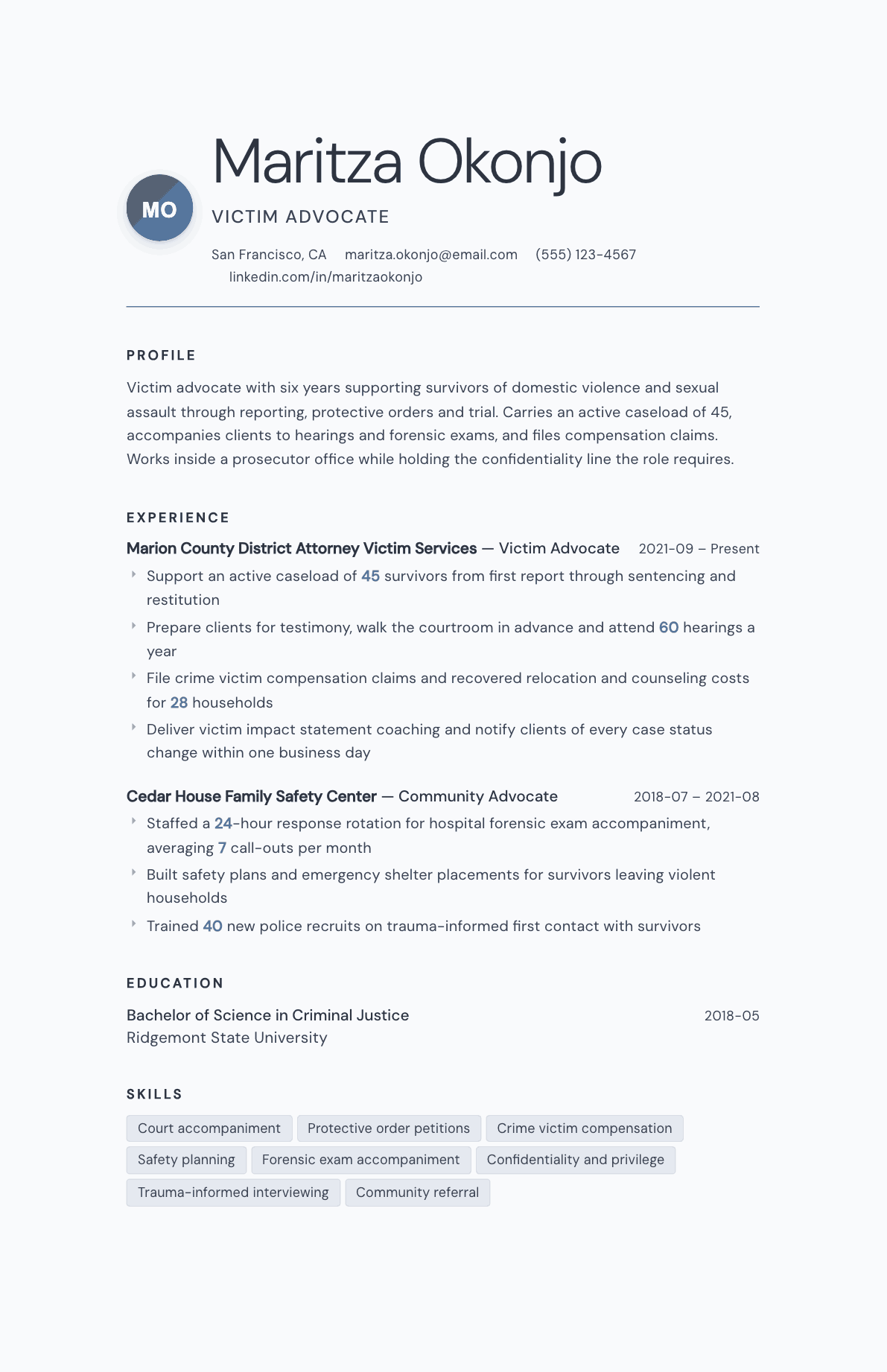
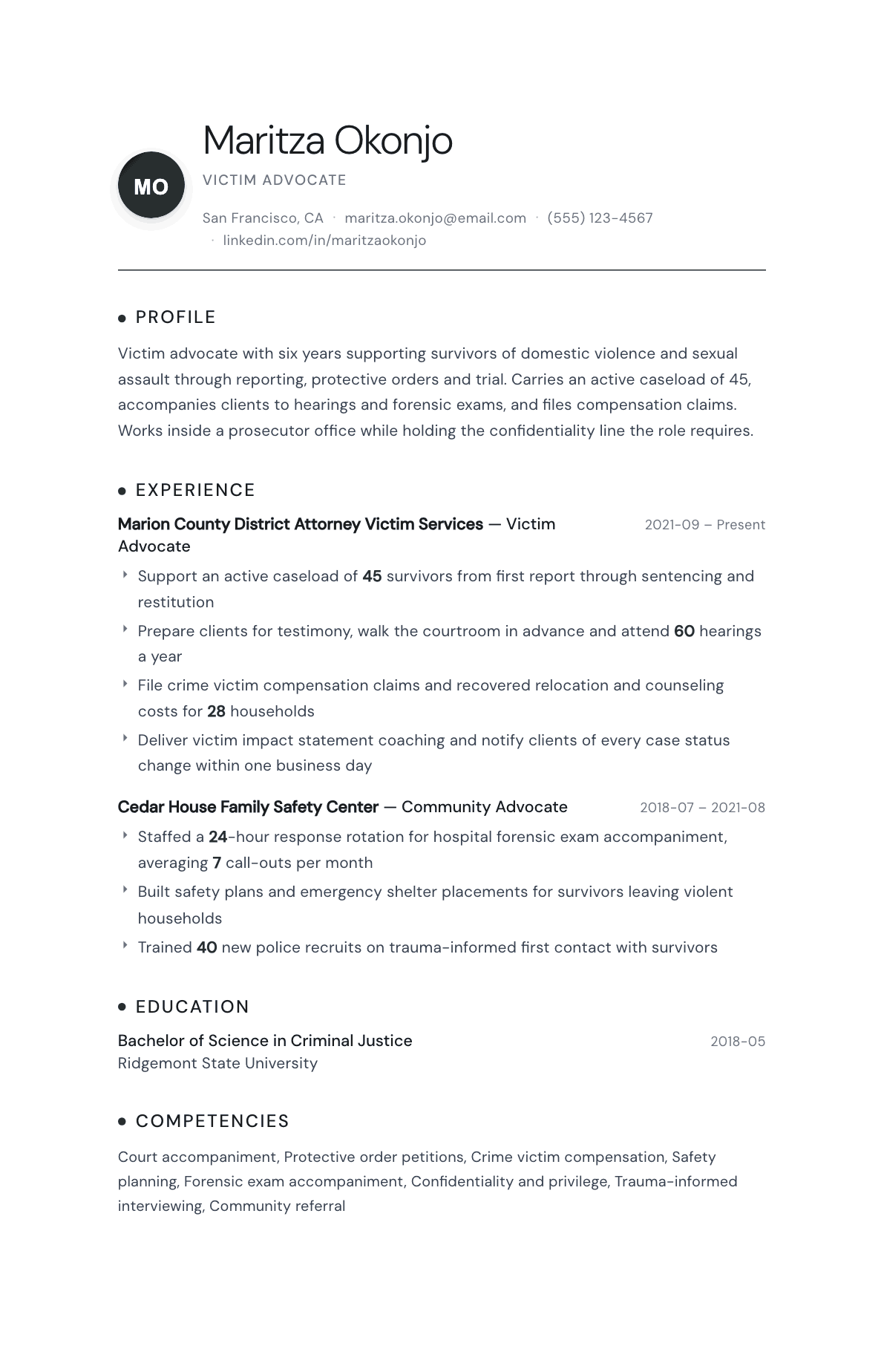
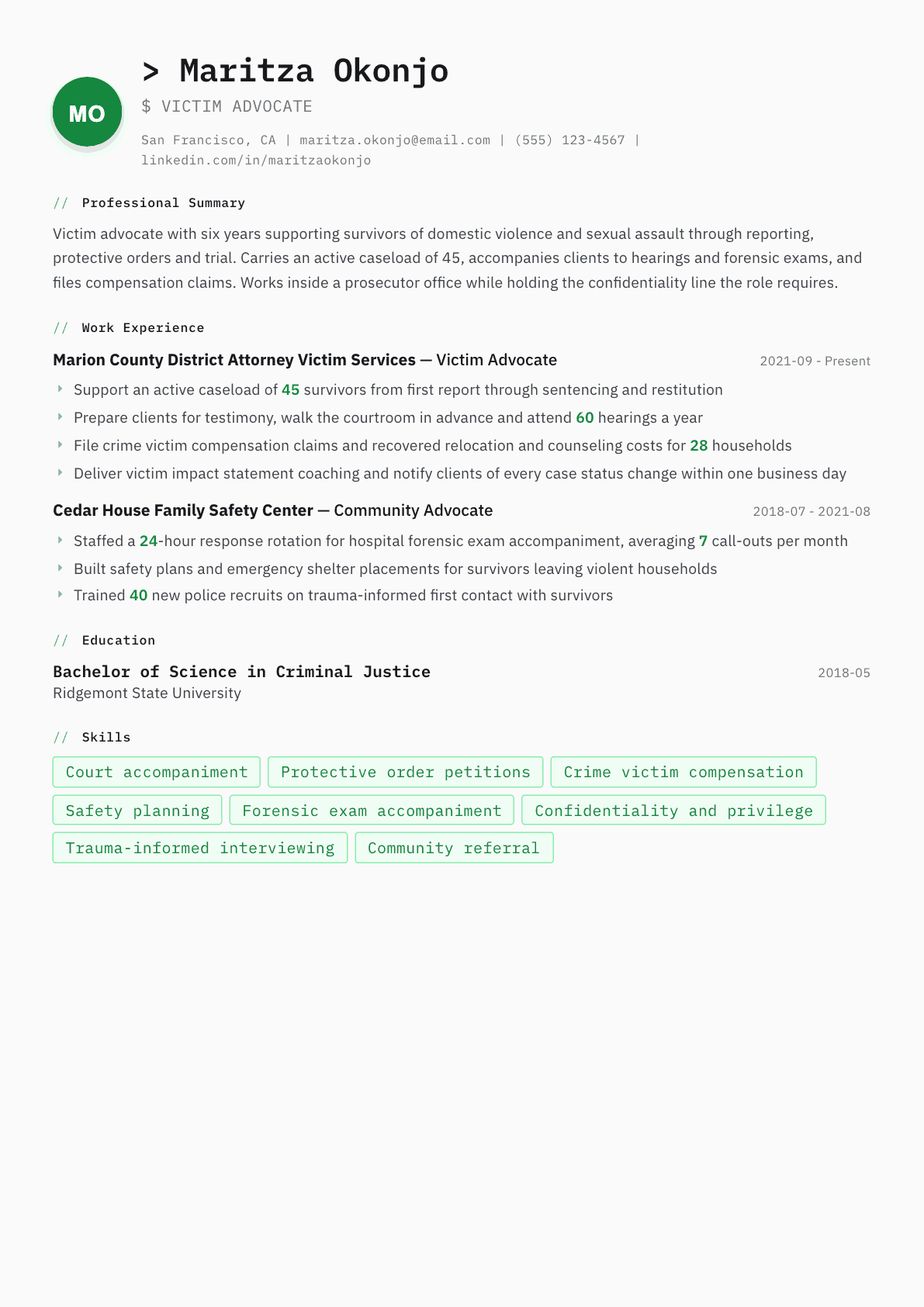
Example Victim Advocate summary
Victim advocate with six years in a prosecutor based unit and a community family safety center, supporting survivors of domestic violence and sexual assault. Carries 45 active cases, accompanies clients to hearings and forensic exams, and files compensation and protective order paperwork. Trains law enforcement on trauma-informed first contact. Available for overnight response rotation.
Skills to list on a Victim Advocate resume
- Victim advocacy
- Court accompaniment
- Protective order assistance
- Crime victim compensation claims
- Safety planning
- Trauma-informed interviewing
- Confidentiality and privilege
- Hospital forensic exam accompaniment
- Emergency shelter placement
- Case notification and status updates
- Community resource referral
- Multidisciplinary team participation
- Victim impact statement support
- Crisis intervention
What actually gets this resume read
- State the setting plainly: prosecutor based, law enforcement based or community based, because privilege rules differ between them.
- Quantify the caseload and the hearings attended per year so a supervisor can picture your court schedule.
- Show compensation and protective order work with filing volume, since those are the tasks a hiring panel checks first.
- Describe confidentiality handling in one bullet, because advocacy employers screen for candidates who understand privileged communication.
- Include hotline rotation and hospital accompaniment availability, including overnight call-out, if you have carried it.
- List advocate credentials and the training hours behind them rather than describing yourself as passionate about survivors.
How to write a victim advocate resume
Victim advocate postings look similar and describe very different jobs. One is inside a prosecutor office, where you sit at the elbow of a trial team and your notes may be discoverable. One is inside a police department, where you arrive with the responding officer. One is at a community agency, where your communications may be privileged and part of your work is telling a survivor what the prosecutor cannot promise. A hiring panel reads your resume looking for evidence that you know which one you worked in.
The second thing they read for is capacity. Advocacy is a caseload job with a court calendar attached, so the panel wants the number of survivors you carry, the hearings you attend, the compensation claims you file and the after-hours rotation you cover. Warmth is assumed. Volume, paperwork accuracy and courtroom composure are what get tested.
This guide walks the resume in the order that panel reads it, with sample summaries for a new advocate, an experienced one and a supervising advocate, before and after bullets, and answers to the questions advocates raise most when they apply across program types.
Say where you sat: system based or community based
Write the program type into the job line itself. A system based advocate in a district attorney office works the case calendar, notifies survivors of continuances and pleas, and operates under the office's disclosure rules. A community based advocate at a shelter or family safety center holds confidentiality differently and often supports people who will never file a report. Panels hire for one or the other, and mixing the vocabulary makes an applicant look untrained.
If you have done both, say so plainly and use it as an advantage. Advocates who have worked either side understand why a survivor stops returning calls after the first hearing, and that understanding is worth a sentence in the summary.
- Job line: agency, program type, the crime types you covered, and the counties or jurisdictions served.
- State whether your communications were confidential, privileged, or subject to office disclosure rules.
- Note after-hours rotation, hospital accompaniment call-outs, and whether you carried a program phone.
Caseload, court calendar and notification duties
Give the active caseload and the flow through it: new referrals per month, cases carried at once, and how long a case stays open from report to sentencing. Then give the courtroom side, because that is what makes this job distinct from general case management. Hearings attended per year, arraignments and preliminary hearings covered, trials sat through, and how you prepared a survivor to testify.
Notification is quietly the largest workload in system based advocacy and is almost never on a resume. Continuances, plea offers, release decisions and sentencing dates all require contact within a defined window. Say what your window was and that you met it, because a panel that has been burned by a missed notification will notice.
The paperwork that actually moves money and safety
Compensation claims and protective orders are the two forms of concrete help an advocate delivers, and both are documentation heavy. Count the compensation claims you prepared, the categories you covered such as relocation, counseling and funeral costs, and the appeals you carried when a claim was denied. Count the protective order petitions you helped complete and whether you attended the hearing.
Add the other paperwork that keeps people safe: address confidentiality program enrollment, landlord and employer letters, immigration relief certification requests handled with an attorney, and emergency shelter placements. These are the tasks a supervisor hands a new advocate on day one, so proving you can do them shortens your ramp.
Confidentiality, boundaries and the multidisciplinary team
Write one bullet that shows you understand the limits of your role. What you documented and what you deliberately did not, how you handled a defense investigator's call, how you responded when a survivor disclosed something that changed the case. Panels ask about this in interviews because a well meaning advocate can damage a prosecution or a survivor's safety in a single afternoon.
Then show the team work: sexual assault response teams, domestic violence high risk teams, child advocacy center case reviews and fatality review boards. Naming the team, your role on it and its cadence proves you have worked across agency lines rather than beside them.
Keywords and credentials advocacy postings screen for
Postings repeat a narrow vocabulary: trauma-informed, crisis intervention, safety planning, court accompaniment, victim notification, compensation, protective order, mandatory reporting, community referral and confidentiality. Use the posting's exact phrasing once in a skills block and once inside a bullet where it describes real work.
Credentials matter more in this field than applicants expect. Advocate credentialing programs and the training hours behind them belong near the top, with the issuing organization spelled out. If your state or coalition requires a set number of core advocacy training hours, list the hours completed and the coalition that provided them.
- List languages, since survivor services route by language and interpreter access is often limited.
- Include any experience testifying about advocacy records, because it signals a program that trained you well.
- Name the case management system you used to log contacts and required grant reporting fields.
Victim Advocate resume summary examples
First advocacy role
Victim advocate with one year at a community family safety center, supporting survivors of domestic violence through protective order petitions, safety planning and shelter placement. Completed 40 hours of core advocacy training, covers the overnight hospital accompaniment rotation, and logs every contact for grant reporting.
Five years advocating
System based victim advocate with five years in a district attorney office, carrying 45 active cases from first report through sentencing. Attends about 60 hearings a year, prepares survivors for testimony, files compensation claims, and notifies clients of every case status change within one business day.
Lead advocate
Lead victim advocate with ten years across community and prosecutor based programs, supervising four advocates and the after-hours response rotation. Sits on the sexual assault response team, rebuilt the compensation filing workflow, and trains new police recruits on trauma-informed first contact.
Work experience bullets: before and after
Before: Provided support to victims of crime.
After: Carried 45 active cases involving domestic violence, sexual assault and homicide survivors, staying with each from first report through sentencing and restitution collection.
Case count, crime types and the span of the relationship show the workload rather than the intention behind it.
Before: Went to court with clients.
After: Attended about 60 hearings a year, walked survivors through the empty courtroom before testimony, and arranged separate waiting space so they did not share a hallway with the defendant.
The preparation detail and the waiting space arrangement are things only a practicing court advocate would think to write.
Before: Helped clients apply for victim compensation.
After: Prepared and filed crime victim compensation claims covering relocation, counseling and lost wages, recovered costs for 28 households, and appealed six denials with supporting documentation.
Claim categories, households helped and appeals carried prove fluency with a form that defeats most applicants.
Before: Kept client information confidential.
After: Held the confidentiality line on advocacy records, routed defense investigator contacts to the office attorney, and documented only what the program's privilege standard allowed.
Concrete handling of a real pressure point demonstrates judgment where a general confidentiality claim demonstrates nothing.
Before: Trained police officers about victims.
After: Delivered trauma-informed first contact training to 40 police recruits per academy class, using recorded scenario reviews and a debrief on questions that retraumatize survivors.
Audience size, format and content turn a one-line claim into a curriculum a program can reuse.
Hard skills
- Victim advocacy
- Court accompaniment and testimony preparation
- Victim notification within statutory windows
- Crime victim compensation claims
- Protective order petitions
- Safety planning
- Hospital forensic exam accompaniment
- Emergency shelter placement
- Address confidentiality enrollment
- Trauma-informed interviewing
- Multidisciplinary team participation
- Grant contact logging and reporting
Soft skills
- Composure in the courtroom
- Boundary clarity
- Nonjudgmental presence
- Difficult message delivery
- Cross-agency diplomacy
- Sustained follow-through
Certifications worth listing
- National Advocate Credentialing Program (NACP) (National Organization for Victim Assistance)
- Sexual Assault Advocate Certification (D-SAACP) (Department of Defense Sexual Assault Prevention and Response Office)
- Mental Health First Aid (National Council for Mental Wellbeing)
Mistakes that cost victim advocate candidates the interview
- Applying to a prosecutor based unit with a resume written entirely in shelter language, or the reverse, which signals you have not read the program type.
- Leaving the caseload number off, so a panel cannot tell whether you carried six survivors or sixty.
- Never mentioning notification duties, the deadline-driven work that consumes most of a system based advocate's week.
- Describing emotional support at length while omitting compensation claims and protective orders, the tangible help the job delivers.
- Claiming to be trauma-informed without naming a single practice that proves it, such as choice-based scheduling or separate waiting arrangements.
- Omitting after-hours availability when the posting clearly runs a call-out rotation, which reads as a quiet no.
Victim Advocate resume questions
What is the difference between a system based and a community based victim advocate?
A system based advocate works inside law enforcement or a prosecutor office and follows that office's disclosure rules. A community based advocate works at a nonprofit and often holds privileged communications. The daily tasks overlap, but confidentiality and loyalty differ, and panels test for that.
Do I need a degree to become a victim advocate?
Many community programs hire on training hours and lived competence rather than a specific degree, while prosecutor based units often prefer a bachelor degree in criminal justice, social work or psychology. Core advocacy training hours from a state coalition strengthen either application.
How do I show trauma-informed practice without it sounding like a slogan?
Replace the phrase with the practice. Describe giving survivors choices about meeting location, avoiding repeated retelling by coordinating with the interviewer, and arranging separate courthouse waiting space. Concrete arrangements read as trained, while the label alone reads as borrowed.
Should I include the crime types I have worked with?
Yes, because programs staff by specialty. Naming domestic violence, sexual assault, child abuse, human trafficking or homicide survivor support tells the panel which caseload you can absorb immediately and which one would need supervision at first.
How do I handle confidentiality when writing about my advocacy work?
Write about volume, process and outcomes, never about an identifiable case. Say how many claims you filed or hearings you attended, not what happened to a particular survivor. Restraint on the resume is itself an advocacy credential.
Related resume examples
- Advocacy Specialist Resume example
- Case Manager Resume example
- Crisis Counselor Resume example
- Caseworker Resume example
- Child Welfare Social Worker Resume example
- Child Protective Services Worker Resume example