Foster Care Case Manager Resume Examples: free ATS score
A Foster Care Case Manager Resume Built Around Permanency Outcomes
By Mustafa Tarabya, founder of CVBooster · Published · Updated
Foster care case manager resume sample with permanency planning bullets, licensing keywords, and a step by step guide to writing each section.
Sample resumes for a foster care case manager
The same foster care case manager content laid out in three CVBooster templates, so you can see what the finished document looks like before you write a word.
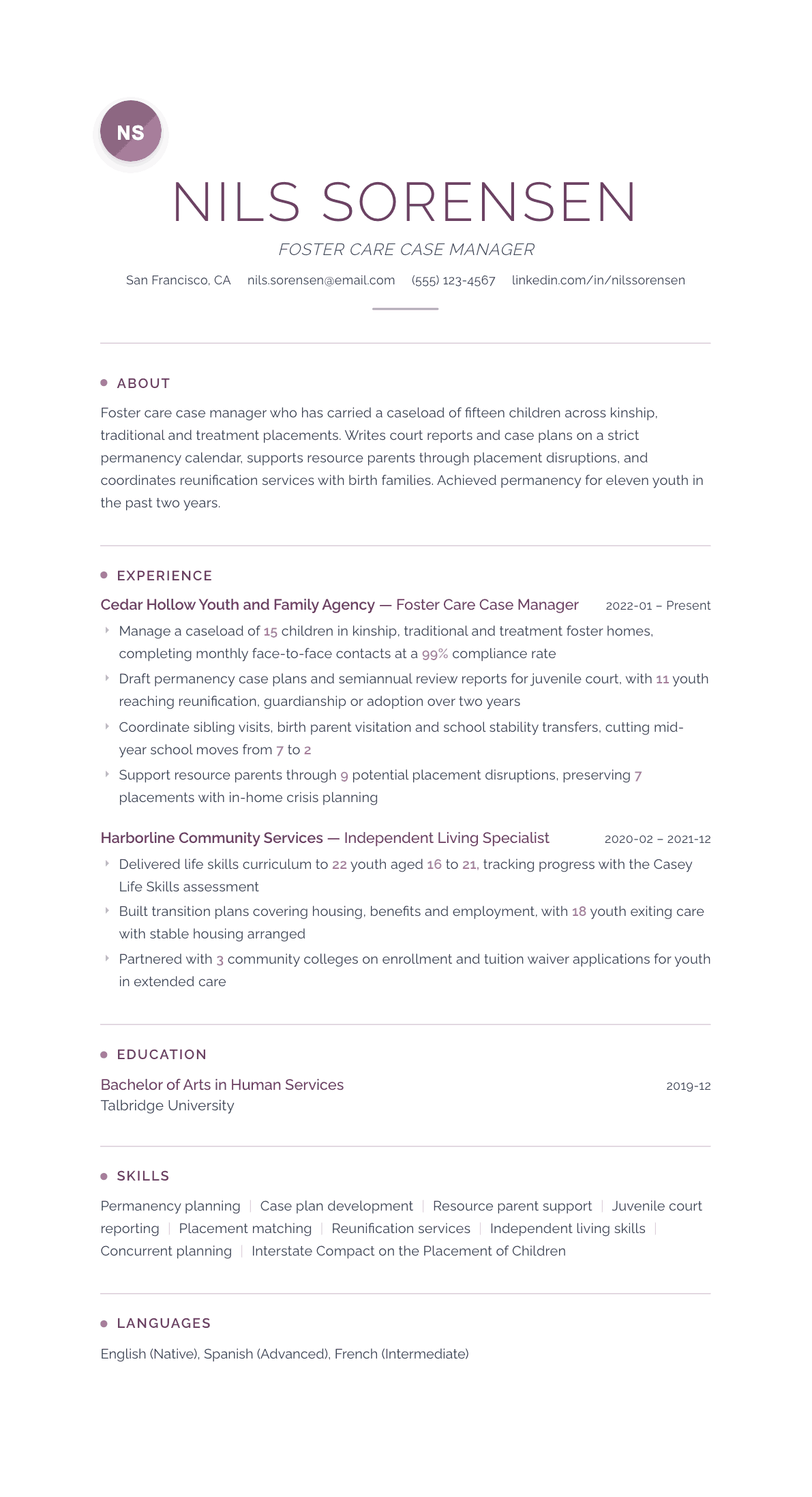
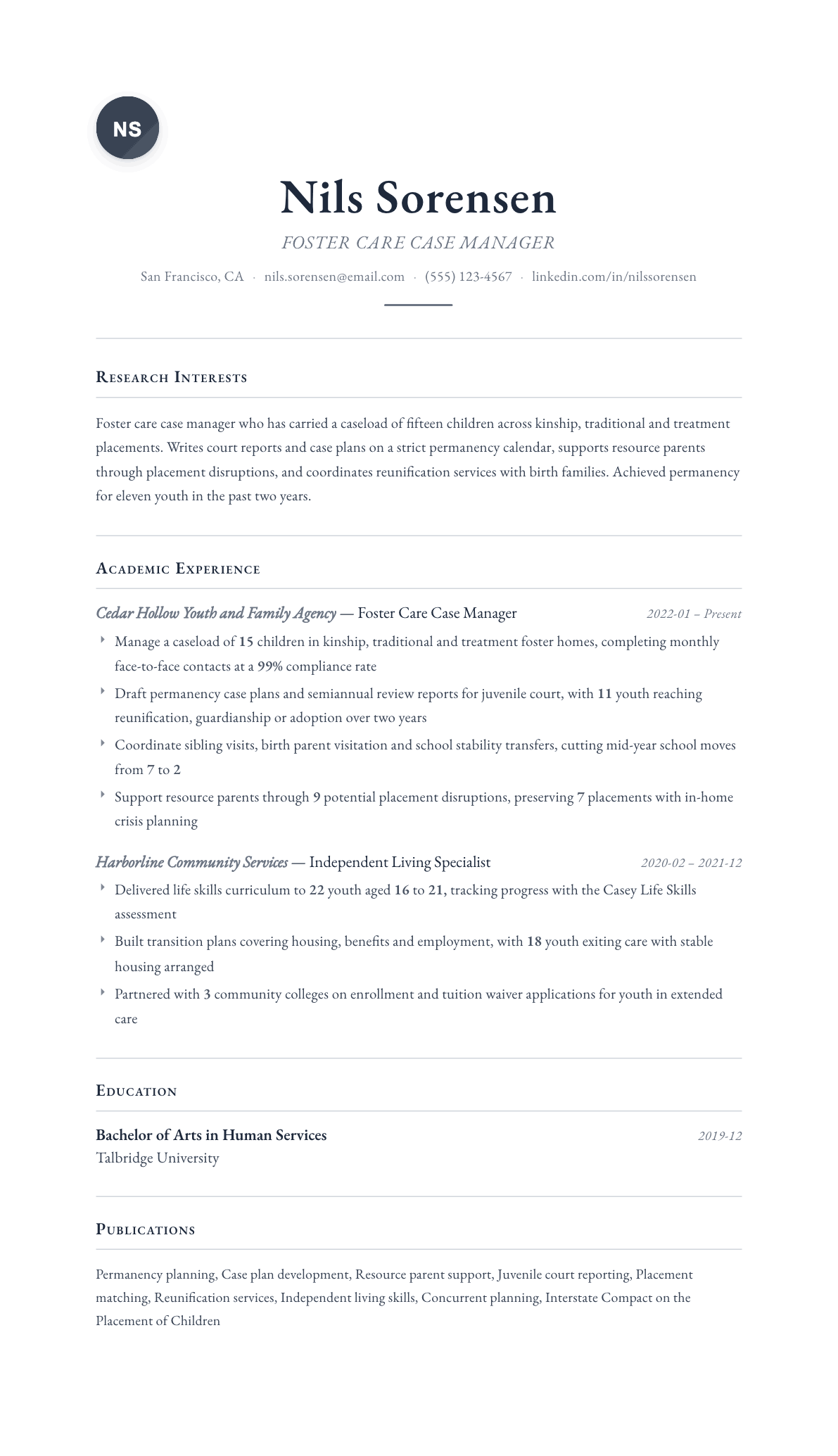
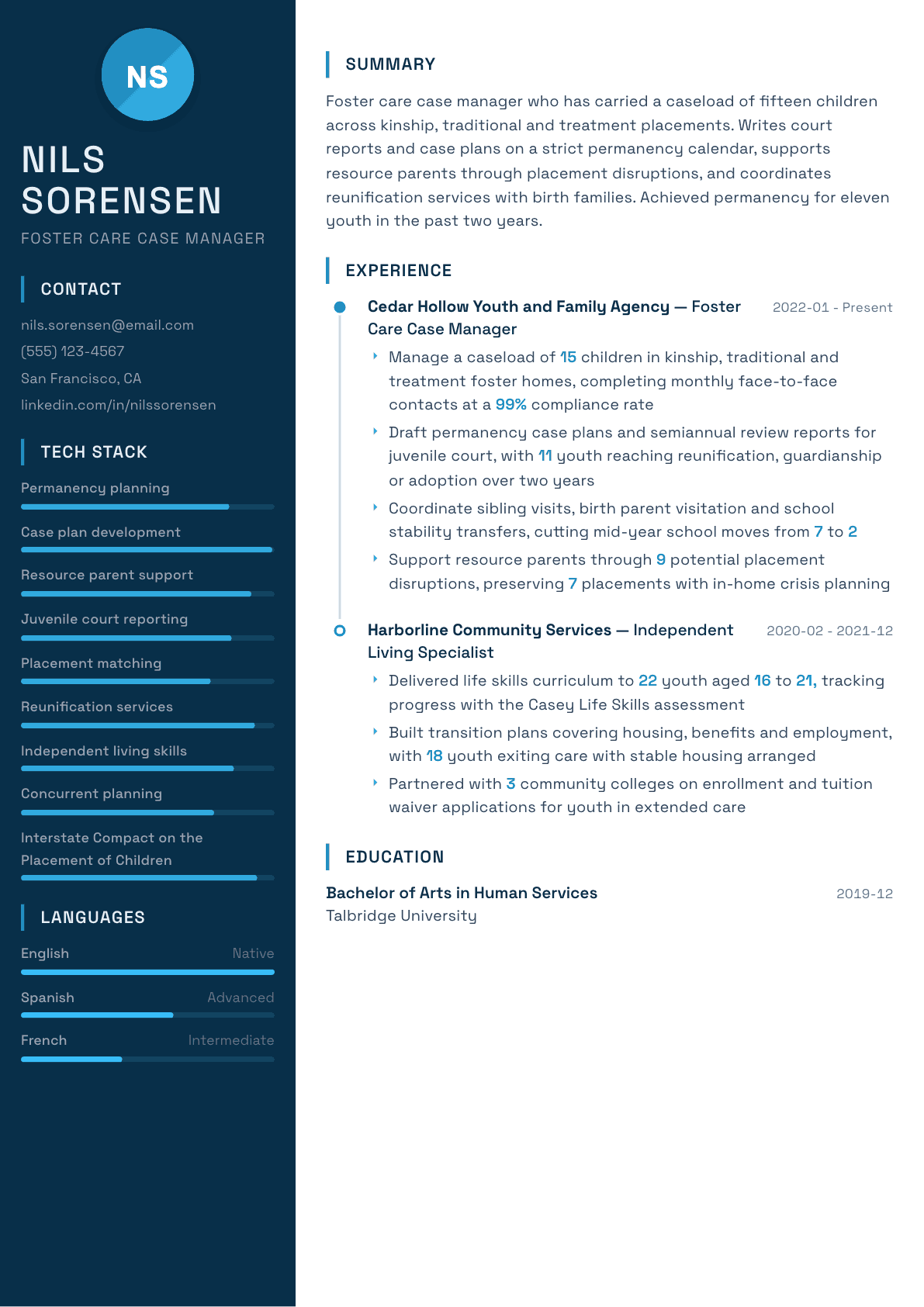
Example Foster Care Case Manager summary
Foster care case manager with four years supporting children in kinship, traditional and treatment homes. Carries fifteen youth, keeps monthly contact compliance near perfect, and writes the case plans and court reports that move a file toward permanency. Guided eleven youth to reunification, guardianship or adoption while coaching resource parents through disruptions. Looking for a permanency supervisor track.
Skills to list on a Foster Care Case Manager resume
- Permanency planning
- Concurrent planning
- Case plan writing
- Juvenile court reports
- Placement matching and stability
- Resource parent coaching
- Kinship navigation
- Reunification and visitation planning
- Independent living transition
- Casey Life Skills assessment
- Interstate Compact on the Placement of Children
- Title IV-E documentation
- Trauma-informed care
- Crisis intervention
- Service referral coordination
What actually gets this resume read
- State your caseload size and placement types, because a hiring supervisor reads volume and complexity in the same glance.
- Report permanency outcomes by name: reunification, guardianship, adoption, and how many youth reached each one.
- Show monthly face-to-face contact compliance, since that single figure predicts whether you can pass a state audit.
- Mention resource parent retention work, because agencies lose homes faster than they recruit them and hire for that.
- Include placement stability details such as disruptions prevented, school moves avoided, and sibling connections kept.
- Name the court documents you personally wrote, from case plans to semiannual reviews and termination affidavits.
How to write a foster care case manager resume
Foster care hiring runs on two anxieties. The agency worries about audits: monthly face-to-face contacts, case plans filed on the calendar, court reports delivered before the deadline. The permanency supervisor worries about children sitting in care while a file drifts. A resume that speaks to both gets a call, and the fastest way to speak to both is to put compliance figures and permanency outcomes on the same page.
The common failure is a resume that lists duties every foster care worker performs. Coordinated services, maintained case files and worked with families describes the whole profession. What a supervisor wants to see is your caseload, the placement types inside it, how many children moved to a permanent home while you held the case, and whether you kept resource parents from quitting.
Below is the section order a permanency supervisor reads, three summaries for different career stages, before-and-after bullets, and the questions that come up when a foster care case manager rewrites the file for a promotion or a private agency move.
Format: compliance visible in the top third of page one
Use reverse chronological order and keep it to one page until you pass five years. Put the degree, any social work license and your training completions in a compact block near the top, because private agencies with state contracts have to show a licensing reviewer that every case manager met the qualification on the day of hire.
Keep the layout single column with plain headings. Agencies of this size often use inexpensive applicant tracking software, and a sidebar that looks elegant on screen can arrive as one unreadable block in the recruiter queue.
- Header: name, city and state, phone, email, degree and license abbreviation.
- Order: summary, credentials and training, foster care experience, related experience, skills.
- Include a driver license line, since transporting children and home visits are core duties.
Summary: caseload, placement mix, permanency record
Say how many children you carry and what kind of placements they sit in, because kinship, traditional and treatment homes demand different work from the same job title. Then give a permanency result in plain language: how many children reached reunification, guardianship or adoption while the case was yours. Close with one thing that makes you useful beyond the caseload, such as licensing new resource homes or covering the on-call phone.
If you are crossing from investigation into foster care, name what transfers. You already know court, safety assessment and family engagement. What you are learning is the permanency calendar and resource parent support, so say that rather than letting a supervisor guess.
Experience: the calendar, the court, the placement
A foster care job runs on dates. Monthly face-to-face contact with every child, quarterly or semiannual case plan reviews, permanency hearings on a statutory schedule, and a concurrent plan that has to be real rather than a checkbox. Build your bullets around that calendar and attach a compliance figure to the first one, because contact compliance is the number a licensing reviewer pulls first.
Then show placement work. Matching a child to a home, preparing a resource parent for what the child brings with them, and holding a placement together when it starts to fail are the skills that separate an experienced case manager from a new one. Quantify disruptions you prevented, school moves you avoided, and sibling connections you preserved.
Give court its own bullet with the documents you personally drafted: case plans, semiannual administrative review reports, permanency reports, and affidavits supporting a change of goal. If you have ever carried a case through a termination of parental rights process, say so plainly, because it is a demanding piece of work that many case managers avoid.
Resource parents, youth voice and transition work
Agencies lose foster homes faster than they recruit them, so anything you did to retain resource parents is worth a line. Respite coordination, prompt reimbursement problem solving, being reachable on a bad night, and running a support group all count. Say how many homes you supported and whether any of them closed while you were assigned.
For older youth, name the transition work: independent living assessments, credit recovery with the school, benefit applications, driver license support, and housing arranged before the exit date. Extended foster care caseloads are a specialty and should be labeled as one rather than folded into a general caseload count.
- Placement stability: disruptions prevented, respite arranged, school of origin maintained.
- Resource parent support: home visits, training hours delivered, retention through a hard year.
- Youth transition: life skills assessment, housing plan, benefits, education and employment.
Keywords the posting will repeat
Foster care postings reuse a small vocabulary: permanency planning, concurrent planning, case plan, reasonable efforts, monthly face-to-face contact, resource family, kinship placement, reunification, guardianship, adoption, sibling connection, interstate placement. Use the phrasing the posting uses once in the skills block and once inside a bullet where a reader can see it happening.
Where funding language matters, name it correctly. Title IV-E eligibility documentation and the interstate compact process are both real workload items, and a case manager who has handled either should not leave it off.
Foster Care Case Manager resume summary examples
First year in permanency
Human services graduate with a year of foster care experience carrying 9 children in kinship and traditional homes. Completed monthly contacts on schedule, drafted 12 case plans under supervisory review, and attended 15 permanency hearings. Trained in trauma-informed care and the state child welfare record system.
Four years carrying a full caseload
Foster care case manager holding 15 children across kinship, traditional and treatment placements with 99% monthly contact compliance. Wrote case plans and permanency reports that supported 11 exits to reunification, guardianship or adoption in two years, and preserved 7 of 9 placements facing disruption.
Permanency supervisor
Permanency supervisor for a private agency unit of 6 case managers holding 84 children. Reviews every case plan and court report, chairs monthly permanency staffings, and moved the unit average time to permanency down by 4 months while closing two licensing reviews with no findings.
Work experience bullets: before and after
Before: Managed a caseload of foster children.
After: Managed 15 children placed across kinship, traditional and treatment foster homes, completing monthly face-to-face contacts at a 99% compliance rate over 8 quarters.
Placement mix plus a contact compliance rate is exactly what a licensing reviewer and a supervisor both check.
Before: Wrote case plans and court reports.
After: Drafted permanency case plans, semiannual review reports and change of goal affidavits for 15 open cases, filed ahead of every court deadline across 2 years.
It names the documents by type and adds the deadline record that proves you can hold a court calendar.
Before: Worked with foster parents to support placements.
After: Coached resource parents through 9 placements at risk of disruption using in-home crisis planning and respite, preserving 7 of them and closing no homes during the period.
Retention numbers speak to the problem agencies actually have, which is losing homes.
Before: Helped older youth prepare for independence.
After: Completed independent living assessments with 22 youth aged 16 to 21 and built transition plans covering housing, benefits and employment, with 18 exiting care into arranged housing.
The assessment, the plan and the exit outcome turn a soft claim into a measurable piece of practice.
Before: Coordinated visits between children and their families.
After: Scheduled and supervised weekly birth parent and sibling visits for 15 children, arranging transport and neutral sites, and documented each visit in the state record within 48 hours.
Visitation is a compliance item, so the logistics and the documentation window are the substance.
Hard skills
- Permanency and concurrent planning
- Case plan and court report writing
- Monthly face-to-face contact compliance
- Placement matching and stabilization
- Resource parent support and retention
- Kinship assessment and navigation
- Reunification and visitation planning
- Independent living transition planning
- Interstate Compact on the Placement of Children
- Title IV-E eligibility documentation
- State child welfare record systems
- Family team and permanency staffings
Soft skills
- Holding a court calendar without slipping
- Difficult conversations with resource parents
- Advocacy inside school and medical systems
- Patience with birth family ambivalence
- Coordination across many agencies at once
Certifications worth listing
- Certified Social Work Case Manager (C-SWCM) (National Association of Social Workers)
- Certified Advanced Social Work Case Manager (C-ASWCM) (National Association of Social Workers)
- Trauma-Focused Cognitive Behavioral Therapy Web Training (Medical University of South Carolina)
Mistakes that cost foster care case manager candidates the interview
- Reporting a caseload number with no placement mix, so a reader cannot tell twelve stable kinship homes from twelve treatment placements.
- Omitting permanency outcomes entirely, which leaves the resume describing motion without any destination.
- Treating resource parent support as an afterthought when home retention is the constraint every agency is fighting.
- Listing court attendance without naming the documents you personally drafted and filed.
- Skipping contact compliance, the single figure that tells a licensing reviewer whether your files would survive a review.
- Copying the job specification back onto the resume word for word, which reads as a person who has never held the caseload.
Foster Care Case Manager resume questions
What caseload size should I list for a foster care case manager role?
List your typical carried number rather than the worst month, and mention the placement types inside it. A supervisor reading fifteen children across kinship and treatment homes learns more about your capacity than a bare number ever tells her.
How do I show permanency outcomes without taking credit for the whole team?
Attribute honestly by describing your contribution. Say the number of children who reached reunification, guardianship or adoption while the case was assigned to you, and name the documents or staffings you drove. Supervisors respect precise attribution and distrust sweeping claims.
Is foster care experience in a private agency valued the same as county experience?
Both are valued, but they are not identical, so name which one you did. Private agency work usually means contract compliance and resource home management. County work usually means statutory authority and court standing. Say which system you know and the practice model you worked under.
Should I include the training hours my agency required?
Include the ones that are recognizable and relevant, such as trauma-informed care, the state pre-service curriculum, and any placement stabilization or child sexual abuse response training. Leave out routine annual refreshers that every employee completes, since they crowd out the credentials that differentiate you.
How do I write this resume if I want to move into supervision?
Move mentoring, unit coverage and quality review to the top of your most recent job. Supervisors are hired on whether they can review other people work, so evidence that you have already read colleagues case plans or covered the on-call rotation matters more than another year of caseload.
Related resume examples
- Social Worker Resume example
- Case Manager Resume example
- Child Protective Services Worker Resume example
- Child Welfare Social Worker Resume example
- Youth Counselor Resume example
- Refugee Resettlement Caseworker Resume example