Outreach Coordinator Resume Examples: what gets the call
Extend Your Reach with an Outreach Coordinator Resume
By Mustafa Tarabya, founder of CVBooster · Published · Updated
Build an outreach coordinator resume showcasing your community engagement, partnership development, and program awareness strategies.
Sample resumes for a outreach coordinator
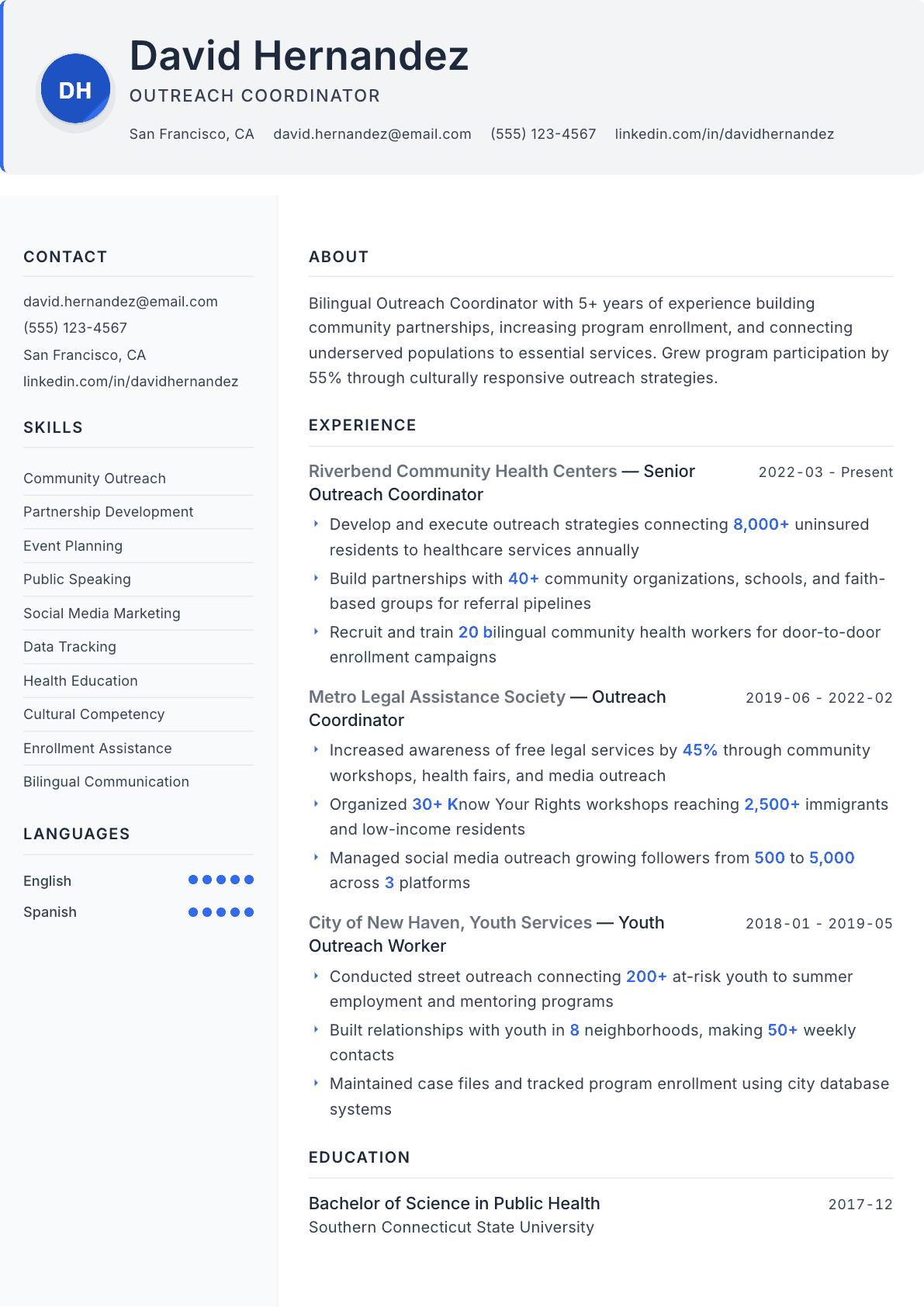
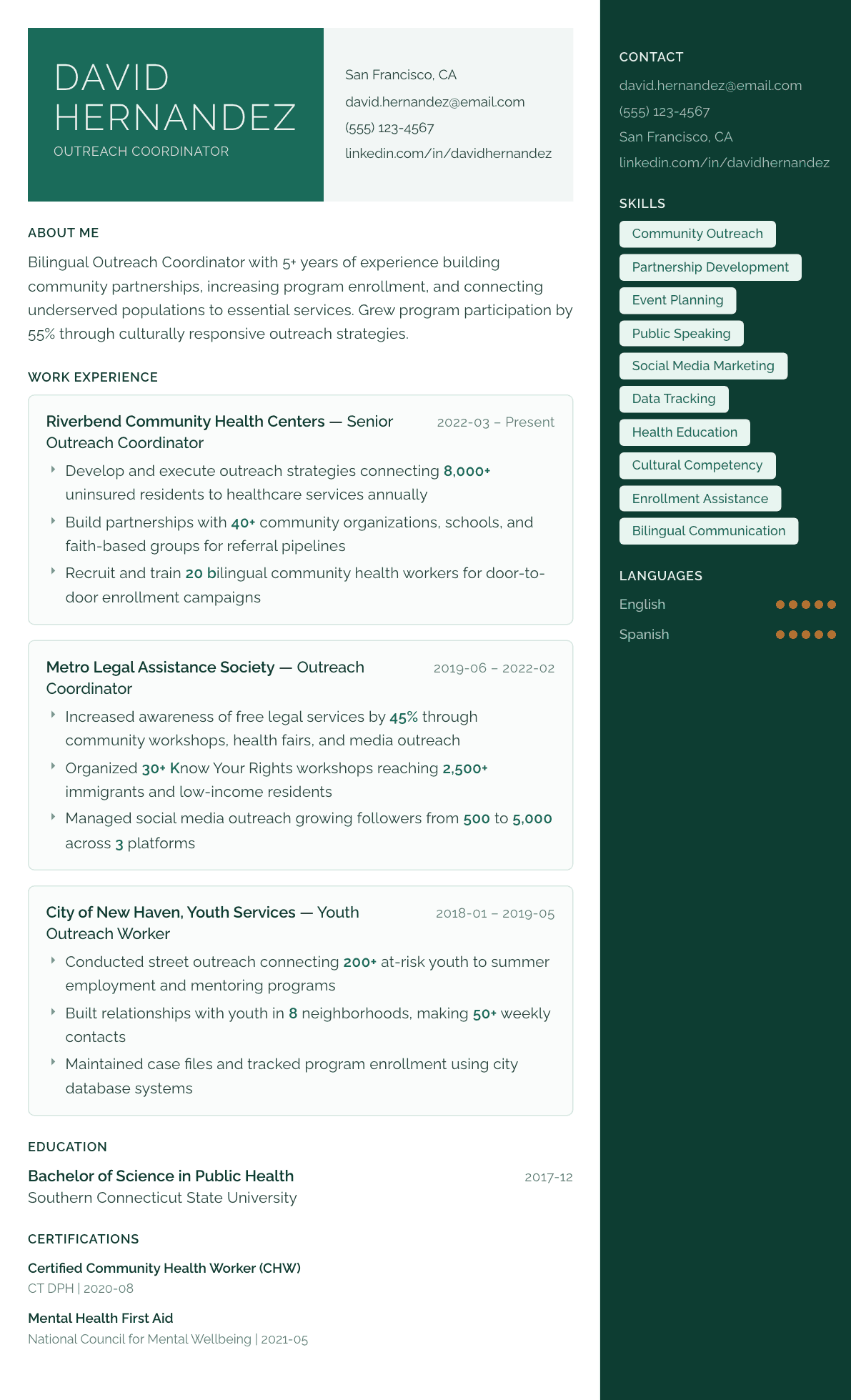
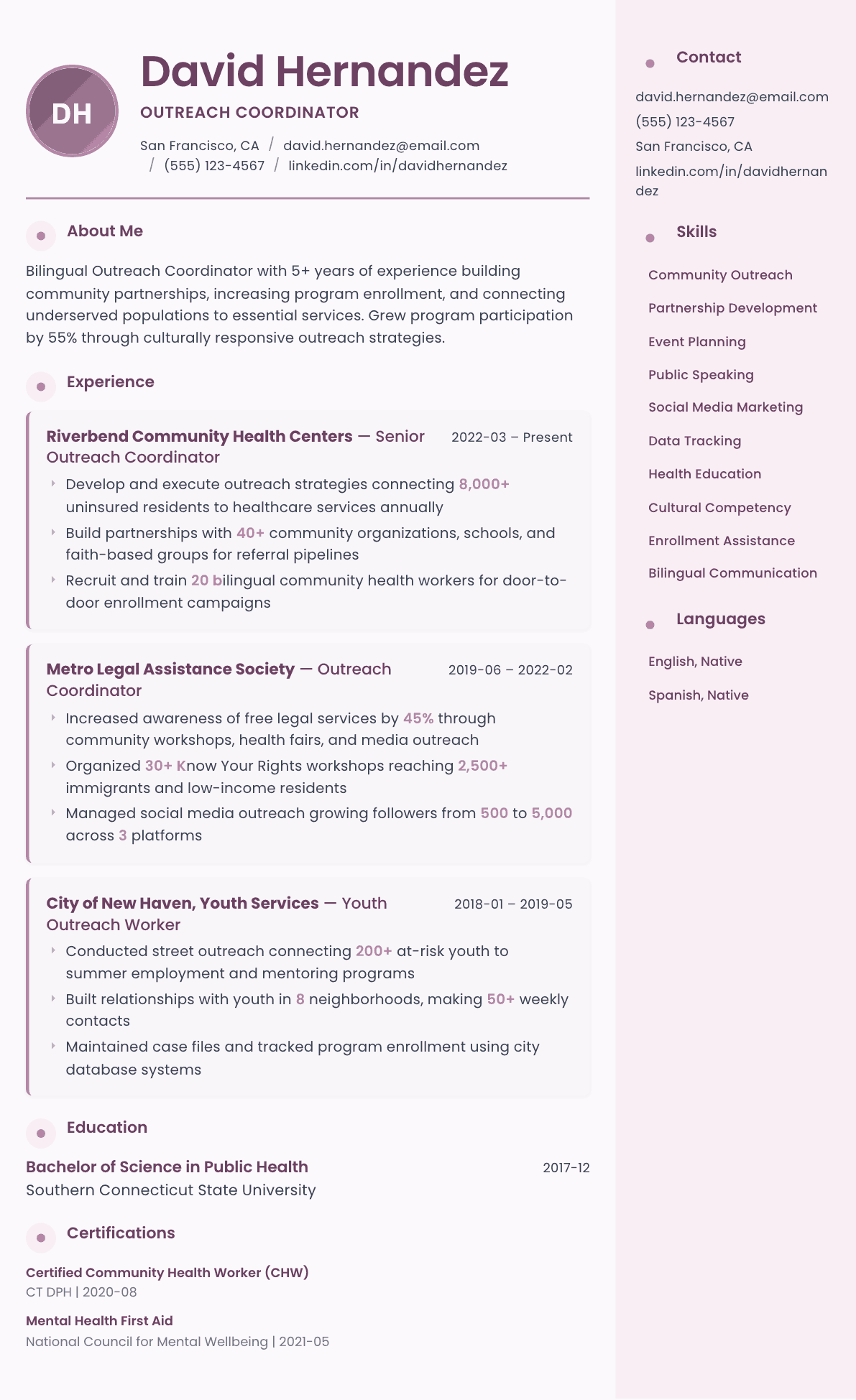
The same outreach coordinator content laid out in three CVBooster templates, so you can see what the finished document looks like before you write a word.
Example Outreach Coordinator summary
Bilingual Outreach Coordinator with 5 years of experience connecting underserved populations to healthcare, legal, and social services. Grew program participation by 55% through partnerships with 40+ community organizations. Seeking a community engagement manager role.
Skills to list on a Outreach Coordinator resume
- Community Outreach
- Partnership Development
- Event Coordination
- Public Speaking
- Social Media Outreach
- Data Tracking & Reporting
- Health Education
- Cultural Competency
- Enrollment Assistance
- Bilingual Communication
- Workshop Facilitation
- Street Outreach
- Referral Coordination
- Needs Assessment
What actually gets this resume read
- Quantify your outreach impact: people reached, enrollment increases, partnerships built.
- Highlight bilingual and multicultural competency. These skills are essential for outreach roles.
- Show your ability to build trust in underserved communities through culturally responsive approaches.
- Include community health worker or peer specialist certification if you have one.
- Mention specific outreach methods: door-to-door, health fairs, workshops, social media, street outreach.
How to write a outreach coordinator resume
An outreach coordinator is hired to close the gap between a service that exists and the people who are eligible for it but never walk in. The manager reading your resume is measured on enrollment, so they are scanning for one thing: evidence that when you were responsible for getting people through the door, more people came through the door.
The resumes that stall describe presence rather than results. Tabled at community events, distributed flyers, attended coalition meetings, posted on social media. None of those say how many people enrolled, which partner referred them, or which channel worked. Outreach is measurable at every step, and coordinators who track their own funnel stand out immediately.
This guide covers the section order, how to describe a referral network and a channel mix, summaries from a first outreach job through a coordinator running a team of community health workers or peer navigators, and rewrites that turn activity into enrollment.
Format: one page, population and territory up front
One page is right for almost every outreach coordinator. Lead each job with the population you served and the geography you covered, since a coordinator working with newly arrived families across three neighborhoods is doing different work from one covering rural clinics in four counties.
Languages belong in the header, with an honest level. Bilingual and bicultural capacity is often the reason a specific coordinator gets hired, and burying it under a skills list at the bottom means an initial screener may never see it.
- Header: name, city, phone, email, and languages with proficiency level.
- Order: summary, outreach experience, partnerships, skills and systems, education, training.
- Include a driver license line if the job involves field travel, since many postings require it.
Summary: population, channels, and enrollment lift
Three lines that say who you reach, how you reach them, and what changed. Name the setting: schools, clinics, shelters, faith communities, public housing, farmers markets, detention reentry, employer sites. Then name your channels: door knocking, tabling, warm handoffs from partner agencies, text campaigns, promotoras, radio, or a referral agreement.
End with the number that matters to the hiring manager, which is almost always enrollment or utilization. If you cannot claim enrollment, claim the closest thing you owned: referrals generated, appointments kept, applications completed.
Partnerships: the referral network is the asset
A coordinator who arrives with working relationships is worth a great deal, so describe the network concretely. How many partner organizations you had formal referral agreements with, what each one sent you, and how you kept the relationship alive. A signed memorandum of understanding with a school district, a standing table at a food pantry, or a weekly slot at a resource fair are the details that make a network real.
Show the maintenance work as well as the recruitment. Quarterly partner check-ins, a shared referral form, closing the loop back to the referring agency, and a partner list you actually pruned when organizations stopped sending anyone.
- Number of active referral partners and what each contributed.
- Formal agreements: memoranda of understanding, data sharing, co-location days.
- Loop closing: what you sent back to the referrer after an enrollment.
- Coalitions or task forces where you held a role rather than a seat.
Field work and events: conversions, not attendance
For every event or field activity, report what came out of it. A table at a festival that produced ninety conversations and thirty-one completed intake forms is a result. A table at a festival is furniture. If the conversion was poor, say what you changed: moving to the clinic waiting room instead of the sidewalk, or shifting to evening hours when the population you serve is not at work.
Materials work belongs here too. Translating and plain-language testing enrollment materials, running them past community members before printing, and reading level matter more in outreach than in most communications jobs, because a form that nobody can finish is the actual barrier.
Data and systems: track your own funnel
Name the systems you have used to log contacts and referrals: Salesforce, Apricot, CharityTracker, Unite Us, Efforts to Outcomes, a client management system inside an electronic health record, or a well-built spreadsheet you designed yourself. Say what you reported and to whom, since outreach coordinators in grant-funded roles usually owe monthly numbers to a funder.
Then show the funnel: contacts, screened, referred, enrolled, retained. A coordinator who can name a drop-off point and what they did about it is demonstrating the analytic habit that gets people promoted into program management.
Outreach Coordinator resume summary examples
First outreach role
Bilingual outreach coordinator with 1 year connecting families to a community health center across 3 neighborhoods. Held 600 field conversations, completed 240 eligibility screenings, and built a standing weekly table at 2 food pantries that now supplies steady referrals.
Four years in
Outreach coordinator with 4 years serving immigrant and refugee households, managing 18 referral partners and a text reminder program. Raised completed enrollments 55% in 2 years by shifting field hours to evenings and rewriting intake materials at a lower reading level.
Lead coordinator
Senior outreach coordinator with 8 years in public health and social services, supervising 5 community health workers across 4 counties. Built the county referral agreement network, standardized the intake funnel in Salesforce, and reported monthly enrollment metrics to 3 grant funders.
Work experience bullets: before and after
Before: Attended community events to promote programs.
After: Ran 26 field events a year at pantries, schools and clinic waiting rooms, holding 600 screening conversations and completing 240 eligibility forms on site rather than handing out flyers.
Event count, conversation volume and on-site completions convert presence into a measurable funnel.
Before: Built relationships with community partners.
After: Signed referral agreements with 18 partner agencies including a school district and 2 shelters, set a shared intake form, and returned enrollment confirmations to each referrer within a week.
Agreements, a shared form and loop closing describe a network that will still exist after you leave.
Before: Increased program enrollment.
After: Raised completed enrollments 55% over 2 years by moving field hours to evenings and weekends, adding text reminders before appointments, and cutting the intake packet from 9 pages to 4.
Naming the three changes shows the reader a method they could repeat, not a fortunate trend.
Before: Created outreach materials in Spanish.
After: Rewrote and translated the enrollment packet into Spanish and Haitian Creole, tested it with 12 community members, and lowered the reading level so intake could be finished without staff assistance.
Testing with community members and the reading level change show competence rather than translation alone.
Before: Tracked outreach activities in a database.
After: Logged every contact in Salesforce through a 5-stage funnel, found that a third of screened clients never returned for intake, and added a same-day appointment option that closed most of that gap.
Identifying a drop-off point and fixing it is the difference between recording data and using it.
Hard skills
- Community outreach and field canvassing
- Eligibility screening and intake
- Referral network development
- Memoranda of understanding with partners
- Health education presentations
- Multilingual material development
- Text and phone reminder campaigns
- Salesforce and Apricot case systems
- Grant reporting on outreach metrics
- Event coordination and tabling logistics
- Community needs assessment
- Motivational interviewing basics
Soft skills
- Trust building with wary clients
- Cultural humility
- Persistence with no-shows
- Public speaking to small groups
- Boundary setting in the field
- Collaboration across agencies
Certifications worth listing
- Community Health Worker Certification (State health departments, requirements vary by state)
- Certified Application Counselor (Centers for Medicare and Medicaid Services)
- Mental Health First Aid (National Council for Mental Wellbeing)
- Certified Health Education Specialist (CHES) (National Commission for Health Education Credentialing)
Mistakes that cost outreach coordinator candidates the interview
- Counting flyers distributed and events attended, which measure effort rather than the enrollment the manager is judged on.
- Leaving the population and the territory out of the job line, so the reader cannot gauge the difficulty of the work.
- Burying language skills at the bottom when they are often the reason a specific candidate is hired.
- Naming partner organizations without saying what each one actually referred or contributed.
- Describing social media posting as outreach when the audience you serve was reached some other way.
- Omitting the data system, since most grant-funded outreach roles require monthly numbers to a funder.
Outreach Coordinator resume questions
What numbers should an outreach coordinator put on a resume?
Contacts made, screenings completed, referrals generated, enrollments closed and retention where you have it. Pick the stage you actually owned and be honest about where your responsibility ended, because managers will ask exactly that in the interview.
How do I show language skills correctly?
Put them in the header with a level such as native, fluent or conversational, and say where you used them. Claiming fluency you cannot sustain in a client conversation is caught in the first interview and ends the process immediately.
Does volunteer or lived experience count for an outreach role?
Yes, and in this field it often carries real weight, because trust with a community is the hardest part to hire for. Present it with the same structure as paid work: the population, the setting, the hours and what resulted from your involvement.
Should I list every coalition and task force I sat on?
Only the ones where you held a role or produced something. Chairing a subcommittee, writing the shared referral form or organizing an annual resource fair is worth a line. Attendance at a monthly meeting is not.
How is an outreach coordinator resume different from a marketing resume?
Marketing measures reach and impressions, outreach measures people served. Keep the campaign vocabulary minimal and center the funnel: who you found, who you screened, who enrolled and who stayed. That framing is what a program manager is hiring for.
Related resume examples
- Community Organizer Resume example
- Program Coordinator Resume example
- Case Manager Resume example
- Volunteer Coordinator Resume example
- Community Health Worker Resume example
- Social Worker Resume example