Cell Phone Repair Technician Resume Examples: free score
Write a Cell Phone Repair Technician Resume That Proves Steady Hands
By Mustafa Tarabya, founder of CVBooster · Published · Updated
Cell phone repair technician resume example, keywords and a guide covering screen and battery work, microsoldering, repair volume and success rate.
Sample resumes for a cell phone repair technician
The same cell phone repair technician content laid out in three CVBooster templates, so you can see what the finished document looks like before you write a word.
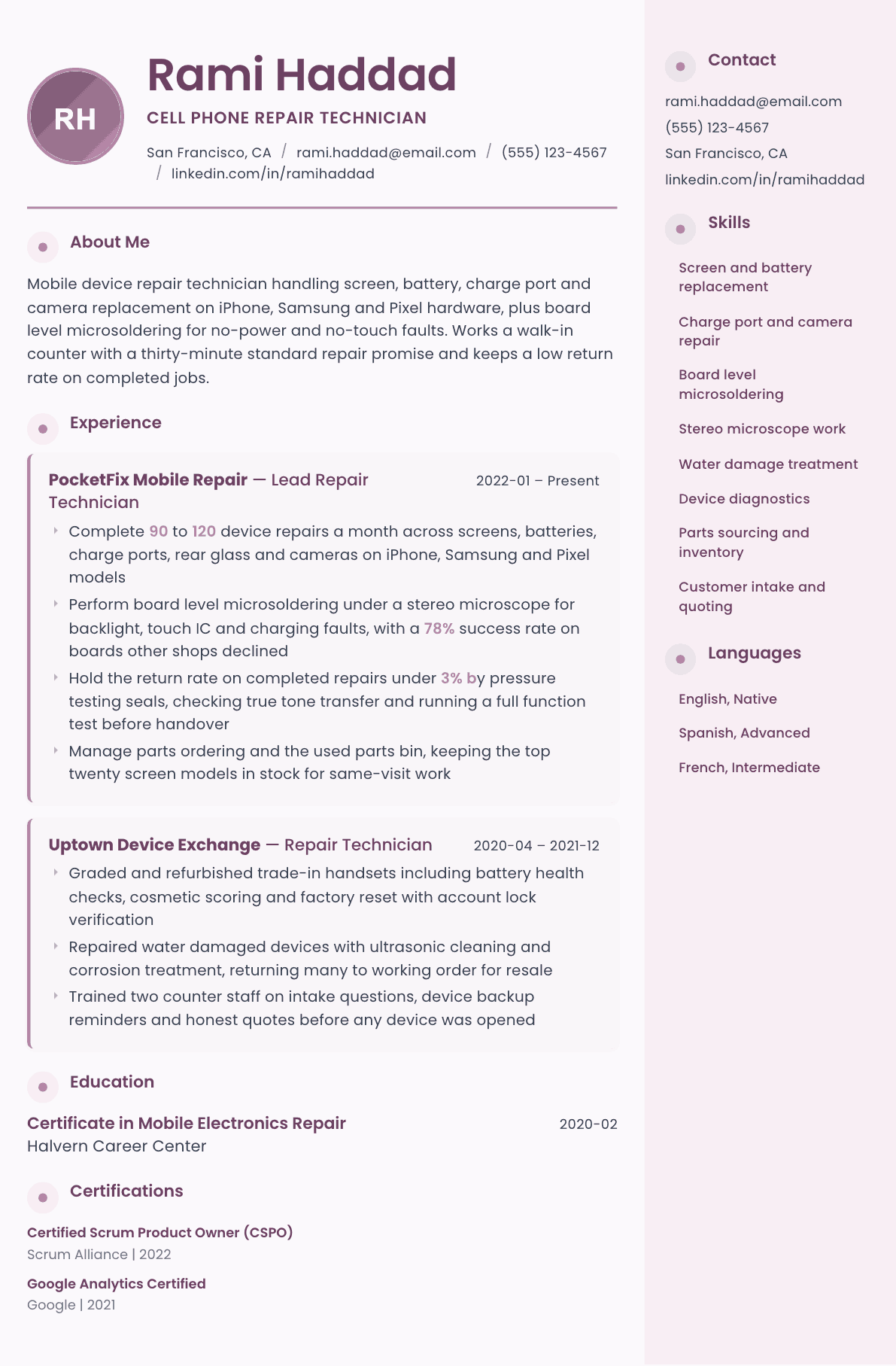
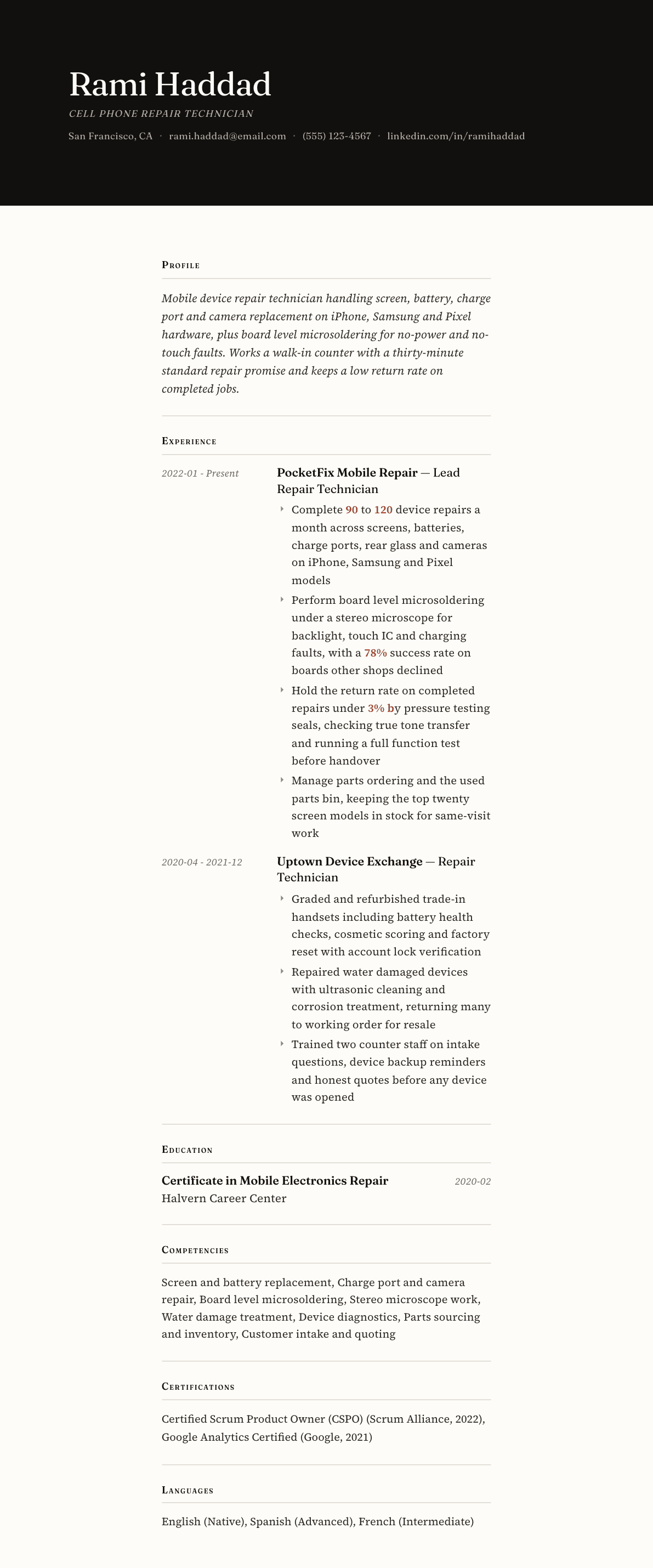
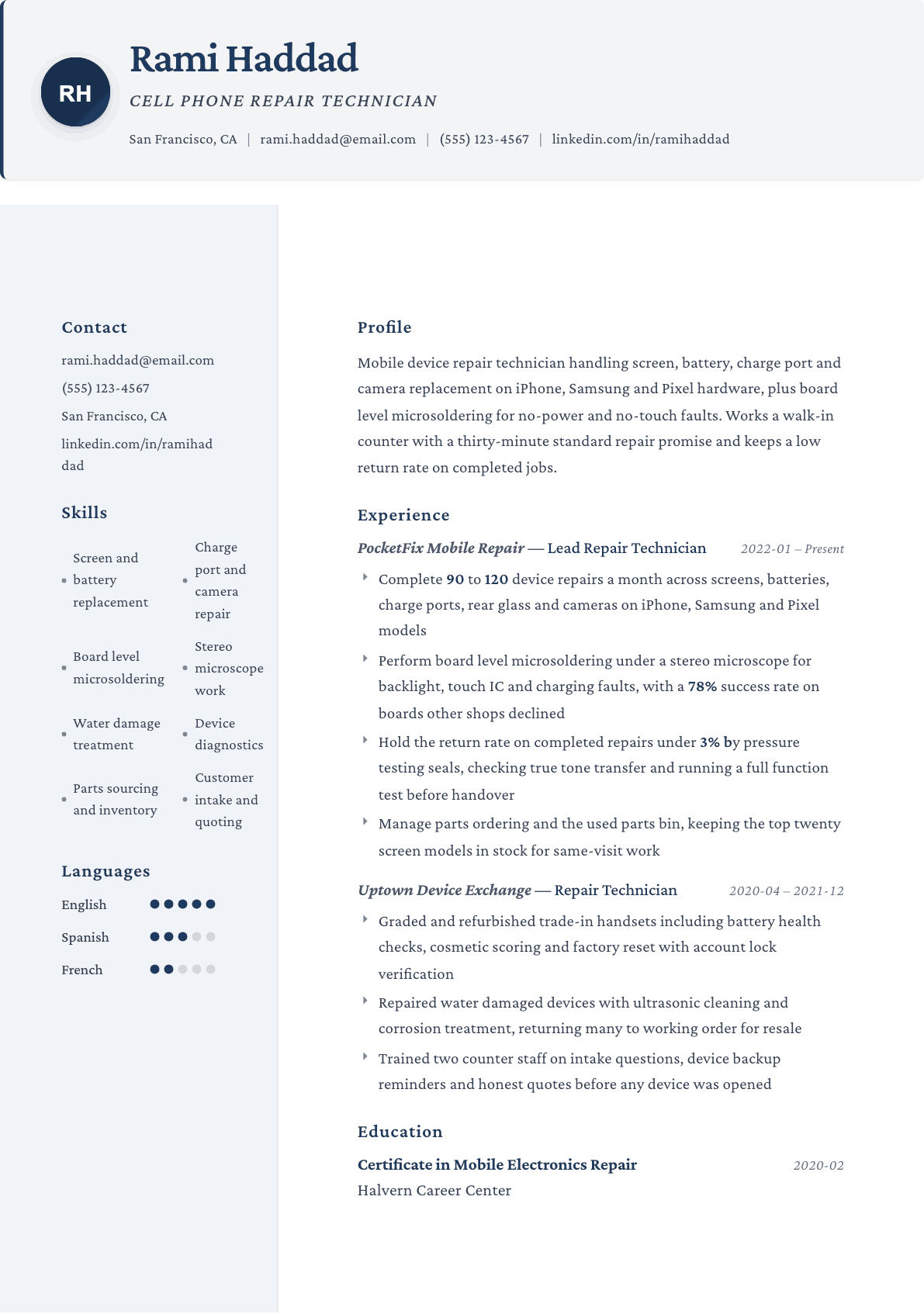
Example Cell Phone Repair Technician summary
Cell phone repair technician completing screen, battery, charge port and camera work on iPhone, Samsung and Pixel hardware, plus board level microsoldering for no-power and touch faults under a stereo microscope. Runs a walk-in counter on a thirty-minute standard repair promise, keeps returns low by function testing before handover, and manages parts stock so common models are fixed on the first visit.
Skills to list on a Cell Phone Repair Technician resume
- Screen and digitizer replacement
- Battery replacement and health testing
- Charge port and flex cable repair
- Rear glass and housing swap
- Camera and speaker module repair
- Board level microsoldering
- Stereo microscope technique
- Hot air and preheater use
- Schematic and boardview reading
- Water damage and corrosion treatment
- Ultrasonic cleaning
- Device diagnostics and function testing
- Data backup and transfer
- Parts sourcing and inventory control
- Customer intake and quoting
- Warranty and return handling
What actually gets this resume read
- Split your resume between part replacement and board level microsoldering, because shops hire for the second at a premium.
- Give monthly repair volume and your return rate, since those two numbers describe a bench better than any adjective.
- Name the device families you work on and note where your experience thins out, which reads as honesty.
- List the tooling you use: hot plate, stereo microscope, hot air station, ultrasonic cleaner, programmer.
- Show your intake routine including backup reminders and account lock checks, because that prevents most disputes.
- Mention parts sourcing and stock decisions if you own them, as a shop owner cares about margin as much as skill.
- Add water damage recovery work with your method, since corrosion jobs are where technique actually shows.
How to write a cell phone repair technician resume
A repair shop owner reading applications is trying to work out one thing before anything else: can this person open a glued, pressure-sealed phone in fifteen minutes without cracking the back glass, tearing a flex cable or killing the display. Everything else on the resume is secondary to that, because a technician who damages one device a week costs more than the wage saved by hiring cheaply.
The second question is whether you go past part replacement. Screens, batteries and charge ports are a volume business with thin margins. Board level microsoldering is where a shop makes real money and turns away almost nothing. A resume that keeps those two capabilities distinct, and states honestly which one you own, is instantly easier to hire than one that says experienced in mobile device repair.
This guide covers what a shop owner or repair manager reads in order, with summaries for a new technician, a working bench technician and a lead, before and after bullets from screen, port and board work, and answers to the questions technicians ask when they move between walk-in counters, carrier programs and refurbishment operations.
Format: capability first, device families second
One page, reverse chronological, no graphics. Directly under the header, write two lines that split your work: the part replacement repairs you do at volume, and the board level work you do under a microscope. If you do not do board work, say so and lead with volume and quality instead. Owners respect the line being drawn.
Follow with the device families you handle. Name the manufacturers and generations, since tooling, adhesives and disassembly order differ enormously between them. A shop that lives on one ecosystem will filter on that name, and the technician who lists it precisely gets read.
- Header: name, city and state, phone, email, and any repair certification you hold.
- Capability block: part replacement repairs at volume, board level repairs under magnification, and diagnostics you run before quoting.
- Each job names the setting: walk-in retail counter, mail-in repair depot, carrier authorized center, refurbishment floor, or a mobile route service.
- New technicians lead with tooling owned, personal or training repairs completed with counts, and any electronics coursework.
Summary: repairs a month, return rate, and the hard jobs you take
Three lines carrying four facts: repair volume, the repair types you cover, your return or callback rate, and whether you take board work other shops decline. Volume tells an owner about speed, return rate tells him about quality, and board work tells him about margin.
If you specialize, say it early. Water damage recovery, data extraction from dead boards, and rear glass replacement with laser separation are all specialties that shops advertise. A technician who names one and can back it up is not competing with everyone else in the pile.
Experience: repairs, tooling and the checks before handover
Open each job with monthly repair count and the mix. Ninety to a hundred and twenty devices a month across screens, batteries, charge ports, rear glass and cameras describes a real bench. Repaired mobile phones and tablets describes nothing, and is what most of the pile says.
Then show craft. Pressure testing seals after a battery or screen replacement. Transferring the original components a display needs to keep full functionality. Checking that face authentication, ambient light response and touch calibration all still work. Torque and screw mapping so no screw ends up in the wrong hole. These are the details that separate a technician from someone following a video.
Board work gets its own bullets. State the magnification you work at, the tooling you use, the fault families you take on such as backlight, touch, charging and power, and your success rate on boards that arrived declined by another shop. Add whether you read boardview files and schematics, because that is what makes board work repeatable rather than lucky.
- Give monthly repair volume, your return rate, and the share of same-visit repairs.
- Name the tooling you use: hot plate, stereo microscope, hot air station, ultrasonic cleaner, programmer, power supply with current display.
- Include the intake routine: symptom questions, backup reminders, account lock checks, and the written quote before opening.
- Describe parts sourcing decisions if you own them, including grading of aftermarket displays and how you handle warranty on them.
Water damage, data and the jobs that build a shop's reputation
Corrosion work is where technique is visible. Describe your process: full disassembly, ultrasonic cleaning with the right solution, inspection under magnification, corrosion treatment, targeted component replacement, and a staged power-up with a current-limited supply. An owner reading that knows you will not simply dry a board and hand it back to fail a week later.
Data extraction from a device that will never work again is the single most valuable service a shop can offer, and it is also the one where honesty matters most. Say how you set expectations, how you charge for the attempt rather than the result, and what you do when a board is beyond recovery. That paragraph wins interviews.
Skills and keywords a mobile repair posting filters on
Postings recycle a tight vocabulary: screen replacement, digitizer, battery, charge port, rear glass, camera module, microsoldering, board level, backlight, touch integrated circuit, water damage, data recovery, refurbishment, grading, walk-in counter. Use the posting words in your skills block and again inside a bullet where the work is proven.
Do not neglect the retail side. Many shops sell cases, screen protectors, accessories and device trade-ins alongside repair, and an owner staffing a counter wants a technician who can take an intake, quote, close a sale and still hit the bench. Say plainly whether you have run the counter as well as the bench.
Cell Phone Repair Technician resume summary examples
New technician
Mobile repair technician trained on screen, battery and charge port replacement across recent iPhone and Samsung models. Owns a hot plate, precision driver set and adhesive tooling, and completed 120 practice and personal repairs with a working device returned each time. Seeking a bench seat at a walk-in repair counter.
Three years at the counter
Cell phone repair technician completing 90 to 120 repairs a month across screens, batteries, charge ports, rear glass and cameras on iPhone, Samsung and Pixel hardware. Holds the return rate under 3% by pressure testing seals and running a full function test before handover, and manages parts stock for same-visit work.
Lead technician with board work
Lead repair technician with 7 years across a walk-in counter and a refurbishment floor. Performs board level microsoldering under a stereo microscope for backlight, touch and charging faults with a 78% success rate on boards other shops declined, and trains counter staff on intake, quoting and honest expectations.
Work experience bullets: before and after
Before: Replaced phone screens and batteries.
After: Completed 90 to 120 device repairs a month across screens, batteries, charge ports, rear glass and camera modules on iPhone, Samsung and Pixel hardware at a walk-in counter.
Volume, repair mix and device families give an owner a concrete picture of the bench you can run.
Before: Did microsoldering on phone boards.
After: Performed board level microsoldering under a stereo microscope for backlight, touch integrated circuit and charging faults, restoring 78% of boards that other shops had declined.
Naming the fault families, the magnification and the success rate proves board skill instead of asserting it.
Before: Made sure repairs were done properly.
After: Held the return rate under 3% by pressure testing seals after every battery and display job, transferring original components and running a full function test in front of the customer.
The rate plus the three checks behind it shows quality was engineered into the process, not hoped for.
Before: Fixed water damaged phones.
After: Recovered water damaged devices through full disassembly, ultrasonic cleaning, corrosion treatment under magnification and a staged power-up on a current-limited supply before reassembly.
A described method turns a common claim into evidence of technique that survives past the first week.
Before: Talked to customers about their repairs.
After: Ran the intake routine covering symptom questions, backup reminders, account lock verification and a written quote before any device was opened, which removed almost all repair disputes.
A specific procedure with an outcome tells an owner his complaint volume will drop.
Hard skills
- Screen and digitizer replacement
- Battery replacement and health verification
- Charge port and flex cable repair
- Rear glass and housing replacement
- Camera, speaker and haptic module repair
- Board level microsoldering
- Stereo microscope technique
- Hot air and preheat plate use
- Boardview and schematic interpretation
- Water damage and corrosion treatment
- Ultrasonic cleaning
- Device diagnostics and function testing
- Data backup, transfer and extraction
- Parts sourcing, grading and inventory control
Soft skills
- Setting honest expectations before a board is opened
- Steady hands late in a busy counter shift
- Explaining why a cheaper part carries a shorter warranty
- Turning a walk-in question into a booked repair without pressure
- Admitting when a device is beyond economic repair
Certifications worth listing
- WISE Certification (CTIA)
- Certified IPC Specialist for IPC-7711 and IPC-7721 (IPC)
- CompTIA A+ (CompTIA)
Mistakes that cost cell phone repair technician candidates the interview
- Writing mobile device repair without separating volume part replacement from board level microsoldering.
- Giving no monthly repair count, which leaves an owner unable to judge speed or staffing fit.
- Ignoring the return rate, the single number that tells a shop whether repairs are actually holding.
- Listing tooling you do not own or use, which shows up the moment an owner asks about magnification settings.
- Skipping the intake routine, when disputes over lost data and pre-existing damage are a shop's biggest headache.
- Claiming every device family when your real experience sits with one ecosystem and two or three generations.
Cell Phone Repair Technician resume questions
Do I need microsoldering skill to get hired at a repair shop?
No, most counters run on part replacement volume and hire for speed and quality first. Board work raises your value considerably though, because a shop that can fix what competitors decline keeps the hardest and most profitable jobs in house rather than sending them away.
How do I prove skill when my repairs were done independently?
Count them and describe them. State how many devices you have repaired, the models, the repair types, and how many came back. Add photos of board work if you have them and mention the tooling you own. Independent work described with numbers reads as real bench history.
Does aftermarket versus original parts experience matter on the resume?
Yes, because it is a daily judgment call. Say how you grade aftermarket displays, what you tell customers about brightness, touch response and warranty differences, and how you handle a part that fails early. Owners want a technician who manages that conversation rather than avoiding it.
How should I present refurbishment work?
Frame it as throughput and grading accuracy. Give the number of devices processed, the grading standard used, battery health thresholds applied, and the account lock and reset verification steps. Refurbishment managers care about consistency and returns, so accuracy figures matter more than repair difficulty.
What should I say about data recovery attempts that fail?
Say how you handle them, because that is the professionalism a shop is buying. Explain that you quote for the attempt rather than the result, set expectations before opening the device, and give the customer a clear answer when a board is beyond recovery instead of stringing the job out.
Related resume examples
- Computer Repair Technician Resume example
- Electronics Technician Resume example
- Retail Sales Associate Resume example
- IT Support Specialist Resume example
- Appliance Repair Technician Resume example
- Marine Mechanic Resume example